
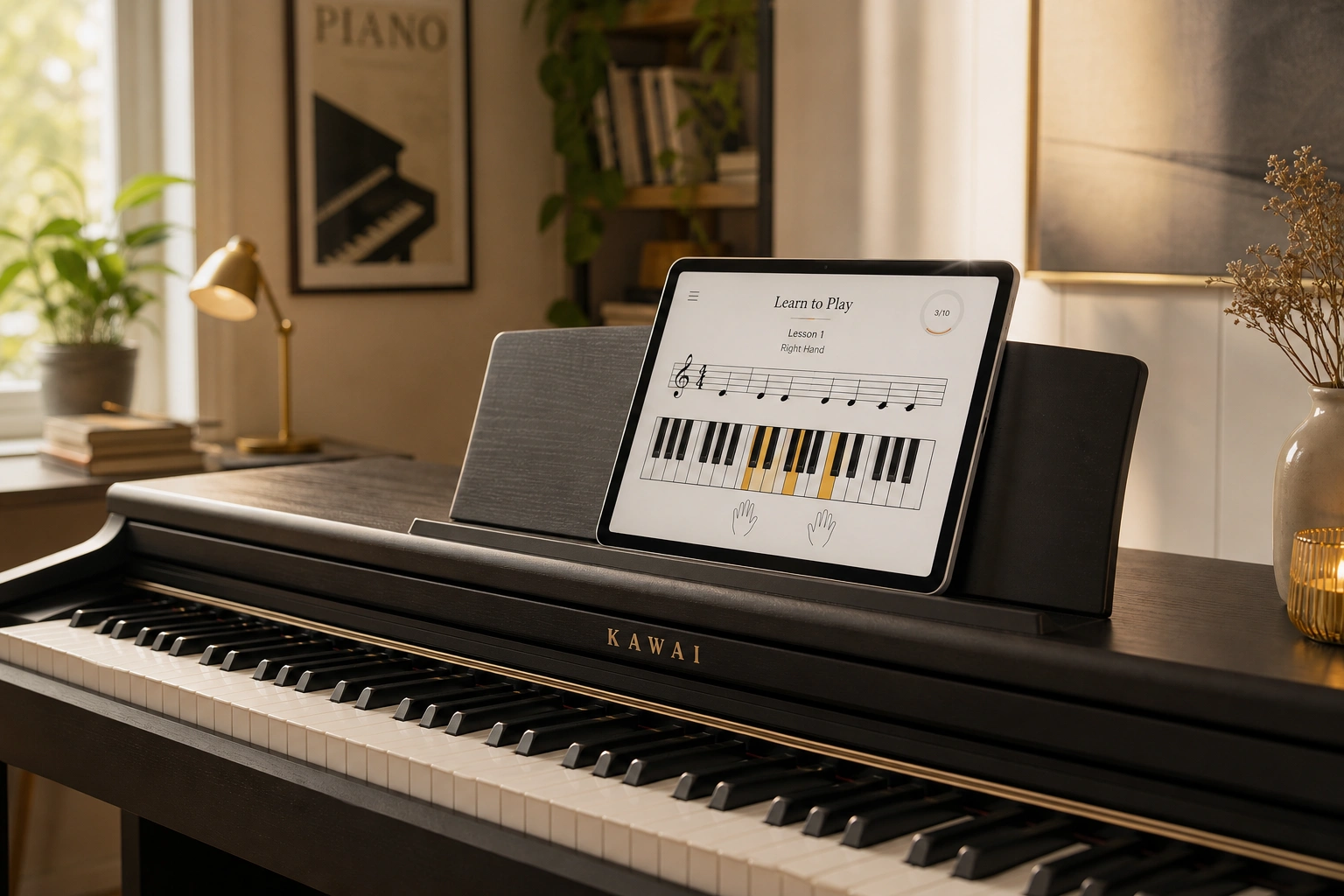
As a piano teacher with over a decade of experience, I get asked constantly whether do piano learning apps work. Parents wonder if they should skip traditional lessons. Adults hope an app might be the low-pressure solution they’ve been looking for.
The question comes up in nearly every free trial lesson I teach. Here’s my honest answer: do piano learning apps work? Yes, they can work, but not in the way most people hope.
They’re useful tools for specific situations, but they have serious limitations that developers don’t advertise. In this article, I’ll walk you through exactly what these apps do well, where they fail, and who actually benefits from using them.
The short answer
Do piano learning apps work? Yes, but only for motivation, basic familiarity, and supplemental practice.
They excel at getting complete beginners to touch the keys and learn a few simple songs. They fail at teaching proper technique, musicality, sight-reading, and anything beyond beginner repertoire.
Most students plateau quickly without real feedback. Apps can’t see your posture, catch tension in your wrists, or explain why your rhythm feels off.
For those things, you need human eyes and ears. The reality is that apps provide a starting point, not a complete learning path.
They’re best understood as motivation tools rather than comprehensive instructors. When asking do piano learning apps work as a replacement for lessons, the answer becomes much more complicated.
What piano apps actually do well
Let me start with what piano apps genuinely offer. I’ve watched students use them, tested several myself, and I can confirm they have real strengths in specific areas.
Lowering the barrier to entry
Apps make starting feel effortless. There’s no scheduling, no commute, no performance anxiety.
You download the app, plug in a keyboard, and you’re playing notes within minutes. For someone intimidated by traditional lessons, that ease matters.
The psychological barrier to starting piano is real. Apps dissolve that fear and get people actually sitting at the keyboard, which is half the battle.
This accessibility has introduced countless people to piano who might never have taken that first step otherwise. That’s genuinely valuable, even if it’s just the beginning of a longer journey.
Instant gratification and gamification
Piano apps reward you immediately. You earn points, unlock levels, see your streak counter climb.
For beginners who need encouragement, this feedback loop keeps them coming back. Traditional piano practice can feel slow.
Apps make progress visible in a way that sheet music doesn’t, especially in the first few weeks. The dopamine hit from completing a level or maintaining a streak can be powerful motivation for establishing a daily practice habit.
That consistency matters, even if the practice itself is limited. Many students tell me the app got them to practice daily for the first time in their lives.
Flexible scheduling
You can practice at midnight or during lunch. There’s no coordinating calendars or waiting for your lesson day.
For busy adults or parents juggling schedules, this flexibility is appealing. Apps are always available, removing one common excuse for not practicing.
When you have fifteen minutes between meetings or after the kids go to bed, you can squeeze in a session. This on-demand access fits modern lifestyles in a way that weekly scheduled lessons sometimes struggle to match.
Song-based learning that feels fun
Most piano apps teach through popular songs rather than exercises. You’re playing a tune you recognize, not drilling scales.
That makes the first sessions enjoyable. Many of my students discovered they liked piano through an app first, then came to me when they wanted to go deeper.
That pathway is valid. Learning songs you actually want to play creates emotional investment in the process.
Apps capitalize on this by offering recognizable melodies from the start. The instant reward of playing something familiar keeps motivation high in those critical first weeks.
Low financial risk for exploration
At $10-$30 per month, apps represent a minimal financial commitment compared to traditional lessons. If you’re unsure whether piano is for you, this low barrier makes experimentation easier.
You can test the waters without making a significant investment. For many people, this feels like a safer first step than committing to a series of lessons.
The low cost removes financial anxiety from the exploration phase, which can be valuable for people on tight budgets or those who simply want to try before investing more seriously.
“I started as a complete beginner, and Austin made the learning process feel comfortable.” – Noah Peterson
Where do piano learning apps work best?
So when do piano learning apps work in practice? Based on what I’ve seen, they’re most effective in these specific scenarios.
Absolute beginners exploring interest
If you’ve never touched a piano and want to see whether you enjoy it, an app is a reasonable starting point.
You’ll learn where middle C is, how to press keys in sequence, and whether the instrument appeals to you. This is essentially a trial phase.
Apps work well for the first few weeks of curiosity. They answer the basic question: “Do I actually like sitting at a piano and making music?”
That’s valuable information before you invest in lessons or equipment. The app becomes a low-stakes exploration tool that helps you make an informed decision about next steps.
Supplemental ear training and rhythm games
Some apps include rhythm exercises, interval recognition, and call-and-response drills. These can complement real lessons.
I occasionally recommend specific apps to students as homework tools. Used alongside a teacher, certain app features add value.
Just don’t rely on them as your primary instructor. They work best as focused practice tools for specific skills.
The gamified format actually serves these repetitive drills well, making what could be tedious practice more engaging. When someone asks do piano learning apps work for ear training specifically, I can say yes—with caveats.
Casual players with no performance goals
If your only goal is to play a handful of simple songs for personal enjoyment and you’re not concerned with technique or advancing, apps can meet that need.
You’ll learn basic melodies and have fun. This is a small audience, but it exists.
For those people, do piano learning apps work? Sure, within that limited scope. If you’re content playing simplified versions of popular songs in your living room and have no ambitions beyond that, apps can deliver exactly what you’re looking for.
Daily practice motivation between lessons
Students who take weekly lessons sometimes use apps to maintain momentum on non-lesson days. The app provides structure and accountability for daily practice sessions.
This hybrid approach leverages the app’s strengths (consistency, accessibility, motivation) while relying on the teacher for everything else. It’s one of the smartest ways to use app-based tools.
The combination addresses the question of whether do piano learning apps work as supplements rather than replacements—and the answer is a definitive yes.
The serious limitations nobody talks about
Now let’s talk about where piano apps fall short. These aren’t minor issues—they’re fundamental problems that prevent most students from progressing beyond a basic level.
No feedback on technique
Apps can’t see your hand position, wrist angle, or finger curvature. They can’t tell if you’re building tension, collapsing your knuckles, or using awkward fingerings.
Over time, bad habits solidify and become painful to unlearn. I’ve worked with dozens of students who started with apps and developed issues I had to spend months correcting.
Tension, incorrect thumb positioning, and weak fourth fingers are the most common problems I see. These issues don’t just slow progress—they can lead to pain and even injury if left unchecked.
Proper technique isn’t just about playing correctly. It’s about playing sustainably, protecting your body, and building a foundation for advanced repertoire.
Apps completely ignore this dimension. They measure note accuracy but miss everything about how you’re producing those notes, which matters enormously for long-term development.
They don’t teach sight-reading
Most apps use falling note animations or color-coded keys, not traditional sheet music. You’re following visual cues on a screen, not reading notation.
This might feel easier, but it keeps you dependent on the app forever. Real musical independence requires the ability to read sheet music.
Apps actively prevent that skill from developing. You’re memorizing patterns and reacting to visual prompts, which uses completely different cognitive pathways than reading staff notation.
Without sight-reading skills, you can never sit down at a piano with a piece of sheet music and play something new. You’re permanently limited to whatever content the app provides.
This is one of the biggest reasons why do piano learning apps work only to a point—they create dependency rather than independence.
Limited repertoire depth
Apps typically offer beginner-level pop songs and simplified classics. Once you exhaust that library, there’s nowhere to go.
You can’t learn an actual Chopin nocturne or work through a Beethoven sonata using an app. The ceiling is low.
Students hit it within months and then plateau. Real piano literature spans centuries and includes works of staggering complexity and beauty.
Apps give you access to maybe one percent of that repertoire, and even then in simplified versions. This limitation becomes frustrating quickly for anyone who develops genuine interest in the instrument.
No musical interpretation or expression
Apps measure whether you hit the right note at the right time. They don’t teach dynamics, phrasing, rubato, or emotional expression.
Playing piano becomes a mechanical game of accuracy, not an artistic practice. Music without interpretation is just noise.
Apps don’t address this at all. The difference between playing notes and making music is everything.
Apps train you for the former while ignoring the latter completely. You never learn how to shape a phrase, when to pull back the tempo for emotional effect, or how to balance melody against accompaniment.
These are the skills that make piano playing genuinely rewarding. Without them, the instrument becomes a button-pushing exercise rather than an expressive art form.
Algorithm-based progression that ignores individual needs
Apps follow pre-programmed learning paths. They can’t adjust based on your specific struggles, learning style, or goals.
Everyone gets the same sequence regardless of their background or needs. A human teacher adapts constantly, spending extra time on concepts that challenge you and moving quickly through material you grasp easily.
Apps can’t do this. This one-size-fits-all approach works for some students and frustrates others, but it never optimizes learning the way personalized instruction can.
Understanding what’s missing in app-based learning is much clearer when a teacher explains it in real time. Your first 30-minute lesson with Austin is free – no card, no pressure.
Do piano learning apps work for reading music?
This deserves its own section because it’s one of the most common misconceptions. Many people assume that using a piano app will teach them to read music.
It won’t. Apps that use scrolling notes, light-up keys, or tablet overlays actively train you to rely on visual shortcuts instead of traditional notation.
You’re learning patterns and memorizing sequences, not decoding staff notation in real time. Some apps claim to teach reading, but their approach is usually superficial.
They might label notes occasionally or quiz you on flashcards, but that’s not the same as reading fluently while playing. If literacy is your goal, do piano learning apps work for that purpose?
No. You need structured sight-reading practice with actual sheet music, ideally guided by someone who can explain rhythm, intervals, and how to practice reading efficiently.
For a foundational approach to this skill, understanding basic music theory makes a meaningful difference. Musical literacy is the difference between being able to play only what someone else has programmed for you and being able to pick up any piece of sheet music and learn it independently.
That freedom is what most serious students ultimately want. Apps trade that long-term independence for short-term ease.
It’s a bad bargain if your goal is genuine musical development. Real reading skills require understanding notation, rhythm values, key signatures, and the ability to translate symbols into sound in real time.
Apps bypass this entire cognitive process by giving you color cues and falling notes. It feels easier initially, but it prevents you from developing the skill that unlocks the full world of piano music.
The gamification question
Let’s address the gamification feature that apps lean on heavily. Points, streaks, and achievements can motivate beginners, but they also create problems that aren’t immediately obvious.
Extrinsic vs intrinsic motivation
Apps train you to play for rewards—unlocking levels, maintaining streaks, earning badges. This is extrinsic motivation.
It works short-term, but it doesn’t build the intrinsic love of music that sustains long-term practice. According to research on motivation and learning, extrinsic rewards can actually undermine deeper engagement once the novelty fades.
Students stop asking “do I love this music?” and start asking “did I get my points?” That shift changes your relationship with the instrument in subtle but important ways.
Long-term piano students practice because they love the sound they create, the challenge of mastering difficult passages, or the emotional release music provides. Apps never cultivate these deeper motivations.
Shallow engagement
Gamification encourages speed and completion. You rush through a song to hit 100% accuracy and move on.
There’s no incentive to replay a piece slowly, focus on tone, or explore emotional nuance. Piano mastery requires deep, patient engagement with material.
Apps are designed for the opposite: quick wins and constant novelty. The best practice happens when you spend thirty minutes on eight measures, refining every detail until it sounds exactly right.
Apps punish this approach by making it boring and unrewarded. The metrics they track—songs completed, accuracy percentage, streak days—all encourage surface-level engagement rather than deep learning.
The streak anxiety problem
Many students report feeling anxious about breaking their streak, even when they’re sick, traveling, or genuinely need a break.
The app’s motivational tool becomes a source of stress. This external pressure can turn practice from a joy into an obligation.
That’s the opposite of what we want in music education. When the fear of losing a streak becomes the primary driver, you’ve lost the intrinsic connection to music itself.
Apps vs teachers: the real comparison
People often position apps and teachers as competitors. The truth is, they’re fundamentally different tools that serve different purposes.
Let’s break down what each actually provides. Understanding this distinction helps answer the core question of whether do piano learning apps work as standalone solutions.
What a teacher offers that apps don’t
A teacher watches your hands, corrects your posture, explains why something sounds wrong, customizes your curriculum, answers questions, and adapts to your learning style.
We catch problems before they become habits. We also teach musicality—how to shape a phrase, when to linger on a note, how to balance hands, how to build toward a climax.
Apps have no framework for this. At Weaver Music, every lesson is personalized.
Whether you’re learning remotely via Zoom or in person here in the Bay Area, I’m watching, listening, and giving you real-time feedback that no algorithm can replicate.
A teacher also provides accountability, encouragement during frustrating plateaus, and the expertise to diagnose exactly why a passage isn’t working. These human elements are irreplaceable.
What apps offer that lessons don’t
Apps are available anytime, cost less upfront, and feel less intimidating for anxious beginners. They’re convenient and commitment-free.
For someone testing the waters or looking for casual entertainment, those benefits matter. But if your goal is genuine skill development, the convenience comes at a steep cost.
Apps also offer instant practice opportunities without needing to schedule anything. That spontaneity appeals to people with unpredictable schedules.
The trade-off is that you sacrifice quality for convenience. Apps give you access, but not expertise.
Cost comparison over time
Apps typically charge $10-$30 per month. Lessons cost more—at Weaver Music, 60-minute lessons are $99, and your first 30-minute trial is completely free.
Over a year, apps seem cheaper. But consider what you’re paying for.
With a teacher, you make measurable progress. With an app, most users stall within weeks and quit within months.
The cost-per-outcome ratio actually favors lessons if you’re serious about learning. If you spend a year with an app and plateau at a beginner level, you’ve wasted that time and money.
If you spend a year with a teacher and can now play intermediate repertoire with proper technique and musicality, that’s an investment that pays dividends for life.
For a fuller breakdown of lesson pricing, you can review how much piano lessons cost and what that investment includes.
The accountability factor
Having a scheduled lesson with a real person creates accountability that apps can’t match. You practice because you don’t want to show up unprepared.
That external structure helps many students stay consistent. Apps try to replicate this with streaks and reminders, but it’s not the same as knowing a human is expecting to hear your progress next Tuesday.
The social contract of teacher-student relationships drives practice in ways that gamification simply cannot replicate. Human accountability runs deeper than digital badges.
Who should actually use piano apps
So do piano learning apps work for anyone? Yes. Here are the specific profiles where apps make sense and can deliver real value.
Curious beginners testing interest
If you’re not sure you want to commit to lessons but you’re piano-curious, try an app for a month.
See if you enjoy sitting at the keys. If you do, transition to real instruction.
This exploratory phase is legitimate. Not everyone knows whether they’ll connect with piano, and apps provide a low-risk way to find out.
Kids who need a fun introduction
Young children sometimes respond well to the game-like interface. Apps can spark initial interest before formal lessons begin.
Just don’t let them replace lessons long-term. For parents considering options, understanding the benefits of piano lessons for kids helps clarify why live instruction matters.
Apps can be a gateway, getting kids excited about piano so they’re receptive when real lessons begin. That’s a valuable role.
Adults returning to piano casually
If you played as a child and want to noodle around for fun without serious goals, apps provide easy access to simple songs.
This is recreational, not developmental. For those looking to truly rebuild skills, getting back into piano as an adult is more effective with guidance.
But if your only goal is casual enjoyment and you’re content with limited repertoire, apps can serve that purpose without frustration.
Supplement to weekly lessons
Some students use apps for rhythm games, ear training drills, or quick daily motivation between lessons. This works if the app complements rather than replaces real instruction.
I sometimes assign app-based ear training as homework. Used this way, apps add value without the limitations becoming problematic.
Travelers who want to maintain basic skills
If you’re traveling for work or vacation and won’t have access to a piano or lessons for several weeks, an app on a portable keyboard can help you maintain basic finger dexterity and rhythm.
This is maintenance mode, not learning, but it serves a purpose for students who want to avoid losing ground during travel.
Can you combine apps with lessons?
Absolutely. In fact, this is the smartest approach for certain students.
Apps can handle repetitive drills and maintain daily engagement, while lessons provide the technique, musicality, and personalized feedback that apps can’t offer.
For example, you might use an app for five minutes of interval recognition each day, then bring questions and repertoire to your weekly lesson. The app keeps you engaged between sessions without trying to replace the teacher.
At Weaver Music, students have access to a four-level lesson path covering technique, theory, and repertoire. This structured content works alongside live lessons to reinforce concepts.
That combination—guided instruction plus on-demand resources—gives you the best of both worlds. Think of apps as practice tools, not teachers.
Used correctly, they’re helpful. Used as substitutes, they fail. The key is understanding what each tool is good for and using it accordingly.
Apps for daily motivation and specific skill drills. Lessons for everything that requires human judgment, feedback, and expertise.
This hybrid model acknowledges that do piano learning apps work best when integrated into a broader learning strategy rather than serving as the sole instructional method.
The smarter path forward
If you’ve been wondering whether do piano learning apps work well enough to skip lessons, here’s what I’d recommend instead.
Try an app if you want, but set a deadline. Give yourself two to four weeks.
If you’re still interested and want to improve beyond basic songs, book a real lesson. You’ll progress faster, avoid building bad habits, and actually develop the skills that make piano rewarding long-term.
Apps can introduce you to the instrument, but they can’t teach you to play it with confidence, fluency, or musicality. At Weaver Music, we teach students of all ages and levels, from total beginners to advanced players.
Lessons are available worldwide via Zoom or in person here in the Bay Area. Every student starts with a free 30-minute trial where we assess your current level, talk through your goals, and map out a personalized plan.
You can explore the keyboard on your own and pick up a few patterns. But one guided lesson will show you what you’re missing—and get you to your goals infinitely faster.
No app can replace the moment when a teacher watches you play, identifies exactly what’s holding you back, and shows you the fix in real time. That clarity is what moves people forward.
Apps keep you busy. Teachers help you improve. If your goal is actual skill development rather than casual entertainment, invest in instruction that can actually deliver results.
The students who make the most progress are those who combine structured lessons with disciplined daily practice. Apps can support that practice, but they can’t replace the structure and feedback that lessons provide.
What to look for in your first lesson
When you book a trial lesson, pay attention to whether the teacher assesses your technique, asks about your goals, and explains their teaching philosophy.
These are signs of someone who personalizes instruction rather than following a rigid curriculum. At Weaver Music, the trial lesson is designed to give you clarity.
We identify what you already know, where you want to go, and exactly what needs to happen to bridge that gap. That roadmap is something no app can provide because it requires understanding you as an individual learner with unique strengths, challenges, and aspirations.
Setting realistic expectations
Whether you use apps or lessons, understand that piano mastery takes years of consistent practice. Apps promise fast results, but meaningful progress is gradual.
A good teacher sets realistic timelines and celebrates incremental improvement. That honest approach builds sustainable motivation rather than the boom-and-bust cycle that apps often create.
Understanding what’s achievable in weeks, months, and years helps you stay motivated through the inevitable plateaus. Apps rarely communicate these timelines honestly, which leads to disappointment when progress slows.
Making the transition from app to lessons
If you’ve been using an app and realize you want more, don’t worry about “starting over.” A good teacher will assess what you’ve learned, identify gaps, and build from there.
Many of my students began with apps. We work together to preserve the positive habits they developed while addressing the technical issues that need correction.
The transition is smoother than most people expect, and the acceleration in progress once you have personalized feedback is dramatic. Within a few weeks, most students realize how much they were missing.
Ready to find out for yourself?
Your first 30-minute lesson with me is completely free – we will evaluate where you are, talk through your goals, and map out your path.