
One of the most common questions I hear from new students is whether they should learn piano chords or notes first. After 10+ years of experience and hundreds of students, I can tell you this: the answer isn’t what most piano methods want you to believe, and it has everything to do with what you actually want to play.
The debate over whether you should learn piano chords or notes first isn’t just academic. This decision shapes your entire first year at the piano, determines how quickly you’ll play recognizable music, and influences whether you’ll stick with it long enough to get good.
If you’re starting your piano journey or helping someone else start theirs, a free trial lesson can help you choose the path that fits your musical goals.
The short answer
Should you learn piano chords or notes first? If your goal is to play pop, rock, worship music, or singer-songwriter material within weeks rather than months, start with chords. If you want to play classical repertoire, read complex sheet music fluently, or build the most complete foundation possible, start with note reading.
Most adults I teach do best with a hybrid approach: learning chord shapes and patterns first to get making music quickly, then adding note reading once they’ve built confidence and motivation at the keyboard.
The truth is that both paths lead to the same destination eventually. But the route you take determines how long before you’re playing songs that make you want to keep practicing.
Why this question matters so much
When I started teaching piano in the Bay Area, I followed the traditional method: notes first, always. Treble clef, bass clef, middle C, note names, staff reading. It’s how I learned, and it’s what every method book prescribed.
Then I started noticing a pattern. Adult students who wanted to play Coldplay or Alicia Keys were spending months on “Mary Had a Little Lamb” and “Ode to Joy.” Many quit before they ever played a song they’d actually choose to listen to.
The kids were different. They had patient parents, structured lesson times, and years ahead of them. But the adults? They needed wins. They needed to feel musical.
And the question of whether to learn piano chords or notes first became the single most important decision in whether they’d still be playing six months later.
“I started as a complete beginner, and Austin made the learning process feel comfortable.” – Noah Peterson
According to research on adult learning from the field of adult education, grown-up students need to see immediate relevance and application. A child will trust that note reading will pay off eventually. An adult with limited practice time needs proof that this is working right now.
What learning notes first looks like
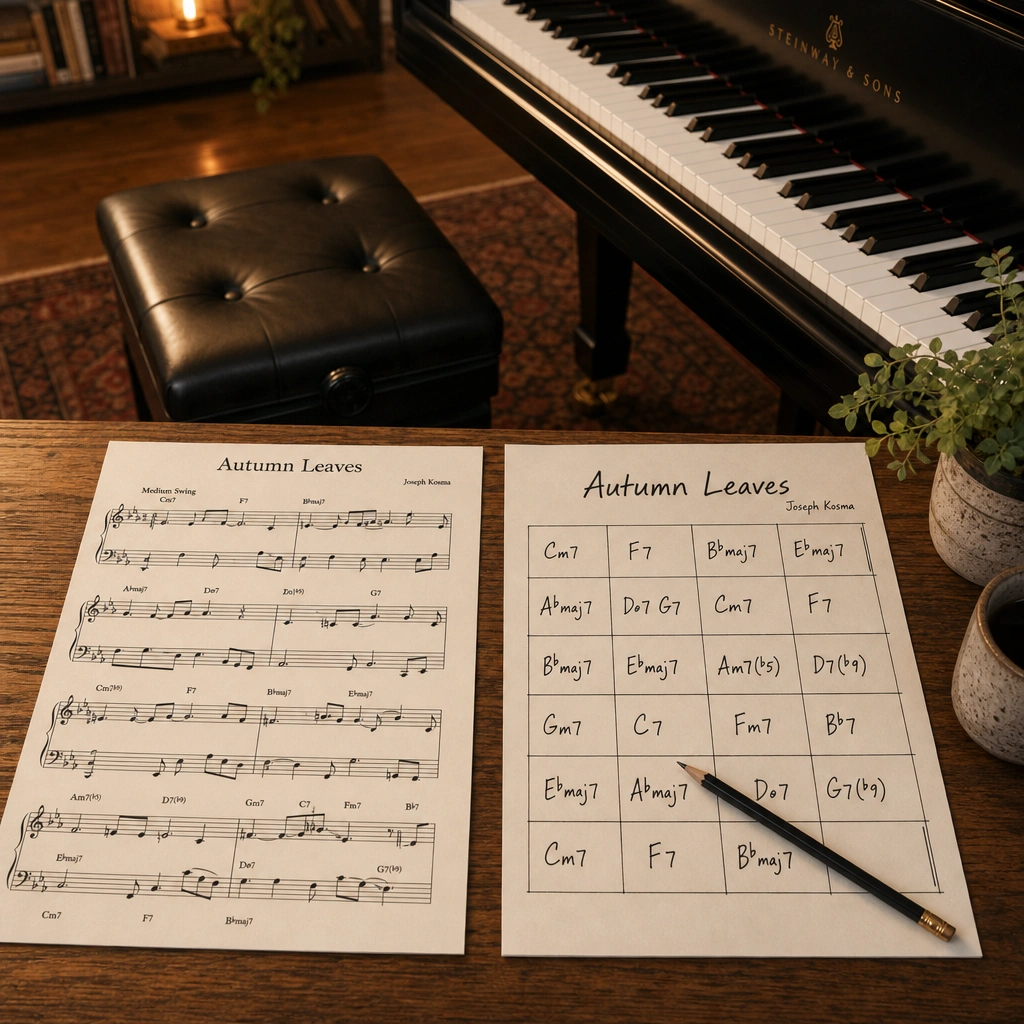
The traditional approach starts with the grand staff. You learn that the lines of the treble clef are E-G-B-D-F, the spaces spell FACE, and the bass clef uses different mnemonics. You practice identifying notes, then finding them on the keyboard, then reading simple melodies.
This method builds several valuable skills:
- The ability to read any piece of written music eventually
- Understanding of musical notation conventions
- Strong note-to-key association across the entire keyboard
- A foundation for classical repertoire
- Finger independence through carefully graded exercises
The downside? It’s slow. Really slow. Most students spend three to six months before they can read and play even a simplified pop song.
The repertoire in method books skews heavily toward folk songs and classical excerpts, not the music most adults listen to.
I still teach this way to students who specifically want classical training or who are starting young with patient temperaments. But when someone asks me whether they should learn piano chords or notes first, I always ask them what songs they dream of playing first.
What learning piano chords or notes first means in practice
When you start with chords, you learn patterns instead of individual notes. A C major chord is always C-E-G, whether you read the notes or not. You learn the shape, the sound, and how to move between a handful of common chords.
Within the first lesson, you can play a I-V-vi-IV progression (C-G-Am-F), which is the foundation of dozens of pop hits. Add a simple right-hand melody or rhythmic pattern, and suddenly you’re playing recognizable music.
Here’s what the chord-first path typically looks like:
- Week 1: Learn C, G, Am, F chord shapes
- Week 2: Practice smooth transitions, add simple right-hand patterns
- Week 3-4: Play simplified versions of 2-3 songs you actually know
- Month 2: Add Dm, Em, more sophisticated rhythms
- Month 3: Introduction to seventh chords, inversions, and bass lines
The advantage is motivation. You sound musical quickly. The disadvantage is that you’re not reading music fluently, and you’ll need to add that skill later if you want access to the full range of piano literature.
When students ask whether they should learn piano chords or notes first, this approach wins for anyone whose primary goal is contemporary music and who needs early victories to stay motivated.
Figuring out which approach fits your goals is much faster when a teacher can hear what you want to play and map out your path. Your first 30-minute lesson with Austin is free – no card, no pressure.
The songs you love test
Here’s the most practical way I know to decide whether you should learn piano chords or notes first: make a list of five songs you’d love to play within your first year at the piano.
If your list includes Chopin nocturnes, Bach inventions, or Debussy preludes, you need to prioritize note reading. Classical repertoire requires fluent sight-reading and precise interpretation of written scores. There’s no shortcut.
If your list includes Imagine, Clocks, A Thousand Years, Hallelujah, or Let It Be, chords will get you there fastest. These songs are built on chord progressions with melody layered on top, exactly what the chord-first method teaches.
Most students I work with fall into the second category. They want to play music they hear on Spotify, lead worship at church, or accompany themselves while singing.
For them, learning piano chords or notes first isn’t even a real question—chords win every time.
Three honest truths from 10+ years of experience
After teaching hundreds of students through both approaches, here’s what I’ve learned about whether you should learn piano chords or notes first:
Truth 1: Motivation beats method
The best approach is the one you’ll actually stick with. I’ve had students make incredible progress with the “wrong” method simply because they were excited about what they were learning.
If chord-based learning keeps you practicing daily, it’s better than the theoretically superior note-reading approach that you abandon after a month.
Truth 2: You’ll need both eventually
Whether you should learn piano chords or notes first is really asking which skill to prioritize, not which to learn exclusively. Every complete pianist needs both chord fluency and note-reading ability.
The question is just about sequencing, not about choosing one forever.
Truth 3: Adults and kids need different paths
Children generally do better starting with notes. They have time, they’re building foundational skills for life, and they’re more willing to trust the long-term process.
Adults typically need the immediate gratification and practical application that chords provide first. If you’re wondering about the best approach for a young student, this guide on piano lessons for kids covers what matters most at different ages.
When notes first is the right choice
Despite my general preference for chord-first learning with adults, some students absolutely should learn piano chords or notes first by prioritizing notes. You’re a good candidate for the traditional note-reading path if:
- You’re drawn primarily to classical repertoire
- You’ve tried the chord approach before and found it unsatisfying
- You’re a child under 10 with supportive parents and time to build skills slowly
- You have previous musical training and already understand basic theory
- You specifically want to develop sight-reading as a core skill
- You’re patient and intrinsically motivated by gradual mastery
The traditional method is time-tested for good reason. It builds a comprehensive foundation and opens doors to the entire canon of written music. It just takes longer to reach the songs most people want to play first.
When chords first is the right choice
You should learn piano chords or notes first by prioritizing chords if:
- Your goal is to play contemporary pop, rock, folk, or worship music
- You’re an adult with limited practice time who needs early wins
- You want to accompany singing (yourself or others)
- You’ve tried traditional methods before and quit from boredom
- You learn best by doing rather than by studying theory first
- You’re motivated by playing recognizable songs quickly
Most of my adult students fall into this category. They come to me after trying piano apps or method books and feeling frustrated by the pace. When we switch to a chord-first approach, suddenly they’re making music they’re proud to share.
The hybrid approach that works for most adults
Here’s what I actually do with most new adult students who ask whether they should learn piano chords or notes first: we start with chords for motivation, then layer in note reading once they’re hooked.
In the first month, we focus entirely on chord shapes, common progressions, and playing simplified versions of songs they love. This builds confidence, develops basic hand position and finger strength, and proves that they can actually do this.
By month two or three, once they’re practicing consistently and enjoying their progress, we start adding note reading. But now it’s not abstract—we’re reading the melody line of a song they already know how to play by chords.
The context makes the note reading meaningful and much easier to learn.
By month six, most students are comfortable with both systems. They can learn a new pop song from a chord chart in an afternoon, and they can slowly work through a simple piece of written music when they want to.
They haven’t lost time by starting with chords; they’ve actually progressed faster because they never hit the motivation crisis that causes so many beginners to quit.
This hybrid approach acknowledges that the question of whether you should learn piano chords or notes first is actually a false choice for most people. You need both, and the order matters less than maintaining momentum.
Why the hybrid method succeeds
The reason this combined approach works so well is that it addresses both the emotional and technical sides of learning piano. Starting with chords gives you immediate emotional satisfaction—you’re making real music right away.
Then, once you’re emotionally invested and motivated, adding note reading becomes a skill you want to acquire rather than a hurdle you have to overcome. The fear is gone because you already know you can play piano. Now you’re just adding another tool to your toolkit.
What this looks like in real lessons
At Weaver Music, we customize every Zoom lesson based on your goals. The free 30-minute trial lesson is specifically designed to figure out where you are and what path makes sense for you.
For students who choose the chord-first path, lessons look like this:
- We start with your hand position and basic technique (this matters regardless of approach)
- You learn 3-4 essential chords in the first lesson
- We apply those chords to a song fragment immediately
- Each week adds new chords, rhythm patterns, or musical concepts
- You get access to Weaver Music’s four-level video course library for reference
- Within 4-6 weeks, you’re playing recognizable versions of real songs
For students who need the traditional note-reading foundation, we use a structured method book approach, but I still try to bring in more contemporary repertoire as early as possible. The goal is always to get you playing music you care about as quickly as your skill allows.
The 60-minute lesson format ($99 per lesson) gives us time to work on both technique and repertoire without rushing. Whether you should learn piano chords or notes first becomes less important when you have time to develop both systematically.
“My confidence at the piano has grown so much since starting lessons.” – Mia Reynolds
Tracking your progress along the way
One thing I do with all my students is set clear milestones. If you start with the chord approach, we’ll identify specific songs you want to master within your first three months, six months, and year.
These become your benchmarks for progress. For note-reading students, the milestones look different—they’re about reading fluency, repertoire difficulty levels, and technical skills.
But either way, you know where you’re going and can measure how you’re getting there.
Should you learn piano chords or notes first? Making your decision
If you’re still unsure whether you should learn piano chords or notes first, ask yourself these questions:
- What are the first three songs you want to be able to play?
- Are you more motivated by quick wins or by building the “right” foundation?
- How much time can you realistically practice each week?
- Have you tried learning piano before, and what happened?
- Do you primarily listen to classical music or contemporary music?
Your honest answers will point you in the right direction. And remember: this isn’t permanent. You can start with chords and add note reading later (or vice versa). The best choice is the one that keeps you engaged and practicing.
For what it’s worth, about 70% of my adult students start with chords, 20% start with traditional note reading, and 10% are already somewhere in between when they come to me. All three groups end up as capable pianists—they just take different routes to get there.
You can also explore learning piano without reading music if the chord-based approach particularly appeals to you, though I always encourage adding reading skills once you’ve built momentum.
Trust your instincts about your learning style
One final piece of advice: trust what you know about yourself as a learner. If you’ve always been someone who needs to understand the theory before the application, starting with note reading might feel more comfortable.
If you’re a hands-on learner who needs to see results before diving into fundamentals, chords will probably serve you better.
The decision about whether to learn piano chords or notes first matters less than the decision to start. Most people spend more time researching the perfect method than they spend actually practicing.
Pick an approach that excites you, commit to it for three months, and adjust from there based on what you discover about how you learn best.
With consistent practice and good guidance—whether through structured lessons or on your own—you’ll develop both skills over time. The question isn’t really whether you should learn piano chords or notes first as much as it is what will keep you motivated through the challenging early months when everything feels unfamiliar and difficult.
Finding the right support system
Every path has value. The best one is the path you’ll actually walk all the way down. And you don’t have to walk it alone.
Working with an experienced teacher who can adjust the approach based on your progress and preferences makes everything faster and more enjoyable. That’s true whether you’re in the Bay Area or connecting from anywhere in the world via Zoom, and whether you’re seven or seventy.
Having someone to answer your questions, correct your technique before bad habits form, and celebrate your progress makes the entire journey more rewarding. When you’re wondering whether you should learn piano chords or notes first, having a teacher who knows both paths intimately means you get personalized guidance rather than a one-size-fits-all answer.
The students who make the fastest progress aren’t necessarily the most talented—they’re the ones who find the right approach for their goals and personality, then stick with it consistently. That combination of smart strategy and persistent effort is what transforms beginners into confident pianists.
Ready to find out for yourself?
Your first 30-minute lesson with me is completely free – we will evaluate where you are, talk through your goals, and map out your path.

Comments
3 responses to “Should You Learn Piano Chords or Notes First?”
[…] is also where a decision about reading chords versus notes tends to surface – trouble spots often trace back to a gap in one or the […]
[…] vs. ear-based learning: students who learn chords first sometimes get to “playing something” faster, though reading pays off […]
[…] and note reading both speed up. If you’re deciding what to focus on first, our piece on learning chords or notes first builds directly on this same […]