
The short answer
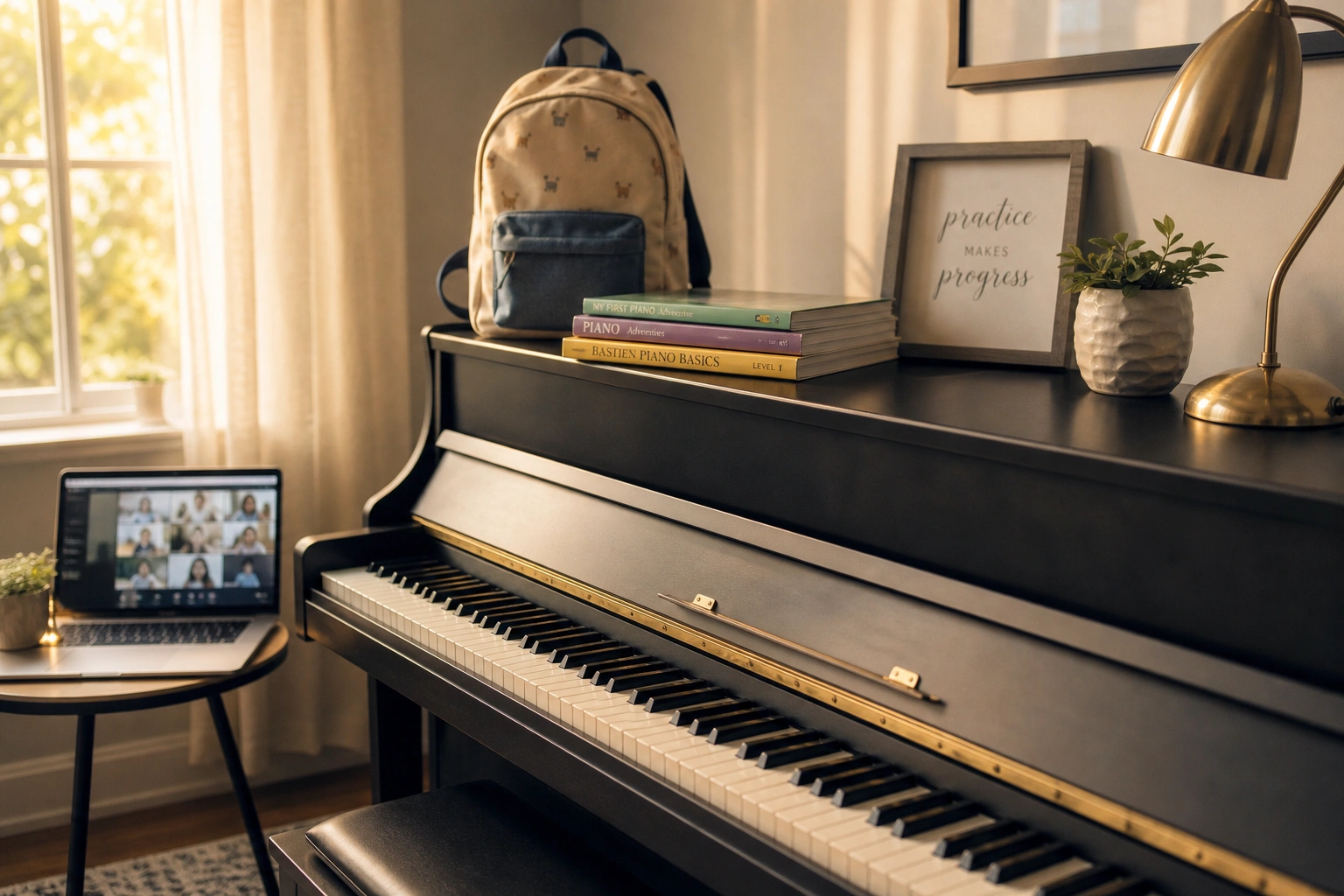
Online piano lessons for kids work well starting around age 6 or 7, when a child can sit, focus, and follow verbal instruction for 20-30 minutes. For younger children, in-person lessons or a parent-assisted online setup usually go smoother. I’ve taught both formats, and the deciding factor is rarely the child’s age alone – it’s attention span and whether an adult is nearby to help in the first few months. You can see what that looks like in a free 30-minute trial lesson before committing to anything.
I get this question from Bay Area parents constantly, usually right after a friend mentions switching to Zoom lessons or a school schedule stops leaving room for driving across town. The honest answer is: it depends less on the technology and more on the kid. Some 6-year-olds thrive online. Some 10-year-olds need a teacher in the room for the first semester. Let’s go through it by age.
What age is right for online piano lessons?
Most children are ready for online piano lessons by age 6 or 7, once they can follow spoken instructions without constant redirection and sit through a 20-30 minute session. Kids younger than that – roughly ages 4 to 5 – typically do better with an in-person teacher who can physically guide hand position and keep them engaged face to face.
Here’s the breakdown I actually use when a parent asks me where to start:
- Ages 4-5: In-person is usually easier. Their attention is short, and a screen adds a layer of distance that makes it harder to correct a slouched wrist or a curled thumb in real time.
- Ages 6-8: Online works for most kids, especially with a parent sitting nearby for the first month or two.
- Ages 9-12: Online works well independently. Kids this age can usually manage the screen, the keyboard, and the instructions on their own.
- Teens: Online is often their preferred format – no driving, easy to fit around homework and sports.
I’ll say this plainly: this is based on what I’ve observed teaching hundreds of students, not a hard scientific rule. Every kid is different, and I’ve had 5-year-olds who did beautifully on Zoom because they were used to video calls with grandparents. The guide above is a starting point, not a verdict.
How do online lessons work for young kids?
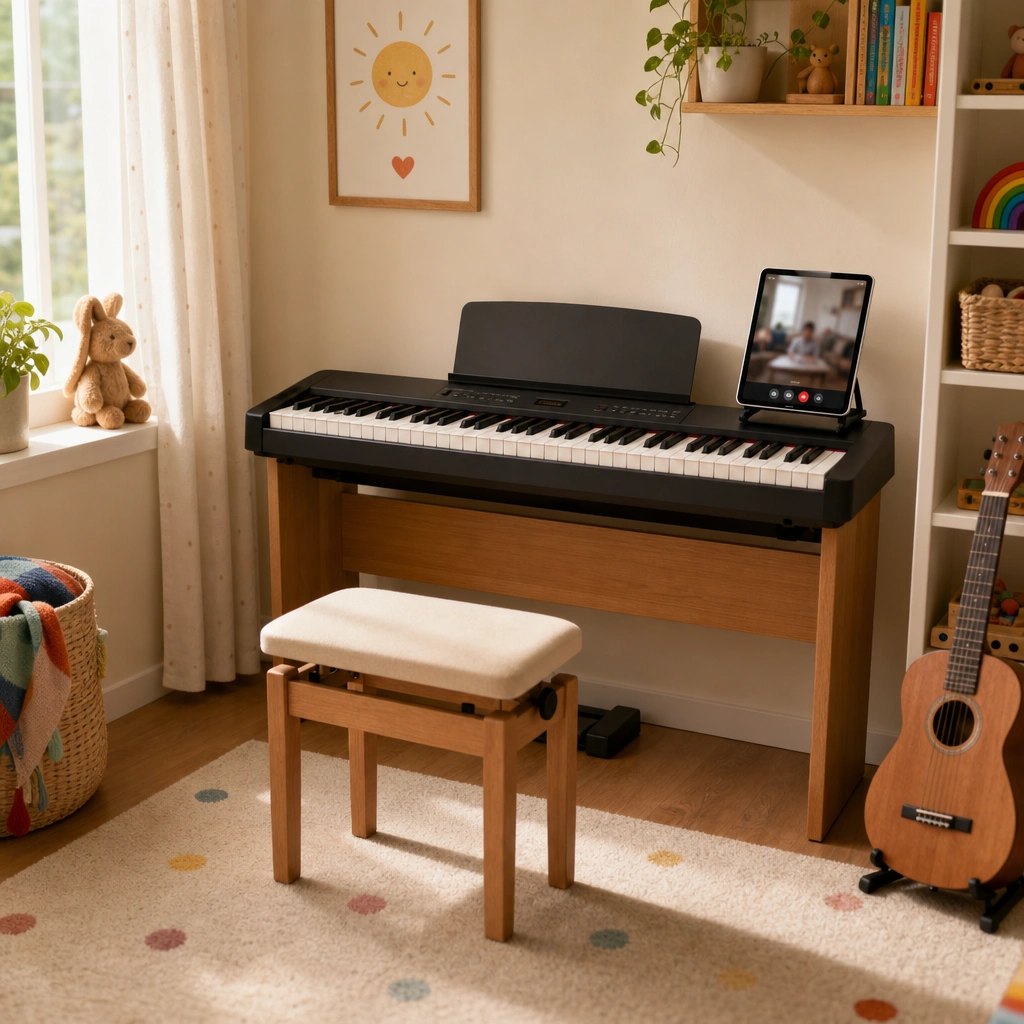
Online piano lessons for young kids, ages 6 to 8, work best when a parent sits within earshot for the first several sessions and the keyboard is positioned so the teacher can see the student’s hands clearly on camera. The teacher talks the child through posture, finger numbers, and note names the same way they would in person, just through a screen.
A few things that make a real difference at this age:
- Position the camera to show the full keyboard and the student’s hands, not just their face.
- Keep the first few lessons short on talk and long on doing – young kids lose focus fast during explanations.
- Have the parent nearby, not necessarily watching, just available if the child freezes up or the connection drops.
I had a 7-year-old student, Lily, whose mom sat quietly in the next room for the first six weeks. By week seven, Lily was setting up the keyboard and logging into Zoom herself. That’s typical – the parent’s job shrinks fast once the routine sticks. If your child is younger and still finding focus, our piece on motivating kids to practice has routines that pair well with online lessons.
What do online piano lessons look like for tweens?
Online piano lessons for tweens, roughly ages 9 to 12, typically run 30 to 45 minutes and require little to no parent involvement once the first month is over. Kids this age can manage their own camera angle, follow a lesson plan, and take notes on what to practice before the next session.
This is actually my favorite age range to teach online. Tweens are old enough to self-direct but still eager to please, which means they tend to practice what you ask. A common mistake I see at this stage: parents assume independence means the child needs less structure. It’s the opposite – a clear, written practice plan matters more once a parent stops sitting in on every lesson.
At Weaver Music, every lesson follows a consistent curriculum covering technique, reading, theory, and repertoire, built around music the student actually wants to play. That structure matters even more online, because there’s no in-person routine (walking into a studio, sitting on a specific bench) to anchor the habit. The lesson plan has to do that work instead.
Curious whether online lessons would click for your child? Your first 30-minute lesson with Austin is free – no card, no pressure.
Can teenagers succeed with online piano lessons?
Teenagers often succeed better with online piano lessons than younger kids do, because they can manage their own schedule, troubleshoot basic tech issues, and prefer the flexibility of not driving to a studio after a full day of school. Online lessons also let a serious teen keep working with the same teacher through a move or a busy sports season.
Teens tend to want one of two things: a song they’re genuinely excited about, or exam/audition prep for school music programs. Online lessons handle both fine. One of my teenage students, Daniel, kept his weekly Zoom lesson through two cross-country moves in one year – something that simply wouldn’t have worked with an in-person-only setup.
“I have improved more with Weavers Music than I expected. Austin is patient and encouraging.” – Daniel Brooks
If a teen is deciding between learning songs they love versus a more traditional path, our guide on classical or pop piano first is a good next read.
What equipment does my child need?
A child taking online piano lessons needs a keyboard with at least 61 full-sized keys, a stable internet connection, a device that can run Zoom, and a way to position the camera so the teacher can see both the keys and the student’s hands. A piano is ideal but not required to start.
Equipment basics by priority:
- Keys: 61 keys minimum; 88 full-size keys is better long-term if the budget allows.
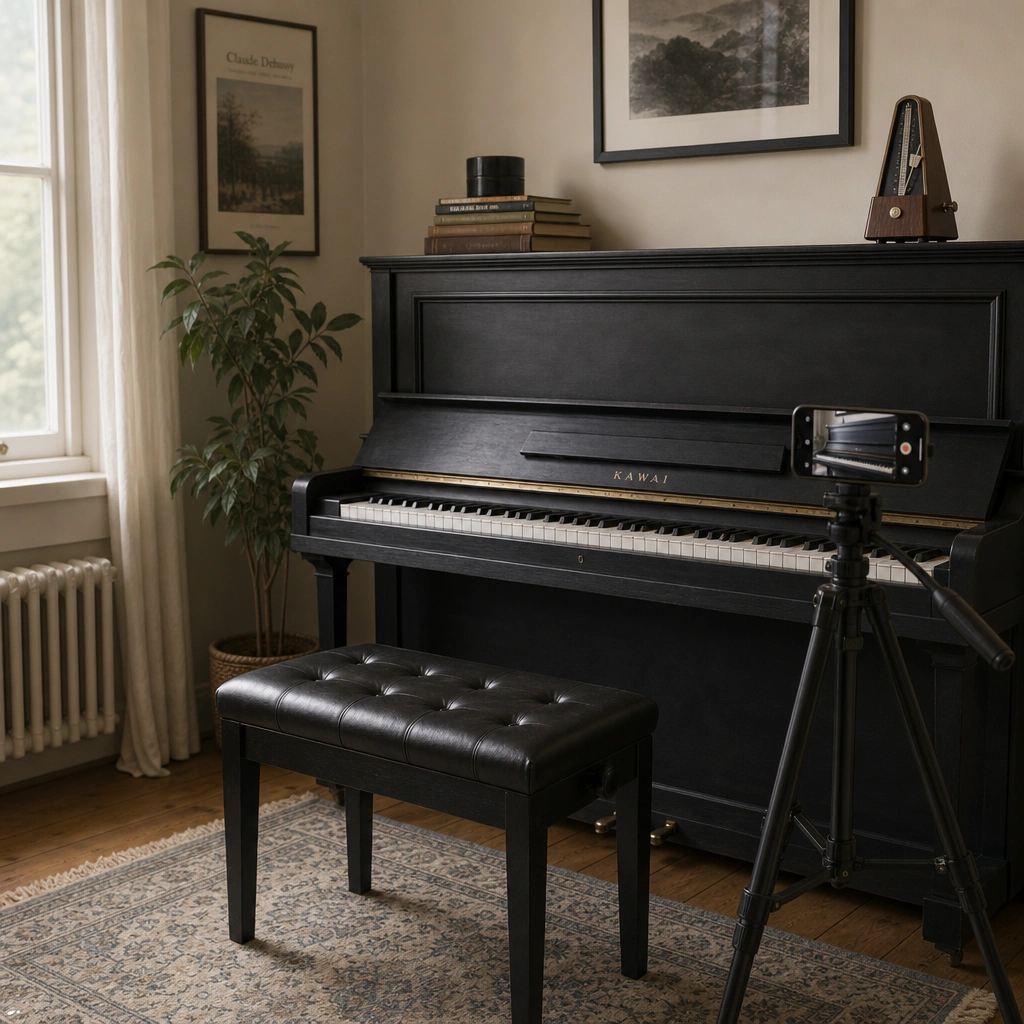
- Camera position: A laptop propped up or a phone on a small tripod, angled to show the keyboard and hands.
- Audio: Built-in laptop speakers are fine for lessons; headphones help if there’s household noise.
- Internet: A standard home connection is sufficient for one-on-one video calls – lag is more often a camera placement issue than a bandwidth one.
Lessons at Weaver Music run live and one-on-one over Zoom. All ages and levels are welcome, from a first lesson ever to advanced repertoire.
How do I know if online lessons are working?
Online piano lessons are working for a child if they can play what was assigned the previous week with reasonable accuracy, if they bring questions or progress between sessions, and if they’re not dreading lesson day. Watch for steady small wins rather than dramatic weekly leaps – that’s normal progress, not a red flag.
Signs to check after the first month:
- The child can find notes and fingerings without constant re-explaining.
- They remember what to practice without being reminded every single day.
- They show you something, unprompted, that they learned or figured out.
If none of that is happening after six to eight weeks, it’s worth a direct conversation with the teacher before assuming online lessons as a format are the problem. In my experience, the fix is almost always logistics – camera angle, lesson length, or practice routine – not the format itself.
“Austin explains everything clearly and makes online piano lessons easy to follow.” – Emily Carter
Lesson length matters here too: 30 minutes ($60) suits most kids under 9, 45 minutes ($80) fits many tweens, and 60 minutes ($99) works well for older kids or teens tackling more advanced repertoire. Books are the only added cost beyond the lesson itself. If you’re weighing lesson length against progress, our note on finger independence is a useful read for parents of intermediate players.
Common questions
Is it harder for a teacher to correct hand position over video?
It’s a little harder, but manageable with a good camera angle showing the full keyboard and the student’s hands. I ask parents to angle the device low and slightly to the side rather than straight-on, which makes wrist and finger position just as visible as it would be in person.
Should my child switch to online lessons if we just moved?
Yes, often. Online lessons let a child keep the same teacher and curriculum through a move instead of starting over with someone new. Continuity matters more for progress than physical location, especially for kids who’ve already built a rapport with their teacher.
What if my child gets distracted during online lessons?
Short attention spans are common early on and usually improve within a few sessions as the routine settles. Moving the keyboard to a quiet room, closing other tabs or apps, and keeping a parent nearby for the first few weeks solves most distraction issues I see.
Can siblings share one online piano lesson?
Weaver Music lessons are one-on-one, so siblings each get their own session rather than sharing a slot. This keeps the pace matched to each child’s actual level, which matters a lot between, say, a 7-year-old beginner and a 12-year-old intermediate sibling.
Do online piano lessons work without owning a real piano?
Yes, a 61-key keyboard is enough to start and learn the fundamentals. Many of my beginner students start on a basic keyboard and upgrade to a full 88-key piano later, once they know they’re sticking with it and want the extra range and weighted feel.
How soon will I see if online lessons are a good fit for my child?
Most parents have a clear sense within three to four lessons. By then you’ll see whether your child engages with the format, remembers practice assignments, and looks forward to lesson day – all stronger indicators than any single first impression.
Ready to find out for yourself?
Your first 30-minute lesson with me is completely free – we will evaluate where you are, talk through your goals, and map out your path.
