
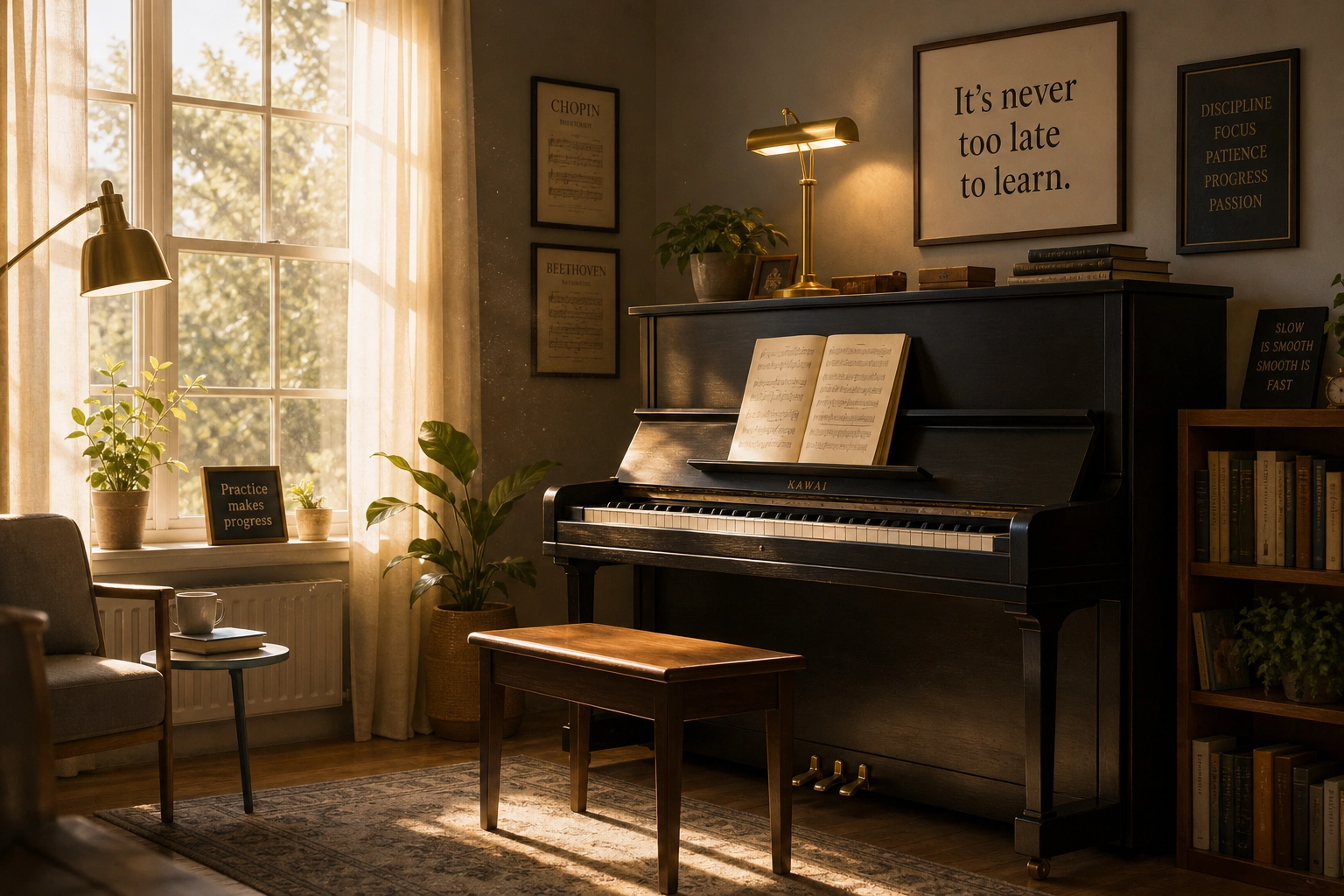
The short answer
No, it is not too late to learn piano at 30, 40, 50, or 60. Adult brains absorb finger patterns, reading, and theory more slowly than a child’s, but adults learn more efficiently because they understand structure, stay motivated, and practice with purpose. I have started students in their 60s who played recognizable songs within two months.
If you want a quick gut check before reading further, Weaver Music offers a free 30-minute trial lesson where I evaluate your hands, your goals, and your realistic timeline – no card required.
Why do adults think it’s too late to learn piano?
Adults believe it’s too late because they compare themselves to child prodigies, assume motor skills decline too much to learn an instrument, or remember quitting lessons as a kid and assume that failure predicts the future. None of these assumptions hold up in an actual lesson room.
- They watched a viral video of a 7-year-old playing Chopin and concluded skill is only possible if you start young.
- They tried lessons decades ago, hated the rigid method book, and never separated “I quit” from “I can’t.”
- They assume stiff joints or less free time mean slower progress than it actually does.
I’ve had students in their 50s apologize before their first lesson, convinced their fingers were “too old.” Within three lessons they’re playing a simple two-hand arrangement and the apology stops.
Is 30 too old to start learning piano?
Thirty is not too old to start piano – it’s arguably an ideal age. Your hands are fully developed, you can read instructions and theory without a parent translating, and you likely have enough income to invest in a decent keyboard and consistent lessons without financial strain.
I taught a 31-year-old software engineer who started with zero musical background. He practiced 20 minutes a day, five days a week, and played a simplified version of “Clair de Lune” by month four. His advantage wasn’t talent – it was consistency and a clear book list from day one.
At this age, the main risk isn’t ability, it’s scheduling. Thirty-somethings often juggle demanding jobs and young kids, so lessons need to fit real life. One-on-one lessons over Zoom solve a lot of that – no commute, no missed dinner.
Can you learn piano at 40 or 50 and actually get good?
Yes, adults at 40 and 50 absolutely learn to play piano well, often faster than people expect because they bring patience and discipline that teenagers rarely have. I’ve taught several 45-to-55-year-olds who went from no reading ability to playing hymns, pop songs, or simple Chopin pieces within a year of steady weekly lessons.
What changes at this age isn’t capacity, it’s approach. Joint stiffness from years of typing or manual work means warm-ups matter more. I always start these students with a few minutes of slow stretching and scale work before anything technical – it prevents the wrist strain I see when someone skips straight to repertoire.
If you’re in your 40s or 50s and wondering whether your hands can still learn new patterns, the only real way to find out is to try one lesson and see. Your first 30-minute lesson with Austin is free – no card, no pressure.
Is 60 too late to start piano?
Sixty is not too late to start piano. I’ve taught multiple students in their 60s and early 70s who went from never touching a keyboard to playing simple arrangements of songs they love within three to four months of weekly lessons and short daily practice.
One student, a retired nurse in her late 60s, started lessons mainly for something to look forward to each week. She wasn’t chasing Beethoven – she wanted to play “Fly Me to the Moon” for her husband. Eight weeks in, she did, slightly slower than the original tempo, hands shaking a little from nerves, and it was genuinely moving to watch.
“My confidence at the piano has grown so much since starting lessons.” – Mia Reynolds
Realistic expectations matter most at this age. Progress is steady, not instant, and some students benefit from shorter, more frequent practice sessions – 10 minutes twice a day instead of one 20-minute block – to avoid hand fatigue.
What actually slows adult beginners down?
Adult beginners are slowed down far more by inconsistent practice and perfectionism than by age itself. The students who plateau aren’t the oldest ones – they’re the ones who practice erratically, skip fundamentals, or quit the moment a piece sounds imperfect.
- Skipping technique basics. Jumping straight to a favorite song without learning hand position leads to tension and bad habits that take months to unlearn.
- All-or-nothing practice. Twenty minutes a day beats a rushed two-hour session once a week, every time.
- Fear of sounding bad. Adults judge themselves harder than kids do, and that self-judgment slows the repetition needed to actually improve.
- No structured plan. Bouncing between random YouTube tutorials instead of following a sequence, like the first things worth learning on piano, wastes real time.
I see the perfectionism issue constantly. A student in his 30s once refused to move past measure four of a piece because it “wasn’t perfect yet.” I had him record himself and listen back – he was shocked how close it already was. Recording yourself is one of the fastest fixes for this.
How long does it realistically take an adult to play real songs?
Most adult beginners play a simple two-hand song within six to eight weeks when practicing around 20 minutes a day, five days a week. Recognizable, polished performance-level pieces typically take six months to a year, depending on the song’s difficulty and how consistent practice stays.
Timelines shift based on goals. Someone who wants to play basic chords and sing along might get there in a month. Someone aiming for an intermediate classical piece, or wanting to understand the circle of fifths and build real theory fluency, is looking at a longer runway – usually a year or more of steady lessons.
Here’s a rough benchmark I use with new adult students:
- Weeks 1-4: Note reading, hand position, first simple pieces with separate hands.
- Weeks 5-10: Hands together on simple songs, basic rhythm counting, first scales.
- Months 3-6: First full song learned to performance level, basic chord reading.
- Months 6-12: Intermediate repertoire, more music theory, playing by ear begins to develop.
Every lesson at Weaver Music follows a curriculum covering technique, reading, theory, and repertoire built around what you actually want to play – whether that’s scales and classical pieces or pop songs you already love. Lessons run $60 for 30 minutes, $80 for 45 minutes, or $99 for a full hour, live and one-on-one over Zoom.
“I started as a complete beginner, and Austin made the learning process feel comfortable.” – Noah Peterson
Common questions
Is there an age where it actually becomes too late to learn piano?
No specific age makes learning piano impossible. Physical limitations from certain conditions can require adapted technique, but healthy adults in their 70s and 80s still learn to play. Motivation and consistent practice matter far more than the number on your birthday.
Do older adults learn piano differently than younger adults?
Older adults often need more warm-up time for joint flexibility and may benefit from shorter, more frequent practice sessions rather than long single sessions. Mentally, older adults frequently grasp music theory faster because they’re comfortable with structured, patient learning.
Should I buy a piano before starting lessons as an adult?
A full piano isn’t necessary to start. A weighted 61- or 88-key keyboard works fine for the first months of lessons, and I help new students figure out exactly what they need during the free trial lesson before they spend any money.
Is it harder to learn piano as an adult than as a child?
Children often pick up listening skills faster, but adults learn reading, theory, and structured practice more efficiently because they already understand how to study. Overall learning speed between focused adults and children is closer than most people assume.
Can adult beginners learn to play by ear instead of reading music?
Yes, adult beginners can learn by ear, though combining ear training with basic reading gives the most flexibility long-term. Many adult students start with songs they already know, which makes playing by ear and improvising feel natural much sooner.
What if I quit piano lessons once already as an adult?
Quitting before doesn’t predict quitting again. Most adults who quit did so because of a rigid teaching style or an unrealistic practice schedule, not lack of ability. A different teaching approach and a free trial lesson often changes the outcome entirely.
Ready to find out for yourself?
Your first 30-minute lesson with me is completely free – we will evaluate where you are, talk through your goals, and map out your path.
