
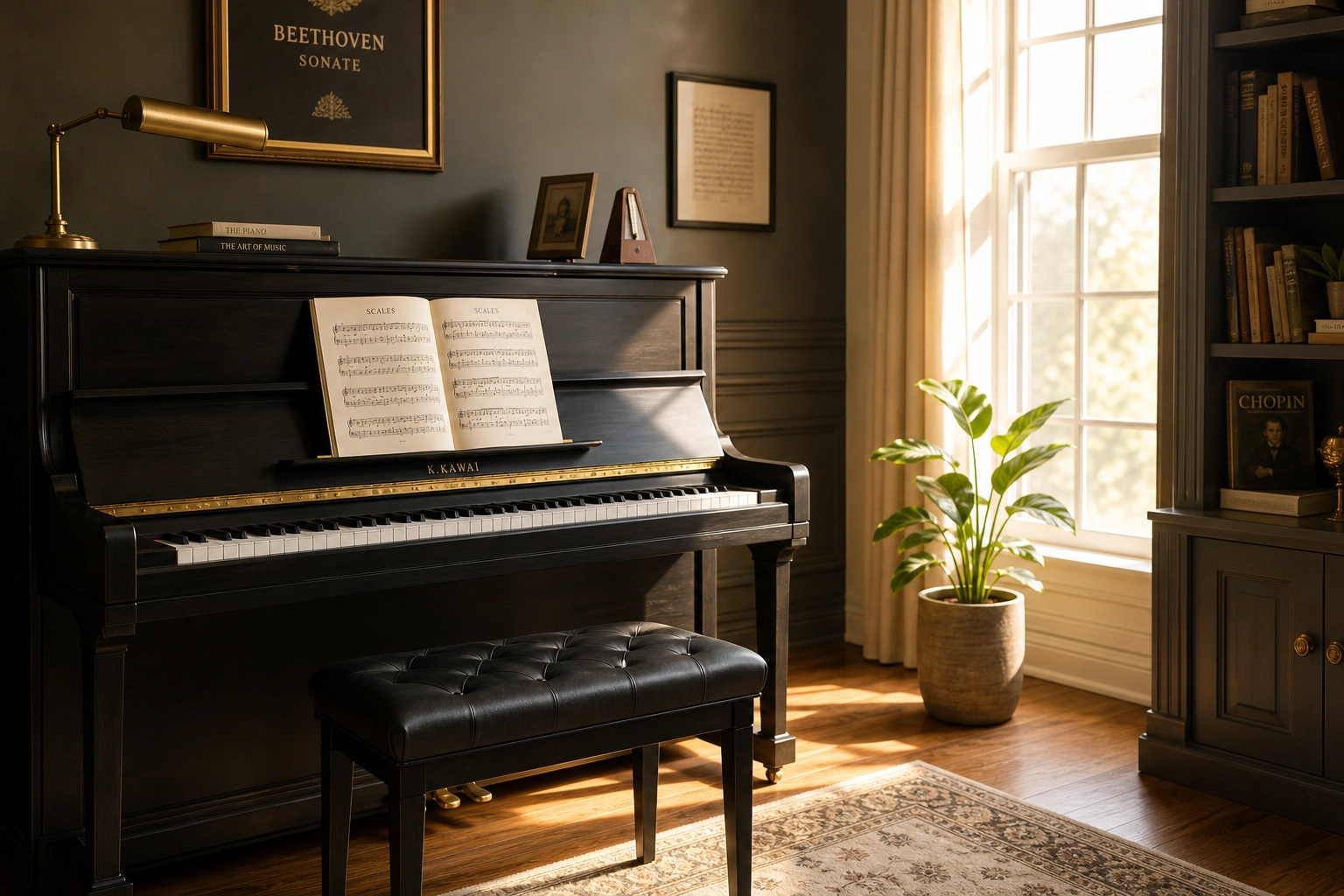
The short answer
Piano scales matter because they train your fingers, ears, and eyes all at once: they build the hand coordination needed for fast, even playing, they teach you the key signatures that explain most written music, and they train your ear to recognize patterns instantly, which makes sight-reading and improvising much faster to learn.
I tell every new student the same thing in their free trial lesson: scales are not busywork, they are the shortcut. A student who drills a G major scale for two weeks will read a piece in G major noticeably faster than one who hasn’t, because their fingers already know where the black key goes.
What do scales actually train?
Scales train three things simultaneously: physical technique (even finger strength and smooth thumb crossings), music theory (key signatures, sharps and flats, and how melodies are built), and ear training (recognizing whether a note sounds “right” in a key). Few other exercises cover all three at once this efficiently.
Here’s what I actually watch for when a student plays a scale in a lesson:
- Evenness – are all eight notes the same volume and length, or does the thumb bang louder on the crossing?
- Fingering – standard fingerings exist because they prevent awkward stretches later in real pieces.
- Tempo control – can they speed up without falling apart, using a metronome?
- Hand shape – relaxed wrist, curved fingers, no tension creeping into the forearm.
I had a student, Daniel, who could play his assigned songs beautifully but froze the moment a piece modulated to a new key. Two months of daily scale practice later, he could feel a key change coming before he even read the key signature – his hands just knew the pattern. That’s the theory piece of scales working in real time, not from a textbook. If you want the full map of how keys relate to each other, our circle of fifths guide pairs well with scale practice.
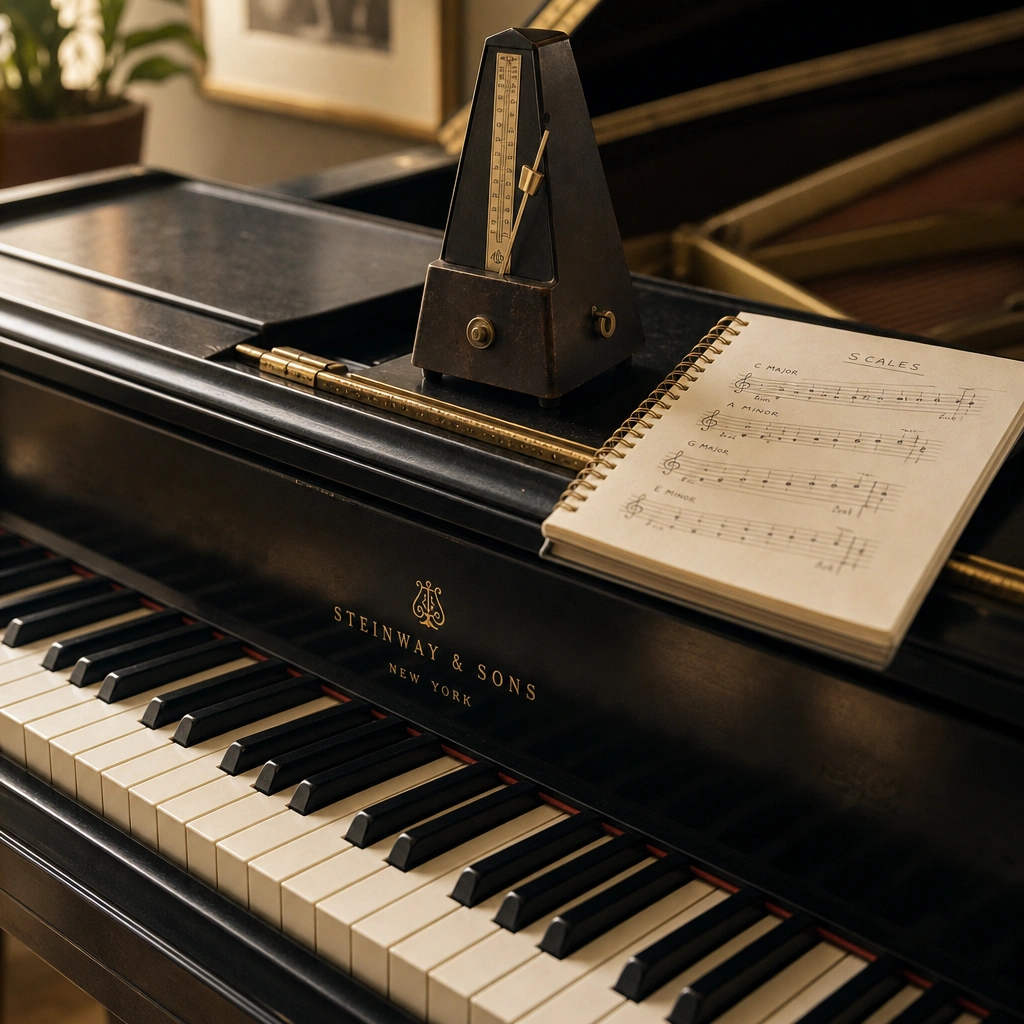
Do you really need scales to play songs?
Scales are not strictly required to play a specific song, but they dramatically shorten the time it takes to learn new songs overall. A student who knows their major scales recognizes scale-based runs in sheet music instantly instead of decoding each note one at a time.
Think of it this way: a C major scale run buried in a pop song is just the scale you already practiced, rearranged. Students who skip scales tend to treat every new piece as a brand-new puzzle. Students who know their scales treat most new pieces as familiar patterns with a few surprises. That difference compounds over months and years of playing.
This is also where scales connect directly to hand coordination. If your fingers trip over each other during scales, they will trip over each other in songs too – the fix is usually the same drills either way. Our guide on finger independence digs deeper into that connection.
If scales feel like a mystery you’re practicing blind, a few minutes with a teacher can clear it up fast. Your first 30-minute lesson with Austin is free – no card, no pressure.
How much time should scales take in practice?
Most students should spend 5 to 10 minutes on scales per practice session, which is roughly 15-25% of a typical 30-45 minute session. Beginners benefit from daily repetition at a slow, even tempo; intermediate players can rotate through scales across the week instead of drilling all of them every day.
A realistic breakdown for a 30-minute practice session:
- 5 minutes: scales and technique warm-up
- 5 minutes: a focused exercise, like Hanon patterns
- 15 minutes: current repertoire
- 5 minutes: review of something already learned
I’ve seen two common mistakes with timing. The first is students who skip scales entirely because they’re “boring” and then plateau on technique for months. The second, more common one, is students who spend 20 minutes on scales and leave no time for actual music – that’s just as unproductive. Scales should feel like a warm-up, not the whole workout. A metronome keeps this honest; without one, most people unconsciously speed up the easy parts and slow down the hard ones.
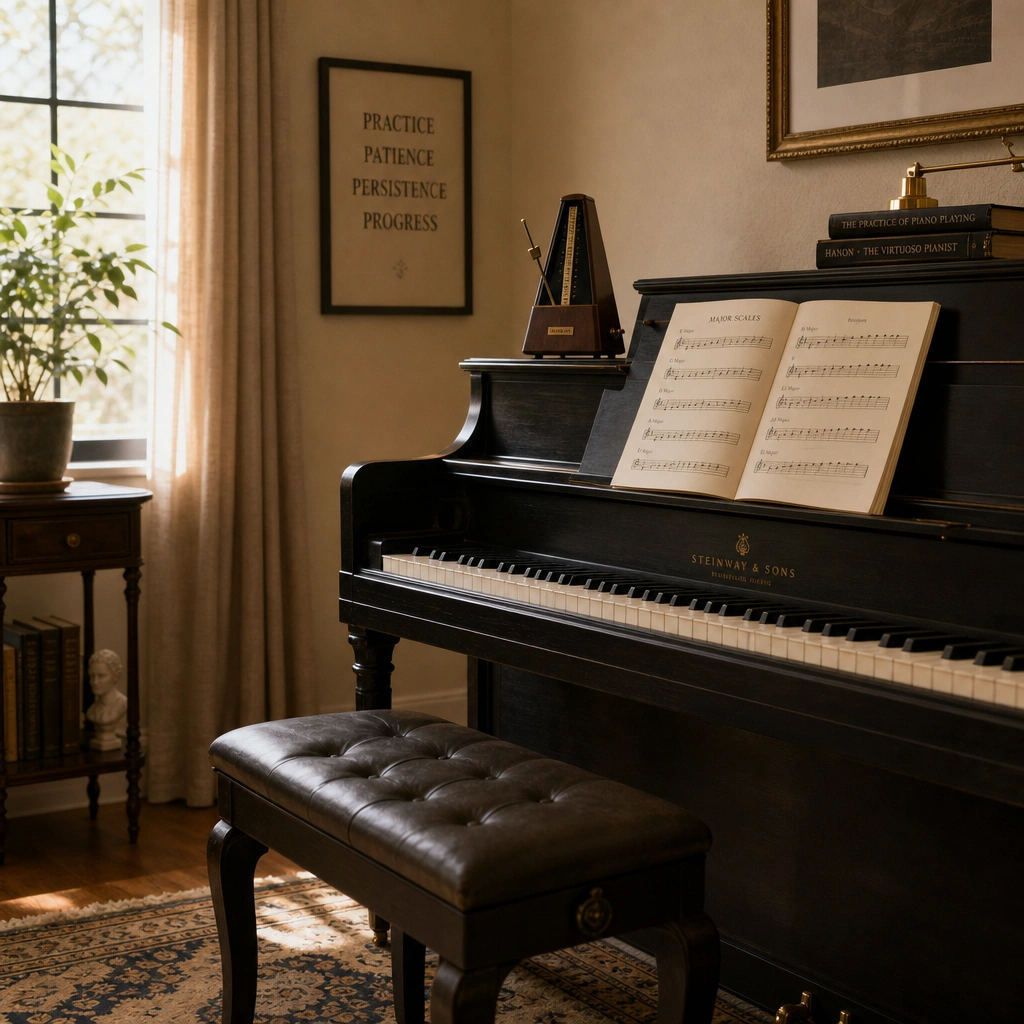
What order should you learn scales in?
Most teachers, myself included, start students with C major because it has no sharps or flats, then move to G major and F major, which each add just one accidental. From there, students progress around the circle of fifths, adding one sharp or flat at a time until all 12 major scales are covered.
A typical first-year sequence looks like this:
- C major, G major, F major (the easiest three)
- D major, B-flat major (two accidentals each)
- A major, E-flat major (three accidentals each)
- Remaining majors, then natural minor scales once majors feel solid
Minor scales usually come second because students need the major scale fingerings locked in first – the patterns share a lot of overlap, and introducing both at once tends to confuse beginners more than it helps. If you’re just starting out and not sure what belongs in week one versus month three, our first things to learn on piano guide lays out a broader roadmap.
Can you skip scales and still get good?
Skipping scales entirely is possible, especially for players who learn purely by ear, but it usually shows up later as shaky technique, slower sight-reading, and more time spent decoding what key a song is in. Scales aren’t the only way to build these skills, but they’re the fastest, most direct one.
I’ve taught plenty of adult students who came to me after years of playing by ear with no formal scale work. They could often play beautifully, but asked to transpose a song up a step, or sight-read something new, they’d struggle in ways a scale-trained player wouldn’t. It’s not that ear-based players are worse musicians – it’s that scales fill a specific, narrow gap efficiently: muscle memory tied directly to music theory.
“I started as a complete beginner, and Austin made the learning process feel comfortable.” – Noah Peterson
According to the Wikipedia entry on musical scales, scales have formed the backbone of Western music pedagogy for centuries precisely because they distill pitch relationships into a repeatable, learnable pattern. That’s not a trend – it’s just how the physical and theoretical sides of music happen to line up.

Common questions
Do scales help with sight-reading?
Yes. Scales train your eyes and fingers to recognize stepwise note patterns instantly, so when sheet music shows a run of notes moving up or down a scale, you read it as one shape instead of six separate notes, which speeds up sight-reading significantly.
Should kids learn scales before songs?
Not necessarily first, but alongside songs. Most kids stay motivated by learning a simple song in their first few lessons, with basic five-finger scale patterns introduced in parallel once they’re comfortable finding notes and reading simple rhythms.
How long does it take to learn all 12 major scales?
With consistent practice of one new scale every two to three weeks, most students learn all 12 major scales within 6 to 9 months. Minor scales typically take another 4 to 6 months after that, depending on practice frequency.
Are scales useful for improvising?
Very useful. Scales are the raw material improvisers draw from – knowing a scale cold means your fingers can explore a key without you having to think about which notes are safe to play. Our improvisation guide builds directly on scale knowledge.
Do scales cause hand tension or pain?
Scales themselves shouldn’t cause pain if played with a relaxed hand and proper fingering, but rushing tempo before technique is solid often does. If you notice tightness, slow down and check your wrist position – our piano hand tension guide covers common fixes.
Can adults learn scales as easily as kids?
Adults often learn the theory behind scales faster than kids since they grasp key signatures conceptually right away, but the physical muscle memory can take a bit longer to build. Either way, consistent short daily practice gets there – age is rarely the limiting factor.
Scales are one of those things that feel pointless for the first few weeks and then suddenly click – a student will play a new song and realize their hand already “knows” the shape because of scale practice. That moment of recognition is worth the repetition. Scales fit into every lesson plan at Weaver Music, from absolute beginners to advanced students polishing repertoire.
Ready to find out for yourself?
Your first 30-minute lesson with me is completely free – we will evaluate where you are, talk through your goals, and map out your path.
