
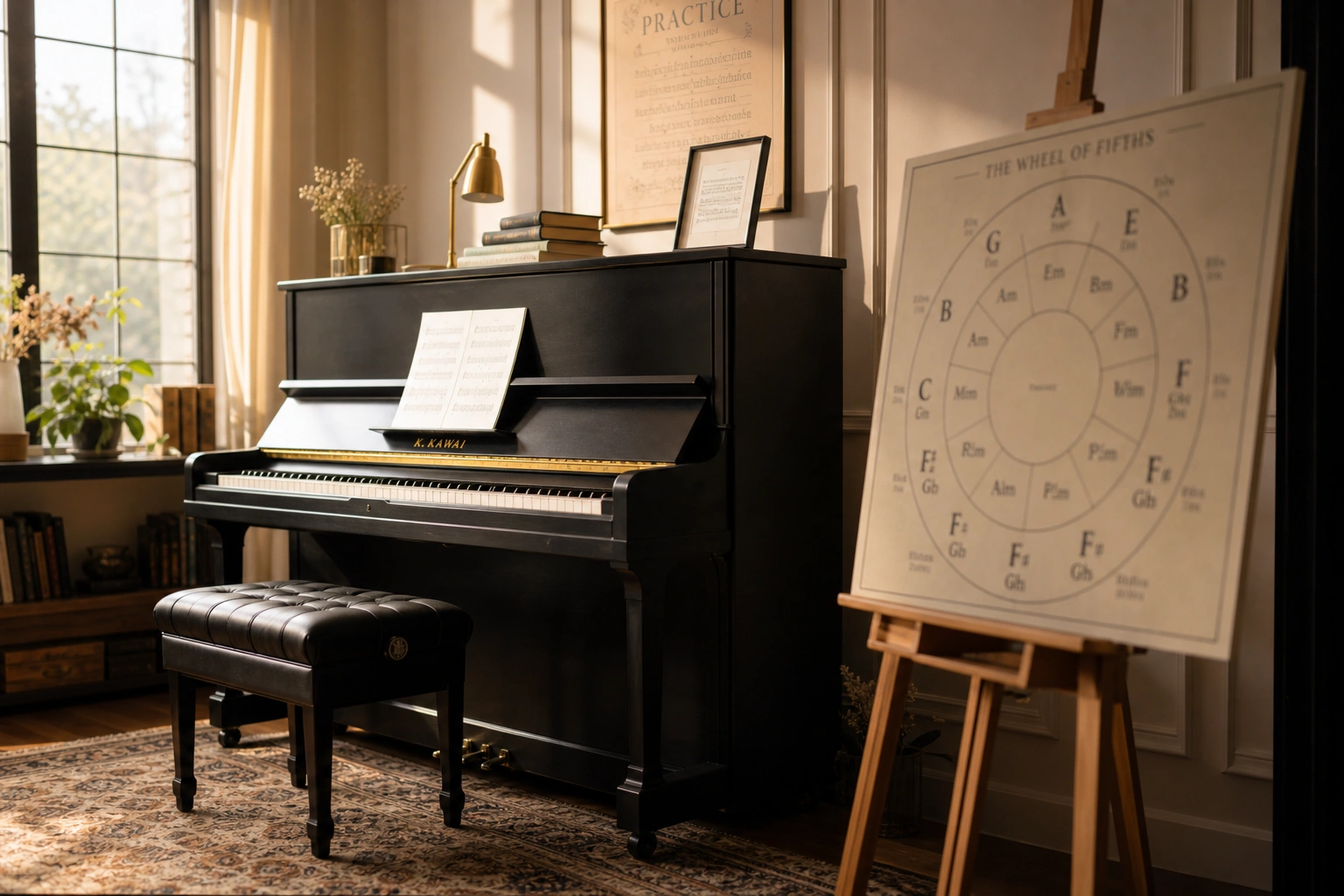
The short answer
The circle of fifths is a diagram that arranges all 12 musical keys in a circle, each one a perfect fifth from its neighbor. Pianists use it to quickly find key signatures, understand which chords belong together, and recognize chord progressions by sight instead of guessing. It’s essentially a visual shortcut for how Western music organizes itself.
I show this chart to almost every student within their first few months, right around the time they start asking why certain chords “just sound right” together. If you’re still working out the first things to learn on piano, this can wait – but once you’re reading notes comfortably, it’s worth a look. A free 30-minute trial lesson is a good place to find out exactly where you are and whether this is the right next step for you.
How does the circle of fifths work?
The circle of fifths works by placing C major at the top, then moving clockwise in jumps of a perfect fifth (seven semitones) – G, D, A, E, B, and so on – until it loops back to C. Each step clockwise adds one sharp to the key signature; each step counter-clockwise adds one flat.
A perfect fifth is just the distance from one note up to the fifth note of its scale – C to G, G to D, D to A. Stack those intervals in order and you get every key that exists, sharps and flats included. The circle isn’t a metaphor or a simplification; it’s a literal map of how key signatures relate mathematically.
- Clockwise from C: G (1 sharp), D (2 sharps), A (3 sharps), E (4 sharps), B (5 sharps)
- Counter-clockwise from C: F (1 flat), B♭ (2 flats), E♭ (3 flats), A♭ (4 flats), D♭ (5 flats)
- At the bottom, sharp keys and flat keys meet and overlap enharmonically, like F♯ and G♭
For a deeper technical breakdown of the interval math behind this, Wikipedia’s circle of fifths article is a solid reference.
Why should pianists care about it?
Pianists should care about the circle of fifths because it turns key signatures and chord relationships from memorized trivia into something you can see and predict. Instead of flipping through a book to check how many sharps are in E major, you glance at the circle and know instantly.
I had a student, Daniel, who spent weeks trying to memorize key signatures one at a time with flashcards. It wasn’t sticking. The week I drew the circle on a whiteboard and showed him the clockwise sharp pattern, something clicked – he stopped memorizing and started reasoning it out. That’s the real value: it replaces rote recall with logic.
It also matters for sight-reading speed, for understanding chord progressions in pop and jazz, and for improvising with confidence instead of guesswork – which ties directly into learning to improvise on piano.
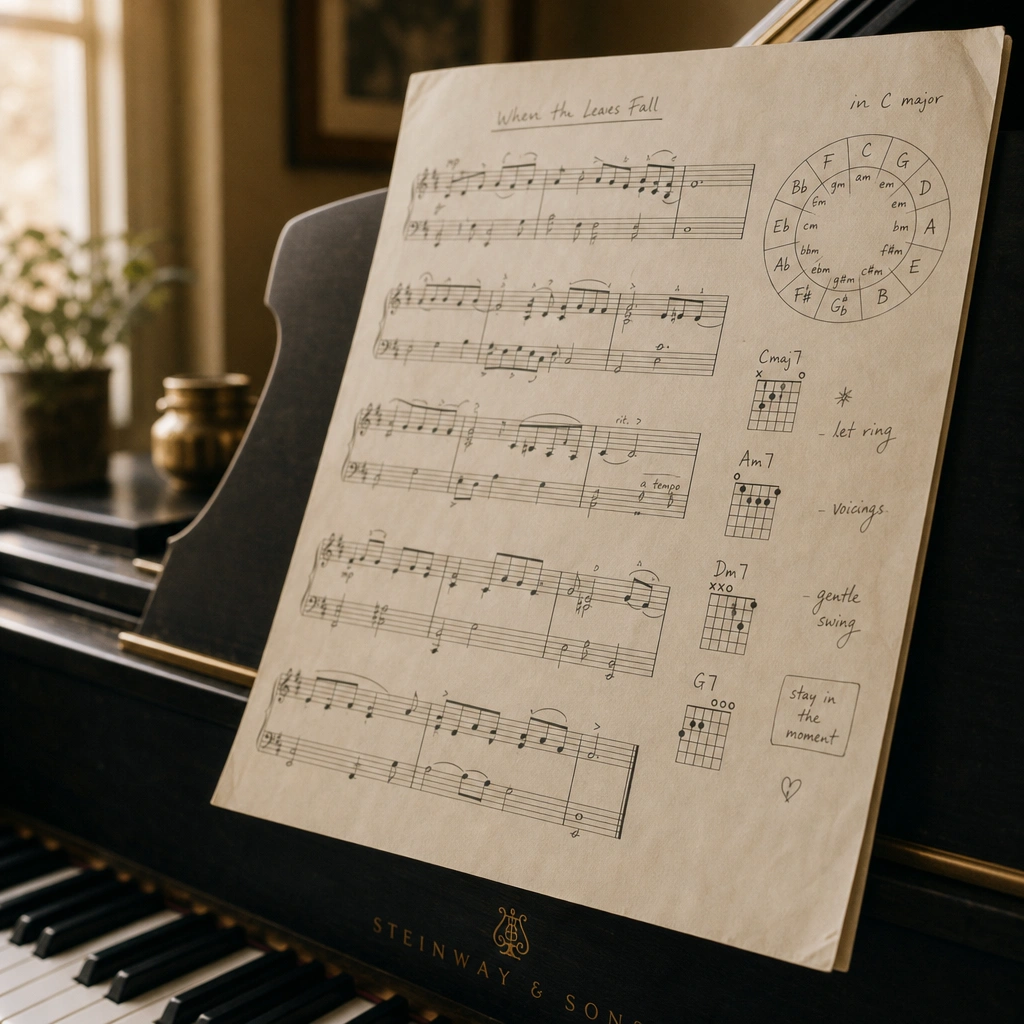
How do I actually read the chart?
Reading the circle of fifths chart means starting at the top with C major and tracking clockwise or counter-clockwise to find any key’s signature and its closest relatives. The keys right next to each other on the circle share almost all the same notes, which is exactly why they sound related.
Here’s how I walk a student through it the first time:
- Find C at the top – no sharps, no flats, the reference point
- Move one step clockwise to G – that’s one sharp (F♯)
- Each additional clockwise step adds the next sharp in order: F♯, C♯, G♯, D♯, A♯
- Move counter-clockwise from C to F – one flat (B♭)
- Each additional counter-clockwise step adds the next flat: B♭, E♭, A♭, D♭, G♭
- Notice neighboring keys differ by only one note – that’s the whole trick
Most students I’ve taught get the clockwise sharp order memorized within two or three practice sessions once they see the pattern repeats in a fixed sequence (F♯-C♯-G♯-D♯-A♯-E♯-B♯) every single time.
How does it help with key signatures?
The circle of fifths helps with key signatures by showing exactly how many sharps or flats a key has and in what order they appear, removing the need to memorize twelve separate signatures from scratch. Once you know the pattern, you can derive any key signature on the spot.
A common mistake I see: students memorize “D major has two sharps” as an isolated fact, then forget it a month later because it was never connected to anything. On the circle, D is simply two steps clockwise from C – which also tells you those two sharps are F♯ and C♯, because that’s the fixed order sharps always appear in.
This matters for sight-reading because recognizing a key signature instantly – rather than counting sharps one by one on the staff – is what lets you read ahead instead of decoding note by note, something I cover in more depth around counting rhythm on piano as well, since both skills rely on pattern recognition over memorization.
If key signatures and chord patterns still feel like guesswork at the keyboard, a second pair of ears can save you months of confusion. Your first 30-minute lesson with Austin is free – no card, no pressure.
How does it help with chords and songwriting?
The circle of fifths helps with chords because the three keys immediately around any given key on the circle – its neighbors and the key directly across – tend to form the most common chord progressions in popular music. That’s why so many songs share the same basic chord shapes transposed into different keys.
Take the classic I-IV-V progression (think thousands of pop, blues, and folk songs). In the key of C, that’s C, F, and G – and on the circle, F and G sit directly on either side of C. This isn’t a coincidence; those three chords are harmonically the closest relatives C has, which is exactly why they sound so natural together. This same logic underlies the 12-bar blues progression, which leans on those same I-IV-V relationships.
It also explains relative minors – the minor key sharing a key signature with a major key sits just inside the circle from its major partner (A minor shares no sharps or flats with C major, for example).
“I started as a complete beginner, and Austin made the learning process feel comfortable.” – Noah Peterson
If you’re working toward learning a specific song rather than general theory, that’s where a custom approach matters more than a chart – at Weaver Music the song can be arranged at the student’s level and made harder as they improve.
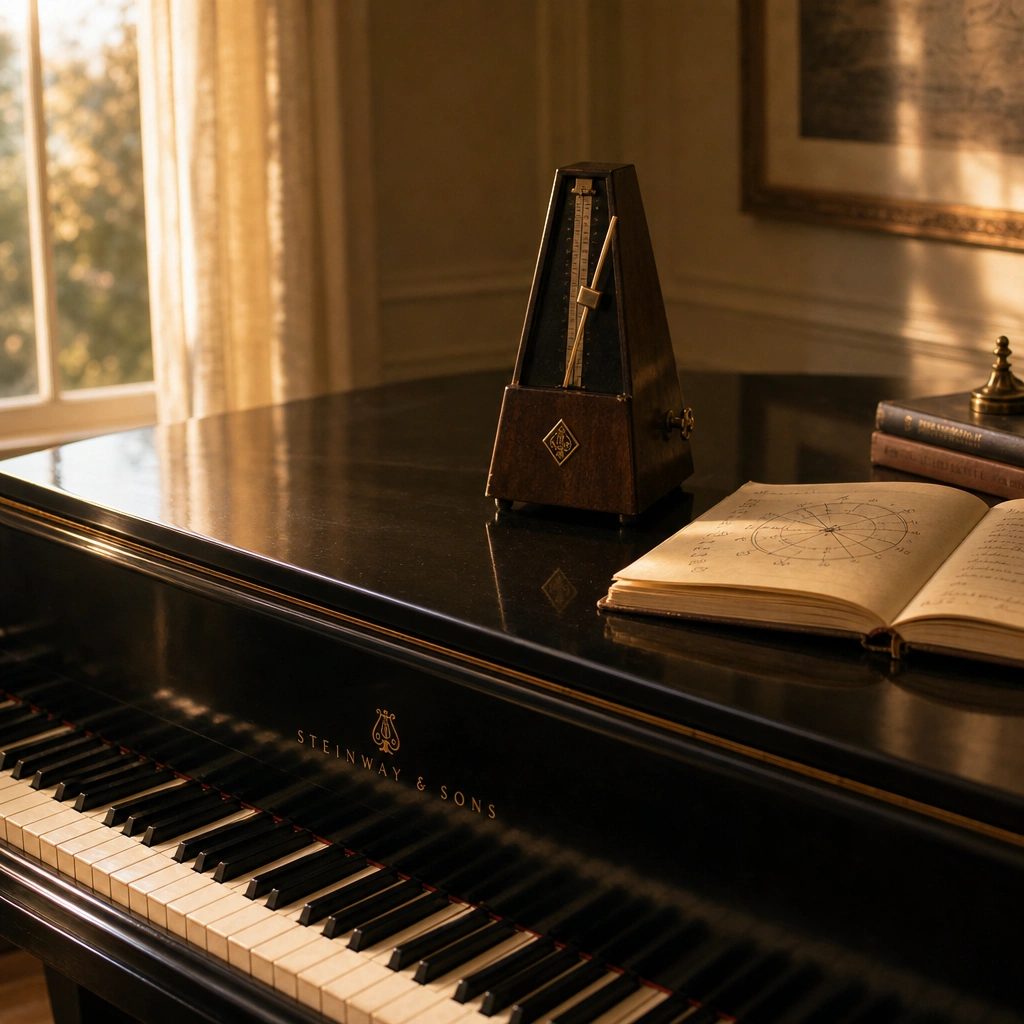
What’s a good way to practice it?
A good way to practice the circle of fifths is to draw it from memory a few times a week, then apply it directly at the keyboard by naming the key signature and the I-IV-V chords for each key as you go around. Passive memorization doesn’t stick; active recall and physical practice do.
- Spend 5 minutes drawing the blank circle and filling in sharps/flats from memory
- Play the I, IV, and V chords in every major key, moving clockwise around the circle
- Say the key signature out loud before you play a new piece in that key
- Practice relative minors alongside their major partners
- Use a metronome and keep the pace slow – accuracy first, speed later
One student, Mia, practiced this for about ten minutes a day for three weeks and went from needing 20-30 seconds to identify a key signature to doing it almost instantly. That speed shows up directly in sight-reading and in how fast she learns new pieces now. If tension creeps in while you’re drilling chord shapes quickly, it’s worth checking your setup against our notes on avoiding piano hand tension.

As of 2026, this is still taught the same way it has been for decades – the circle of fifths is a settled piece of music theory, not a trend, so there’s no newer “better” version to worry about missing.
Common questions
Do I need to understand the circle of fifths before I can play songs?
No. Plenty of beginners play simple songs for months before ever seeing the circle of fifths. It becomes genuinely useful once you’re reading key signatures regularly and want to understand chords instead of just memorizing finger positions.
Is the circle of fifths the same as the circle of fourths?
They’re the same diagram read in opposite directions. Moving clockwise traces fifths (C to G to D); moving counter-clockwise traces fourths (C to F to B♭). Most teachers just call it the circle of fifths regardless of which direction you’re reading.
Why do some keys have both a sharp and flat name, like F♯ and G♭?
These are enharmonic keys – they sound identical on the piano but are written differently depending on the musical context. They sit at the bottom of the circle, where the sharp side and flat side meet and overlap.
Can the circle of fifths help with improvising?
Yes. Knowing which chords are harmonically closest to your key makes it much easier to guess what will sound good before you try it, rather than hunting for notes by trial and error. It’s one of the building blocks behind confident improvising.
How long does it take to actually learn the circle of fifths?
Most students I teach can recall the basic sharp and flat order within two or three short practice sessions, roughly a week. Applying it fluently at the keyboard – naming chords and key signatures instantly – usually takes a few more weeks of regular practice.
Do I need a teacher to learn this, or can I just study a chart?
A chart alone can teach you the pattern, but a teacher helps you apply it at the keyboard immediately and catches gaps before they become habits. That hands-on correction is often what makes the difference between memorizing a diagram and actually using it.
Curious how this fits into a bigger learning plan? Our overview of what piano lessons typically include walks through where theory topics like this show up alongside technique and repertoire.
Ready to find out for yourself?
Your first 30-minute lesson with me is completely free – we will evaluate where you are, talk through your goals, and map out your path.
