
The short answer
To count rhythm on piano, assign each note a number based on how many beats it lasts, then speak those numbers aloud in a steady pulse while you play – “1” for a quarter note, “1-and” for two eighth notes, “1-2-3-4” for a whole note. Counting out loud, slowly, is what actually builds the skill.
I ask nearly every new student to book a free 30-minute trial lesson before we touch repertoire, because rhythm problems are almost always easier to fix early than after six weeks of guessing. In that first session I can hear in about two minutes whether a student is counting internally or just copying a recording.
Why does counting rhythm matter if I can already hear the beat?
Counting rhythm matters because hearing a beat and reproducing it accurately on your own are two different skills, and sheet music gives you no sound at all – only symbols. Without a counting system, you’re guessing durations by feel, and feel drifts the moment a piece gets unfamiliar or fast.
I see this constantly with students who learned a song by watching a YouTube tutorial. They can play it, but the moment I cover the keyboard and ask them to clap the rhythm from the sheet music alone, they freeze. That’s the tell. Counting is the bridge between the page and your hands, and it’s the one skill that transfers to every new piece you’ll ever learn, not just the one you memorized.
It’s also the fastest way to catch your own mistakes before a teacher does. If you count “1-2-3” in a measure that should hold four beats, you’ll feel the gap yourself.
What do the counting numbers actually mean for each note value?
Each note value in standard notation gets a fixed number of counts in 4/4 time: a whole note gets four counts, a half note gets two, a quarter note gets one, and an eighth note gets half a count, usually spoken as “and.” These values hold true regardless of tempo, which is exactly why counting works at any speed.
Here’s the breakdown most method books use, and the one I teach from day one:
- Whole note: “1-2-3-4” – held for all four beats of the measure
- Half note: “1-2” – held for two beats
- Quarter note: “1” – one full beat
- Eighth note: “1-and” – half a beat each, two per quarter note
- Sixteenth note: “1-e-and-a” – four per quarter note, a count most students meet in their second year
- Dotted quarter note: one and a half beats, usually counted “1-and-2” when paired with an eighth note
Rests follow the exact same math – a quarter rest silently takes up one count, a half rest takes up two. Students often forget to count rests at all, which throws off everything that follows in the measure.
How do you count aloud while playing a piece?
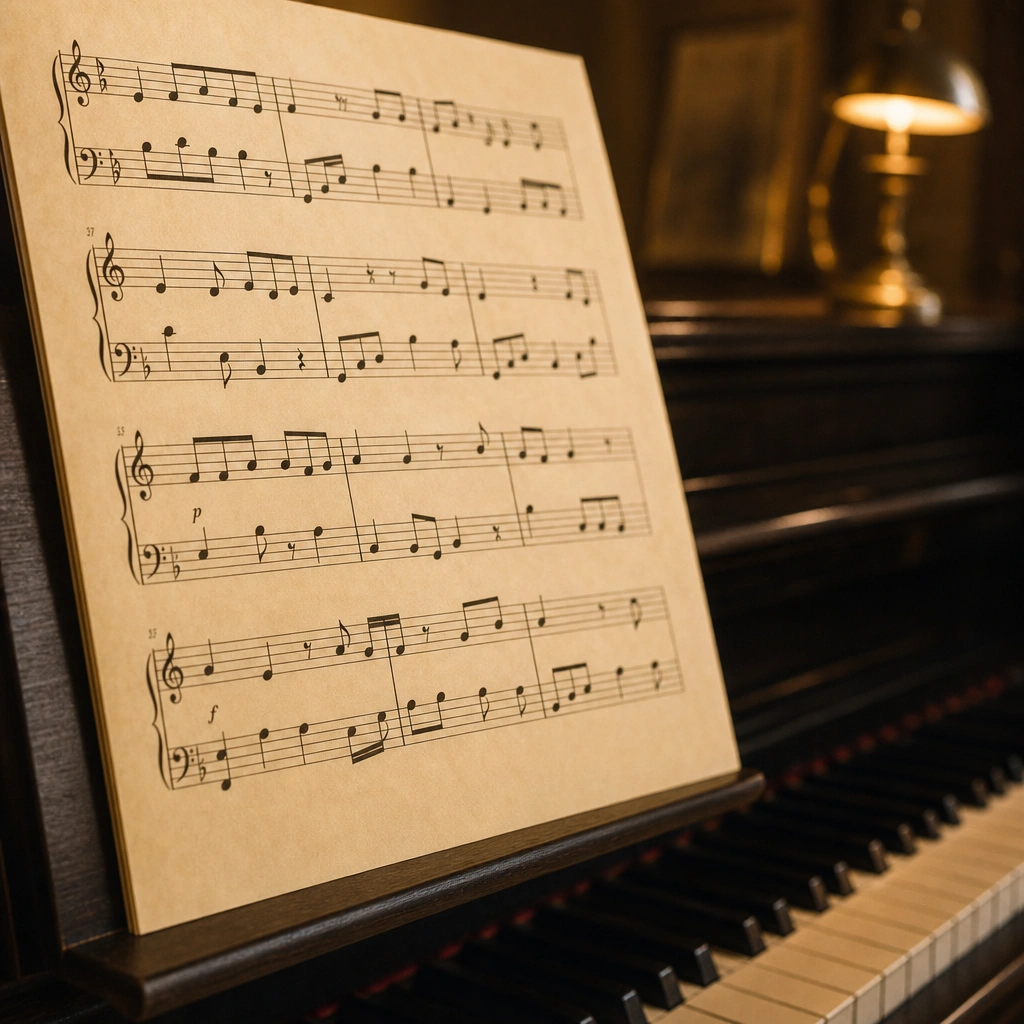
You count aloud by speaking the beat numbers in a steady, unchanging tempo while your hands execute the notes, treating the spoken counts as the “clock” your fingers follow rather than the other way around. This feels awkward for the first week or two and then becomes automatic.
Here’s the process I walk students through:
- Clap or tap the rhythm on your lap first, speaking the counts, with no piano involved.
- Play just the right hand, counting aloud, very slowly – half your eventual tempo is fine.
- Add the left hand separately, counting aloud again.
- Combine both hands, still counting aloud, still slow.
- Only increase speed once you can count and play the full phrase three times in a row without stopping.
I had an adult student last year who insisted she “just needed more practice” on a piece she’d been stuck on for a month. We went back to clapping and counting without the piano, and the actual problem surfaced in ninety seconds – she was rushing every dotted quarter note. Counting aloud doesn’t just teach rhythm; it diagnoses exactly where things break down.
If you’re working on a specific song and want help building a count-along plan around it, that’s exactly the kind of thing we cover in lessons built around a song you want to learn.
If counting rhythm out loud feels clumsy right now, that’s completely normal – a teacher listening live can usually spot the exact beat where things go sideways. Your first 30-minute lesson with Austin is free – no card, no pressure.
What mistakes do beginners make when counting rhythm?
The most common rhythm mistake beginners make is counting only when the music feels hard and going silent during the easy parts, which causes the tempo to speed up without the student noticing. Consistency matters more than difficulty when it comes to counting.
Other patterns I see repeatedly:
- Skipping rests entirely – playing the next note early because the silence “felt long enough”
- Counting in your head instead of out loud – this hides the exact moment where tempo drifts
- Rushing eighth notes – squeezing “1-and” into something closer to “1-uh,” especially when nervous
- Ignoring the time signature – trying to count four beats in a measure of 3/4 music
- Stopping to fix a wrong note mid-rhythm – which trains your hands to associate mistakes with silence instead of keeping time
One of my long-time students, a 10-year-old who’s since become one of my most consistent practicers, used to stop dead every time she hit a wrong note, which meant she never actually practiced the rhythm as written – she practiced “rhythm with pauses.” Once we worked on playing through wrong notes and fixing them on repeat, her timing improved almost immediately, within two or three weeks.
How does a metronome help with counting rhythm?
A metronome helps by providing an external, unbiased pulse that exposes exactly where your internal counting speeds up or slows down, something your own counting can’t catch because you unconsciously adjust to your own mistakes. Most method books recommend starting 20-30% slower than the printed tempo marking.
A few practical tips from lessons:
- Set the metronome to click on beat 1 only at first if subdivisions overwhelm you, then move to clicking every beat.
- Practice clapping with the metronome before adding the instrument – it isolates the rhythm problem from the note-reading problem.
- If you can’t stay with the metronome at a given tempo, the tempo is too fast for where you are today, not a sign you’re bad at rhythm.
- A simple phone metronome app works fine; you don’t need anything expensive.
Rhythm itself is a well-documented element of music cognition – Wikipedia’s overview of rhythm is a solid plain-language starting point if you want the theory side of why humans perceive beat and subdivision the way we do.
What is a good way to practice counting rhythm at home?
A reliable home practice method is to isolate rhythm from notes completely: clap or tap the rhythm on a flat surface while counting aloud, repeat it until it’s automatic, and only then transfer it to the keyboard. This separates two skills that beginners often try to learn simultaneously, which is harder than it needs to be.
A simple 10-minute daily routine:
- Pick one line of a current piece – no more than four measures.
- Clap and count it five times in a row, correctly, before touching the keys.
- Play it hands separately with a metronome at a slow, comfortable tempo.
- Combine hands at the same slow tempo.
- Raise the metronome by 5-10 bpm only after three clean repetitions.
This is slower in the short term and dramatically faster in the long term – students who count rhythm deliberately from the start typically read new pieces with correct timing on the first attempt within a few months, instead of needing weeks of trial and error on every new song.
As one of my students put it:
“I started as a complete beginner, and Austin made the learning process feel comfortable.” – Noah Peterson
Rhythm is one of those areas where a live teacher catches things recordings and apps miss – something we talk more about in our guide to how Zoom piano lessons actually work. Lessons at Weaver Music are live, one-on-one, and run $60 for 30 minutes, $80 for 45 minutes, or $99 for a full hour, with everyone starting on a free 30-minute trial first.
Common questions
Do I need to know how to read sheet music before I can count rhythm?
No – you can learn to count rhythm by clapping patterns a teacher writes out or demonstrates, entirely by ear, before ever reading notation. That said, counting becomes far more useful once you’re reading music, since it tells you exactly how long each symbol on the page should last.
What’s the difference between counting beats and counting measures?
Counting beats tracks the pulse within a single measure, like “1-2-3-4” in 4/4 time, while counting measures tracks how many full measures have passed, which helps musicians stay in sync in ensembles or with a conductor. Beginners mainly need beat counting.
Can I count rhythm using a different system, like “ta” and “ti-ti”?
Yes – systems like Kodály’s “ta” for a quarter note and “ti-ti” for two eighth notes work well, especially for younger children who find syllables easier than numbers. Either system builds the same underlying skill; consistency matters more than which one you pick.
How long does it take to get comfortable counting rhythm?
Most beginners feel reasonably comfortable with basic counting – quarter, half, and whole notes – within 3-4 weeks of consistent practice at 15-20 minutes a day. Eighth notes and syncopation typically take a few more months to feel natural.
Should I count out loud even as an advancing player?
Yes, especially when learning anything rhythmically unfamiliar, like a new time signature or a piece with syncopation. Professional musicians still count aloud or subdivide mentally when sight-reading tricky passages – it never stops being useful, it just becomes faster and quieter.
What if I keep losing the beat when both hands play different rhythms?
This is one of the most common intermediate hurdles, and it’s solved by practicing each hand’s rhythm separately against a metronome before combining them, then combining at a much slower tempo than either hand alone. Rushing this step is the number one cause of persistent two-hand rhythm trouble.
Ready to find out for yourself?
Your first 30-minute lesson with me is completely free – we will evaluate where you are, talk through your goals, and map out your path.
Ready to find out for yourself?
Your first 30-minute lesson with me is completely free – we will evaluate where you are, talk through your goals, and map out your path.
