
The short answer
Piano lessons typically include one-on-one instruction time, a personalized practice plan, technique and reading work, real-time feedback, and progress notes – but rarely the books themselves. At Weaver Music, a standard lesson covers technique, reading, theory, and repertoire for $60 (30 min), $80 (45 min), or $99 (60 min), with books as the only add-on cost.
That’s the baseline every reputable teacher should offer. But “what’s included” varies a lot from studio to studio, and it’s worth knowing exactly what you’re paying for before you commit to anything. If you want to see it firsthand rather than take my word for it, every new student starts with a free 30-minute trial lesson – a skill check, your questions answered, and a plan with a book list, no card required.
What’s actually in a standard lesson?
A standard piano lesson includes live, one-on-one instruction covering four core areas: technique (hand position, posture, finger independence), reading (note names, rhythm, sight-reading), theory (scales, chords, key signatures), and repertoire (the actual pieces you’re learning). Nothing about that structure is optional – skip one and progress stalls.
I structure every lesson around those four pillars because I’ve watched what happens when a student only gets one or two of them. A kid who only ever plays songs by rote, without theory, hits a wall around grade 2-3 level because they can’t figure out a new piece without someone showing them note by note. A student who drills scales and reading but never gets repertoire loses motivation fast – nobody sticks with piano to play exercises.
- Technique: posture, hand shape, finger numbering, basic exercises
- Reading: staff notation, rhythm counting, sight-reading practice
- Theory: scales, intervals, chords, key signatures explained in plain language
- Repertoire: the songs and pieces you actually want to play
At Weaver Music, all of this happens live over Zoom. Lessons are one-on-one – no group format, no shared attention. You can read more about how the Zoom lesson format works if you’re weighing online versus in-person.
Do lessons include books or sheet music?
Books and sheet music are almost never included in the lesson price itself – most teachers, myself included, treat them as a separate, one-time purchase you make as needed. At Weaver Music, the free trial lesson ends with a specific book list matched to your level, and books remain the only extra cost beyond the lesson fee.
This surprises some parents who assume “lessons” means an all-inclusive package. It rarely does, and for good reason – book needs change constantly. A beginner might need one method book for six months. A student working through a Bach invention needs a completely different edition than one learning a pop arrangement. Bundling book costs into a flat lesson fee would either overcharge people who need less or undercharge those who need more.
What should be included, and what I always provide, is guidance on exactly which book to buy and why – not a vague “get any beginner book” but a specific title, edition, and where to find it cheaply.
Can lessons be built around a song I want to learn?
Yes. Lessons cover the full curriculum – technique, reading, theory, and repertoire chosen to build skill progressively – and that repertoire can include a specific song the student wants.
This comes up constantly: a student – often an adult, sometimes a teenager – comes in wanting to play one song. Maybe it’s a wedding piece, a favorite artist’s single, or a song from a show they love. If sheet music exists, great. If it doesn’t (this happens constantly with newer pop releases or obscure film scores), I work it out by ear and simplify it to their actual skill level, then make it harder as they improve.
If you’re starting because of one specific song, my guide to lessons for learning a specific song goes deeper on how that process works.
If you’re not sure where to start, the trial lesson is the easiest way to find out. Your first 30-minute lesson with Austin is free – no card, no pressure.
Do I get anything between lessons?
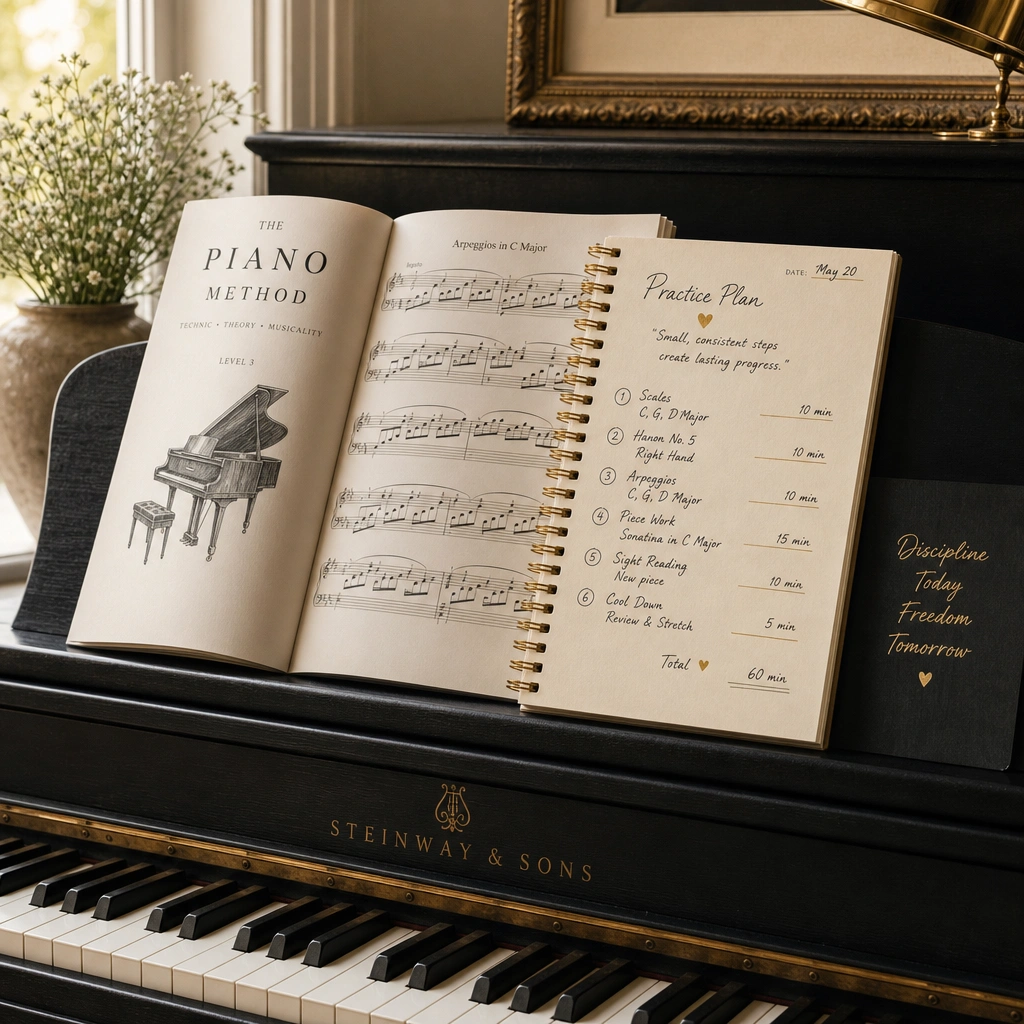
Between lessons, students should receive a clear practice plan – specific, written instructions on what to work on, not a vague “practice more.” At Weaver Music, every lesson ends with notes on exactly what to practice, how much, and how to know it’s going well, plus access to a four-level video course library for extra reinforcement.
I learned to be specific here the hard way. Early on I’d tell a student “work on measures 9 through 16,” and they’d come back the next week having practiced it wrong the whole time – same mistake, seven days of repetition. Now I write down tempo targets, hand-separate instructions, and what a “good” run sounds like, so there’s no ambiguity sitting at the piano alone.
“Austin explains everything clearly and makes online piano lessons easy to follow.” – Emily Carter
For families managing multiple kids’ schedules, or homeschool families building music into a broader curriculum, this kind of structured takeaway matters more than usual. If that’s you, the homeschool piano lessons page covers how lesson content fits into a school day.
Are there hidden fees or extra costs?
Reputable piano lessons should have no hidden fees beyond the stated lesson price and the cost of books. At Weaver Music, that’s the whole list – $60 to $99 for a lesson depending on length, and books, which typically run $10-25 each and last months.
Watch for these common extra charges at other studios, which Weaver Music does not use:
- Registration or enrollment fees charged before your first lesson
- Recital fees tacked on separately from tuition
- Cancellation penalties for reasonable notice
- Equipment rental fees for shared studio pianos
A student’s parent once told me she’d been paying a $150 “materials fee” annually at her son’s old studio on top of tuition, with no itemized explanation of what it covered. That’s the kind of thing worth asking about directly before enrolling anywhere – not just here.
According to research summarized by the Wikipedia entry on music education, structured, consistent instruction correlates strongly with skill retention – which is part of why a clear, predictable lesson structure (not a rotating cast of extras and fees) tends to produce better long-term outcomes than piecemeal instruction.
Common questions
Do I need to buy a piano before starting lessons?
No. You can start lessons on any keyboard with weighted or semi-weighted keys and at least 61 keys, ideally 76-88. Many students begin on what they already own and upgrade later once they know they’ll stick with it. Austin covers keyboard options honestly during the free trial lesson.
Can I switch between 30, 45, and 60-minute lessons?
Yes. Lesson length isn’t locked in – a younger beginner might start at 30 minutes and move to 45 as their attention span and repertoire grow, while an adult juggling a busy week might shorten temporarily. Pricing simply adjusts to whichever length you book that week.
Is the trial lesson really free with no obligation?
Yes. The 30-minute trial lesson includes a skill check, answers to your questions, and a personalized plan with a book list – no credit card is required to book it, and there’s no obligation to continue afterward.
Do lessons include recital or performance opportunities?
Performance opportunities depend on the student’s goals rather than being automatically bundled into every lesson package. Some students specifically prepare a piece for a family gathering or school event; others prefer to focus purely on skill-building without a performance deadline. This gets discussed during the trial and adjusted over time.
What if I already know how to read music – do lessons still include theory?
Yes, theory is still part of the curriculum, but the pace and depth adjust to what you already know. A student who reads well but has never studied chord theory or key signatures still benefits from that layer – it’s what separates playing by rote from actually understanding the music.
Are lessons different for kids versus adults?
The four core areas – technique, reading, theory, repertoire – stay the same, but pacing, repertoire choice, and communication style shift a lot. A 7-year-old needs shorter drills and more variety; an adult beginner often wants to understand the “why” behind an exercise before doing it. Both get one-on-one, personalized attention either way.
Whatever your starting point, the clearest way to know what a lesson actually includes is to sit in one. If you’re weighing formats entirely, the private vs. group lessons comparison is worth a read too.
Ready to find out for yourself?
Your first 30-minute lesson with me is completely free – we will evaluate where you are, talk through your goals, and map out your path.
