
The short answer
Italian tempo markings are words printed at the start of a piece of piano music that tell you how fast or slow to play, ranging from Largo (very slow, around 40-60 beats per minute) to Presto (very fast, around 168-200 beats per minute). Composers settled on Italian terms in the 1600s, and the tradition stuck worldwide. If you want a teacher to walk you through reading them in real time, Austin offers a free 30-minute trial lesson where tempo and rhythm basics are usually the first thing covered.
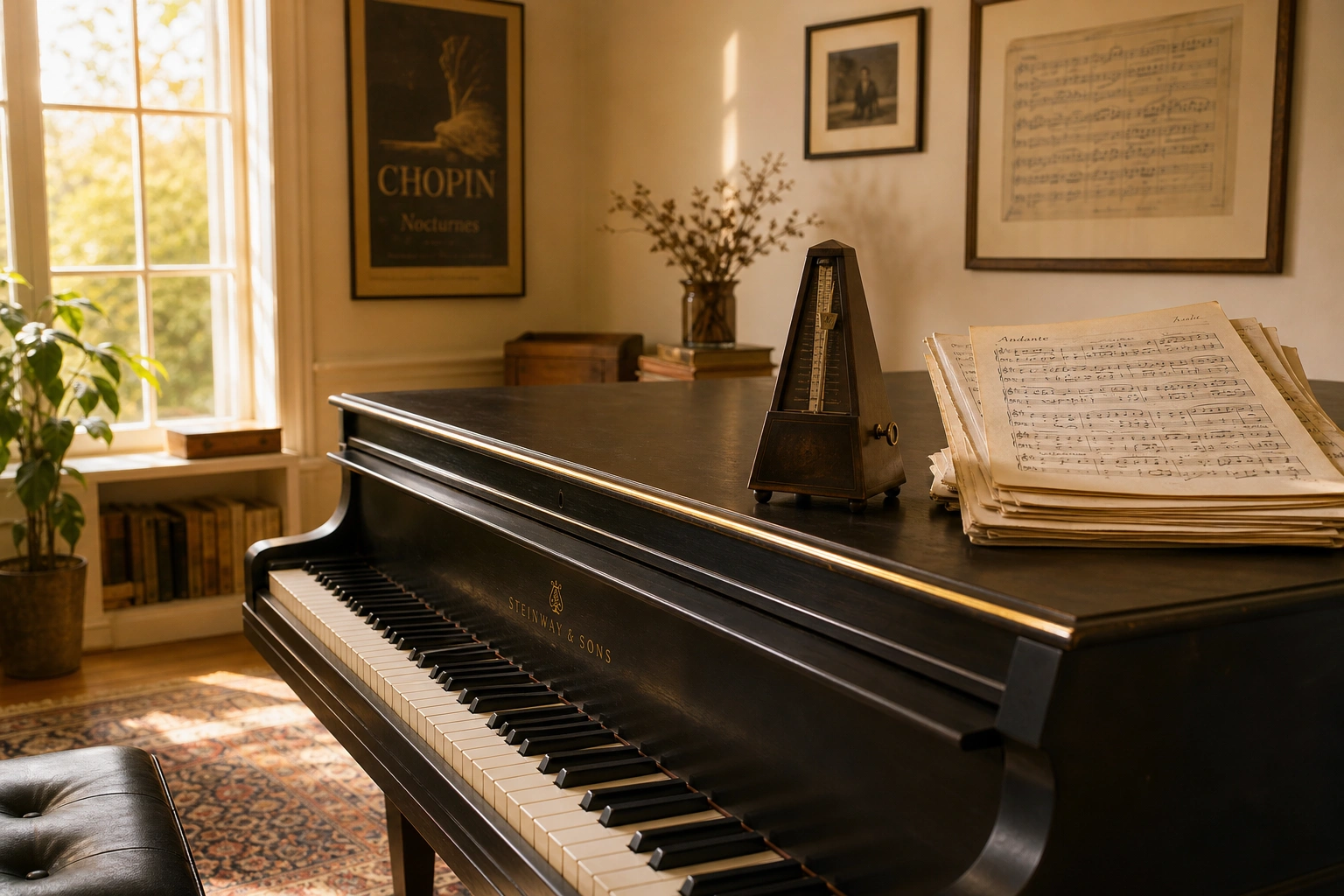
I still remember a student, a retired engineer named Gary, who brought in a Chopin nocturne marked “Andante” and played it so slowly it nearly stopped moving. He had assumed slower always meant more expressive. Once he understood Andante actually means “at a walking pace,” the piece came alive. That mix-up is incredibly common, and it’s exactly why these terms deserve a plain explanation instead of a vague feeling.
Why are tempo markings written in Italian instead of English?
Italian tempo markings exist because Italy led the development of modern music notation during the Baroque era, and composers across Europe adopted Italian terms as a shared musical vocabulary. By the 1600s and 1700s, Italian was simply the professional language of music, the same way English is the professional language of aviation today.
Even composers who didn’t speak Italian kept using Italian terms because musicians everywhere already understood them. This became a practical standard rather than a stylistic choice. A German, French, or English composer in 1750 wrote “Allegro” at the top of a score knowing that a performer in Vienna, Paris, or London would read it the same way.
That convention has barely changed. Walk into any conservatory in 2026 and you’ll still see Italian tempo markings on nearly everything from Bach to contemporary film scores, though some modern composers now write tempo instructions in their own language alongside a metronome number for extra clarity.
What are the most common Italian tempo markings and what do they mean?
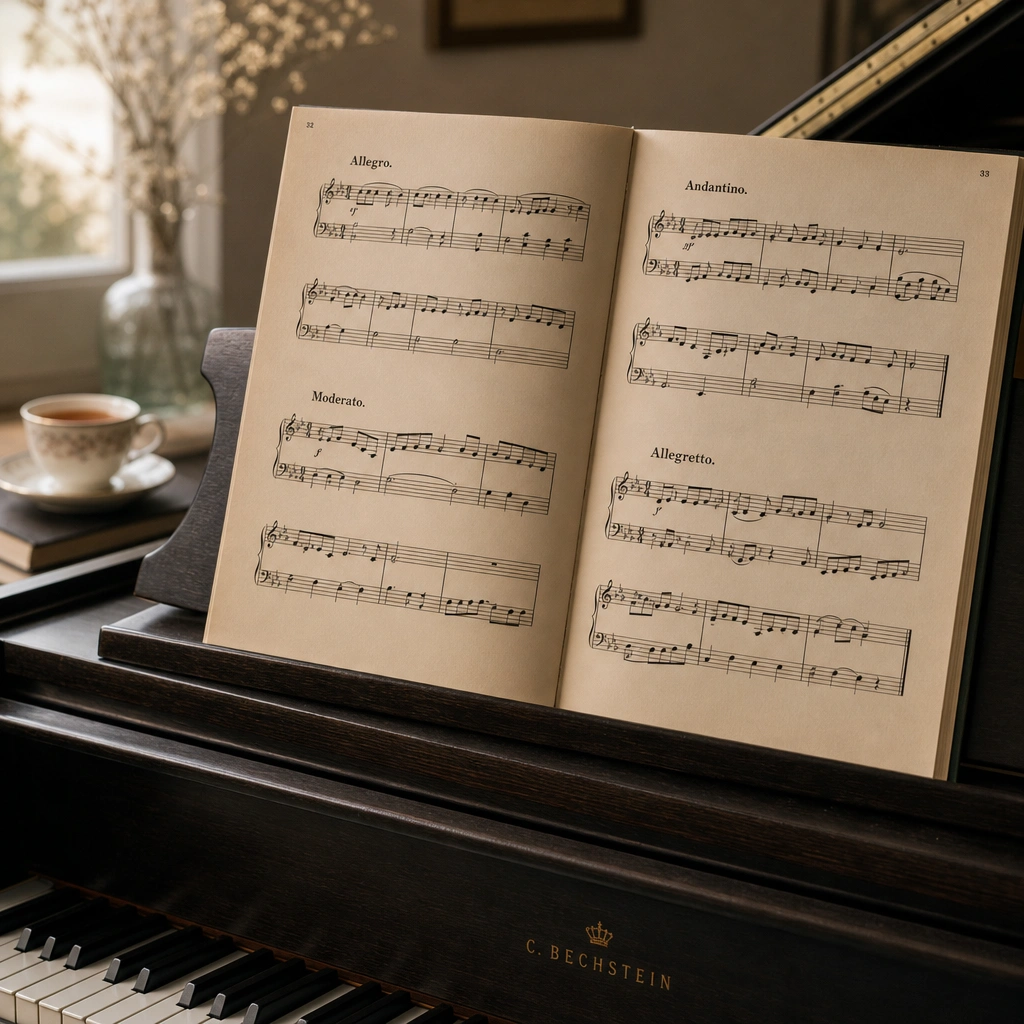
The most common Italian tempo markings, from slowest to fastest, are Largo, Adagio, Andante, Moderato, Allegro, Vivace, and Presto, each describing a general speed and feel rather than an exact number. Beginner method books usually introduce these in roughly this order as pieces get more advanced.
- Largo – very slow and broad, often used for solemn or spacious pieces
- Adagio – slow and leisurely, literally “at ease”
- Andante – at a walking pace, unhurried but moving forward
- Moderato – moderate speed, neither slow nor fast
- Allegro – fast, lively, and bright
- Vivace – lively and brisk, faster and more energetic than Allegro
- Presto – very fast
Most beginner and early-intermediate repertoire sticks to Andante, Moderato, and Allegro. I rarely see true Presto markings until a student is several years in, simply because the physical coordination required to play that fast accurately takes time to build. That’s one more reason rushing tempo too early tends to cause more harm than good – it’s worth pairing this with solid rhythm counting habits before chasing speed.
What BPM number does each tempo marking actually correspond to?
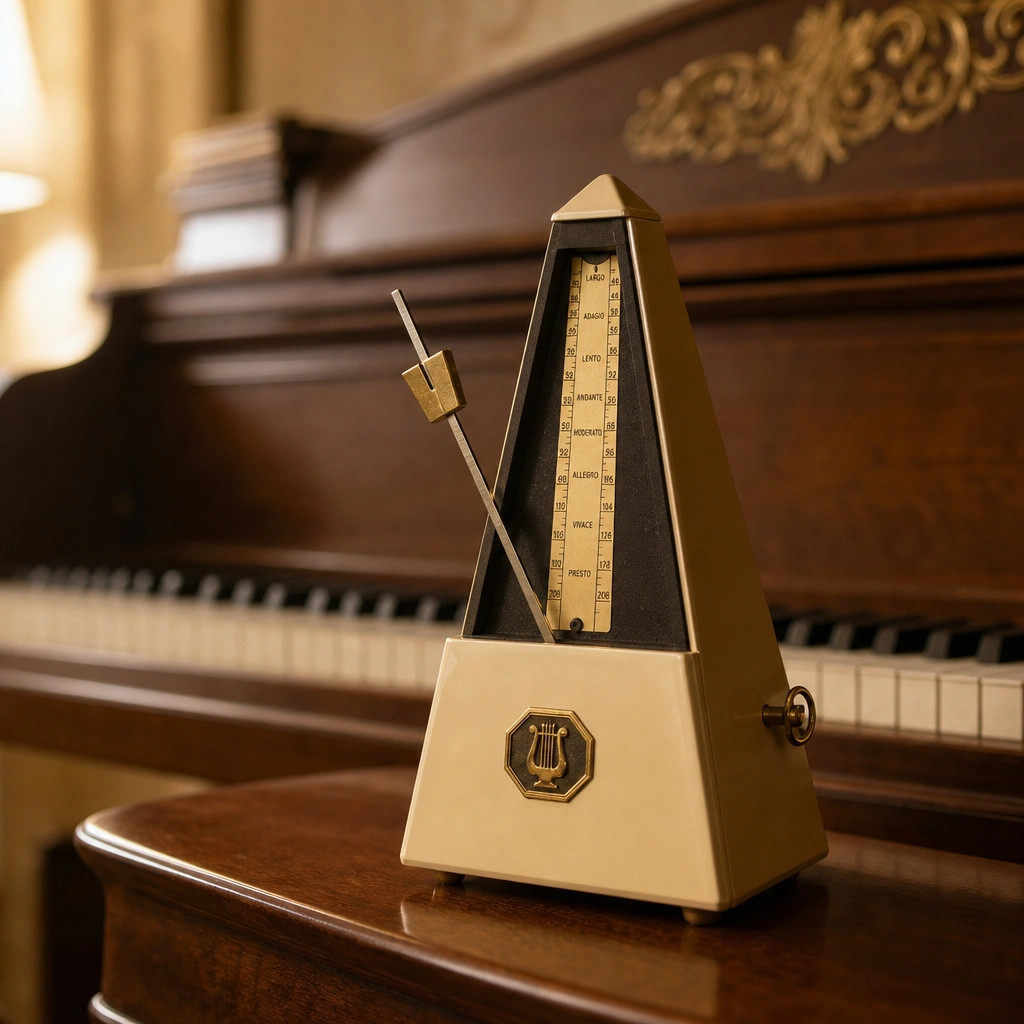
Each Italian tempo marking corresponds to a general range of beats per minute rather than one fixed number, because tempo markings describe a character as much as a speed. A metronome gives you the precise range; the marking gives you the feeling within it.
Here are the ranges I give students as a working reference:
- Largo: 40-60 BPM
- Adagio: 66-76 BPM
- Andante: 76-108 BPM
- Moderato: 108-120 BPM
- Allegro: 120-156 BPM
- Vivace: 156-176 BPM
- Presto: 168-200 BPM
Notice the overlap between Allegro and Vivace, and between Vivace and Presto – these aren’t strict boundaries. Two professional recordings of the same “Allegro” piece can differ by 20 BPM and both be perfectly valid interpretations. This is one area where real notation can feel looser than people expect; for more on how notation itself is structured, Wikipedia’s overview of tempo is a solid plain-language reference.
If reading tempo markings and counting rhythm still feels like guesswork on your own sheet music, a second set of ears helps more than another app. Your first 30-minute lesson with Austin is free – no card, no pressure.
What do words like “poco,” “molto,” and “non troppo” add to a tempo marking?
Modifier words attached to Italian tempo markings fine-tune the speed or mood without changing the core instruction, the way “slightly” or “very” modifies an English adjective. “Allegro ma non troppo” means fast, but not too fast – a direct caution against overdoing it.
Common modifiers you’ll run into:
- Poco – a little (poco allegro = a little fast)
- Molto – very (molto adagio = very slow)
- Non troppo – not too much
- Assai – very, extremely
- Meno – less (meno mosso = less motion)
- Più – more (più mosso = more motion)
You’ll also see tempo change markings mid-piece, like ritardando (gradually slowing) or accelerando (gradually speeding up). These aren’t fixed tempos at all – they’re instructions to move away from the current tempo smoothly. I tell students to think of these as a dimmer switch rather than an on/off switch; the change should feel gradual, not sudden. A student of mine, a teenager named Priya, used to hit a ritardando and slam the brakes all at once. We fixed it by having her silently count the gradual slowdown over four full beats before playing it, and it instantly sounded more musical.
How can a beginner actually memorize these terms?
Beginners memorize Italian tempo markings fastest by sorting them into three simple speed groups first – slow, medium, fast – before worrying about exact BPM numbers or rare terms. Trying to memorize all seven-plus markings with precise ranges on day one usually backfires.
A few things that genuinely help:
- Group terms by speed category before learning exact BPM numbers
- Say the word out loud every time you see it in your music, not just read it silently
- Set a metronome to the marked tempo and physically feel the difference between Andante and Allegro
- Keep a small running list in your practice notebook of every new term you encounter
- Connect each term to a piece you already know well, as an anchor
This pairs naturally with learning to count rhythm accurately and getting comfortable with a metronome, since tempo markings are meaningless without a steady internal pulse to measure them against. It also connects to broader reading fluency – once you’re comfortable with tempo words, the rest of early music reading tends to click faster too.
“Austin explains everything clearly and makes online piano lessons easy to follow.” – Emily Carter
At Weaver Music, these terms come up naturally within the first few weeks of the curriculum, folded into real repertoire rather than taught as a vocabulary list to memorize in isolation. Lessons run live, one-on-one, over Zoom, anywhere in the world. A 60-minute Standard lesson is $99 ($60 for 30 minutes, $80 for 45 minutes), and every new student starts with a free 30-minute trial lesson including a skill check and a plan with a book list.
Common questions
Is Moderato faster or slower than Andante?
Moderato is faster than Andante. Andante sits around 76-108 BPM and feels like a relaxed walking pace, while Moderato runs about 108-120 BPM, a moderate, comfortable speed that’s quicker but still unhurried.
What does “Allegretto” mean compared to “Allegro”?
Allegretto means moderately fast, a notch slower and lighter than Allegro. Think of it as “a little bit Allegro” – cheerful and brisk but without the full energy or drive of a true Allegro marking.
Do all pianists play the same tempo marking at the exact same speed?
No. Tempo markings give a range and a character, not one fixed number, so interpretation varies. Two pianists can both play an authentic “Allegro” and differ by 15-20 BPM while still being musically correct.
Why do some pieces have a metronome number next to the Italian word?
Composers sometimes add a precise metronome marking, like “Allegro (quarter note = 132),” to remove ambiguity and specify an exact intended speed, especially in pieces from the 19th century onward when metronomes became widely available.
Are Italian tempo markings still used in modern sheet music?
Yes. As of 2026, Italian terms remain the standard across classical, film, and most printed sheet music worldwide, though many modern composers now pair them with an English description or exact BPM for extra clarity.
What’s the difference between a tempo marking and a dynamic marking?
A tempo marking tells you how fast to play, like Allegro or Adagio. A dynamic marking tells you how loud or soft to play, like forte or piano. They’re both written in Italian but control completely different aspects of the performance.
Ready to find out for yourself?
Your first 30-minute lesson with me is completely free – we will evaluate where you are, talk through your goals, and map out your path.
