
The short answer
Most beginners play a simple, recognizable two-hand song within 4 to 8 weekly lessons, assuming they practice 15-20 minutes most days. That’s roughly one to two months. A student who only practices during the lesson itself, with no practice at home, will take two to three times longer to get there.
I’ve taught hundreds of students at Weaver Music, from six-year-olds to retirees, and this timeline holds up remarkably well across ages. The variable isn’t talent – it’s consistency. If you want a clearer read on your own starting point, a free 30-minute trial lesson includes a skill check and a realistic plan, no card required.
What counts as a “real song”?
A “real song” means a complete piece with a melody and accompaniment played hands together, not just a five-finger warm-up or a single-line tune. Think “Ode to Joy,” a simplified “Für Elise” excerpt, or a pop song’s verse and chorus played with both hands moving independently.
This distinction matters because a lot of beginner method books have students playing something by the end of lesson one – but it’s usually a five-note right-hand-only exercise, not a song most people would recognize off the street. I tell parents this directly because it prevents disappointment.
- Week 1-2: single-hand melodies, basic rhythm reading
- Week 3-5: simple hands-together coordination, often a well-known tune
- Week 6-8: a full short song with both hands moving somewhat independently
By that eighth lesson, most of my students have at least one song they can play start to finish for family without stopping.
What changes the timeline the most?
Practice frequency changes the timeline more than any other factor, followed by song choice and prior musical experience. A student practicing 20 minutes daily will typically play a first song in half the lessons it takes someone practicing only once a week.
I saw this play out clearly with two students who started the same month a couple years back. Both were adult beginners, similar age, similar goals. One practiced most days for 15 minutes; the other practiced right before each weekly lesson, maybe twice a week total. The first was playing a full song by lesson five. The second took until lesson thirteen for something comparable.
Other factors that matter:
- Song complexity: a simple folk melody in 4/4 time is faster than anything with syncopation or big hand jumps
- Reading vs. ear-based learning: students who learn chords first sometimes get to “playing something” faster, though reading pays off longer-term
- Prior instrument experience: guitarists and singers often grasp rhythm faster; the coordination is still new
- Instrument at home: a properly weighted keyboard or piano makes technique transfer smoother – see our piano vs. keyboard guide if you haven’t bought one yet
A 2019 research summary from the field of music psychology backs up what I see in lessons: distributed short practice sessions beat infrequent long ones for motor skill retention, which is exactly what playing piano hands-together requires.
How many lessons do kids need versus adults?
Kids age 7-10 and adults reach a first playable song in a similar number of lessons, usually 6-10, but for different reasons: kids often need more repetition for reading skills while adults need more time unlearning tension and overthinking.
Younger kids, age 5-6, typically need a bit longer – often 10-14 lessons – because reading and hand independence are both brand new at once. That’s not a knock on ability; it’s just more skills stacking at once. I cover more of this age-specific nuance in what to look for in piano lessons for kids.
Adults bring a different challenge. They’re often more self-critical, which slows progress more than lack of coordination does. I’ve had adult students who could physically play a passage correctly on the third try but wouldn’t believe it was “good enough” until the tenth. Part of my job is simply telling them to move on.
Whether you’re six or sixty, the fastest path to your first real song starts with an honest look at where you’re starting from. Your first 30-minute lesson with Austin is free – no card, no pressure.
Can you learn a specific song you actually want to play?
Yes – learning a specific song from day one is possible with the right arrangement, but it usually takes longer than a method-book song chosen for its simplicity. A custom arrangement matched to your actual skill level closes that gap significantly.
At Weaver Music, lessons ($60 for 30 minutes, $80 for 45, $99 for 60) follow a structured curriculum of technique, reading, theory, and repertoire – great for building fundamentals fast. When a student has a specific song in mind, I simplify it to their level and make it harder as they improve.
I did this for a teenage student who wanted to play a Coldplay song in her third month of lessons – way outside a typical beginner songbook. I stripped the arrangement down to match her actual hand-independence level, and she played a recognizable version by lesson four of working on it. Nobody hands a true beginner the full sheet music version of a song they heard on the radio and expects it to go well.
Books are the only added cost. If your motivation hinges on a specific song rather than “a song,” working on that song from the start usually keeps you more engaged along the way.
“I started as a complete beginner, and Austin made the learning process feel comfortable.” – Noah Peterson
What actually happens in those first few lessons?
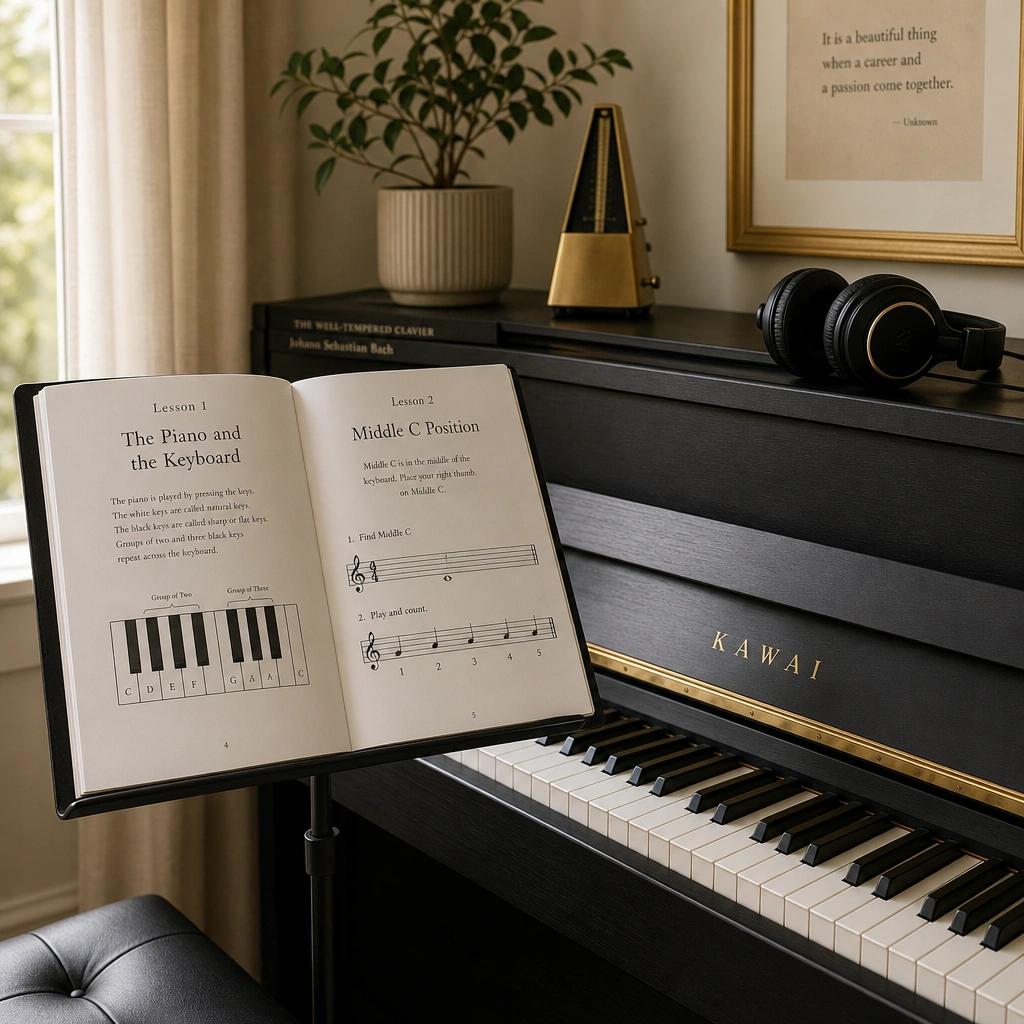
The first few piano lessons focus on posture, hand shape, basic rhythm reading, and one or two simple patterns played hand-over-hand or separately. Song-playing usually begins once a student can find notes without hunting and keep a steady beat.
Here’s roughly how I structure the first month for a total beginner:
- Lesson 1: posture, hand position, finding notes on the keys, first simple right-hand pattern
- Lesson 2-3: basic rhythm reading, left-hand patterns introduced separately
- Lesson 4-5: hands together on something small – often just four measures
- Lesson 6-8: a full short song, played start to finish
A metronome comes in early – not to rush anyone, but because rhythm mistakes are far more common than wrong-note mistakes at this stage. I also assign 10-15 minutes of daily practice from lesson one, since students who wait until they “know more” to start practicing consistently lose the most time. Our guide on practicing piano effectively covers exactly what that daily routine should look like.
One mistake I see constantly: students try to play a song at full speed before their hands know where to go. Slowing down to half-tempo for the first several run-throughs is the single biggest lever for getting a song “playable” sooner, and almost nobody wants to do it voluntarily.
Common questions
Is it normal to still make mistakes after learning a song?
Yes, it’s completely normal. Even advanced pianists make small mistakes in pieces they’ve played for years. What matters for a beginner is playing through without stopping, not playing it flawlessly – polish comes with repetition over weeks, not perfection on the first attempt.
Do I need to read sheet music to play a real song?
No, you can learn a song by ear, chord charts, or simplified notation without traditional sheet music, though reading tends to speed up long-term progress. Our guide on learning piano without reading music covers this path in detail.
What if I miss lessons or practice inconsistently for a few weeks?
Missing a week or two won’t undo your progress, but it does add time to your timeline – expect roughly the same delay in weeks as you missed in practice. Picking back up with short, low-pressure sessions gets momentum back faster than trying to “catch up” all at once.
Can a total beginner play a song by their very first lesson?
A total beginner can usually play a simple five-note melody with one hand by the end of lesson one, but a full two-hand song takes several more weeks. Some method books market “play a song today,” which is technically true but sets an overly narrow definition of “song.”
Does age affect how fast someone learns their first song?
Age affects the type of challenge more than the overall speed – young children often need extra time for reading skills, while adults sometimes slow themselves down through overthinking and self-criticism rather than any physical limitation.
Is it better to start with an easy song or the song I actually want to play?
Starting with an easy foundational song builds coordination and reading skills faster, but a custom-arranged version of a song you love keeps motivation high, which matters just as much for long-term progress as raw efficiency.
If you’re weighing how to structure lessons around a goal like this, our post on how long piano lessons should be is a useful companion read, especially for parents deciding between 30- and 45-minute formats.
Ready to find out for yourself?
Your first 30-minute lesson with me is completely free – we will evaluate where you are, talk through your goals, and map out your path.
