

The short answer
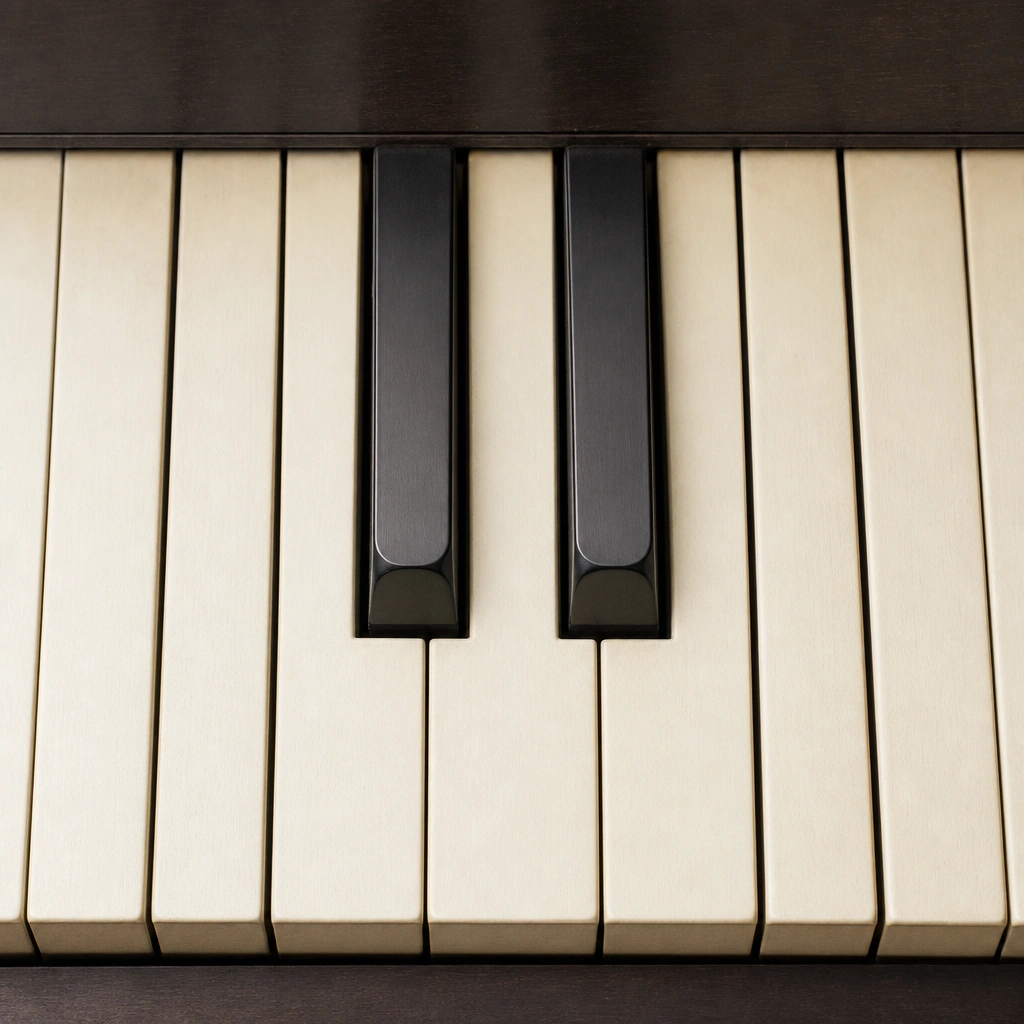
Middle C is the white key immediately to the left of a group of two black keys, located roughly in the center of the keyboard. On a full 88-key piano, it sits just left of the two black keys nearest the brand logo above the keys, directly in front of where a seated player’s body naturally lines up.
I show this to every single beginner in their free 30-minute trial lesson because it’s the one landmark that makes the rest of the keyboard click into place. Once you can find it without hunting, note reading stops feeling like decoding a secret alphabet.
Why are the black keys grouped in twos and threes?
The black keys on a piano repeat in a pattern of two, then three, all the way up and down the keyboard. This pattern exists because a full octave has 12 notes total, and the black keys mark the sharps and flats that fall between certain white keys. It’s the fastest visual anchor on the whole instrument.
Here’s the process I walk every new student through, even before they know a single note name:
- Look at the black keys and notice they’re not evenly spaced – they cluster into groups of two, then three, repeating.
- Find any group of two black keys.
- Play the white key directly to the left of that pair. That’s a C – every group of two black keys has a C right beside it.
- To find the specific “middle” one, locate the group of two black keys closest to the center of the keyboard, roughly aligned with the manufacturer’s name plate.
Students who’ve never touched a piano usually get this in under a minute. I’ve had six-year-olds and retired engineers point to it correctly on their very first try, because it’s a pattern, not a memorization task.
Is there a faster way using the keyboard’s brand logo?
Most pianos and keyboards have the manufacturer’s logo printed on the wood or plastic panel just above the keys, and that logo is almost always centered directly above middle C. Look straight down from the logo to the white key below it, positioned left of the nearest pair of black keys.
This shortcut isn’t a hard rule – a handful of keyboard brands print the logo slightly off-center – but on the vast majority of pianos, from a Yamaha console to a Casio portable, it lines up closely enough to confirm what you found using the black-key pattern. I tell students to use both methods together the first few times, until finding it becomes automatic and they stop needing either trick.
If you’d like someone to check you’re finding middle C correctly and building good habits from day one, that’s exactly what the first lesson is for. Your first 30-minute lesson with Austin is free – no card, no pressure.
Does middle C move on a 61-key or 76-key keyboard?
Middle C stays in a physically similar spot relative to your body on any full-size keyboard, but its position on a shorter keyboard shifts because there are fewer keys total. On a 61-key keyboard, middle C is usually the second or third C from the left, rather than the center-most C on an 88-key piano.
This trips up more students than you’d expect. I had an adult student bring in a small 49-key beginner keyboard she’d bought online, and she kept looking for middle C dead-center the way she’d seen in a video filmed on a full piano. On her keyboard it was actually closer to the left third of the keys. The black-key grouping trick still worked perfectly – she just had to stop relying on “the middle of the instrument” and instead look for the correct black-key pattern.
- 88 keys (standard piano): middle C is the 4th C from the left, close to true center.
- 76 keys: middle C sits slightly left of center.
- 61 keys: middle C is usually the 2nd or 3rd C from the left edge.
- 49 keys or smaller: middle C may be near the left third of the keyboard.
If you’re still choosing your first instrument, our guide to piano vs. keyboard for beginners covers key count and what actually matters for learning.
Why does middle C matter so much for beginners?
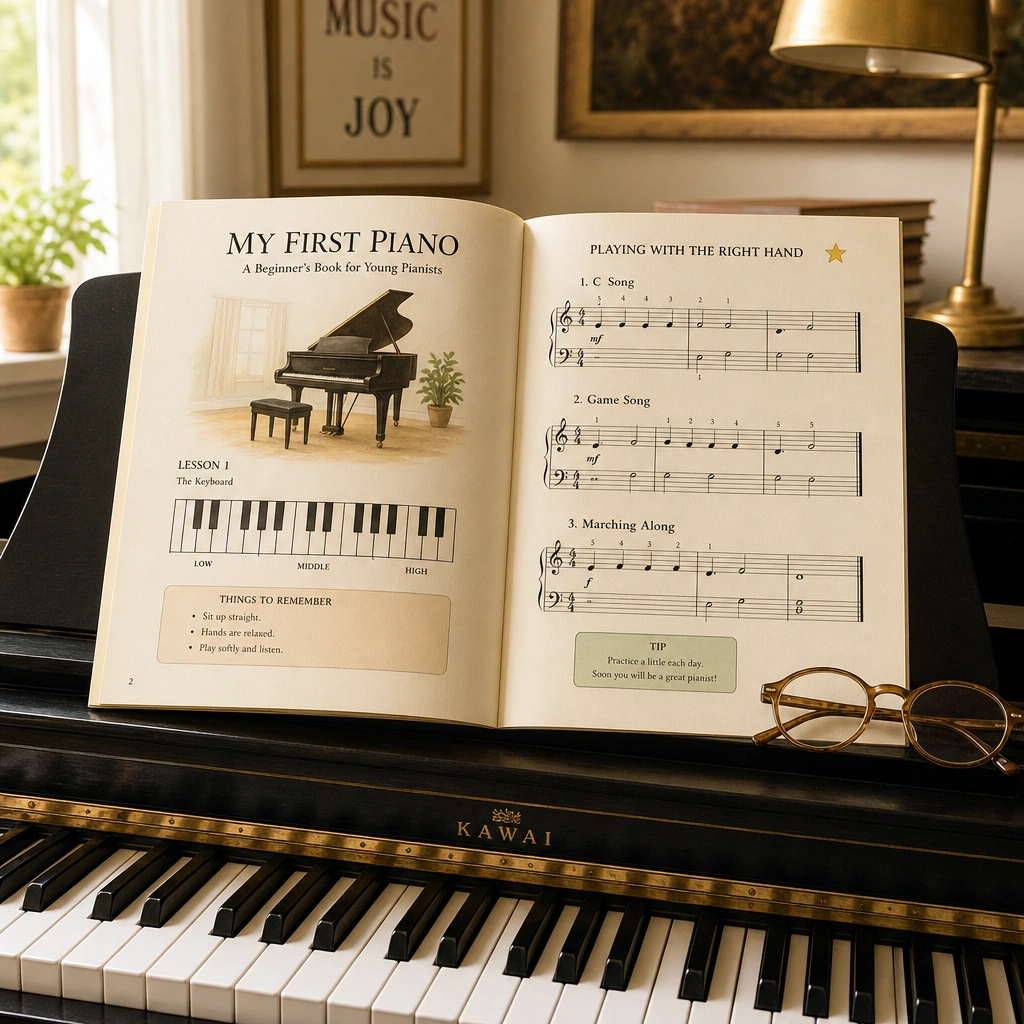
Middle C matters because it’s the reference point that connects the treble and bass clef staffs in written music, and it’s where most beginner method books position the hands for early exercises. Almost every “Twinkle Twinkle” or five-finger position starts with the right thumb resting on middle C.
On the staff, middle C sits on a short ledger line just below the treble clef and just above the bass clef – it’s literally the note where the two hands’ reading systems meet. That’s not a coincidence; it’s why method books like the ones I assign use it as the starting anchor for note reading.
According to the Wikipedia entry on piano key frequencies, middle C corresponds to the 4th octave C, scientifically labeled C4, vibrating at approximately 261.63 Hz. You don’t need to memorize that number, but it’s a useful fact if you’re ever curious why tuners and apps refer to “C4” instead of “middle C.”
Once a student can find middle C instantly, hand position and note reading both speed up. If you’re deciding what to focus on first, our piece on learning chords or notes first builds directly on this same landmark.
“I started as a complete beginner, and Austin made the learning process feel comfortable.” – Noah Peterson
What mistakes do beginners make when finding middle C?
The most common mistake beginners make is assuming middle C is always in the physical center of whatever keyboard they own, without checking the black-key pattern first. This works on a standard 88-key piano but fails on smaller keyboards and can cause confusion for weeks.
A few other patterns I see over and over in lessons:
- Counting white keys instead of using the black-key pattern. Counting is slow and error-prone; pattern recognition is instant and stays accurate at any speed.
- Confusing “any C” with “middle C.” Every group of two black keys has a C beside it – only one of those, near the center of a full keyboard, is middle C.
- Not rechecking hand position after moving. I’ve watched students drift an octave off mid-song without noticing, simply because they never re-anchored to middle C.
- Relying only on stickers. Keyboard stickers labeling notes are fine for the first day or two, but students who lean on them for months struggle later to find notes on an unmarked piano.
The fix that works best in my experience is simple repetition away from the instrument: close your eyes, picture the two-black-key group, and point to where middle C would be. Do that ten times a day for a week and it becomes permanent memory instead of a lookup step.
Common questions
Why is it called “middle C” if it’s not always in the middle?
Middle C got its name from its position near the center of a standard 88-key piano, where it sits between the bass and treble halves of the keyboard. On smaller keyboards it’s simply not centered physically, but it keeps the same name because it still marks the same musical pitch, C4.
Do all pianos have the same middle C sound?
Yes, middle C always vibrates at approximately 261.63 Hz on a correctly tuned instrument, whether it’s an acoustic piano, digital piano, or keyboard. The physical location differs by keyboard size, but the actual pitch you hear when you press middle C is identical everywhere.
Can I find middle C without counting keys at all?
Yes, the fastest method is spotting any group of two black keys and playing the white key just to its left, which is always a C. To confirm it’s the specific middle C, choose the pair closest to the keyboard’s center or its brand logo.
What note comes right after middle C?
The white key immediately to the right of middle C is D, followed by E, F, G, A, and B before the pattern repeats at the next C. This seven-letter sequence, A through G, repeats across the entire keyboard.
Does middle C look different on a digital piano versus an acoustic piano?
No, the black-and-white key layout and the two-versus-three black key grouping are identical on acoustic and digital pianos. The only real difference beginners notice is key weight and touch sensitivity, which our piano vs. keyboard guide explains in more detail.
How soon should a beginner be able to find middle C without thinking?
Most beginners can find middle C instantly within their first one or two practice sessions once they learn the two-black-key trick. I ask every new student to find it from a few different starting points in their very first lesson, and nearly all do it confidently by the end.
Ready to find out for yourself?
Your first 30-minute lesson with me is completely free – we will evaluate where you are, talk through your goals, and map out your path.
