Blog

  • Piano Practice Schedule for Adults With a Full-Time Job

    Piano Practice Schedule for Adults With a Full-Time Job

    The short answer

    A realistic piano practice schedule for adults with a full-time job is four focused 20- to 25-minute sessions a week plus one floating catch-up session, roughly 90 to 120 minutes total. Practice at the same time of day when you can, give each session one clear goal, and keep a 10-minute fallback for busy days.

    If you’d like help fitting that into your work week, that’s what a free 30-minute trial lesson is for: a skill check, your questions answered, and a plan with a book list. No card required.

    What does a weekly piano practice schedule look like for a working adult?

    A weekly piano practice schedule for a working adult should rest on four protected core sessions of 20 to 25 minutes, each with its own focus, plus one flexible 15- to 30-minute session that floats to wherever the week has room. Five-minute touchpoints on off days are optional but keep your hands familiar with the keys.

    Here’s the piano practice schedule for adults I give most of my students. Swap the days to fit your calendar.

    Day Session Length Focus
    Monday Core 1 20–25 min Technique: scales, arpeggios, hand-independence drills
    Tuesday Off or touchpoint 0–10 min Play a piece you already know
    Wednesday Core 2 20–25 min New material: learn the next few measures
    Thursday Flex 15–30 min Make up a missed session, or go longer if you have energy
    Friday Core 3 20–25 min Problem-solving: loop the hardest passages slowly
    Saturday Off or touchpoint 0–10 min Improvise or sight-read something easy
    Sunday Core 4 20–25 min Performance: play pieces all the way through

    The flex session is your insurance policy: when a work crisis eats Wednesday, Thursday’s flex slot covers it. Across the week, aim for roughly 70 percent of your time on pieces at your level, 20 percent on easier pieces you’ve already learned, and 10 percent on something that stretches you.

    Why four short sessions instead of one long one? Skills settle in between sessions, not only during them. Researchers at the National Institutes of Health reported in 2019 that people learning a new sequence of keystrokes made most of their gains during short rest breaks. Spacing practice out, known as the spacing effect, gives your brain more of those windows than one Saturday marathon.

    Brand new to piano? I cover the first few months in how often a beginner should practice piano.
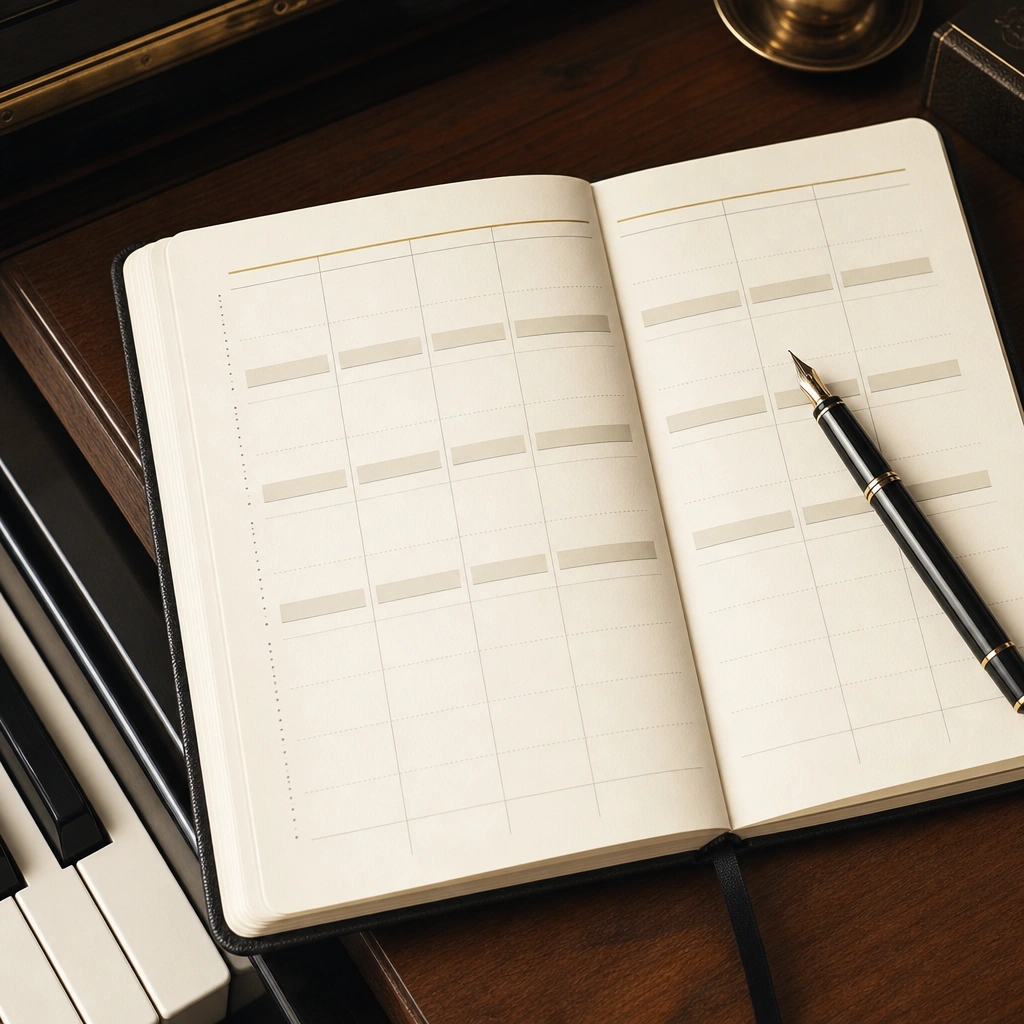
    Weekly planner showing structured piano practice schedule for adults

    How should you use 25, 15 or 10 minutes at the piano?

    A 25-minute piano session should spend about 10 minutes slowly looping the hardest passages in your current piece, with short blocks of warm-up, technique and review around that core. On tighter days, cut the warm-up and review first at 15 minutes, and at 10 minutes pick one specific goal and work on nothing else.

    For a full session after work, this is the split I recommend:

    Minutes What to do
    1–3 Warm-up: a scale, arpeggio or finger exercise
    4–8 Technical work tied to your current piece
    9–18 Loop the hardest 2–4 measures of your repertoire slowly
    19–22 Play through easier or review material
    23–25 Sight-reading or exploring, if time allows

    The step-by-step version of a single session lives in my guide on how to practice piano effectively. Here’s what to cut when your workday shrinks the window.

    When you only have 15 minutes

    1. Problem measures in your current piece, the ones you can’t play smoothly yet
    2. New material you’re actively learning
    3. Technical exercises that support those pieces
    4. Everything else: warm-ups, sight-reading and easy review go first

    When you only have 10 minutes

    Use a one-goal session. Decide the goal before you sit down, and stop when the timer does:

    • “Get measures 9–12 smooth at half tempo.”
    • “Memorize the right-hand melody of the B section.”
    • “Drill the chord change in measure 16.”

    Whatever the length, play new passages at 50 to 70 percent of full tempo, and speed up only after five clean repetitions in a row. Rushing to feel productive when time is short is exactly backward.
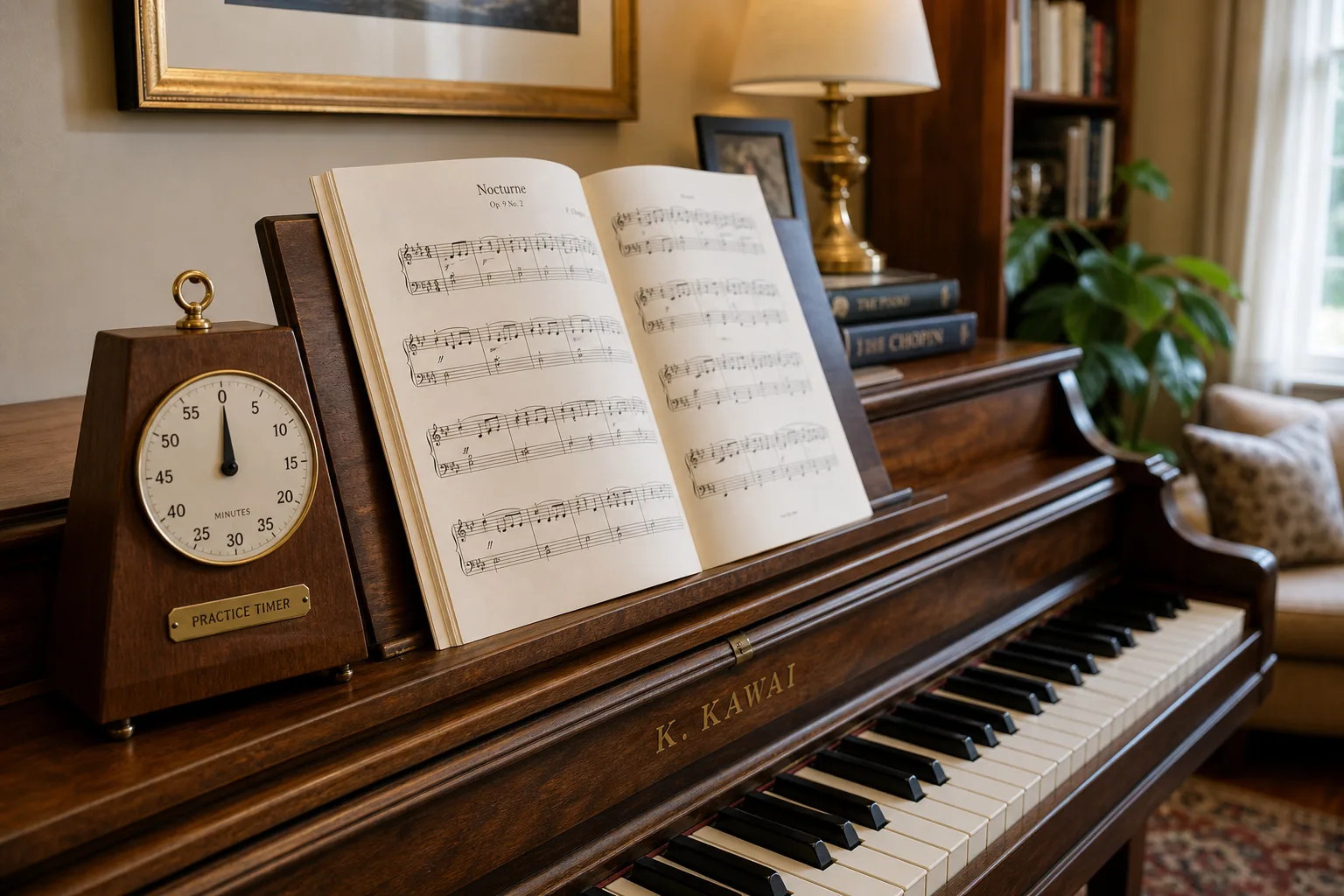
    Practice timer and sheet music on a piano marking a focused piano practice schedule for adults

    What is the best time of day to practice piano with a full-time job?

    The best time of day to practice piano with a full-time job is whenever you are reliably alert and uninterrupted, which for many working adults means early morning before work. Practicing at the same point in your day matters more than the exact hour, because a fixed slot turns practice into a habit instead of a daily decision.

    The windows that tend to work:

    • Early morning, before work. Nothing has derailed your day yet.
    • Lunch break, if you work from home.
    • Before dinner, as a buffer between work and home.
    • After the kids’ bedtime, if you still have focus left.
    • Weekend mornings, when your mind is fresh for new material.

    Not sure which is yours? Track your energy for one week. Fifteen minutes when you’re alert beats 45 minutes when you’re drained after a long day.

    Early mornings in a shared home usually mean a digital piano and headphones. My guide to practicing piano in an apartment covers how to do that without waking anyone.

    What do practice schedules look like for office workers, parents and shift workers?

    Practice schedules for working adults differ by job, but each successful one protects a few predictable windows: an office worker practicing before work plus weekends, a parent using 5:30 AM before the kids wake, or a shift worker planning four 20-minute sessions every Sunday. All three land between 60 and 100 minutes a week.

    These are adapted from real schedules of adult students I’ve worked with.

    Who When they practice Weekly total What makes it work
    Office worker, 9 to 6 with a 45-minute commute Tue and Thu 6:45–7:05 AM; Sat 9:00–9:30 AM; Sun 7:30–7:55 PM; flex on a Wed or Fri lunch when working from home 75–100 min Everything set up the night before: book open to the right page, coffee on a timer
    Parent of two kids under seven Mon, Wed, Fri 5:30–5:50 AM; 15–20 min during Saturday nap time; optional 5–10 min after bedtime 60–90 min Headphones, so early practice doesn’t wake the house
    Nurse on rotating shifts Four 20-minute sessions planned each Sunday around the week’s shifts: afternoons after day shifts, or before leaving on night-shift weeks 80 min A weekly target instead of fixed time slots

    The office worker removed every decision from her early mornings and kept that schedule for two years. The parent accepts that some weeks land at the low end of his range. The nurse’s schedule changes every week, but her total doesn’t. You don’t need a routine schedule, just a routine commitment.

    If you work full time and can’t see where piano fits in your week, we can map out a realistic schedule together in one conversation. Your first 30-minute lesson with Austin is free – no card, no pressure.

    Book your free trial →

    How do you practice piano with a busy schedule?

    Practicing piano with a busy schedule works best when you shrink sessions instead of skipping them, keeping a 10-minute minimum on hectic days and adding five-minute touchpoints or commute-time mental practice around them. Ten focused minutes on a bad day keeps the habit alive, while skipping entirely makes the next session harder to start.

    These are the patterns I see fail most often with working adults:

    • The daily two-hour plan. It lasts about three days before work intervenes.
    • The weekend warrior. One Saturday cram gives your hands one round of reinforcement a week instead of four.
    • All or nothing. If you can’t do a “full” session, you skip it, and guilt does the rest.

    Early in my teaching, I assigned adults practice plans that looked great on paper and fell apart in real life. The students who stuck with piano were doing something much simpler that matched the energy they actually had after work.

    Tools for busy days

    • Touchpoints (5–10 minutes): run through a piece you know, improvise, or play one hard measure.
    • Mental practice: visualize fingerings, hum the melody, or listen to a recording of your piece on the commute.
    • Double-duty technique: if your piece has Alberti bass or octave jumps, make that pattern your warm-up.

    Mental practice is a real supplement, not a replacement. In a well-known 1995 study led by neurologist Alvaro Pascual-Leone, people who only imagined practicing a five-finger piano exercise showed brain changes similar to those who physically played it, though actually playing still improved performance more.

    What should you do when work derails your practice for a week or more?

    When work derails your piano practice for a week or more, return with shorter, easier sessions rather than long make-up sessions: 10 to 15 minutes of music you already know, rebuilding to full length over three or four practices. Muscle memory is more resilient than it feels, and most skills come back within a week or two.

    The comeback plan

    • Start with 10–15 minutes of easy pieces you already know
    • Rebuild to your full session length over 3–4 practices
    • Lower your expectations for hard passages for a few days
    • Rebuild the habit before you worry about progress

    Maintenance mode for busy seasons

    For heavier stretches, like a job change, a move or a yearly crunch at work, switch to maintenance mode:

    • At least two 15-minute sessions per week
    • Only pieces you already know
    • No new material, and no guilt about it
    • The goal is staying connected to the piano, not making progress

    One student kept twice-a-week maintenance sessions through the birth of her first child. She learned nothing new for six months, then was back to full learning capacity within a month of refocusing.

    If your busy season is predictable, say November through January, plan maintenance mode for it in advance and go deeper during quieter months.

    How do you make a practice schedule actually stick?

    A piano practice schedule for adults sticks when sitting down at the piano is the easiest option at your chosen time, so keep the instrument where you walk past it, leave the music open, and set up the night before. A 30-second practice log and a monthly five-minute review show you which slots work and which to move.

    Remove the friction

    • Keep your piano or keyboard in a room you pass through, not a spare room
    • Leave your music open to the right page, with a pencil nearby and headphones plugged in
    • Put each core session in your calendar like a meeting

    Track lightly

    After each session, log the date and length, what you worked on, and one sentence on how it went. Once a month, check which slot keeps getting skipped. If Sunday evening never happens, move it instead of blaming yourself.

    Every 4 to 6 weeks, record your pieces on your phone. Listening back months later reveals progress your day-to-day ear misses, which is exactly what you need during a plateau.
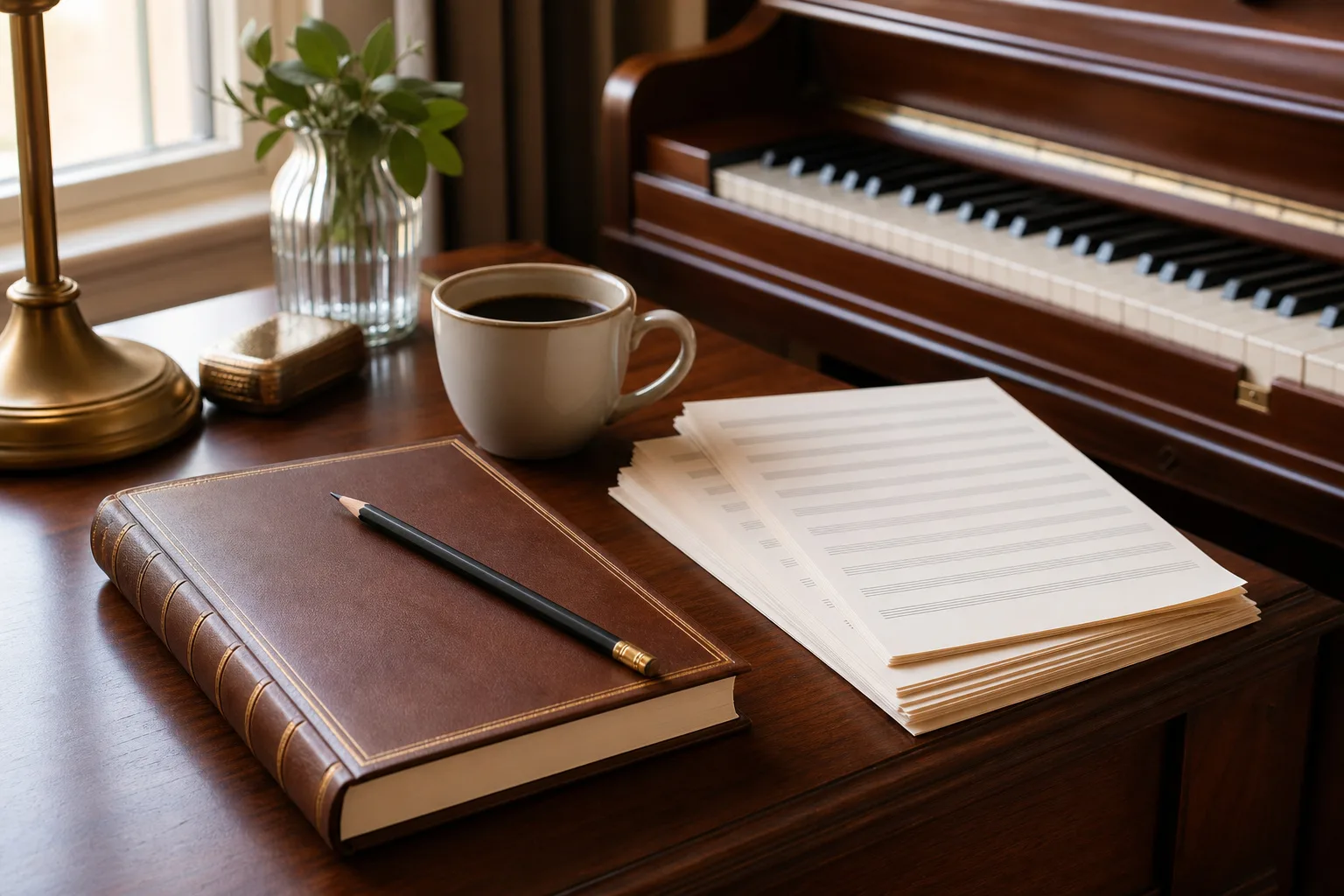
    Leather practice journal, pencil and coffee beside a piano for tracking a piano practice schedule for adults

    Leave room for play, and get some accountability

    Let some sessions be pure play, with no metronome and no agenda. They remind you why you started. A weekly lesson also helps: it gives your schedule a deadline and gives you someone to adjust the plan when your work life changes.

    “My confidence at the piano has grown so much since starting lessons.” – Mia Reynolds

    Lessons with me are live and one-on-one over Zoom. Start with a free 30-minute trial lesson, or start on your own today: put four 20-minute windows in this week’s calendar and show up for them.

    Common questions

    How many minutes a day should an adult practice piano?

    Most adults should practice piano 15 to 30 minutes a day, four or five days a week. Twenty focused minutes is a strong default for a beginner with a full-time job. If you have more time on a given day, two shorter sessions usually work better than one long session when you’re already tired.

    Is 20 minutes of piano practice a day enough?

    Yes, 20 minutes of focused piano practice a day is enough for steady progress, especially for beginners and early intermediate players. The key word is focused: 20 minutes with one clear goal beats an hour of playing songs from the top. Practicing four or five days a week matters more than the exact minutes.

    Can I do all my piano practice on the weekend?

    Weekend-only piano practice works poorly compared with spreading the same minutes across the week. One long Saturday session gives your hands a single round of reinforcement and six days to forget. If weekends are truly your only option, split practice into Saturday and Sunday sessions and add short weekday touchpoints when you can.

    Does mental practice away from the piano count?

    Mental practice counts as a supplement to piano practice, not a substitute for it. Visualizing fingerings, humming melodies and listening to recordings of your pieces during a commute help you arrive at the keyboard with a clearer plan. Keep at least three or four real sessions at the piano each week alongside it.

    Should I take planned weeks off from piano practice?

    A planned lighter week every 6 to 8 weeks helps most working adults avoid burnout. Cut back to two or three short sessions, skip new material, and simply maintain what you’ve built. Planned rest removes the guilt of pulling back, and your brain keeps consolidating what you learned in the weeks before.

    How long does it take a working adult to learn piano?

    A working adult practicing 15 to 30 minutes, four or five days a week, typically plays recognizable songs within 3 to 6 months and reaches intermediate pieces within 1 to 2 years with a teacher or structured curriculum. Consistency affects that timeline more than talent. I go deeper in how long it takes to learn piano as an adult.

    Want a practice schedule that fits your work week?

    Your first 30-minute lesson with me is completely free – we will look at where you are, talk through your schedule and goals, and map out a plan you can actually keep.
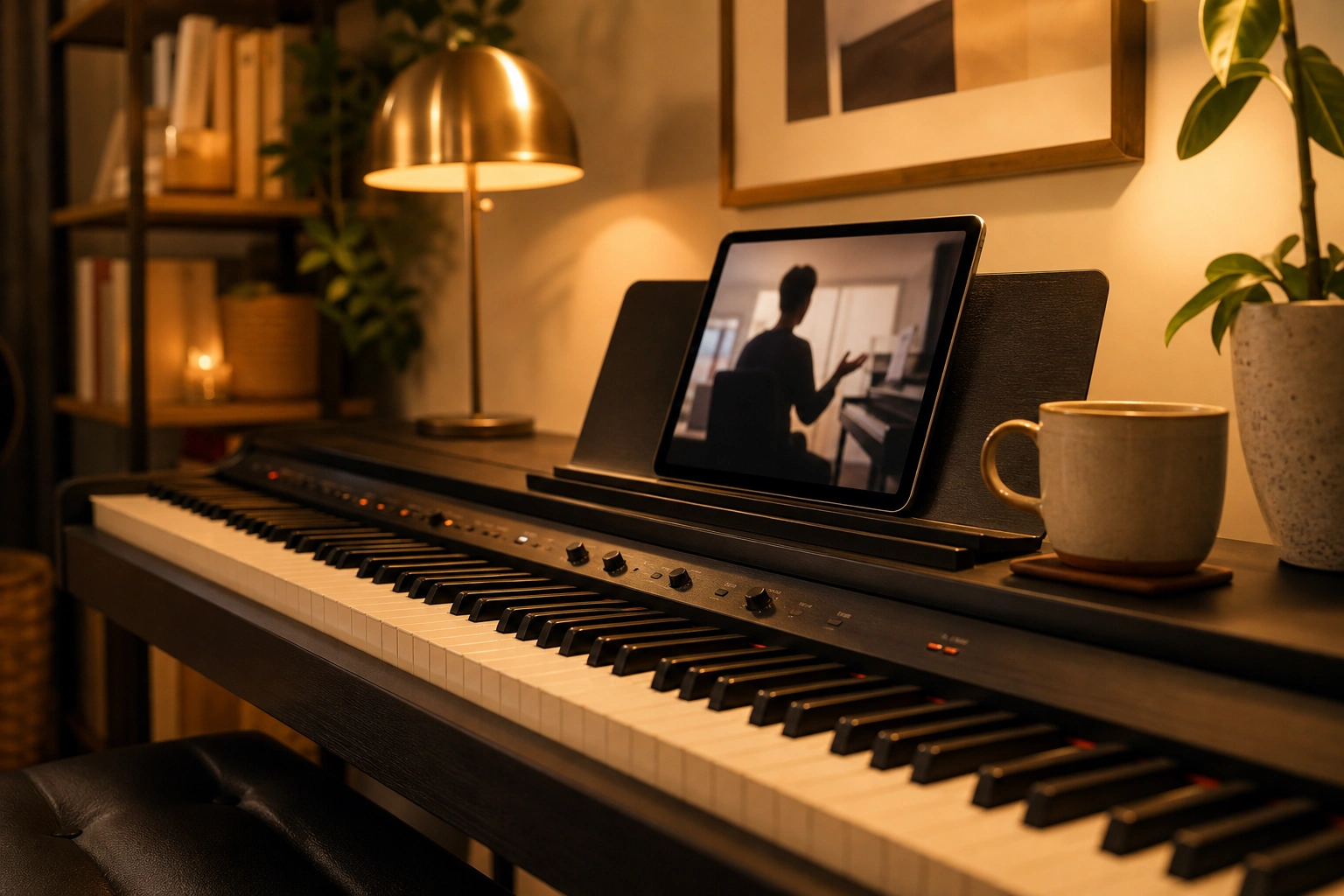
    Book Your Free Trial Lesson

  • Are Online Piano Lessons Effective, and Are They Worth It?

    Are Online Piano Lessons Effective, and Are They Worth It?

    The short answer

    Yes, online piano lessons are effective for the vast majority of students, and they’re worth the money for most adult beginners. Piano is uniquely suited to video: the instrument stays in one place, hands are easy to see on camera, and progress is audible. A few situations still favor in-person teaching, mainly for very young children.

    I teach both ways, over Zoom and sitting beside my students at their own pianos, so I have no incentive to spin the answer. I’ve taught hundreds of students both ways, and “effective” depends on doing online lessons right. If you’d rather feel it than read about it, a free 30-minute trial lesson is the quickest test – no card, no pressure.

    Are online piano lessons worth it for adult beginners?

    Online piano lessons are worth it for most adult beginners because they remove the biggest reasons adults stop taking lessons: the commute and the cancellations a busy schedule forces. Adults also bring the self-direction video lessons reward. The main exceptions are adults with no quiet place to play and those who strongly prefer a teacher in the room.

    Adults are spending their own money and time, so wanting answers before committing is reasonable. These are the worries I hear most:

    • Can a teacher really see my hand position through a camera?
    • Will I learn proper technique, or quietly build bad habits?
    • Will I stay motivated without driving somewhere each week?
    • Am I too old, or not tech-savvy enough, to learn this way?

    The quick version: yes, I can see your hands; technique is taught the same way it is in person; and motivation comes from a clear weekly plan more than from the drive. If you’ve joined a Zoom call, you have enough tech skills, and for most people the camera stops feeling strange within a lesson or two.

    The schedule benefit is bigger than it sounds. A 7 PM lesson means you sit down at your piano at 7 PM, with no parking or traffic. For working adults and parents, that’s often the difference between taking lessons and not taking them at all.

    Empty piano bench and keyboard in a peaceful home setting, representing the question are online piano lessons worth it for adult learners

    What are the benefits of online piano lessons?

    The main benefits of online piano lessons are learning on your own instrument, skipping the commute, recording lessons to review later, and choosing a teacher from anywhere instead of the nearest one. Piano works especially well over video because the instrument doesn’t move and one well-placed camera shows what a teacher watches in person.

    • The camera sees what matters. One phone angled at the keyboard shows me your hands, your fingering, and your posture – everything I’d watch in person.
    • You learn on your own instrument. Practicing on the same piano you take lessons on removes a surprising amount of friction. Your piano’s quirks become part of the lesson.
    • No commute, fewer cancellations. The students who progress fastest are the ones who never miss lessons. Removing the drive removes the main reason lessons get skipped.
    • Recordings. Zoom lessons can be recorded, so “what did my teacher say about that fingering?” has an answer on video.
    • Any teacher, anywhere. You’re no longer limited to teachers within driving distance, so you can pick the right teacher instead of the nearest one.
    • A lower-pressure room. Playing on your own bench makes it easier for self-conscious beginners to relax and focus on the music.

    “Austin explains everything clearly and makes online piano lessons easy to follow.” – Emily Carter

    Do online lessons get the same results as in-person lessons?

    Well-run online piano lessons get results comparable to in-person teaching for most students. Studies of remote music instruction since 2020 consistently find similar skill outcomes, especially for students past the earliest beginner stage. The factor that actually predicts progress is not the lesson format but consistent practice between lessons.

    That matches what I’ve watched in my own studio: my online students pass the same milestones on the same timeline as students taught in person. That’s an observation from teaching both ways, not a controlled study.

    Consistent practice is why my students follow a structured lesson plan that tells them exactly what to work on each week.

    Online lessons aren’t watered down, either. Same teacher, same curriculum, same accountability, same lesson – different room. The only thing that’s watered down is the commute. What does change results is the teacher: a mediocre one doesn’t get better by sitting in the same room.

    What’s harder over Zoom, and how does a good teacher handle it?

    The harder parts of piano lessons over Zoom are camera angles, compressed audio, internet lag, and physical corrections a teacher can’t make by hand. A good teacher handles each one: setting up an angled view of your hands, adjusting Zoom’s audio for music, taking turns instead of playing together, and describing physical adjustments precisely.

    Camera angles

    A laptop straight in front of you mostly shows your face. What works is a phone or tablet off to one side and slightly above the keys, angled down, so both hands, your wrists, and your posture are in frame. If I need to see your pedal foot, I’ll ask you to move the camera for a minute.

    Audio

    Zoom’s default audio processing is built for voices, so it can clip soft or sustained piano notes. Turning on Zoom’s “Original sound for musicians” setting fixes most of that. The compression that remains matters for advanced students refining tone color, and rarely for beginners.

    I can hear tone, rhythm, dynamics, and hesitation through a phone microphone more clearly than students expect. Ten years of listening trains your ears well. On your end, headphones beat laptop speakers, which tend to distort piano sound.

    Digital piano with headphones for clear sound during online lessons, part of an effective remote learning setup

    Latency

    Every video call has a small delay, known as audio latency. Latency means we don’t play simultaneously, so duets happen differently, but teaching rarely requires it. I listen, then respond. With decent internet, the conversation flows naturally, and a wired connection helps if yours is shaky.

    Hands-on corrections

    In person, I can gently reposition a thumb or lower a wrist. Online, I describe the change and watch you make it, which takes a little more back-and-forth at first. Once we share a vocabulary for those adjustments, corrections get quick.

    The fastest way to know whether online lessons work for you is one real lesson on your own piano. Your first 30-minute lesson with Austin is free – no card, no pressure.

    Book your free trial →

    What do you need at home for Zoom piano lessons?

    Zoom piano lessons need three things at home: a piano or keyboard with at least 61 keys (88 weighted keys eventually), a phone or tablet with a camera angled at the keys, and a stable internet connection. A quiet room, good lighting, and headphones help, but none of it requires expensive equipment.

    The setup bar is lower than people fear. The phone can sit on a cheap tripod or even a stack of books. I walk every new student through camera placement in their free trial lesson, and it takes about three minutes. Still shopping? Here’s what size keyboard you need for piano lessons.

    A few habits help the lesson run smoothly:

    • Put the light in front of you. A window behind you turns your hands into silhouettes.
    • Close a door. Silence your phone and tell housemates you’re in a lesson.
    • Keep a notebook on the music stand for fingering reminders and the week’s practice targets.
    • Test first. A five-minute video call with a friend confirms your camera, microphone, and connection.
    Organized piano practice space with sheet music and metronome showing effective online piano lesson setup

    Who are online lessons right for, and who should choose in-person?

    Online piano lessons suit self-directed teens and adults, busy professionals and parents, nervous beginners who prefer privacy, and anyone without a good teacher nearby. In-person lessons are often the better choice for children under about 7, advanced students fixing subtle physical tension, and people who focus better with a teacher in the room.

    Online tends to work well for

    • Self-directed learners who practice between lessons without someone checking in.
    • Busy adults and parents. The easier it is to show up, the more consistent you’ll be.
    • Nervous or private learners who’d rather not walk into a teacher’s studio.
    • People far from good teachers, in small towns or rural areas.

    In-person tends to work better for

    • Very young children (roughly under 7). Little ones often need hands-on redirection and shorter, more playful segments. Video adds a layer of distance that can make this harder.
    • Fine-grained technique correction at advanced levels. Subtle tension in the wrist or arm weight issues are easier to diagnose with my hands near the student’s.
    • Students who struggle with screens. Some people simply focus better with a person in the room. That’s a real preference, not a failure.
    • Homes with no quiet corner. Without 30 uninterrupted minutes behind a closed door, lessons at home feel chaotic.

    My own lessons are all online, live over Zoom, and for children under about 7 I ask a parent to sit nearby. For nearly everyone else, a good online teacher and a well-placed camera are enough. For a full side-by-side, read my comparison of online piano lessons vs in-person.

    How much do online piano lessons cost, and are they worth the money?

    Standard online piano lessons at Weaver Music cost $60 for 30 minutes, $80 for 45 minutes, or $99 for 60 minutes, and every new student starts with a free 30-minute trial lesson with no card required. Lessons are worth that money when you attend consistently, because weekly feedback you actually get beats cheaper lessons you keep skipping.

    Lesson length Price
    30 minutes $60
    45 minutes $80
    60 minutes $99

    Lessons follow the Weaver Music curriculum: technique, reading, theory, and repertoire, built around the songs you want to play. Books are the only extra cost.

    The value side is where online lessons pull ahead. A 20-minute drive each way adds up to more than 30 hours a year of weekly lessons, plus gas and parking. Online, that time goes back into practice, and lessons you’d have canceled on a hectic week still happen.

    Free videos and apps cost less and are useful for picking up songs. What they can’t do is watch your hands and catch a collapsing wrist before it becomes a habit. That feedback is what you pay a teacher for, and it comes through a camera just fine. For the wider picture, see how much piano lessons cost.

    How can you tell after a few lessons whether it’s working?

    After three or four online lessons, you can tell they’re working if the technology has faded into the background, you leave each lesson knowing exactly what to practice, your practice weeks feel more productive, and your teacher catches problems you couldn’t hear or see yourself. If none of that is happening, change the setup or the teacher.

    Check these after your third or fourth lesson:

    1. You’ve stopped noticing the screen. Lesson time goes to music, not troubleshooting.
    2. You know what to practice. Each lesson ends with specific targets, not a vague “keep working on it.”
    3. Feedback carries into practice. Alone at the piano midweek, you remember the key points and can apply them.
    4. You’re showing up. If online lessons make your weekly slot easier to keep, the format is doing its most important job.
    5. Something sounds different. A passage that fell apart two weeks ago now holds together, even if it’s still slow.

    If the answers are mostly no, find the weak link. Blurry video or choppy sound is a setup fix. Feeling lost after lessons points to the teaching: a good teacher explains clearly, tries another approach when something doesn’t land, and has clean audio and video on their own end. My guide on how to choose a piano teacher covers the rest.

    Common questions

    Are online piano lessons good for kids?

    Online piano lessons work well for most kids around age 7 and up who can sit and focus for a 30-minute lesson. Younger children often need hands-on redirection and short, playful segments, which is harder through a screen. For kids under about 7, in-person lessons or a parent sitting nearby during Zoom lessons usually works better.

    Can you learn piano over Zoom with no experience?

    Complete beginners can learn piano over Zoom, and the earliest skills are some of the easiest to teach on camera. Posture, hand position, finger numbers, and finding middle C all show clearly on a phone angled at the keys. Beyond that phone or tablet, a beginner needs a keyboard with 61 or more keys and stable internet.

    Should I record my online piano lessons?

    Recording your Zoom piano lessons is worth doing, as long as your teacher agrees. Zoom can record the session, so explanations and demonstrations are there to rewatch when you forget a fingering midweek. Rewatch with a purpose: find the few minutes spent on your hardest passage and practice that spot right after, rather than replaying the whole lesson.

    Can I mix online and in-person piano lessons?

    Mixing formats can work if you have a teacher who offers both, but Weaver Music lessons are online only, live over Zoom. Most students find one weekly Zoom lesson is all they need. Students farther away take every lesson over Zoom with the same teacher and curriculum.

    What happens in a free online trial lesson?

    A free online trial lesson at Weaver Music is 30 minutes over Zoom with no card required. The lesson includes a quick skill check, time to ask anything about lessons, and a plan for what to learn next, with a book list. It’s also the moment to sort out camera placement, which takes about three minutes.

    How long should an online piano lesson be?

    Thirty-minute piano lessons over Zoom suit young children and most first-year beginners, whose focus and hands tire quickly. Forty-five minutes fits teens and adults building reading and technique together, and 60 minutes suits intermediate students with longer repertoire. At Weaver Music, Standard lessons cost $60, $80, or $99 for those three lengths.

    Online piano lessons work. In-person lessons work. The thing that doesn’t work is waiting for the perfect circumstances to begin.

    Try an online lesson for yourself

    Your first 30-minute lesson with me is completely free – we will set up your camera angle, see where you are, talk through your goals, and map out your path.

    Book Your Free Trial Lesson

  • What’s the Best Age to Start Piano Lessons? A Teacher’s Honest Answer

    What’s the Best Age to Start Piano Lessons? A Teacher’s Honest Answer

    Parents ask me this constantly, usually with a slightly worried tone — as if there’s a secret window that slams shut. Here’s the truth from 10+ years of experience and students from age five to well past retirement: there’s a convenient age to start, but there is no deadline.

    The short answer

    For most children, ages 6–9 is the sweet spot to begin formal piano lessons. Younger than that, informal musical play often serves better than structured lessons. And past that window? Nothing closes. Teens learn fast, and adults — who ask this question about themselves more often than you’d think — bring advantages kids don’t have.

    Why 6–9 works so well for kids

    Around age six, a few things line up: hands are big enough to reach five keys comfortably, attention spans can carry a 30-minute lesson, most kids are learning to read (which pairs beautifully with reading music), and counting is solid enough for rhythm work. Start much earlier and lessons can feel like holding back the tide; start in this window and progress feels natural and fun.

    Signs your child is ready — at any age

    • They can focus on one activity for 15–20 minutes
    • They know left from right and can count to ten comfortably
    • They show curiosity about music — singing, tapping rhythms, reaching for the keys
    • They can follow two-step instructions
    • They want to (this one matters more than all the others)

    What if my child is 3 or 4?

    Very young children benefit enormously from music — but usually through play: singing, clapping games, dancing, listening. If a preschooler is intensely drawn to the piano, short and playful sessions can work with the right approach. In my studio, lessons for young children are patient and game-based, never drilled. The goal at that age is simple: make the piano a place they love to be.

    Is it too late for my 12-year-old? My teenager?

    Not even close. Teens are honestly some of my favorite students to teach: they pick their own music, they understand practice, and when the motivation is theirs, they move fast. A motivated 14-year-old starting from zero routinely overtakes a student who started at six but never practiced. Late starts with strong motivation beat early starts without it, every time.

    And adults? (Asking for a friend…)

    I’ll say it plainly: no age is too late. I teach adult beginners in their 30s, 50s, and 70s. Adults learn differently — more analysis, less repetition — and they bring decades of listening experience to the bench. If the question behind your question is “did I miss my chance?”, the answer is no. (I wrote a whole guide on how long it takes adults to learn piano — the timeline is friendlier than you think.)

    What matters more than starting age

    The teacher fit

    Especially for children, the first teacher decides whether piano feels like joy or like homework. Look for patience, encouragement, and flexibility — a teacher who adapts to the student instead of forcing every child through the same method book. That philosophy is the backbone of how I teach: supportive, personalized, and honest.

    A sustainable practice habit

    Ten to fifteen minutes a day for a young beginner is plenty. The habit matters more than the minutes. Parents help most by making practice a normal, low-pressure part of the day — right after school, before screens.

    Structure between lessons

    Kids (and adults) progress fastest when practice has a clear map. My students work through a structured four-level lesson plan between lessons, so they always know exactly what to work on next.

    The bottom line

    If your child is 6–9 and curious: this is a wonderful time to start. If they’re older: it’s still a wonderful time. If it’s you who’s been wondering: the best age to start piano lessons is, honestly, the age you are when you finally decide to begin.

    Ready to find out for yourself?

    The fastest way to answer any piano question is to sit down at the keys with a teacher. Your first 30-minute lesson with me is completely free — we’ll evaluate where you are, talk through your goals, and map out your path.

    Book Your Free Trial Lesson

  • How Long Does It Take to Learn Piano as an Adult?

    How Long Does It Take to Learn Piano as an Adult?

    The short answer

    Most adults who practice 20–30 minutes a day can play simple, satisfying music within 2–3 months, play recognizable songs they love within 6–12 months, and reach a confident intermediate level, where they can learn most pop songs and easier classical pieces on their own, in 2–4 years. These are typical ranges for steady practice, not guarantees.

    It’s the first question almost every adult asks me before their first lesson: “Realistically… how long is this going to take?” And it deserves a real answer, not a sales pitch. After more than 10 years of experience at the piano and hundreds of students, many of them adults who started from zero, here’s the honest timeline, milestone by milestone.

    Mastery is a lifelong road, but “I can really play the piano” arrives much sooner than most people expect. A free 30-minute trial lesson gives you a skill check and a plan with a book list, no card required.

    What is a realistic piano timeline for an adult?

    A realistic piano timeline for an adult practicing 20–30 minutes a day, five or six days a week, is a first two-hand song in 4–8 weeks, reading simple sheet music in 3–6 months, playing from lead sheets in 12–24 months, and intermediate repertoire in 2–4 years. These are typical ranges, not promises.

    The table also assumes some guidance, from weekly lessons or a structured course. Treat the ranges as a map, not a deadline.

    Milestone What you can do Typical range at 20–30 min/day
    First two-hand song Melody in the right hand, simple notes or chords in the left 4–8 weeks
    Reading simple sheet music Read beginner pieces on the grand staff without writing in letter names 3–6 months
    Songs you actually love Simplified arrangements of real songs 6–12 months
    Playing from lead sheets Right-hand melody plus your own left-hand chords from chord symbols 12–24 months
    Early intermediate repertoire Minuet in G from the Anna Magdalena Notebook, an easy Clementi sonatina 18 months–3 years
    Confident intermediate Learn most pop songs and easier classical pieces on your own 2–4 years
    Advanced repertoire Harder Chopin, Beethoven sonatas, full jazz voicings 5+ years, then a lifelong road

    At 10–15 minutes a day, expect the long end of each range or beyond. At 45–60 minutes, you’ll often land near the short end, but doubling practice rarely halves the timeline, because part of the learning happens between sessions.

    Expect at least one flat stretch in the first year where nothing seems to improve. That plateau is normal and usually breaks once your reading catches up.

    What does the first year of piano look like for an adult?

    An adult’s first year of piano usually moves through three stages: keyboard geography, rhythm and simple notation in months 1–3; scales, chords and left-hand accompaniment in months 3–6; and reading fluency, hand independence and pedaling in months 6–12. Each stage builds directly on the skills from the one before it.

    Months 1–3: foundations that feel like progress

    In the first weeks you’ll learn keyboard geography, basic rhythm, and how to read simple notation. With a good teacher you’ll be playing short pieces hands-together within the first month or two. Adults often outpace kids here: you understand instructions faster, you see the patterns, and nobody has to remind you why you’re practicing.

    That means finger numbers, middle C and nearby landmark notes, whole, half and quarter notes, and counting out loud.

    Months 3–6: your first “real” songs

    This is where five-finger patterns give way to scales, chords, and left-hand accompaniment, the building blocks of nearly every song you’ve ever heard. Students at this stage start playing simplified arrangements of real repertoire: a Beatles tune, a film theme, an easy classical melody.

    Expect C, G and F major scales, the C, F and G chords, and a simple I–IV–V progression.

    Months 6–12: momentum

    By the end of a consistent first year, most of my adult students can read music comfortably at a beginner-intermediate level, play with both hands independently, use the sustain pedal, and perform a handful of pieces they’re genuinely proud of. That’s usually the moment the question changes from “how long will this take?” to “what should I learn next?”

    What speeds up or slows down learning piano as an adult?

    Four factors control how fast an adult learns piano: how consistently you practice, whether a teacher is guiding you, how clearly you’ve defined your goal, and whether you follow a structured path. The most common slowdowns are practicing in weekend bursts, rushing tempos, hidden hand tension and learning songs only by imitation.

    1. Consistency beats duration

    Twenty focused minutes a day will outrun a single two-hour Sunday marathon every time. Piano skill is built by frequent, spaced repetition, and your hands learn while you sleep. If you can protect 15–30 minutes most days, you’re on the fast track.

    2. Guidance

    Self-taught learners can absolutely make progress, but they tend to plateau early, usually because of technique habits that make faster music physically impossible later. A teacher spots those in week two instead of year two. (It’s the single biggest reason students who take lessons move faster.)

    3. Your goals

    “Learn piano” means different things. Playing simple chord accompaniments for singalongs is a 3–6 month goal. Playing Chopin is a multi-year goal. Neither is better, but knowing your target changes the route, which is why I build a personalized plan for every student instead of marching everyone through the same book.

    4. A structured path

    Random YouTube tutorials teach you songs; a curriculum teaches you the instrument. Working through a sequenced course, like the four-level lesson path my students use between lessons, means every new piece builds on the last one instead of starting from scratch.

    What slows adults down the most?

    • Weekend-only practice. Two long sessions a week means relearning what faded in between.
    • Rushing the tempo. Playing faster than your hands know a passage rehearses the mistakes too.
    • Hidden tension. Tight wrists feel fine in slow pieces, then cap your speed later.
    • Learning only from letter names or falling-note videos. Songs come quickly, but reading never develops.

    So can you speed this up? Yes: practice daily (even briefly), take regular lessons, and follow a structured curriculum. Those three together are the whole secret.

    If you’re an adult wondering where you’d land on this timeline, one short skill check will tell you. Your first 30-minute lesson with Austin is free – no card, no pressure.

    Book your free trial →

    Is it harder to learn piano as an adult?

    Learning piano as an adult isn’t harder overall, just different: children usually have more free time and less self-consciousness, while adults often move faster in the early months because they follow explanations quickly and recognize patterns. For most adults, the real obstacles to learning piano are time and perfectionism, not age.

    The adult advantages nobody mentions

    Adults constantly tell me they wish they’d started as a kid, and sure, early starts help. But adult learners have real advantages: you chose this, so motivation is built in; you understand music you’ve been listening to for decades; you can analyze patterns instead of memorizing blindly; and you can structure your own practice. I’ve watched a 60-year-old beginner outpace teenagers simply because she practiced with intention.

    Where adults genuinely struggle

    The honest downsides are practical, not biological. Adult brains keep learning new motor skills throughout life, a property called neuroplasticity. What gets in the way is time, since work and family eat practice first, and the gap between the music in your head and what your hands can do yet.

    A pattern I see constantly: an adult plays a passage right twice, stumbles on the third try, and decides they’re “just not musical.” The fix is slowing down and shrinking the goal to one measure, not questioning talent.

    How long does it take to learn piano with lessons vs self-taught?

    Self-taught adults and adults taking lessons often reach a first simple song in roughly the same one to two months. The difference shows up later: self-taught learners are more likely to plateau in the first year on technique or reading, while students with regular lessons usually keep moving toward intermediate within the typical 2–4 year range.

    Teaching yourself is completely possible. The catch is that you can’t see your own habits: a collapsed wrist, a thumb that never tucks under, or drifting counting all feel normal from the bench until faster music won’t come.

    Here’s how the routes usually compare at the same 20–30 minutes a day:

    • Self-taught with apps and videos: fast first songs, but reading and technique often lag, and first-year stalls are common.
    • Weekly lessons plus daily practice: a similar early pace with fewer detours.
    • Hybrid: lessons every week or two, a structured course between them, and apps for drills.

    “I started as a complete beginner, and Austin made the learning process feel comfortable.” – Noah Peterson

    If you’re weighing the options, my breakdown of piano lessons vs piano apps goes deeper on what each does well.

    How much should an adult practice piano each day?

    Most adult beginners progress well on 20–30 minutes of piano practice a day, five or six days a week, which is the amount the timeline above assumes. Fifteen focused minutes still works if it happens daily, but practicing fewer than three days a week usually means spending each session relearning the last one.

    A simple 25-minute split that works for most adults:

    1. 3 minutes: warm up with a scale or five-finger pattern
    2. 10 minutes: the newest, hardest material, slowly, with a metronome
    3. 7 minutes: one or two trouble spots, isolated down to a measure or less
    4. 5 minutes: a piece you already play well, just for fun

    Attaching practice to an existing habit, like morning coffee, keeps it consistent. For weekly templates built around work and family, see my piano practice schedule for adults.

    Common questions

    Can you learn to play piano as an adult with no musical background?

    Yes, adults can learn piano with no musical background at all. Plenty of adult beginners start without knowing a single note name, and the first months of any good program teach keyboard layout, rhythm and reading from scratch. Steady practice of 20–30 minutes most days matters far more than any prior experience.

    Am I too old to start piano?

    No. I teach everyone from total beginners to advanced players, and some of my most dedicated students started after retirement. Hands stay teachable at every age. Older beginners may need gentler warm-ups and a little more patience with speed, but reading, chords and expressive playing stay within reach at any age.

    Do I need a real piano to start?

    A 61-key keyboard is fine for the first months, as long as it has full-size keys and sits at the right height. By the end of year one you’ll want 88 weighted keys for pedaling and dynamics, but don’t let equipment stop you from starting. A basic digital piano covers that upgrade.

    How long does it take to get back into piano if I played as a kid?

    Returning adults usually get back to their old level much faster than it took to learn the first time, often within a few months of steady practice, because reading and finger patterns come back quickly. Old technique habits may need a refresh. My guide to getting back into piano as an adult covers where to restart.

    How long does it take to learn one specific song?

    A beginner-level arrangement of a song usually takes one to three weeks at 20–30 minutes a day, while an intermediate piece can take one to three months. The arrangement’s difficulty matters more than the song itself, which is why I arrange songs at your level and make them harder as you improve.

    Six months from now you could be playing music you love, or you could still be wondering how long it takes. The timeline starts when you do.

    Ready to start your own timeline?

    The fastest way to know your own timeline is to sit down at the keys with a teacher. Your first 30-minute lesson with me is completely free – we will evaluate where you are, talk through your goals, and map out your path.

    Book Your Free Trial Lesson

  • Welcome to Weaver Music

    Welcome! This is where I’ll share practice tips, listening recommendations, and answers to the questions students ask me most. If you’re brand new here: I teach one-on-one piano lessons over Zoom, backed by a full lesson plan you can follow between lessons.

    The best first step? Book a lesson and let’s hear where you’re at.