
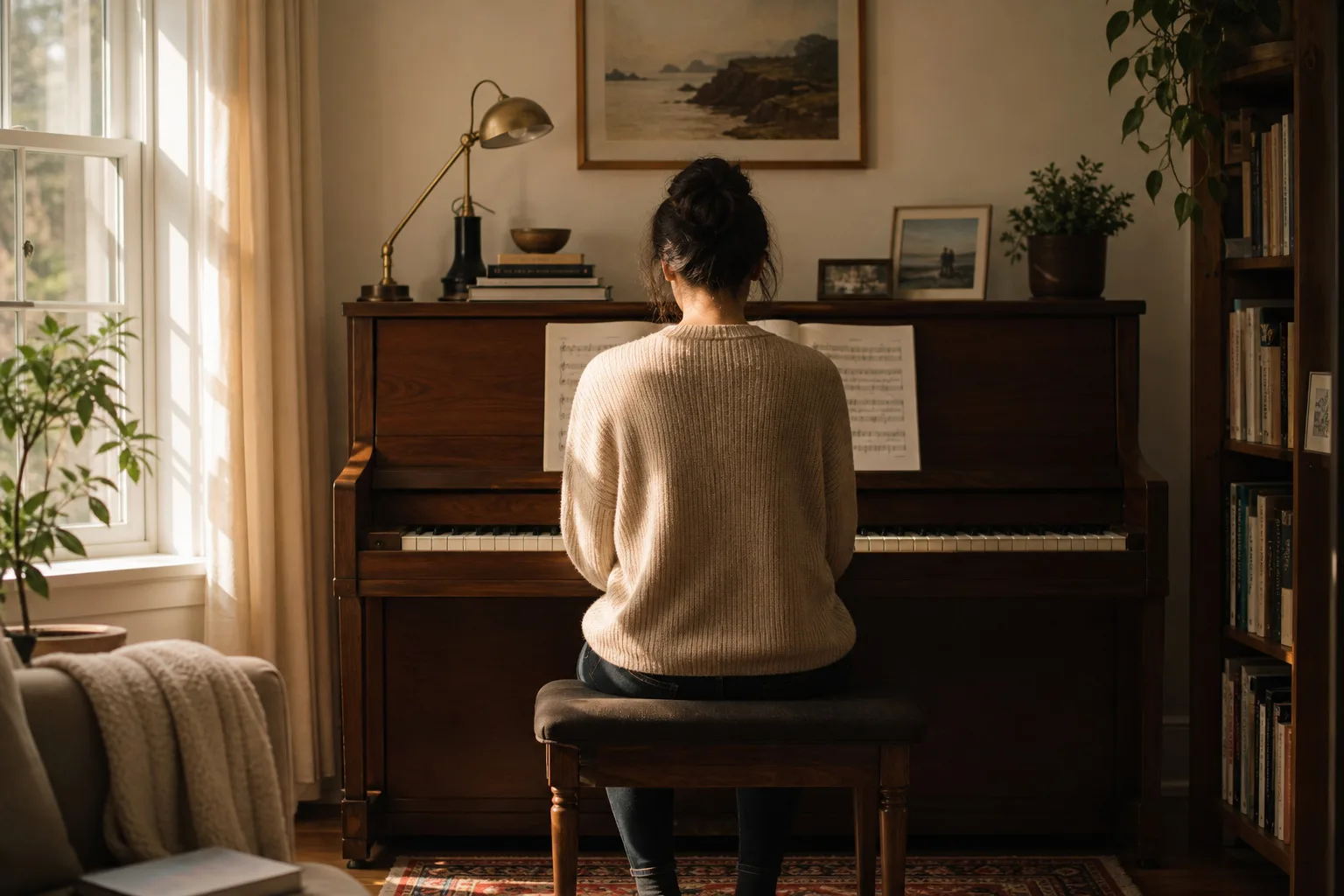
The short answer
Most adults who practice 20–30 minutes a day can play simple, satisfying music within 2–3 months, play recognizable songs they love within 6–12 months, and reach a confident intermediate level, where they can learn most pop songs and easier classical pieces on their own, in 2–4 years. These are typical ranges for steady practice, not guarantees.
It’s the first question almost every adult asks me before their first lesson: “Realistically… how long is this going to take?” And it deserves a real answer, not a sales pitch. After more than ten years at the piano and hundreds of students, many of them adults who started from zero, here’s the honest timeline, milestone by milestone.
Mastery is a lifelong road, but “I can really play the piano” arrives much sooner than most people expect. A free 30-minute trial lesson gives you a skill check and a plan with a book list, no card required.
What is a realistic piano timeline for an adult?
A realistic piano timeline for an adult practicing 20–30 minutes a day, five or six days a week, is a first two-hand song in 4–8 weeks, reading simple sheet music in 3–6 months, playing from lead sheets in 12–24 months, and intermediate repertoire in 2–4 years. These are typical ranges, not promises.
The table also assumes some guidance, from weekly lessons or a structured course. Treat the ranges as a map, not a deadline.
| Milestone | What you can do | Typical range at 20–30 min/day |
|---|---|---|
| First two-hand song | Melody in the right hand, simple notes or chords in the left | 4–8 weeks |
| Reading simple sheet music | Read beginner pieces on the grand staff without writing in letter names | 3–6 months |
| Songs you actually love | Simplified arrangements of real songs | 6–12 months |
| Playing from lead sheets | Right-hand melody plus your own left-hand chords from chord symbols | 12–24 months |
| Early intermediate repertoire | Minuet in G from the Anna Magdalena Notebook, an easy Clementi sonatina | 18 months–3 years |
| Confident intermediate | Learn most pop songs and easier classical pieces on your own | 2–4 years |
| Advanced repertoire | Harder Chopin, Beethoven sonatas, full jazz voicings | 5+ years, then a lifelong road |
At 10–15 minutes a day, expect the long end of each range or beyond. At 45–60 minutes, you’ll often land near the short end, but doubling practice rarely halves the timeline, because part of the learning happens between sessions.
Expect at least one flat stretch in the first year where nothing seems to improve. That plateau is normal and usually breaks once your reading catches up.
What does the first year of piano look like for an adult?
An adult’s first year of piano usually moves through three stages: keyboard geography, rhythm and simple notation in months 1–3; scales, chords and left-hand accompaniment in months 3–6; and reading fluency, hand independence and pedaling in months 6–12. Each stage builds directly on the skills from the one before it.
Months 1–3: foundations that feel like progress
In the first weeks you’ll learn keyboard geography, basic rhythm, and how to read simple notation. With a good teacher you’ll be playing short pieces hands-together within the first month or two. Adults often outpace kids here: you understand instructions faster, you see the patterns, and nobody has to remind you why you’re practicing.
That means finger numbers, middle C and nearby landmark notes, whole, half and quarter notes, and counting out loud.
Months 3–6: your first “real” songs
This is where five-finger patterns give way to scales, chords, and left-hand accompaniment, the building blocks of nearly every song you’ve ever heard. Students at this stage start playing simplified arrangements of real repertoire: a Beatles tune, a film theme, an easy classical melody.
Expect C, G and F major scales, the C, F and G chords, and a simple I–IV–V progression.
Months 6–12: momentum
By the end of a consistent first year, most of my adult students can read music comfortably at a beginner-intermediate level, play with both hands independently, use the sustain pedal, and perform a handful of pieces they’re genuinely proud of. That’s usually the moment the question changes from “how long will this take?” to “what should I learn next?”
What speeds up or slows down learning piano as an adult?
Four factors control how fast an adult learns piano: how consistently you practice, whether a teacher is guiding you, how clearly you’ve defined your goal, and whether you follow a structured path. The most common slowdowns are practicing in weekend bursts, rushing tempos, hidden hand tension and learning songs only by imitation.
1. Consistency beats duration
Twenty focused minutes a day will outrun a single two-hour Sunday marathon every time. Piano skill is built by frequent, spaced repetition, and your hands learn while you sleep. If you can protect 15–30 minutes most days, you’re on the fast track.
2. Guidance
Self-taught learners can absolutely make progress, but they tend to plateau early, usually because of technique habits that make faster music physically impossible later. A teacher spots those in week two instead of year two. (It’s the single biggest reason students who take lessons move faster.)
3. Your goals
“Learn piano” means different things. Playing simple chord accompaniments for singalongs is a 3–6 month goal. Playing Chopin is a multi-year goal. Neither is better, but knowing your target changes the route, which is why I build a personalized plan for every student instead of marching everyone through the same book.
4. A structured path
Random YouTube tutorials teach you songs; a curriculum teaches you the instrument. Working through a sequenced course, like the four-level lesson path my students use between lessons, means every new piece builds on the last one instead of starting from scratch.
What slows adults down the most?
- Weekend-only practice. Two long sessions a week means relearning what faded in between.
- Rushing the tempo. Playing faster than your hands know a passage rehearses the mistakes too.
- Hidden tension. Tight wrists feel fine in slow pieces, then cap your speed later.
- Learning only from letter names or falling-note videos. Songs come quickly, but reading never develops.
So can you speed this up? Yes: practice daily (even briefly), take regular lessons, and follow a structured curriculum. Those three together are the whole secret.
If you’re an adult wondering where you’d land on this timeline, one short skill check will tell you. Your first 30-minute lesson with Austin is free – no card, no pressure.
Is it harder to learn piano as an adult?
Learning piano as an adult isn’t harder overall, just different: children usually have more free time and less self-consciousness, while adults often move faster in the early months because they follow explanations quickly and recognize patterns. For most adults, the real obstacles to learning piano are time and perfectionism, not age.
The adult advantages nobody mentions
Adults constantly tell me they wish they’d started as a kid, and sure, early starts help. But adult learners have real advantages: you chose this, so motivation is built in; you understand music you’ve been listening to for decades; you can analyze patterns instead of memorizing blindly; and you can structure your own practice. I’ve watched a 60-year-old beginner outpace teenagers simply because she practiced with intention.
Where adults genuinely struggle
The honest downsides are practical, not biological. Adult brains keep learning new motor skills throughout life, a property called neuroplasticity. What gets in the way is time, since work and family eat practice first, and the gap between the music in your head and what your hands can do yet.
A pattern I see constantly: an adult plays a passage right twice, stumbles on the third try, and decides they’re “just not musical.” The fix is slowing down and shrinking the goal to one measure, not questioning talent.
How long does it take to learn piano with lessons vs self-taught?
Self-taught adults and adults taking lessons often reach a first simple song in roughly the same one to two months. The difference shows up later: self-taught learners are more likely to plateau in the first year on technique or reading, while students with regular lessons usually keep moving toward intermediate within the typical 2–4 year range.
Teaching yourself is completely possible. The catch is that you can’t see your own habits: a collapsed wrist, a thumb that never tucks under, or drifting counting all feel normal from the bench until faster music won’t come.
Here’s how the routes usually compare at the same 20–30 minutes a day:
- Self-taught with apps and videos: fast first songs, but reading and technique often lag, and first-year stalls are common.
- Weekly lessons plus daily practice: a similar early pace with fewer detours.
- Hybrid: lessons every week or two, a structured course between them, and apps for drills.
“I started as a complete beginner, and Austin made the learning process feel comfortable.” – Noah Peterson
If you’re weighing the options, my breakdown of piano lessons vs piano apps goes deeper on what each does well.
How much should an adult practice piano each day?
Most adult beginners progress well on 20–30 minutes of piano practice a day, five or six days a week, which is the amount the timeline above assumes. Fifteen focused minutes still works if it happens daily, but practicing fewer than three days a week usually means spending each session relearning the last one.
A simple 25-minute split that works for most adults:
- 3 minutes: warm up with a scale or five-finger pattern
- 10 minutes: the newest, hardest material, slowly, with a metronome
- 7 minutes: one or two trouble spots, isolated down to a measure or less
- 5 minutes: a piece you already play well, just for fun
Attaching practice to an existing habit, like morning coffee, keeps it consistent. For weekly templates built around work and family, see my piano practice schedule for adults.
Common questions
Can you learn to play piano as an adult with no musical background?
Yes, adults can learn piano with no musical background at all. Plenty of adult beginners start without knowing a single note name, and the first months of any good program teach keyboard layout, rhythm and reading from scratch. Steady practice of 20–30 minutes most days matters far more than any prior experience.
Am I too old to start piano?
No. I teach everyone from total beginners to advanced players, and some of my most dedicated students started after retirement. Hands stay teachable at every age. Older beginners may need gentler warm-ups and a little more patience with speed, but reading, chords and expressive playing stay within reach at any age.
Do I need a real piano to start?
A 61-key keyboard is fine for the first months, as long as it has full-size keys and sits at the right height. By the end of year one you’ll want 88 weighted keys for pedaling and dynamics, but don’t let equipment stop you from starting. A basic digital piano covers that upgrade.
How long does it take to get back into piano if I played as a kid?
Returning adults usually get back to their old level much faster than it took to learn the first time, often within a few months of steady practice, because reading and finger patterns come back quickly. Old technique habits may need a refresh. My guide to getting back into piano as an adult covers where to restart.
How long does it take to learn one specific song?
A beginner-level arrangement of a song usually takes one to three weeks at 20–30 minutes a day, while an intermediate piece can take one to three months. The arrangement’s difficulty matters more than the song itself, which is why my VIP lessons include custom arrangements written at your level and rewritten harder as you improve.
Six months from now you could be playing music you love, or you could still be wondering how long it takes. The timeline starts when you do.
Ready to start your own timeline?
The fastest way to know your own timeline is to sit down at the keys with a teacher. Your first 30-minute lesson with me is completely free – we will evaluate where you are, talk through your goals, and map out your path.
Leave a Reply