
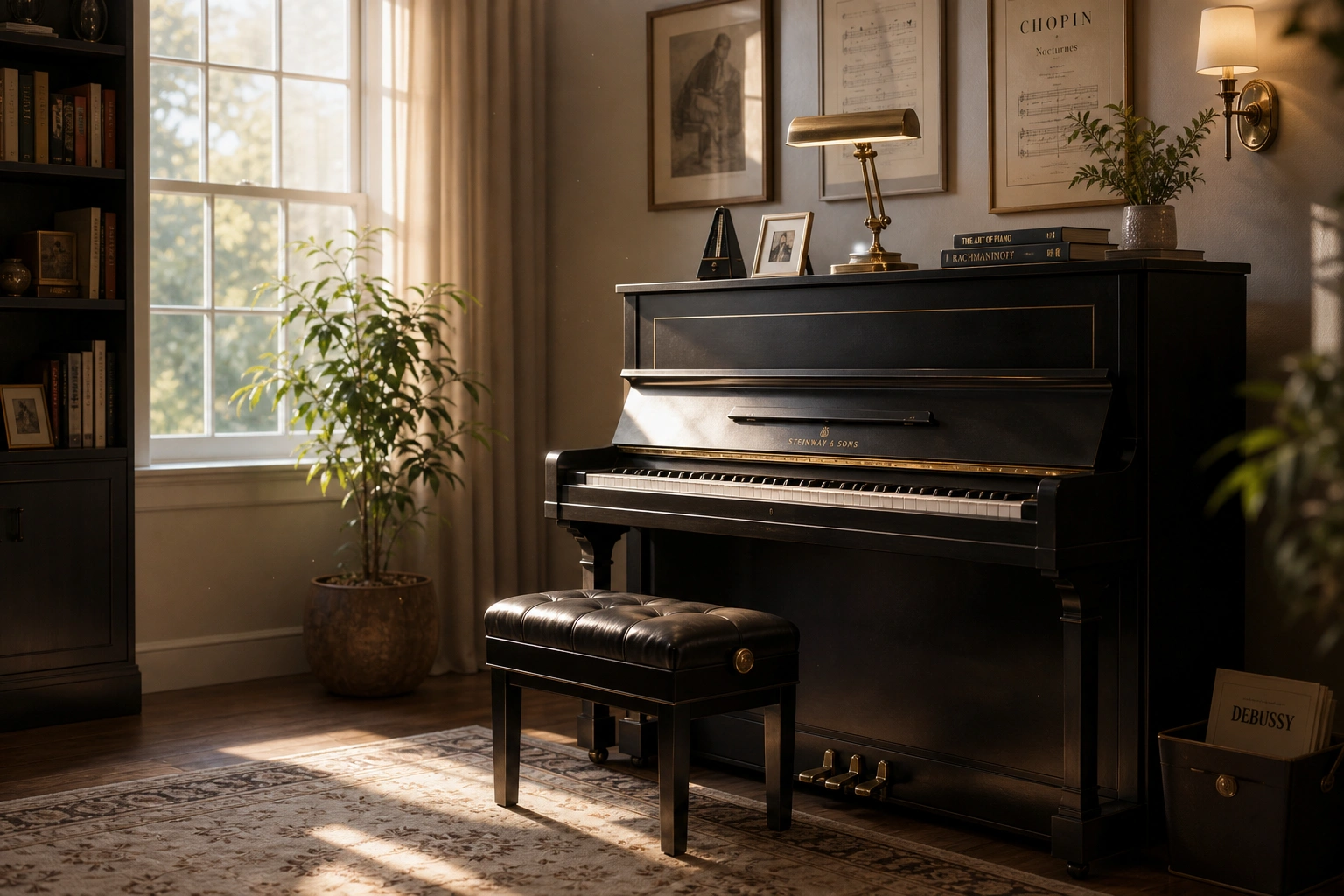
The short answer
You memorize piano notes by learning landmark keys first (the C, F, and G groups), using the pattern of two-black-key and three-black-key clusters to find every other note by relation, then drilling small sections daily until your eyes stop searching. Most beginners can name any key on sight within 2-3 weeks of 10 minutes of daily practice. If you want a faster, more personalized path, a 60-minute first lesson for $29 can map out exactly where your gaps are.
Why is memorizing piano notes so hard for beginners?
Memorizing piano notes feels hard because beginners try to memorize 52 white and black keys as 52 separate, unrelated facts instead of recognizing that the keyboard repeats the same 12-note pattern over and over. Once a student sees the repetition, the “52 facts” problem shrinks to just one pattern memorized seven or eight times.
I see this mistake constantly in first lessons: a student stares at middle C like it’s a stranger every single time, counting up from the far left edge of the keyboard. That’s slow and exhausting, and it falls apart under any tempo. The fix isn’t more memorization – it’s a better strategy.
Here’s what actually makes it difficult:
- There’s no visual separation between note names – every C looks identical to every other white key at a glance.
- Students try to learn all 88 keys at once instead of chunking them into groups.
- Most people skip connecting the keyboard to the staff, so they can play by rote but can’t read or recall note names cold.
What is the fastest way to learn the piano keys?
The fastest way to learn piano keys is the landmark method: find middle C using the group of two black keys, then use every group of two and three black keys as a reference point to locate C, D, E, F, G, A, and B anywhere on the keyboard without counting from the end. This is how I teach every new student, adult or child, starting week one.
Here’s the logic, step by step:
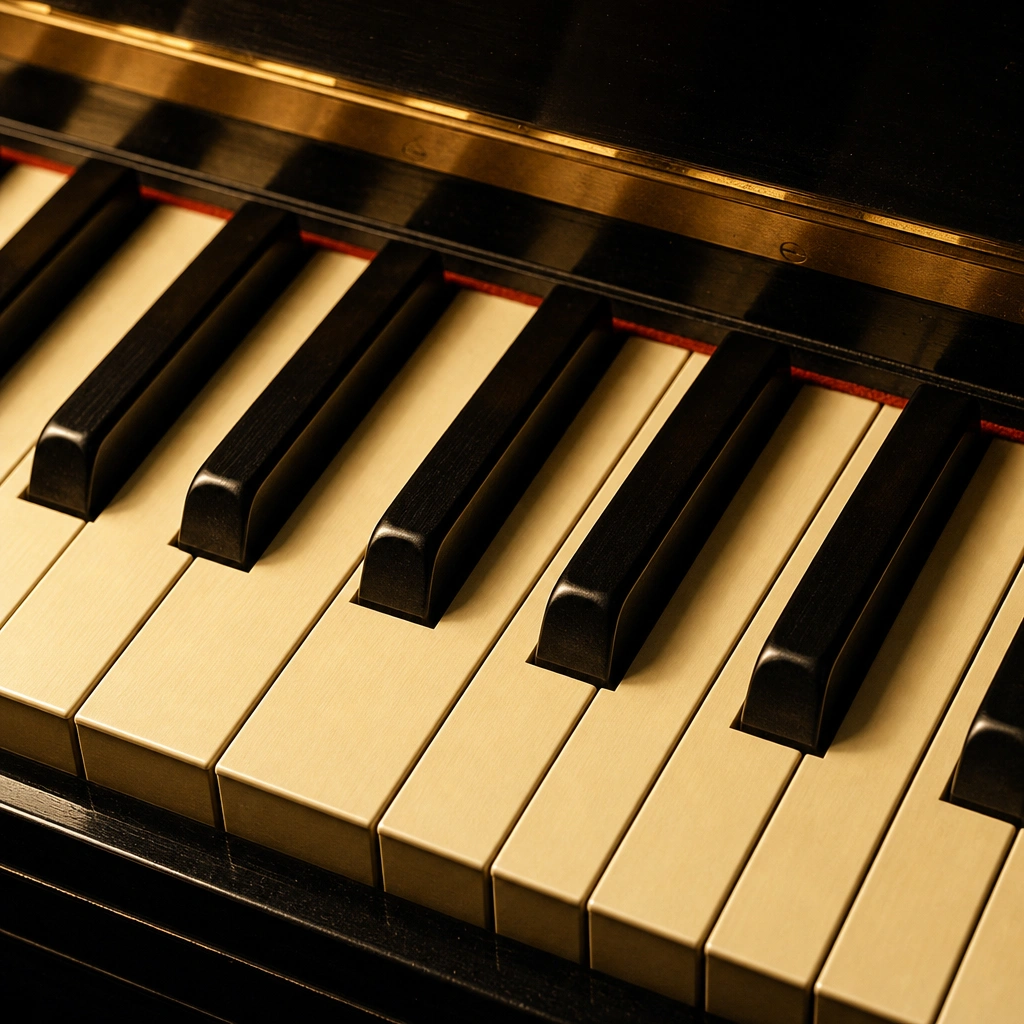
- Find any group of two black keys. The white key immediately to the left of that group is always C.
- The white key between the two black keys is always D.
- The white key immediately to the right of the two-black-key group is always E.
- Find any group of three black keys. The white key immediately to the left is always F, and the white key immediately to the right is always B.
- The two white keys sandwiched between the three black keys are G and A, in that order.
Once a student can spot both black-key groupings instantly, every white key becomes identifiable in under a second – no counting required. I had a seven-year-old student, Lila, nail this in a single 30-minute lesson using only the “two keys, three keys” language. By the next week she was naming random keys faster than I could point to them.
How do you memorize the white keys and black keys separately?
You memorize white keys by their position relative to the black key groups, and you memorize black keys by naming them as sharps or flats of their white-key neighbors – for example, the black key right after C is C-sharp, and the same key is also D-flat. Treating black keys as “extra” notes rather than separate ones cuts the memorization load in half.
A few things that make this click faster:
- Say the note names out loud while you point, don’t just think them. Verbalizing speeds up recall more than silent repetition.
- Practice in both directions – going up the keyboard and coming back down. Most students only drill upward and get stuck when asked to go the other way.
- Start in one octave near middle C before expanding outward. Trying to memorize the whole keyboard at once overwhelms short-term memory.
One common error: students assume every black key only has one name. In reality, context decides whether you call it a sharp or a flat, and that’s a theory conversation worth having once the keys themselves are automatic – our piano scales guide gets into that naming logic in more depth.
If you’ve been stalling out trying to memorize the keyboard on your own, a second set of eyes can spot exactly which landmarks you’re missing. Your first lesson with Austin is a full 60 minutes for just $29 (normally $99). Love it, or it’s on us.
How do you memorize notes on the staff and connect them to the keys?
You memorize staff notes by learning the five lines and four spaces of each clef with a short mnemonic, then immediately matching each staff note to its matching key on the keyboard rather than memorizing the two systems separately. Students who learn staff reading and keyboard geography together retain both far longer than students who learn them in isolation.
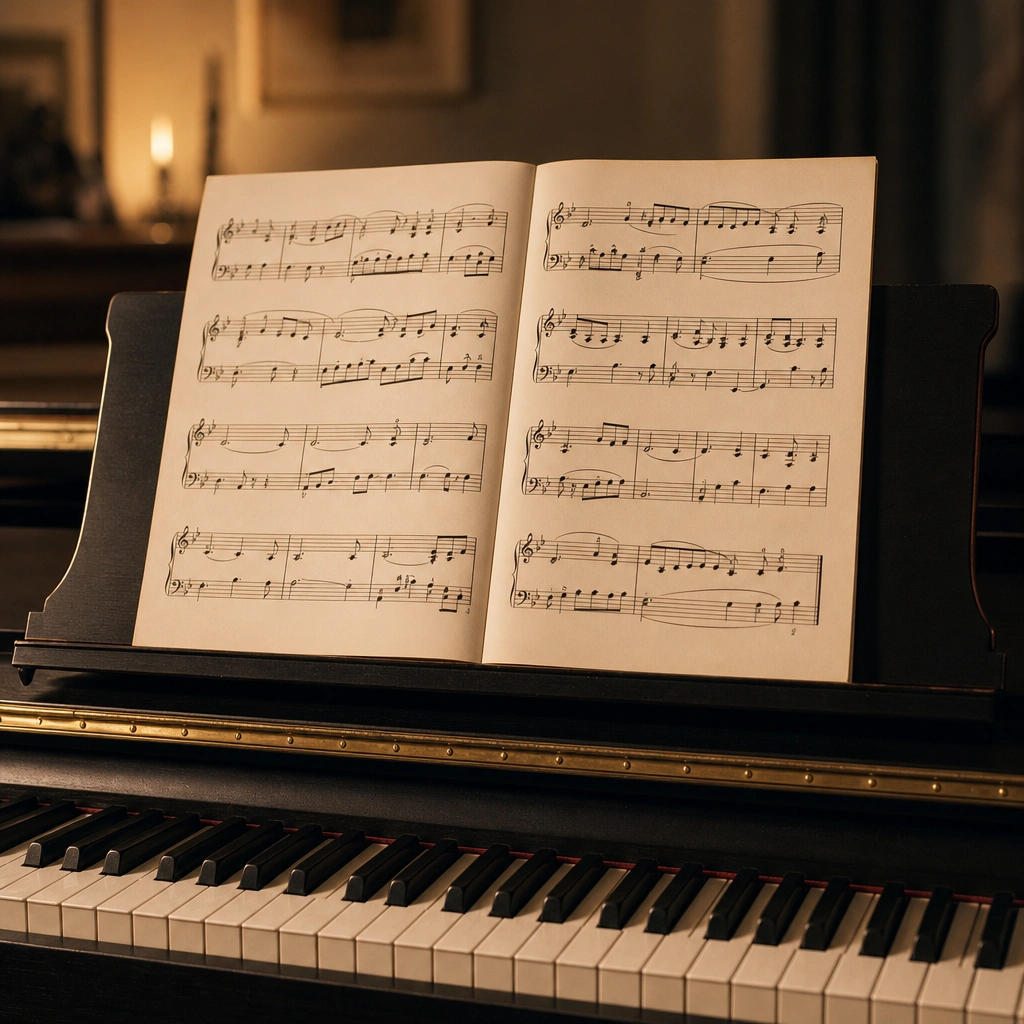
For the treble clef, the lines (bottom to top) are E-G-B-D-F, often remembered as “Every Good Boy Does Fine.” The spaces spell F-A-C-E. For the bass clef, the lines are G-B-D-F-A (“Good Boys Do Fine Always”) and the spaces are A-C-E-G (“All Cows Eat Grass”).
The step most beginners skip: after naming a staff note, physically find it on the keyboard before moving to the next one. I ask students to point and say the note name out loud every single time, even after they think they know it. That one habit builds the staff-to-keys connection far faster than flashcards alone.
How long does it actually take to memorize all the piano notes?
Most of my students can reliably name any white key on the keyboard within 1-2 weeks of practicing 10 minutes a day, and they add confident recall of sharps and flats within another 1-2 weeks after that. Full staff-to-keyboard fluency, where reading and playing happen without conscious translation, typically takes 2-3 months of regular lessons and practice.
A few honest caveats based on what I’ve actually seen:
- Kids under eight often need a few extra weeks because fine motor coordination lags behind pattern recognition – they know the note but haven’t found the key yet.
- Adults usually memorize faster intellectually but need more repetition to make recall automatic under time pressure.
- Daily short sessions beat weekly long ones every time. Ten minutes a day outperforms one 70-minute cram session, in my experience, by a wide margin.
“I started as a complete beginner, and Austin made the learning process feel comfortable.” – Noah Peterson
If you’re working through this with a child, our guide on motivating kids to practice covers how to keep these short daily sessions from feeling like a chore.
What drills help the notes stick for good?
The drills that make piano notes stick combine random-order recall, timed naming, and small staff-reading sets rather than slow, linear repetition from A to G. Memory sticks best when it’s tested under mild pressure, not when it’s passively reviewed.
Three drills I assign constantly:
- Random key-naming: Close your eyes, open them, point to any key, and name it out loud in under 2 seconds. Repeat for 5 minutes a day.
- Staff flash sweep: Flip through 10 random staff notes (flashcards or an app) and name each one, then immediately find it on the keyboard.
- Octave jump drill: Name a note, then find that same letter name in three different octaves across the keyboard as fast as you can.
Avoid the trap of only ever starting from middle C. If every drill begins in the same spot, you’re memorizing a sequence, not the notes themselves. Mix your starting point every time. For hands-on reinforcement once notes feel solid, pairing this with simple two-hand pieces – see our guide on playing piano with both hands – locks the learning in through actual repertoire instead of isolated drills.
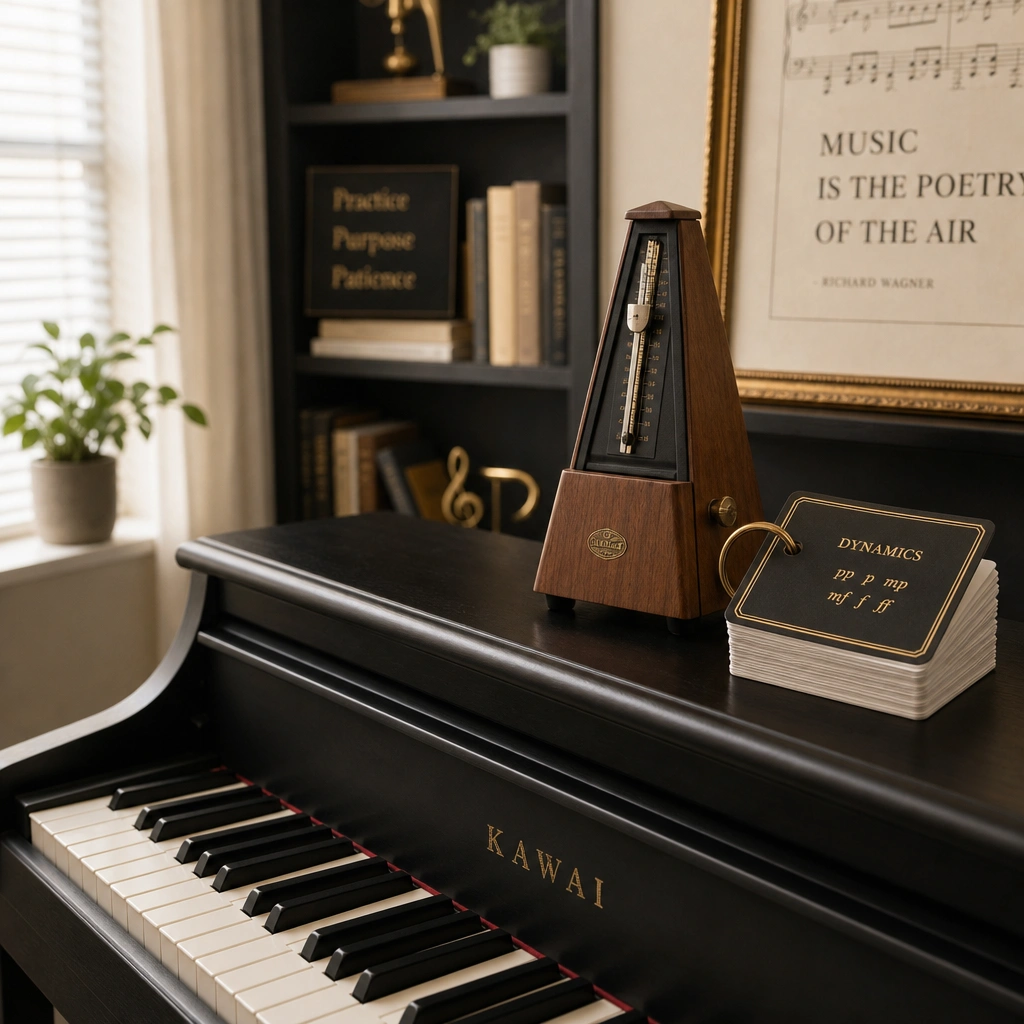
A metronome set at a slow, steady tempo can also add gentle time pressure to these drills once you’re comfortable – you can read more about how a metronome works if you’re new to using one.
Common questions
Is it better to memorize notes by letter name or by finger number?
Letter names, not finger numbers. Finger numbers change depending on the piece and hand position, but a note’s letter name never changes. Students who rely on finger numbers often freeze when a new piece uses different fingering, while students who know letter names can adapt instantly to any music.
Do I need to memorize notes in both treble and bass clef at the same time?
Not necessarily. I usually introduce treble clef first since most early right-hand melodies live there, then layer in bass clef once treble feels automatic, typically after 2-3 weeks. Learning both at once can work for highly motivated adults, but most students retain more by sequencing them.
Can apps replace a teacher for learning piano note names?
Apps are genuinely useful for repetition and flashcard-style drilling, but they can’t catch posture issues, hand position problems, or tell you why a note keeps tripping you up. I use apps as a supplement with my students, never as the main method – live feedback catches mistakes apps simply can’t see.
Why do I keep mixing up F and G, or C and D?
This almost always means you’re still counting from the edge of the keyboard instead of using the black-key landmarks. Go back to the two-black-key and three-black-key groupings and practice identifying those groups first, before naming the white keys around them – the mix-ups usually clear up within a few days.
Does learning note names help with playing by ear?
Indirectly, yes. Knowing note names gives you a vocabulary to describe what you’re hearing, which speeds up transcribing melodies and understanding chord structures later. It’s not a requirement for playing by ear, but nearly every strong ear-player I’ve taught also has solid note-name fluency underneath it.
Should adults and kids memorize piano notes differently?
The core method is the same for both, but pacing differs. Kids often benefit from games, songs, and visual flashcards, while adults tend to prefer structured drills and direct explanation of the logic. At Weaver Music I adjust the approach per student rather than using one fixed system for every age.
Whether you’re a parent helping a child get started or an adult coming back to piano after years away, Weaver Music lessons happen live, one-on-one over Zoom, and are built around the music you actually want to play – no in-person option, just focused, personalized time. Lessons run $60 for 30 minutes, $80 for 45 minutes, or $99 for a full hour, and every new student starts with a 60-minute first lesson for $29, paid after the lesson.
Ready to find out for yourself?
Your first lesson with me is a full 60 minutes for just $29 (normally $99). We will evaluate where you are, talk through your goals, and map out your path.