
The short answer
Beginners should learn C major, G major, F major, and A minor first, because these four chords share the most notes with each other and appear in hundreds of simple songs. Most of my students can play all four cleanly within two to three weeks of daily practice, then start combining them into real progressions.
If you’d rather have someone walk through this with you note by note, a 60-minute first lesson for $29 is a low-pressure way to get a skill check and a book list before you spend a dollar on materials.
Why do these chords come first?
Teachers start beginners on C major, G major, F major, and A minor because these four triads use mostly white keys, share common tones, and form the backbone of thousands of pop, folk, and hymn songs. Learning them first builds hand shapes that transfer directly to nearly every other chord a student will meet later.
Here’s the logic behind the order, in plain terms:
- C major (C-E-G) has zero sharps or flats, so a beginner can find it by sight on the keyboard without thinking about key signatures.
- G major (G-B-D) is a perfect fifth above C and shares a similar hand shape, just shifted over.
- F major (F-A-C) introduces the first real stretch and the first black key many students touch in a chord (if played with a flat, though the basic triad is F-A-C, all white keys).
- A minor (A-C-E) is the relative minor of C major, built from the exact same notes, just starting on a different root.
Once a student is comfortable moving between these four, they already have enough vocabulary to play a surprising number of real songs. I tell parents this constantly: kids don’t need 20 chords to feel like musicians, they need four chords played confidently and musically.
What are C major and G major and why do teachers start there?
C major and G major are the two most common starting chords for beginners because C major has no black keys and G major sits a fifth higher using a nearly identical hand shape. Together they let a new student play simple two-chord songs within the very first week of lessons.
C major is built from C, E, and G. If a student can already find middle C, they simply stack a note two keys up and another two keys above that. G major is built from G, B, and D, and uses the same “every other white key” pattern, just moved to a new starting point.
I ask brand-new students to play C major and G major back and forth, slowly, for about five minutes a day for the first week. One of my students, a 9-year-old named Leo, had his first “aha” moment doing exactly this drill. He said the switch between the two chords finally felt automatic instead of something he had to search for.
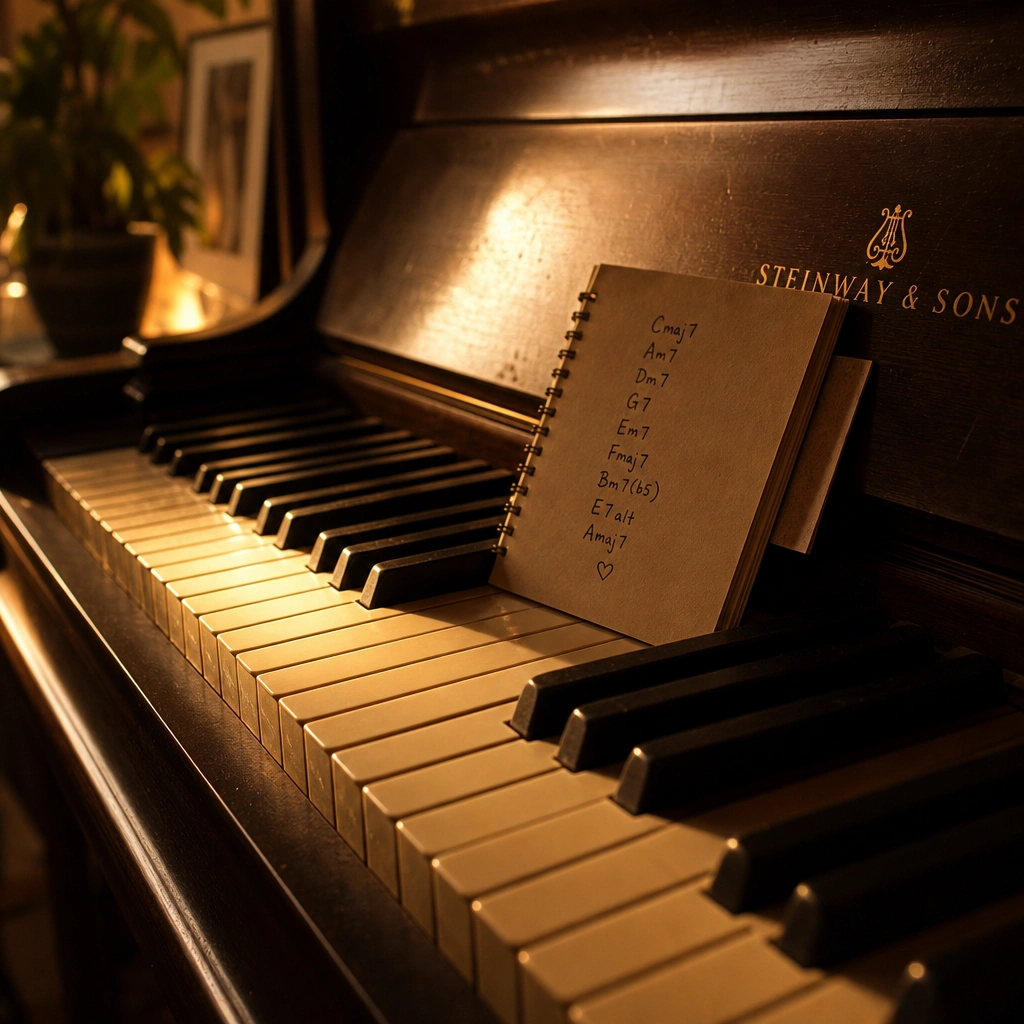
This pairing also sets up students for reading chord symbols above sheet music later, which is covered in more detail in our guide on how to read chord symbols on piano.
When should beginners add minor chords?
Beginners should add A minor as their first minor chord once C major and G major feel comfortable, usually within the second or third week of practice. A minor uses the same three notes as C major, just rearranged, so it rarely feels like learning something brand new.
After A minor, the next minor chords worth learning are E minor and D minor, because both pair naturally with the major chords already in a student’s hands. A simple four-chord loop of C, G, A minor, and F covers an enormous number of pop songs written in the last 60 years.
Minor chords also give beginners their first real taste of musical emotion. I’ve had adult students describe the moment they played A minor for the first time as the point where piano “started sounding like music” instead of an exercise.
If you want a teacher to check your hand shape and chord progressions in real time, that’s exactly what the trial lesson is for. Your first lesson with Austin is a full 60 minutes for just $29 (normally $99). Love it, or it’s on us.
How long does it actually take to learn basic piano chords?
Most beginners can play C major, G major, F major, and A minor cleanly within two to three weeks, practicing about 15-20 minutes a day. Playing those same chords smoothly inside a real song, with both hands coordinated, typically takes four to six weeks.
These numbers come from working with hundreds of students across every age group, not a guess. A motivated adult practicing daily often hits the four-chord milestone faster than a child practicing three times a week, simply because of repetition volume, not talent.
A few honest benchmarks I use with my own students:
- Week 1: find and name each chord without hesitation.
- Week 2: switch between two chords without looking down.
- Week 3-4: play a simple progression (C-G-Am-F) in steady rhythm.
- Week 5-6: add the left hand playing roots while the right hand holds chords.
Students who skip straight to songs without this groundwork tend to stall later, because they never built the muscle memory for the shapes themselves. This is also where coordinating both hands becomes relevant, and our piece on how to play piano with both hands picks up right where chord practice leaves off.
In what order should a beginner practice these chords?
Beginners should practice chords in this order: C major, G major, A minor, F major, E minor, then D minor, moving to the next chord only once the current one feels automatic under the fingers. This sequence keeps each new chord close in shape or sound to the one before it.
A practice routine I give almost every new student looks like this:
- Play the chord five times slowly, saying the note names out loud.
- Play it in rhythm with a metronome at a slow, steady tempo.
- Switch between it and the previous chord ten times without stopping.
- Play a one-minute improvised pattern using only the chords learned so far.
I’ve watched students try to rush this by learning all six chords in one sitting. It almost never sticks. The ones who spend an extra two or three days on a single chord before moving forward end up faster overall, because they’re not constantly re-learning shapes they half-remember.
“I started as a complete beginner, and Austin made the learning process feel comfortable.” – Noah Peterson
This slower, layered approach is also why scales matter early on, since the finger patterns overlap heavily with chord shapes. More on that in our article on why learn piano scales.
What mistakes do beginners make with chords?
The most common beginner mistake with chords is pressing all three notes at slightly different times instead of together, which makes even a correct chord sound sloppy. The second most common mistake is tensing the wrist and forearm while reaching for the notes, which slows down every chord change that follows.
A few other patterns I see constantly in lessons:
- Looking at the keys for every single chord change instead of learning the hand shape by feel.
- Learning chords in isolation but never practicing switching between them.
- Pressing too hard, which tires the hand and often comes from tension rather than needed volume.
- Skipping minor chords because they feel “less important” than major ones.

One adult student, a nurse who started lessons after a 20-year break from piano, kept rushing her chord changes and losing the beat. We slowed her metronome down to a near-crawl for a week, and the sloppiness disappeared almost overnight. Slower, correct practice beats fast, messy practice every time.
If you’re building a practice habit around this, our guide on Italian tempo markings is a useful next stop once you’re reading chord symbols alongside tempo markings on a page.
Common questions
Do I need to learn to read sheet music to play chords?
No. Many beginners learn chords from chord charts or lead sheets long before they read traditional notation fluently. Reading music does help long-term, but it’s entirely possible to play songs confidently using just chord symbols and a good ear for rhythm.
What’s the difference between a chord and a triad?
A triad is a specific type of chord made of three stacked notes, usually a root, a third, and a fifth. Every triad is a chord, but not every chord is a triad, since some chords add a fourth note, like sevenths, for extra color.
Can I learn chords on a keyboard instead of a real piano?
Yes, a full-size 61-key or 88-key keyboard with weighted or semi-weighted keys works fine for learning chords. What matters most is consistent key spacing so the hand shapes transfer correctly to a full piano later.
Should kids and adults learn chords differently?
The chords themselves don’t change, but pacing often does. Kids usually benefit from shorter, more playful practice chunks, while adults can often handle longer focused sessions and move through the four core chords a bit faster.
Are these chords the same ones used in guitar?
The underlying notes are identical, since C major is C major on any instrument. The shapes and fingerings are completely different between piano and guitar, so there isn’t much physical crossover, even though the music theory behind them is the same.
What should I learn after these four or five chords?
After C, G, A minor, F, and E minor feel solid, most students move on to seventh chords and inversions, which add richness without requiring new note names. This is also a natural point to start learning simple full songs rather than isolated chord drills.
Ready to find out for yourself?
Your first lesson with me is a full 60 minutes for just $29 (normally $99). We will evaluate where you are, talk through your goals, and map out your path.