The short answer
Yes, you can teach yourself piano, and plenty of people do it well enough to play songs they love within months. Self-teaching works best for motivated adults with realistic goals, access to good method books or video lessons, and patience to slow down. It works worst for building reading fluency, rhythm precision, and tension-free technique, which is where a teacher usually pays for itself fast.
I’ve watched self-taught students walk into a first lesson already playing three or four songs by ear, which is genuinely impressive. The honest truth is that self-teaching and lessons aren’t enemies. They’re two tools, and knowing which one you’re using at any given moment matters more than picking a side.
What do self-taught players usually get right?
Self-taught players usually get motivation, repertoire choice, and ear training right. They pick songs they actually care about, they practice more consistently because the material is personal, and years of casual listening often give them a decent sense of rhythm and feel before they ever open a book.
I’ve had adult students show up for a trial lesson already able to play a Coldplay song or a hymn from church, entirely by ear, with zero formal instruction. That’s a real skill. It usually means they have good pitch recognition and patience, two things I can’t teach from scratch in a single lesson.
- Strong song selection: self-taught players gravitate toward music that keeps them motivated, which is half the battle in year one.
- Decent rhythmic feel from years of listening to music casually, even without formal counting.
- Comfort experimenting: many self-taught players will noodle around and discover chord shapes or simple improvisations nobody showed them.
- Realistic pacing on songs they’re emotionally invested in, since nobody is pushing them past their comfort zone.
What habits do self-taught players usually miss?
Self-taught players most commonly miss consistent fingering, accurate rhythm under a metronome, physical tension in the hands and wrists, and real sight-reading ability. These four gaps rarely show up on their own; they surface only when someone points them out, which is exactly the problem with learning entirely alone.
Fingering is the big one. I see students who’ve taught themselves a full song using three fingers because it felt natural in the moment, with no system behind it. It works for that one song, then falls apart the instant they try something new, because they never built a repeatable fingering logic.
- Fingering: inconsistent finger choices that work for one passage but collapse under new music.
- Rhythm: playing “close enough” instead of locking in against a metronome, especially with syncopation or rests.
- Tension: hunched shoulders, locked wrists, and a death grip on the keys that causes fatigue or even pain over time.
- Reading: many self-taught players memorize by ear or by watching tutorial videos and never actually learn to read notation fluently.
One student I worked with, a software engineer in his thirties, had taught himself about fifteen songs from YouTube over two years. He played with real feeling, but every single song used the same two fingers for the right hand melody. Once we rebuilt his fingering from scratch, his sight-reading speed and learning pace roughly doubled within a few months. That one fix unlocked everything else.
Tension is sneaky because it doesn’t hurt until it does. I’ve had self-taught adults come in with wrist strain from months of playing with locked, flat wrists, a habit a teacher usually catches in the first five minutes just by watching.
How far can method books and YouTube actually take you?
Method books and YouTube videos can take a motivated beginner to a solid intermediate level on specific songs, roughly the point where someone can play simplified arrangements of favorite songs with both hands after six to twelve months of regular practice. They rarely build the deeper theory and reading skills needed for more advanced or varied repertoire.
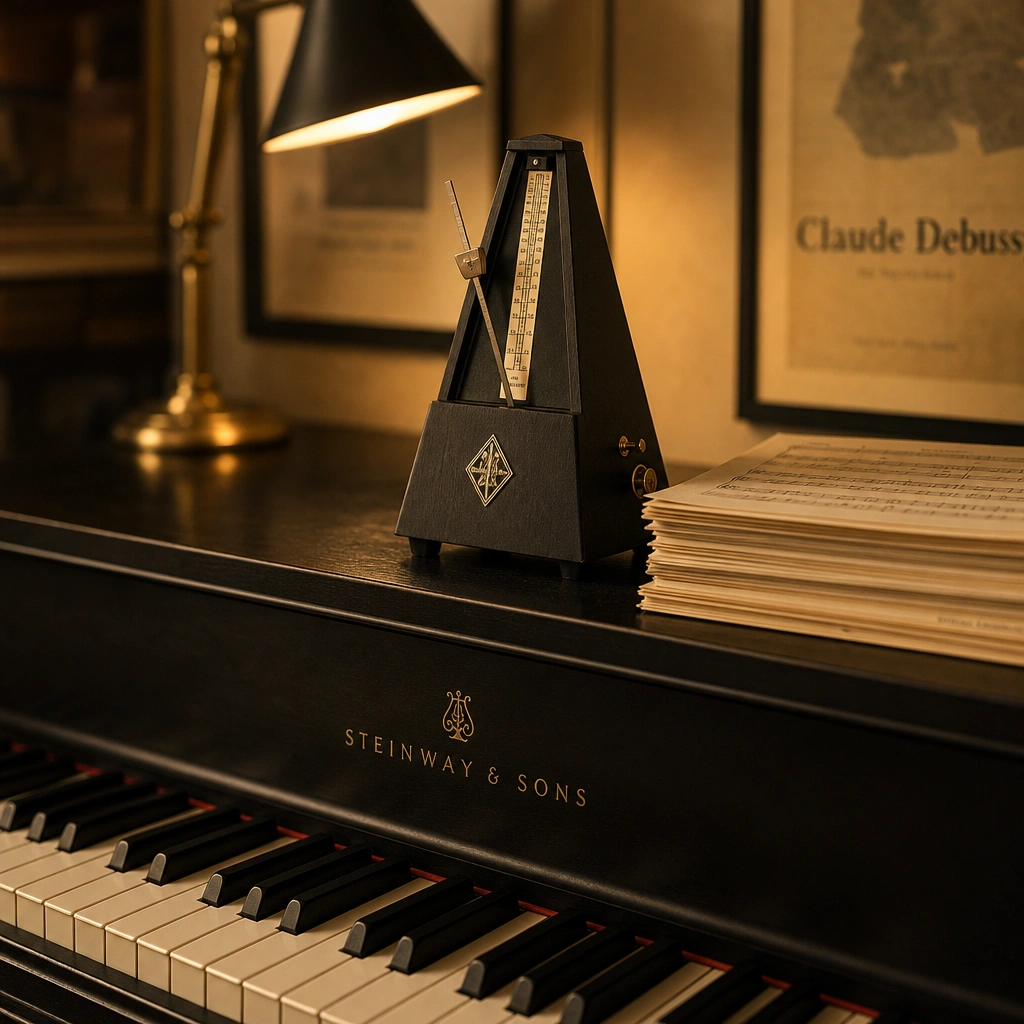
Method books like the classic graded series are genuinely well designed for sequencing. YouTube tutorials are fantastic for learning one specific song quickly, which is why they’re so popular. The limitation is that neither format adapts to you. A book doesn’t notice you’re tensing your shoulders. A video can’t tell you that your tempo keeps dragging in measure twelve.
If you’re weighing self-teaching against structured lessons specifically around apps, that’s a slightly different comparison with its own tradeoffs, which I cover in detail in piano lessons vs. piano apps.
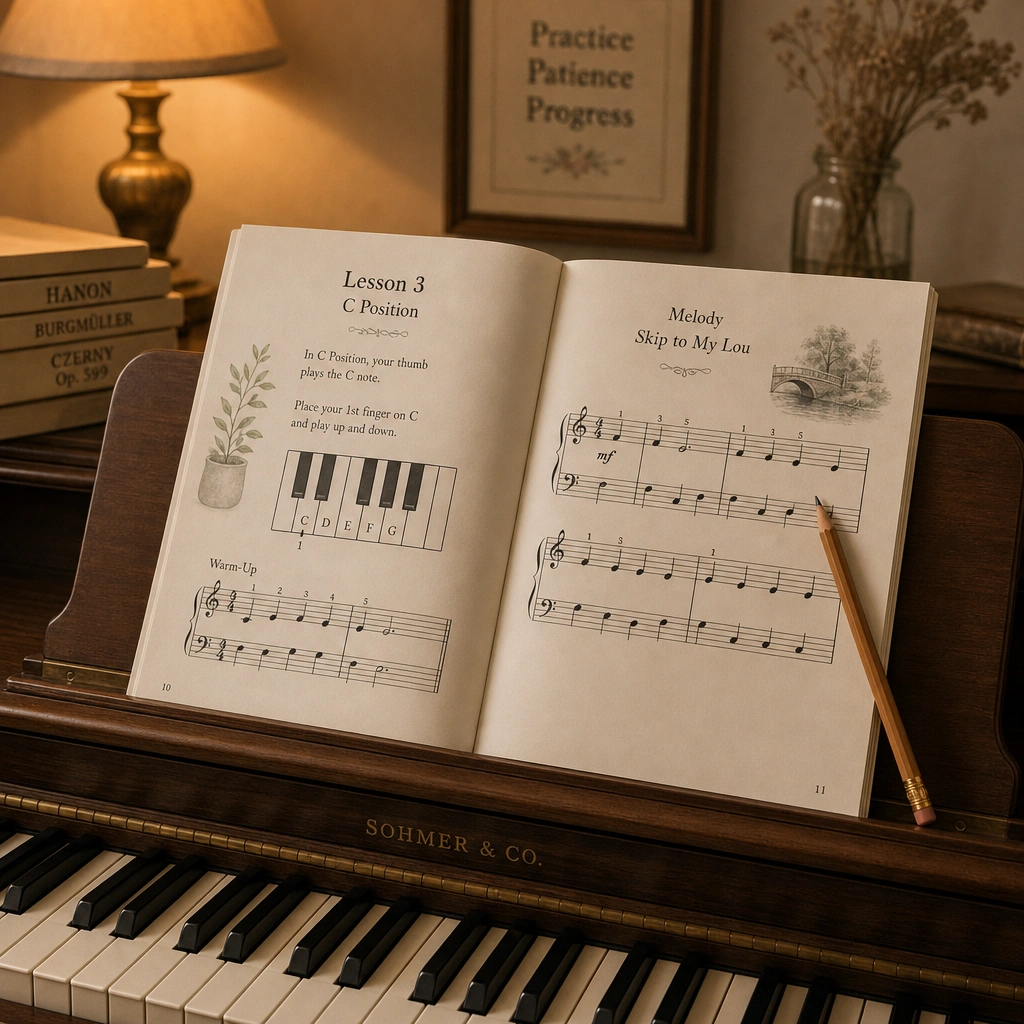
For basics like note names or chord reading, self-teaching resources are often genuinely sufficient. If you want a head start there, see basic piano chords for beginners or how to memorize piano notes.
When does a teacher actually save you time?
A teacher saves the most time when a student has hit a plateau, developed a physical habit that’s starting to hurt, or wants to play music that requires skills they don’t have yet, like reading two staves at once or playing with both hands independently. In my experience, a single focused lesson can fix a habit that would otherwise take months to notice alone.
Coordinating both hands is one of the most common walls self-taught players hit. It’s covered in more depth in how to play piano with both hands, but the short version is that it rarely improves just from repetition if the underlying coordination habit is wrong.
If you’ve hit a wall teaching yourself and want an outside pair of ears to catch what you can’t hear in your own playing, that’s exactly what a trial lesson is for. Your first lesson with Austin is a full 60 minutes for just $29 (normally $99). Love it, or it’s on us.
Can you mix self-teaching with occasional lessons?
Yes, mixing self-teaching with occasional lessons works well for many students, especially adults who want to keep practicing independently between sessions while getting periodic feedback to correct habits before they set in. Weaver Music lessons run live, one-on-one over Zoom only, at $60 for 30 minutes, $80 for 45 minutes, or $99 for a full hour, built around whatever music the student actually wants to learn.
This hybrid approach tends to work especially well for adults returning to piano after years away, or busy parents who can only commit to one lesson every few weeks. Every new student starts with a 60-minute first lesson for $29: a skill check, questions answered, and a plan with a book list, paid after the lesson.
“I started as a complete beginner, and Austin made the learning process feel comfortable.” – Noah Peterson
If you’re a parent weighing this for a child rather than yourself, the dynamics shift quite a bit. Motivation and practice habits matter more than raw self-teaching ability at that age; I go into that in how to motivate a child to practice piano.
And if age is part of your hesitation about starting at all, self-taught or otherwise, that worry comes up constantly and is almost always unfounded. See is it too late to learn piano for more on that.
Common questions
Do I need to read sheet music to teach myself piano?
No, you can teach yourself piano by ear or with chord charts and never learn traditional notation. You’ll be able to play songs you know well, but you’ll struggle with new or complex music that requires reading, and progress will slow once simple tutorials run out.
Is it harder to unlearn bad habits later than to learn correctly from the start?
Generally yes. A habit practiced for six months, like incorrect fingering or a tense wrist, takes real repetition to replace, sometimes longer than it would have taken to learn it correctly the first time. This is the main argument for even a few early lessons.
Can adults realistically teach themselves piano, or is it mostly a kids’ thing?
Adults can absolutely teach themselves piano, often more successfully than children, because they’re self-directed and can read instructions critically. Motivated adults frequently make faster early progress alone than kids do, though the same gaps in fingering and reading still show up.
What’s the fastest way to tell if I’m developing bad technique on my own?
Watch for wrist or forearm soreness after practicing, a strong preference to avoid certain fingers, and consistently slowing down at the same spot in a piece. These are the three signals I check first in a trial lesson, and any one of them is worth addressing early.
Do self-taught pianists ever catch up to those who had lessons?
Yes, especially if they bring in a teacher once or twice to correct foundational habits before they’re deeply ingrained. The gap isn’t really about talent; it’s about which specific skills, like reading or rhythm accuracy, were built with feedback versus guesswork.
Should I start with a keyboard or an acoustic piano if I’m teaching myself?
Either works for starting out, though a keyboard with weighted keys more closely mimics acoustic piano touch and will serve you better long term. The instrument matters less than consistent practice in the first few months of self-teaching.
Ready to find out for yourself?
Your first lesson with me is a full 60 minutes for just $29 (normally $99). We will evaluate where you are, talk through your goals, and map out your path.