
The short answer
Piano lessons for ADHD kids can be a great fit when the lesson structure matches how the child’s attention actually works – short segments, built-in movement, clear routines, and visible goals. Piano is not a cure or a treatment for anything, but the format of the lesson matters far more than whether piano itself is “good” or “bad” for ADHD.
I’ve taught plenty of kids who were labeled “can’t sit still” by other adults, and most of them do just fine at the piano once the lesson is broken into pieces that fit their attention span. If you want to see how a specific child responds before committing to anything, a full 60-minute first lesson for $29 (paid after, only if you love it) is a low-pressure way to find out – there’s a skill check, real questions answered, and a plan built around that particular kid.
What about piano works well for kids with ADHD?
Piano works well for many kids with ADHD because it naturally breaks into small, concrete tasks – a four-bar phrase, a hand position, a rhythm pattern – that give quick wins instead of one long undifferentiated block of “practice.” The instrument also rewards movement, repetition, and immediate feedback, all of which play to common ADHD strengths rather than against them. The CHADD organization notes that structured, predictable routines with short, achievable steps tend to work better for kids with ADHD than open-ended or loosely timed activities, which lines up closely with what good piano lessons already look like.
- Immediate feedback: press a key, hear a result instantly – no waiting for a response.
- Physical engagement: both hands, both feet eventually, full-body coordination, not just sitting and listening.
- Clear, short goals: “get these four measures smooth” is finishable in minutes, not weeks.
- Visible progress: a song that didn’t work last week works this week – that’s tangible.
I had a nine-year-old student a few years back who could not sit through a 10-minute explanation of anything. We stopped trying. Instead I’d give him one task, he’d do it, we’d stand up and clap the rhythm together, then sit back down for the next task. He made more progress in 30-minute lessons structured that way than kids with longer attention spans sometimes make in an hour of straight sitting.
How long should a lesson be for a child with ADHD?
For most kids with ADHD, a 30-minute lesson works better than 45 or 60 minutes, especially at the start – it’s long enough to cover real material but short enough that attention doesn’t collapse halfway through. Some kids do fine at 45 minutes once routines are familiar; very few benefit from starting at a full hour.
At Weaver Music, lessons run $60 for 30 minutes, $80 for 45, or $99 for 60, live and one-on-one over Zoom. For a young student with ADHD, I almost always recommend starting at 30 minutes and only stretching longer once the child is asking for more time, not less. The first lesson is always a full 60 minutes regardless, purely to run a proper skill check and build an honest plan – after that we usually dial it back.
Inside even a 30-minute lesson, the trick is sub-dividing it: five minutes of technique, five of a rhythm game, ten on the current song, five on reading, five wrapping up. Nobody sits still doing one thing for half an hour – not kids with ADHD, not most adults either.
What should parents look for in a teacher?
Parents should look for a teacher who treats attention as a teaching problem to solve, not a behavior problem to correct – someone who plans short segments, builds in movement, keeps routines predictable, and sets goals the child can see and finish. A teacher who insists on long, rigid, silent-sitting lessons is usually the wrong fit, regardless of their credentials.
- Flexible pacing: willing to break a lesson into chunks instead of one long stretch.
- Consistent routine: same opening warm-up, same general flow each week – predictability reduces friction.
- Movement built in: clapping rhythms, standing to stretch, tapping a steady beat before playing it.
- Concrete, visible goals: a checklist or a book list the child can point to and say “I did that.”
- Patience with redirection: someone who can gently bring a wandering child back without making it a confrontation.
I always send new families a book list and a plan after the very first lesson, specifically so the goals aren’t vague. A kid who can see “next up: page 12” has something concrete to aim for, which matters a lot more for a kid with ADHD than it does for a naturally focused one.
If you’re weighing whether piano is worth trying for your child with ADHD, the easiest way to find out is to watch how they respond in a real lesson. Your first lesson with Austin is a full 60 minutes for just $29 (normally $99). Love it, or it’s on us.
Do online one-on-one lessons work for kids with ADHD?
Online one-on-one lessons can work well for kids with ADHD because the entire session is focused on that one child – no waiting for turns, no group distractions, and the teacher can adjust pacing in real time. A living room or bedroom setup also means a child can stand, stretch, or move around without disrupting anyone else.
At Weaver Music every lesson is live and one-on-one over Zoom – there are no in-person lessons and no group classes. For a child who gets overstimulated by a classroom full of other kids, or restless waiting for a shared piano, a private screen-based lesson at their own keyboard, with their own pacing, removes a lot of the friction that makes lessons hard in the first place.
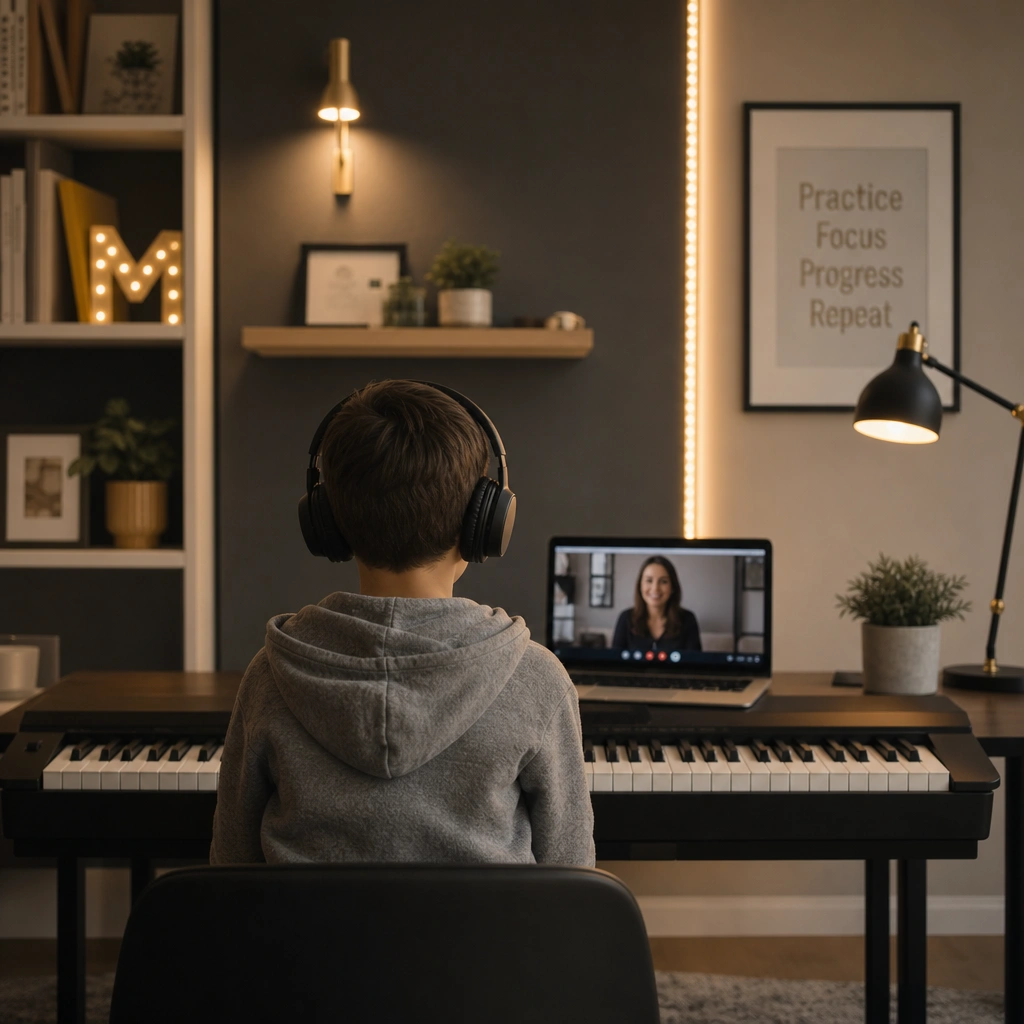
That said, the setup around the screen matters: a keyboard in a quiet room, headphones if the house is noisy, and a parent nearby for the first few sessions to help with the technology, not the teaching. For more on what a first lesson actually involves and why it’s structured the way it is, see our piece on online piano lessons for kids.
“Austin explains everything clearly and makes online piano lessons easy to follow.” – Emily Carter
How do you keep a child with ADHD motivated at the piano?
Keeping a child with ADHD motivated at the piano usually comes down to short practice windows, songs they actually chose, and visible markers of progress – not willpower or longer sessions. Ten focused minutes most days beats one dreaded 30-minute sit-down, and letting the child pick repertoire they care about does more than any reward chart. The CDC’s guidance on behavior-focused strategies for ADHD emphasizes consistent routines and immediate, specific praise over vague encouragement, both of which translate directly to how a practice session should be run.
- Keep practice short: 10-15 minutes, timer visible, done when the timer’s done.
- Let them choose songs: a song the child actually wants to play beats an assigned one every time.
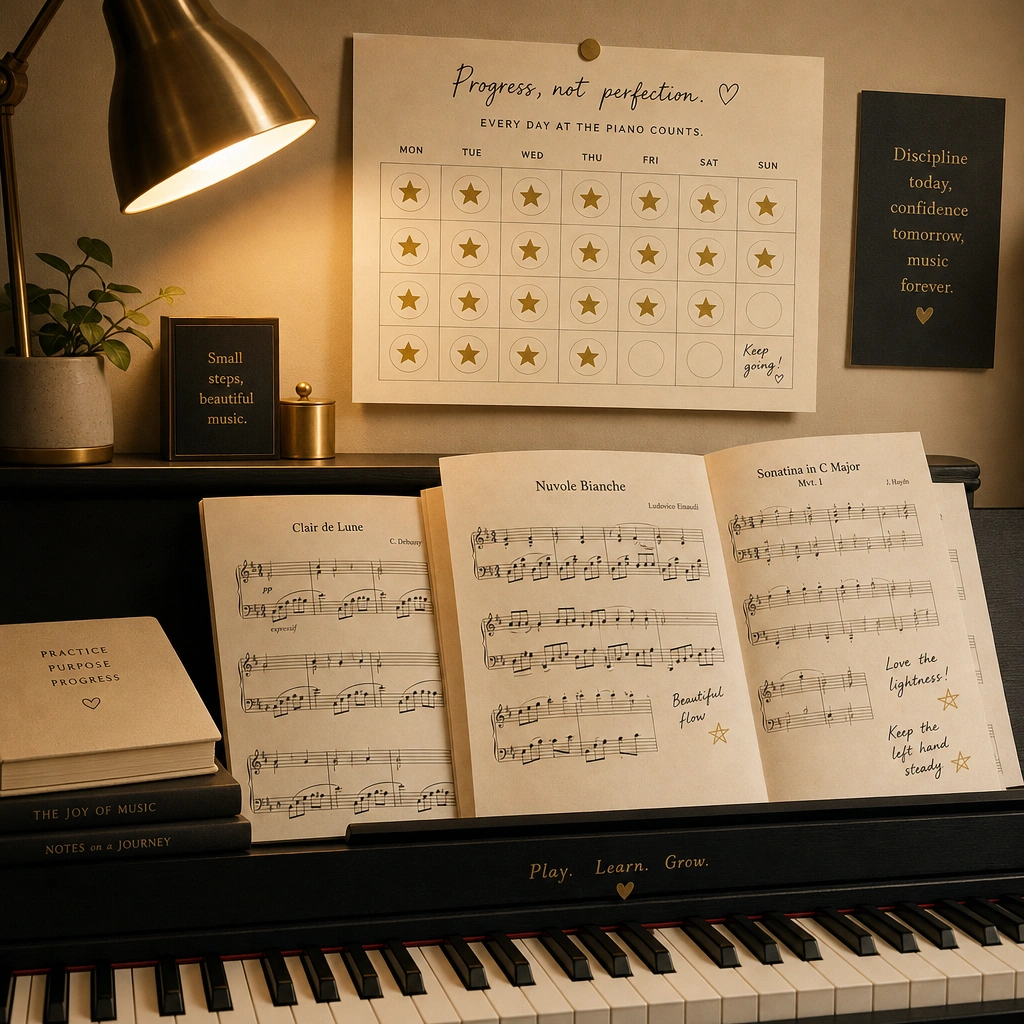
- Use a visible tracker: a sticker chart or checklist gives something concrete to show for the week.
- Keep the routine the same: same time, same spot, same order of tasks – predictability lowers resistance.
- Celebrate small finishes: finishing a four-bar line is worth noticing out loud.
One family I worked with had a daughter who flatly refused to practice anything assigned to her, but she’d happily sit down and pick out a pop song she liked by ear for 20 minutes. We leaned into that – built her reading and theory around songs she chose – and her resistance mostly disappeared. For more on this, our full guide on how to motivate a child to practice piano goes deeper than I can here.
Common questions
Is piano harder for a child with ADHD than other instruments?
Not necessarily. Piano has an advantage because notes are laid out visually and logically, left to right, low to high – there’s less guesswork than instruments requiring embouchure or fretting. Many kids with ADHD find that visual clarity easier to latch onto than instruments with a steeper early learning curve.
What age should a child with ADHD start piano lessons?
There’s no single right age – it depends more on the individual child’s ability to sit for short structured segments than on a birthday. Many kids start comfortably around 6-7, though some younger children with strong routines do fine earlier, and some older kids need more scaffolding at first.
Should I tell the piano teacher about my child’s ADHD diagnosis?
Yes, generally. Sharing it upfront lets the teacher plan lesson length, pacing, and structure around the child from day one instead of guessing after a rough first session. Most teachers, including ours, build the plan around the student’s needs during that first skill check anyway.
Can piano lessons help with focus outside of music?
Piano is not a treatment for attention difficulties, and it’s not accurate to claim it “fixes” focus. What many parents and teachers observe anecdotally is that the routine of regular practice and finishing short tasks can carry over as a helpful habit, but that’s an observation, not a medical claim.
What if my child quits lessons after a few months?
That happens sometimes, and it’s not a failure – sometimes the format, teacher, or timing just isn’t right yet. A different lesson length, a change in repertoire, or simply trying again in six months with a different approach often works better the second time around.
Do kids with ADHD need a weighted keyboard to start?
Not to start. A basic keyboard is fine for the first months of lessons; what matters more early on is a quiet, consistent practice spot. If your child sticks with it, a weighted keyboard or piano becomes more worth the investment as their playing develops.
Every kid pays attention differently, and that’s really the whole point here – the question isn’t “are piano lessons for ADHD kids good” in the abstract, it’s whether a specific child, in a specific lesson format, with a specific teacher, actually wants to come back next week. That’s worth testing directly rather than guessing at from the outside. You might also find our thoughts on keeping any child motivated at the piano useful as a next step, ADHD or not.
Ready to find out for yourself?
Your first lesson with me is a full 60 minutes for just $29 (normally $99). We will evaluate where you are, talk through your goals, and map out your path. Love it, or it’s on us.