The short answer
Clair de Lune is a late-intermediate to early-advanced piece – harder than it sounds on a first listen. It demands a soft, controlled touch, flexible rubato, layered pedaling, and wide stretches in both hands. Most students need solid two years of piano study before they can learn it comfortably, though the opening page alone is approachable sooner.
I’ve taught this piece to dozens of students over my years at the keyboard, and it’s one of the most requested pieces I get – and also one of the most misjudged. People hear its dreamy, slow opening and assume it’s a beginner piece. It isn’t. If you want a second opinion on how it stacks up against another famously “deceptive” piece, I wrote a companion breakdown on how hard Moonlight Sonata’s first movement really is. And if you’d like someone to look at your hands and tell you honestly whether you’re ready, a full 60-minute first lesson is $29, paid only after the lesson.
What level pianist do you need to be to play Clair de Lune?
Most pianists need at least two to three years of consistent study, roughly equivalent to late RCM Level 7-8 or ABRSM Grade 6-7, before Clair de Lune feels playable rather than survivable. You should already be comfortable reading three and four flats, playing hands independently at different dynamic levels, and holding a melody line steady while an accompaniment moves underneath it.
Here’s what I actually check before recommending a student start it:
- Can you play a scale and its relative arpeggio in both hands, hands together, without looking down?
- Can you sustain a true pianissimo for eight bars without the tone going dead or uneven?
- Can you comfortably read notes with ledger lines above and below the staff, since Clair de Lune drifts into both extremes?
- Have you already played at least one piece with a sustained pedal that changes on nearly every beat?
If you answered yes to all four, you’re close. If not, that’s not a failure – it just means there’s a shorter piece or two worth playing first so Clair de Lune doesn’t become a frustration project instead of a joy.
Which passages in Clair de Lune are the hardest?
The hardest passage in Clair de Lune is the famous arpeggiated middle section, where both hands crisscross in flowing sixteenth-note patterns at a quicker tempo, marked by Debussy as “un peu plus animé.” It demands fast, even finger work at a quiet dynamic, which is far harder than playing the same notes loudly.
Three spots trip up nearly every student I work with:
- The middle arpeggio section (around measures 27-36): rolling triplet figures move quickly between hands, and it’s tempting to rush or bang through them. The real skill is keeping them liquid and even at a hushed volume.
- The opening melody’s voicing: the top note of the right hand chords has to sing over inner notes played by the same hand, at the same time, at nearly the same volume – a genuinely tricky balancing act.
- The widely spaced left-hand chords: several stretch close to a tenth, which is a stretch for average-sized adult hands and a real problem for smaller hands. Rolling the chord slightly, rather than forcing it, is usually the fix.
I had a student, a retired engineer who picked piano back up after thirty years away, convinced he could sight-read through the middle section at tempo on day one. He couldn’t – almost nobody can. What worked was slowing it to half speed with a metronome for two full weeks before ever speeding up, which is unglamorous but it’s the actual path through that passage.
Why is the rhythm in Clair de Lune so tricky?
Clair de Lune’s rhythm is tricky because Debussy wrote it with constant tempo flexibility – rubato – built into the music itself, with shifting groupings of twos, threes, and irregular subdivisions layered against each other between the hands. There’s rarely a steady, metronomic pulse, which makes it hard to count in the usual way.
Two specific rhythm traps show up again and again in lessons:
- Two-against-three patterns: one hand plays in duple groupings while the other plays in triplets. Students who learned rhythm mostly by ear often guess at this instead of actually subdividing it, and it shows.
- Written-in tempo changes: Debussy marks “retenu,” “en animant,” and “a tempo” throughout, meaning the pulse is supposed to breathe and stretch. Without a teacher or a trusted recording as a reference, it’s easy to either ignore these markings (and sound flat) or overdo them (and lose the pulse entirely).
My honest opinion, after watching students fight this for years: don’t try to feel the rubato correctly until you can play the notes correctly in strict time first. Rubato on top of insecure notes just sounds like mistakes.
How much pedal does Clair de Lune need?
Clair de Lune needs near-constant, carefully layered pedaling – the sustain pedal is changed dozens of times throughout, often on off-beats, to blend harmonies without creating muddy overlaps. Half-pedaling and quick, shallow pedal changes are essential, not optional, for the piece to sound the way it’s meant to sound.
This is genuinely one of the harder pedal challenges in the standard repertoire for an intermediate player. Three things make it demanding:
- The harmony shifts frequently, so holding the pedal too long smears chords together into mush.
- Full pedal changes are often too abrupt – you need half-pedal technique, where the pedal is only partially released, to keep some resonance while clearing out the old harmony.
- The pedaling has to happen automatically, almost unconsciously, because your ears and hands are already busy with the rubato and the voicing.
I tell students to learn the piece with zero pedal first. It feels bare and strange, but it’s the only way to know your fingers – not the pedal – are creating the legato line. Add pedal back in only once the notes are secure. If you’ve never worked seriously with half-pedaling before, it’s worth a dedicated lesson on pedal technique rather than guessing your way through it.
If Clair de Lune’s pedal work or rubato has you stuck, a second pair of ears usually solves it faster than another week of solo practice. Your first lesson with Austin is a full 60 minutes for just $29 (normally $99). Love it, or it’s on us.
Are there easier arrangements of Clair de Lune?
Simplified arrangements of Clair de Lune exist and are a legitimate, satisfying option – they keep the recognizable melody and harmony while removing the widest stretches, the fastest arpeggios, and some of the voicing demands. They’re not “cheating”; they’re a smart way to play the piece you love at the level you’re actually at.
What to look for in a simplified edition:
- Reduced left-hand stretches (often capped at an octave instead of a tenth)
- A slower suggested tempo for the middle arpeggio section, or the section thinned out
- Pedal markings already written in, which takes the guesswork out while you’re learning
- Melody kept intact – this matters most, since the tune is what people recognize and love
I’ve had younger students and busy adults both go this route successfully, then “graduate” to the full original version a year or so later once their hands and reading have caught up. There’s no shame in that path – plenty of my adult students who came back to piano after a long break start there deliberately.
How long does it take to learn Clair de Lune?
Most intermediate players who practice 30-40 minutes a day can learn a performable version of Clair de Lune in 3 to 5 months. Reaching a polished, concert-ready performance with secure rubato and pedaling usually takes closer to 6 to 9 months, since the finishing touches – tone control and phrasing – take longer than the notes themselves.
A realistic month-by-month path I use with students:
- Weeks 1-4: learn the opening section hands separately, no pedal, slow and exact.
- Weeks 5-8: hands together on the opening, begin the middle arpeggio section hands separately.
- Weeks 9-14: middle section hands together at a reduced tempo, start layering in pedal.
- Weeks 15-20: full piece hands together, work rubato and dynamics, slowly bring tempo up.
One student, a high schooler preparing for an audition, tried to compress this into six weeks by over-practicing the middle section at full speed every day. She ended up with tension in her right hand and had to back off for a week. The fix was cutting her daily practice of that one section to ten focused minutes and trusting the slow build – she was performance-ready two months later, tension-free.
“I started as a complete beginner, and Austin made the learning process feel comfortable.” – Noah Peterson
If you’re working on finger independence or evenness for the middle section specifically, a short daily piano warm-up routine before you touch the piece itself makes a noticeable difference within a couple of weeks.
Common questions
Is Clair de Lune harder than Für Elise?
Yes, Clair de Lune is noticeably harder than Für Elise. Für Elise sits at an early-intermediate level with simpler rhythm and pedaling, while Clair de Lune demands advanced voicing, constant rubato, and much more complex pedal layering, making it a significant step up in difficulty.
Can a beginner play Clair de Lune at all?
A true beginner should not attempt the full piece, but many simplified arrangements let newer players enjoy the opening melody within their first year. The full original score, with its rubato and arpeggio section, is realistically out of reach until late-intermediate level.
What grade level is Clair de Lune?
Clair de Lune is generally placed around ABRSM Grade 7-8 or RCM Level 8-9, depending on the edition and examiner. It’s considered a late-intermediate to early-advanced piece, sitting just below the most demanding standard repertoire.
Why does Clair de Lune sound easier than it is?
Clair de Lune sounds easier than it is because its slow tempo and gentle dynamics mask genuinely difficult voicing, pedaling, and rhythmic layering. Slow, quiet music is often harder to control precisely than fast, loud music, since every small imprecision is exposed.
Do I need big hands to play Clair de Lune?
Larger hands make a few wide chords easier, but they aren’t required. Rolling wide chords slightly, redistributing a note between the hands, or using a simplified arrangement all work well for smaller hands, which is a topic worth exploring separately if it’s holding you back.
Should I learn Clair de Lune by ear or by reading the sheet music?
Reading the sheet music is strongly recommended for this piece. Clair de Lune’s rhythm, voicing, and pedal markings are too intricate to reliably learn by ear, and reading it properly also builds skills that transfer directly to future repertoire.
Ready to find out for yourself?
Your first lesson with me is a full 60 minutes for just $29 (normally $99). We will evaluate where you are, talk through your goals, and map out your path. Love it, or it’s on us.
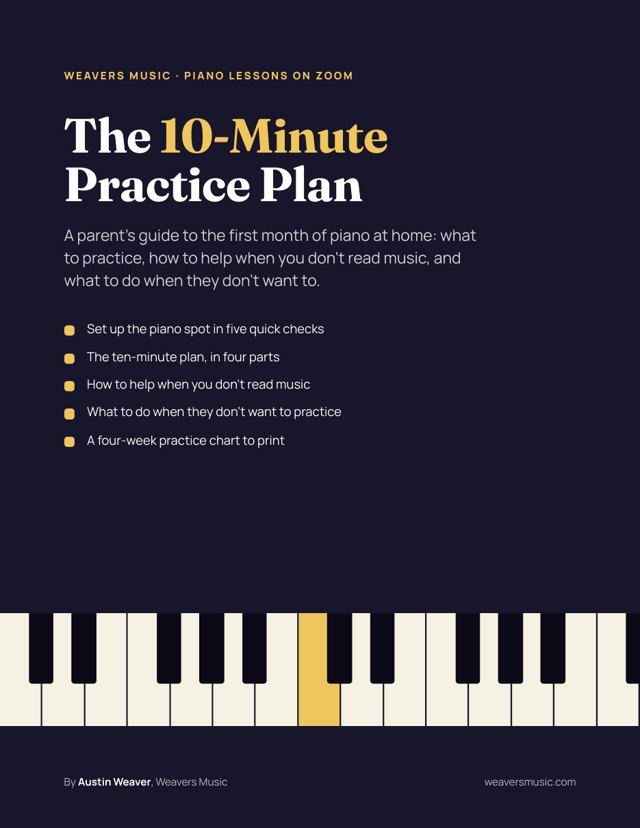
Free guide for parents
The 10-Minute Practice Plan
What to practice, how to help when you don’t read music, and what to do when they don’t want to. A short printable guide from Austin, with a four-week practice chart.