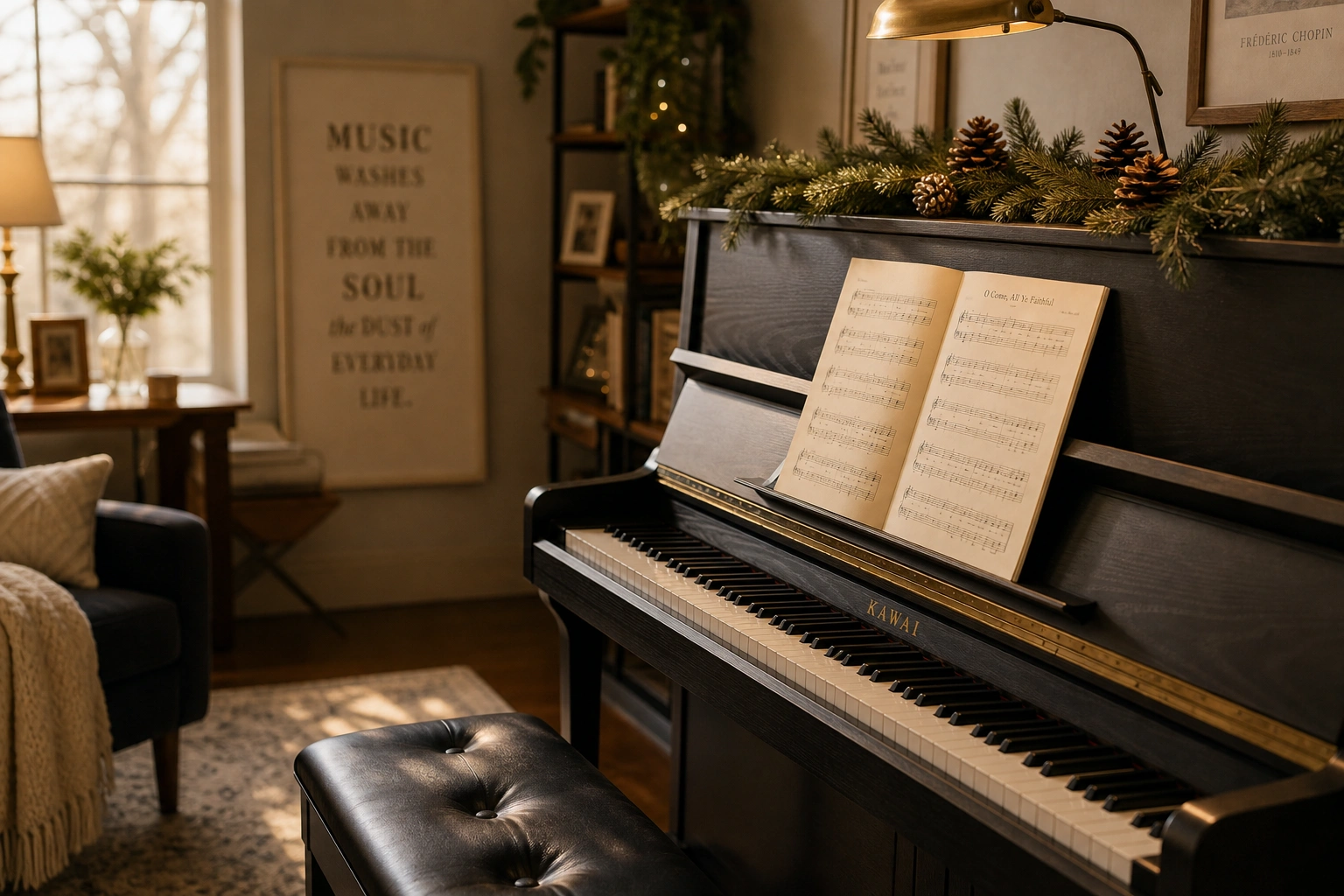
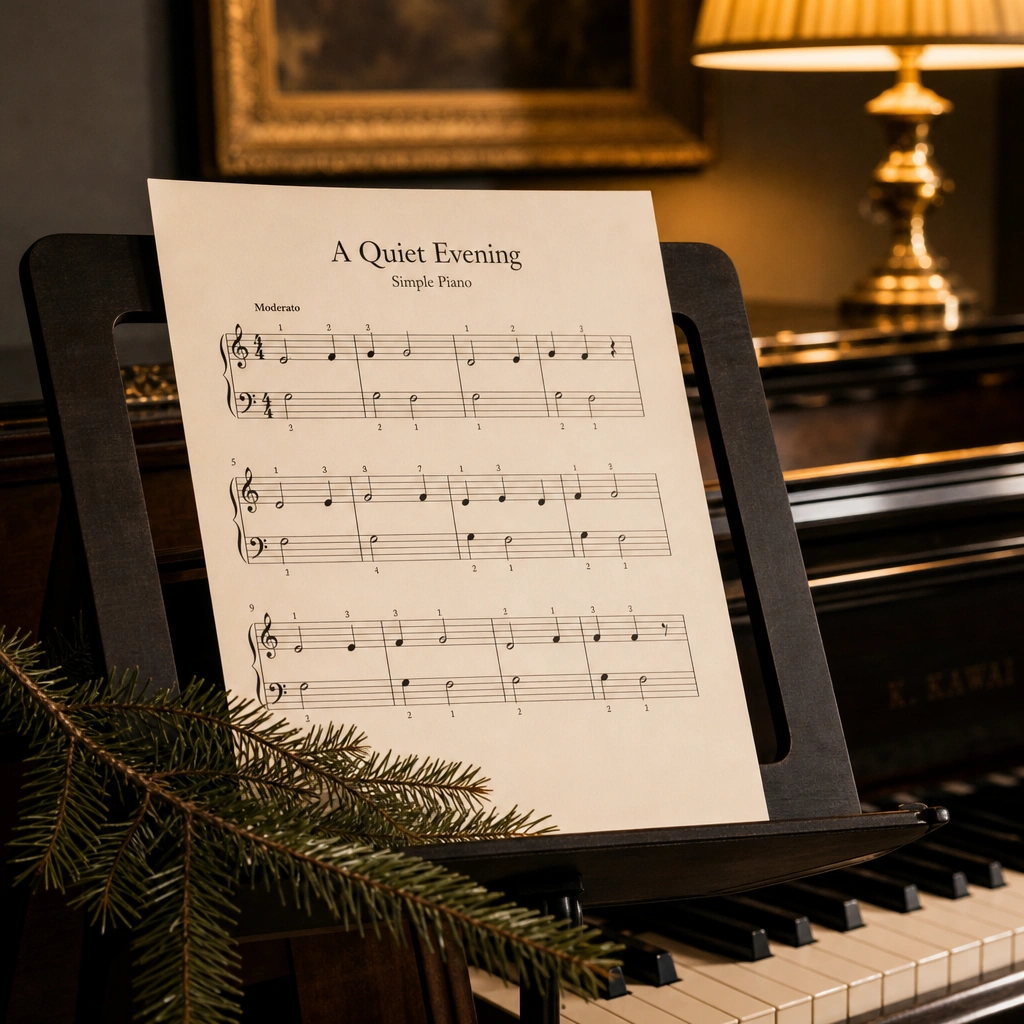
The easiest Christmas songs on piano are “Jingle Bells,” “Hot Cross Buns”-style carols like “Mary Had a Little Lamb” adapted to “Jolly Old St. Nicholas,” “Ode to Joy” (used for many carol arrangements), and “We Wish You a Merry Christmas” in simplified form. All use five-finger hand positions, repetitive patterns, and mostly stepwise melodies that beginners can learn within one to two weeks.
Every December I get the same message from students: “Can I learn a Christmas song for the holiday party?” The good news is that several beloved carols were written (or have been arranged) with simple, singable melodies that sit comfortably under five fingers. If you want a teacher to walk you through one of these note by note, book a free 30-minute trial lesson and we’ll pick one that fits your hands and your timeline.
What makes a Christmas song easy on piano?
An easy Christmas song on piano stays in one hand position, moves mostly by step (not big jumps), repeats the same rhythm pattern throughout, and uses a simple left-hand part like single bass notes or a basic chord. Songs that meet all four conditions can usually be learned in a handful of practice sessions.
I look at four things before I recommend a carol to a new student:
Hand position: does the right hand stay in one five-finger spot, or does it require shifting up and down the keyboard?
Melodic motion: stepwise melodies (do-re-mi-fa-sol) are far easier than melodies with big leaps.
Rhythm: songs built from quarter notes and half notes are simpler than anything with dotted rhythms or syncopation. If rhythm notation trips you up, a quick refresher on counting rhythm at the piano helps a lot.
Left hand: a single held note or simple broken chord is much friendlier than a full chord progression.
“Jingle Bells” checks every box in its basic form, which is exactly why it’s the first Christmas song I teach almost every beginner, kid or adult.
Which Christmas songs can a total beginner play?
A total beginner, meaning someone with zero to a few weeks of piano experience, can realistically play “Jingle Bells” (simplified), “Jolly Old St. Nicholas,” “Ode to Joy,” and “Up on the Housetop” within their first month. All four stay in a single five-finger hand position and use only quarter and half notes.
Here is how I’d rank them from easiest to slightly harder:
“Jingle Bells” (simplified): the right-hand melody uses only three notes (E-D-C) for most of the chorus. I’ve had six-year-olds play this confidently in their second lesson.
“Jolly Old St. Nicholas”: entirely stepwise, five-finger position, no accidentals.
“Ode to Joy”: not technically a Christmas song, but it’s arranged as a carol in many beginner books and is one of the most forgiving melodies in the beginner repertoire.
“Up on the Housetop”: slightly more rhythmic variety but still stepwise and in one hand position.
One of my adult students, a man in his 50s who’d never touched a piano, learned “Jingle Bells” well enough to play for his grandkids after four lessons spread over three weeks, about 15 minutes of practice most days. That’s a realistic timeline, not a best-case one.
What Christmas songs work for someone with a few months of lessons?
Someone with three to six months of lessons can usually handle “We Wish You a Merry Christmas,” “Deck the Halls,” “O Come All Ye Faithful” (simplified), and “Silent Night” with a basic left-hand chord accompaniment instead of single notes. These add hand independence and a bit more rhythmic variety.
At this stage, students are usually comfortable with:
Playing a melody in the right hand while the left hand holds simple block chords (C, F, G)
Reading eighth notes and dotted quarter notes
Moving the hand out of a strict five-finger position for a note or two
“Silent Night” is deceptively tricky for true beginners because of its 3/4 waltz time and the dotted rhythms in the melody, but once a student has a few months of counting practice under their belt, it becomes one of the most rewarding carols to play. I usually introduce it right after a student has gotten solid with basic chord shapes.
If you’re picturing yourself playing a favorite carol by the fireplace this year, the fastest way to find out how close you are is a quick evaluation. Your first 30-minute lesson with Austin is free – no card, no pressure.
How do I simplify a Christmas song that looks too hard?
A song can be simplified by dropping the left-hand part down to single root notes, removing chords above a basic triad, slowing the tempo by half, and playing only the melody for the first week before adding accompaniment. These four changes turn almost any intermediate carol into a beginner-friendly version.
A mistake I see constantly: a student finds the “real” sheet music for a song like “O Holy Night” online, gets overwhelmed by the full chords and octave jumps, and gives up after one sitting. My fix is always the same – strip it down. Play right-hand melody alone for a few days, add one bass note per measure, then slowly build the left hand back up. This is also something I do in lessons: I’ll take whatever carol a student has their heart set on, write a simplified arrangement at their actual level, and then rewrite it harder over the following weeks as they improve, so the song grows with them instead of staying out of reach.
If you’re also deciding whether to start with simpler pop-style arrangements or classical-style melodies in general, this comparison of starting with classical or pop piano first is a useful companion read.
How long does it take to learn a Christmas song?
Most beginners can learn a simplified one-page Christmas song in 7 to 14 days of practicing 15-20 minutes daily. A student with a few months of experience can usually learn a moderately arranged carol, chords and all, in about one to two weeks of the same daily practice.
Three things speed this up more than anything else:
Practicing hands separately before combining them
Using a slow, steady tempo from day one rather than rushing
Repeating short four-measure sections instead of playing the whole song start to finish every time
According to a Wikipedia overview of deliberate practice research, short, focused repetitions with specific goals produce faster skill gains than long unfocused sessions – which matches exactly what I see with students cramming a carol before a holiday gathering.
“I started as a complete beginner, and Austin made the learning process feel comfortable.” – Noah Peterson
Noah’s experience is typical – the students who feel most comfortable are the ones who start with a song genuinely matched to their level, not one picked because it’s a favorite on the radio.
Common questions
What is the single easiest Christmas song for a total beginner to start with?
“Jingle Bells” is the easiest starting point for most beginners because its chorus melody uses only three notes (E, D, and C) in a row, stays in one hand position, and has a rhythm most people already know by heart from hearing it every year.
Do I need to know how to read sheet music to play Christmas songs?
No, many beginner Christmas song arrangements are available in letter-note format or simplified lead sheets that don’t require traditional notation. That said, learning basic note reading opens up far more arrangements and makes future songs easier to pick up on your own.
Can kids learn Christmas songs on piano before they can read music?
Yes, young children often learn Christmas songs by ear or with color-coded or letter-labeled sheets before formal reading skills develop. I regularly teach five- and six-year-olds “Jingle Bells” using finger numbers alone, with note reading introduced afterward.
What key are most easy Christmas songs written in?
Most beginner Christmas arrangements are in C major or G major because both keys use mostly white keys and simple five-finger hand positions, which keeps the sheet music approachable for new players.
Is it better to learn Christmas songs by ear or from sheet music?
Both work, and the better choice depends on the learner. Reading sheet music builds a transferable skill for future songs, while learning by ear can feel faster and more intuitive, especially for very familiar tunes like carols most people already know by heart.
How many Christmas songs should a beginner try to learn in one season?
One or two well-practiced songs beat five rushed ones. I usually recommend beginners pick a single carol, get it solid enough to play without stopping, and then add a second song only if there’s time left before the holidays.
If your child (or you) wants to walk into a holiday gathering and actually play something recognizable, a short lesson now can make that realistic. Weaver Music offers live, one-on-one lessons over Zoom, for all ages and levels – lessons run $60 for 30 minutes, $80 for 45 minutes, and $99 for a full hour. For a broader foundation before diving into repertoire, it also helps to review the first things to learn on piano.
Ready to find out for yourself?
Your first 30-minute lesson with me is completely free – we will evaluate where you are, talk through your goals, and map out your path.
12 bar blues piano is a repeating 12-measure chord pattern built from three chords – usually the I, IV, and V of a key – played in a set order with a shuffle rhythm. In C, that’s C, F, and G. Once you know the pattern, you can play it in any key and improvise over it for hours.
I teach this pattern to almost every student who’s been playing for six months or more, because it’s short enough to memorize in one lesson and it teaches your ear how chords move. If you want someone to walk through it with you live, a free 30-minute trial lesson is a low-pressure way to get the shapes under your fingers with feedback in real time.
The blues form shows up everywhere – rock, jazz, gospel, boogie-woogie – which is part of why it’s worth learning even if blues itself isn’t your main style.
What chords are in a 12 bar blues?
A standard 12 bar blues uses three chords: the I chord (the home chord), the IV chord (a fourth up from home), and the V chord (a fifth up from home). In the key of C, that’s C major, F major, and G major. Some versions add dominant 7ths to each chord for a bluesier flavor.
Using 7th chords instead of plain major triads is what gives blues its characteristic sound. So instead of C-E-G, you’d play C7 (C-E-G-Bb). The same goes for F7 and G7. Here’s the full chord set in C:
C7 – the I chord (home base)
F7 – the IV chord
G7 – the V chord
A common mistake I see: students learn the three chord shapes correctly but keep playing plain triads with no 7th, then wonder why it doesn’t sound “bluesy.” Adding that one extra note (the flat 7th) is often the whole missing ingredient.
How do you count the 12 bars?
Counting a 12 bar blues means tracking which chord you’re on across twelve 4-beat measures in a fixed, repeating order. The most common pattern is: four bars of I, two bars of IV, two bars of I, one bar of V, one bar of IV, and two bars of I to close.
Written out in bar numbers, in the key of C, it looks like this:
Bar 1: C7
Bar 2: C7
Bar 3: C7
Bar 4: C7
Bar 5: F7
Bar 6: F7
Bar 7: C7
Bar 8: C7
Bar 9: G7
Bar 10: F7
Bar 11: C7
Bar 12: C7 (or G7, called the “turnaround,” if repeating)
Bars 9 and 10 (the V-IV move) trip up almost every beginner the first few times, because it’s the only spot where the chord changes every single bar. I have students count out loud – “nine, ten” – while switching chords, just to build the muscle memory of that faster change before adding rhythm. Most people need three or four slow run-throughs of just those two bars before their hands stop hesitating.
What does the left hand play in a blues?
The left hand in a 12 bar blues typically plays a walking bass pattern or a simple “boogie” shape built on the root and fifth of each chord, moving in a steady eighth-note shuffle feel. This is what gives blues its rolling, rhythmic drive underneath the chords.
Two left-hand approaches work well depending on your level:
Beginner version: play just the root note of each chord (C, then F, then G) on beats 1 and 3 of every bar.
Intermediate version: play a five-note “boogie” pattern – root, fifth, sixth, seventh, sixth – moving back and forth in a steady eighth-note shuffle rhythm.
One student of mine, an adult beginner who’d never played anything but classical pieces, spent two weeks stuck because she was playing the boogie pattern perfectly evenly instead of with a shuffle (long-short, long-short) feel. The moment she swung the rhythm, it suddenly sounded like blues instead of a scale exercise. Rhythm feel matters as much as the right notes here. A practical way to check yourself: set a metronome to 70 bpm and say “long-short” out loud on each pair of eighth notes until the uneven feel becomes automatic instead of something you’re thinking about.
How do you add a simple blues riff on top?
A simple blues riff for the right hand uses notes from the blues scale – built on the root, flat third, fourth, sharp fourth, fifth, and flat seventh – repeated and adjusted slightly as the left hand changes chords underneath. In C, that scale is C, Eb, F, F#, G, Bb.
The easiest way to start improvising is to pick a 3-4 note motif from that scale and repeat it with small variations over each chord change, rather than trying to play something new in every bar. I always tell students: play the same short phrase four times before you let yourself change it. Beginners tend to rush toward “more notes,” but a slower, repeated riff almost always sounds more confident and more musical.
If you’d like a blues arrangement built around exactly where your hands are right now, that’s something we can do in lessons. Your first 30-minute lesson with Austin is free – no card, no pressure.
Most students who already know their major chords can learn a basic 12 bar blues – both hands, steady tempo – within two to three practice sessions of 20-30 minutes each. Adding a confident improvised riff on top usually takes another two to four weeks of regular practice.
Session 2: hands together with root-note bass, no riff yet.
Session 3: add the shuffle rhythm and boogie bass pattern.
Weeks 2-4: layer in a simple blues scale riff, four bars at a time.
I usually pair this lesson with a review of how chords sit on the keyboard, since students who are shaky on where notes live tend to lose the beat while hunting for the next chord. If you’re working on a specific song request like this in general, our custom song lessons page explains how that process works.
“I have improved more with Weavers Music than I expected. Austin is patient and encouraging.” – Daniel Brooks
According to Wikipedia’s overview of the twelve-bar blues form, this exact I-IV-V structure has been the backbone of blues, early rock and roll, and much of American popular music since the early 20th century – which is part of why it’s such a durable thing to have in your hands.
Common questions
Can I play a 12 bar blues if I only know a few chords?
Yes. You only need three chords to play a basic 12 bar blues – the I, IV, and V of any key. If you already know C, F, and G major, you can play a simple blues in C today, even before learning the 7th-chord versions.
Do I need to know the blues scale before I start?
No. You can play the full 12 bar chord progression with both hands using only root notes and basic chords, with no scale knowledge at all. The blues scale is only needed once you want to improvise a melody or riff on top of the chords.
What key is easiest to start a 12 bar blues in?
C is the easiest starting key because all three chords (C, F, and G) use mostly white keys, which makes the left-hand shapes simpler to see and feel. Many teachers, myself included, start every student in C before moving to other keys.
Is 12 bar blues the same as boogie-woogie?
Not exactly. Boogie-woogie is a specific left-hand bass pattern often played over a 12 bar blues progression, but the 12 bar blues itself is just the chord structure – it can be played with many different bass patterns, styles, and tempos.
Can beginners really improvise over a blues, or is that advanced?
Beginners can improvise a simple version within a few weeks using just three to five notes from the blues scale repeated in short phrases. True fluent improvisation takes longer, but a basic, musical-sounding riff is genuinely a beginner-friendly goal.
How is 12 bar blues different from a normal chord progression?
A normal pop chord progression is often 4 or 8 bars and can use any chords in any order. A 12 bar blues is specifically a fixed 12-measure, three-chord (I-IV-V) form that repeats, which is what makes it so recognizable and easy to jam over with other musicians.
Ready to find out for yourself?
Your first 30-minute lesson with me is completely free – we will evaluate where you are, talk through your goals, and map out your path.
When you’re just starting your piano journey, one of the most exciting moments is learning your first recognizable song. You want something that sounds like real music, not just scales and exercises, but you also need pieces that won’t leave you frustrated and stuck. That’s exactly where the easiest piano songs for beginners come in—they’re the perfect bridge between technique and musicality.
With more than 10 years of experience at the piano, I’ve watched hundreds of students work through their first songs. I’ve seen which pieces build confidence and which ones accidentally discourage new players. The easiest piano songs for beginners share specific qualities that make them accessible while still feeling rewarding to play.
In this guide, I’ll walk you through my top picks for the easiest piano songs for beginners, explain what makes them work so well, and give you practical tips for learning them effectively. Whether you’re teaching yourself or working with an instructor, these songs will give you a strong foundation.
The short answer
The easiest piano songs for beginners are short, familiar melodies with simple rhythms, limited hand position changes, and minimal or no left-hand accompaniment. Songs like “Ode to Joy,” “Mary Had a Little Lamb,” and “Happy Birthday” fit perfectly because they use just a few notes, stay in one hand position, and let you focus on reading notes and building coordination without overwhelming complexity.
These songs typically stay within a five-finger position and use mostly quarter notes and half notes, making them ideal first pieces.
What makes a piano song easy for beginners?
Not all simple-sounding songs are actually easy to play. Before we dive into specific pieces, it helps to understand what makes certain songs genuinely accessible for beginners versus others that just sound simple.
The easiest piano songs for beginners usually have these characteristics:
Limited range: The melody stays within a five-finger position, meaning you don’t need to move your hand up and down the keyboard constantly
Simple rhythms: Mostly quarter notes, half notes, and whole notes—no complex dotted rhythms or sixteenth notes
Familiarity: Songs you already know by ear make learning much faster because you can hear when you’ve played a wrong note
Right hand only or simple left hand: Many true beginner pieces focus on the melody in the right hand with either no left hand or very basic whole note accompaniment
Repetition: Patterns that repeat give you more practice with the same notes and help with memorization
When I work with new students at Weaver Music, I always start by asking what songs they’d love to play someday. Then we find beginner-friendly versions or stepping-stone pieces that build toward those goals. Understanding what makes a song accessible helps you choose practice material wisely.
One crucial element is hand position. If a song requires constant shifting, it becomes exponentially harder for someone still building basic finger independence and note-reading skills. That’s why I always recommend starting with the easiest piano songs for beginners that keep your hands in a stable position.
Another factor many beginners overlook is tempo flexibility. The easiest piano songs for beginners sound good at any speed, which means you can practice them slowly without losing the musical character. This gives you permission to work at your own pace without feeling like you’re compromising the music.
According to research published in the Journal of Research in Music Education, students who begin with appropriately-leveled repertoire show significantly higher retention rates and greater long-term enjoyment of music study compared to those who attempt pieces beyond their skill level too early.
5 easiest piano songs for beginners
Here are my top five picks for absolute beginners. I’ve taught every one of these songs dozens of times, and I’ve seen firsthand how quickly students can learn them and how much confidence they build in the process. These are the easiest piano songs for beginners that deliver real musical satisfaction.
Each of these pieces can typically be learned in one to three weeks with consistent practice, depending on how much time you put in daily. What makes these particular songs stand out is that they’re not just technically simple—they’re musically rewarding and instantly recognizable, which keeps motivation high throughout the learning process.
1. Ode to Joy (Beethoven)
“Ode to Joy” is probably the most famous melody on this list, and it’s surprisingly perfect for beginners. The entire melody can be played in one five-finger position in the right hand, and the rhythm is almost entirely quarter notes.
What I love about this piece is that it sounds impressive. Your friends and family will recognize it immediately, which gives you a huge motivation boost. The melody sits comfortably in the middle of the keyboard, usually starting on E or C depending on the arrangement.
Most beginner arrangements keep the left hand very simple—either single whole notes or half notes that move in a predictable pattern. Some versions are even right-hand-only, which is perfect if you’re still working on hand independence.
The melody has a clear structure with repeating sections, so once you learn the first phrase, you’re already halfway there. This repetition is exactly what makes these some of the easiest piano songs for beginners.
Tips for learning Ode to Joy
Start with just the right hand and get it solid before adding the left
Practice hands separately until each hand feels comfortable on its own
The melody moves mostly by step (neighboring notes), so finger numbers follow logically
Pay attention to the phrasing—where the musical sentences begin and end
Count out loud initially to ensure you’re holding half notes for the full two beats
2. Mary Had a Little Lamb
“Mary Had a Little Lamb” is often the very first song piano students learn, and for good reason. It uses only four notes (E-D-C-D in the most common version) and has a rhythm simple enough that most people can play it by ear on their first try.
This song is particularly useful because it teaches you to navigate between three adjacent fingers without moving your hand position. The pattern is repetitive and predictable, which builds muscle memory quickly.
Because the melody is so familiar, you’ll know immediately if you’ve hit a wrong note. This instant feedback is invaluable when you’re still learning to read music and connect what you see on the page to what you hear.
Many method books include this as one of the earliest songs, often with just the right hand at first. Once you’re comfortable, you can add simple left-hand notes on the downbeats. The fact that this appears in so many curricula is no accident—it’s genuinely one of the easiest piano songs for beginners.
Why this song works
Only four notes total in the simplest version
Highly repetitive melodic pattern
Everyone knows how it should sound
Natural stepping stone to slightly more complex pieces
Can be played entirely with fingers 2, 3, and 4 of the right hand
If you’re exploring structured learning paths, you’ll likely encounter this song in the very first lessons of any beginner curriculum.
3. Happy Birthday
“Happy Birthday” is one of the most practical songs you can learn. You’ll actually use it in real life, whether at family gatherings or celebrations with friends. That practical application gives you built-in motivation to master it.
The melody fits comfortably in a five-finger position with just one small jump in the middle of the phrase. The rhythm includes a dotted note (on “birth-day to”), which gives you your first taste of slightly more complex rhythms without being overwhelming.
This song is slightly more challenging than “Mary Had a Little Lamb” but still firmly in beginner territory. The small jump I mentioned is usually from G up to C, which helps you start thinking about moving beyond strict five-finger positions.
Most beginner arrangements use whole notes in the left hand on the root note of each chord, making the accompaniment straightforward and predictable. As you advance, you can add fuller chord voicings. The universal familiarity of this melody makes it one of the easiest piano songs for beginners to learn by ear and then match to sheet music.
Learning Happy Birthday
Master the dotted rhythm on “happy birth-day to” before working on speed
The melody has two identical phrases and one that’s slightly different—learn the pattern
Practice the octave jump slowly at first
This is a great song to memorize since you’ll play it so often
Try transposing it to different keys once you’re comfortable—great ear training
4. Chopsticks
“Chopsticks” has a special place in piano culture. It’s often the first duet people learn, and it’s incredibly fun to play with a friend or teacher. The main melody uses a distinctive repeated-note pattern that’s instantly recognizable.
What makes “Chopsticks” one of the easiest piano songs for beginners is its unique approach. You can actually play the melody using just your index fingers on each hand, which is where it gets its name. This makes it accessible even before you’ve developed much finger independence.
The left-hand part is equally simple—just two notes alternating back and forth. When played as a duet, one person plays the simple melody while another adds a more elaborate accompaniment, making it sound fuller than it actually is to play.
The rhythm is straightforward, and the entire piece is based on repetition and variation. Once you get the basic pattern, you’ve essentially learned the whole song. The social aspect of playing “Chopsticks” as a duet also makes practice more enjoyable and builds your ability to stay in time with another musician.
Why Chopsticks is perfect for beginners
Can be played with just index fingers initially
Great introduction to playing with both hands together
Fun to play as a duet, which builds ensemble skills
Simple alternating pattern in the left hand
Teaches the concept of ostinato (a repeating pattern)
5. Twinkle Twinkle Little Star
“Twinkle Twinkle Little Star” is a classic beginner piece that appears in virtually every piano method book. It’s slightly more complex than “Mary Had a Little Lamb” but still very accessible, making it one of the easiest piano songs for beginners.
The melody uses a five-finger position and includes some skips (intervals larger than a step), which helps you start developing spatial awareness on the keyboard. The opening notes jump up a fifth from C to G, teaching you to navigate beyond adjacent keys.
The rhythm is entirely quarter notes and half notes, keeping things simple. The melody has a clear ABA structure—the beginning and end are the same, with a slightly different middle section. This structure helps with memorization and gives you an early introduction to musical form.
What’s particularly useful about this song is that it exists in countless arrangements. You can start with the absolute simplest version and gradually work up to arrangements with more elaborate left-hand patterns as your skills develop. This scalability makes it perfect for long-term skill building.
Progression with Twinkle Twinkle
Start with right hand only until it’s comfortable
Add simple whole notes in the left hand (C and G typically)
Graduate to broken chords or alberti bass patterns as you advance
The melody teaches you to skip notes, not just play adjacent keys
Try the famous Suzuki variations once you master the basic melody
Many students I work with through Weaver Music lessons are surprised at how many variations exist of this simple tune. It’s a song that can grow with you throughout your entire piano journey.
How to approach learning these songs
Knowing which songs to learn is only half the battle. How you practice them makes all the difference in how quickly you progress and how much you actually enjoy the process. Here’s my tested approach for working through the easiest piano songs for beginners.
Start by listening to the piece several times before you even touch the piano. If possible, watch a video of someone playing it. This gives your brain a model to work toward and makes the learning process much more intuitive. You can find excellent performances of all these songs on YouTube, where professional pianists and teachers have recorded clear demonstrations.
When you sit down to practice, always work on one hand at a time first. I cannot stress this enough—trying to put hands together before each hand is comfortable independently will slow you down and create frustration. Get the right hand solid, then the left hand solid, then carefully combine them.
Break the song into small sections. Don’t try to learn an entire piece in one sitting. Work on just the first phrase or even the first few measures until they’re comfortable. Mastery comes from building small successes into larger ones.
Practice strategies that work
Practice slowly at first—speed comes naturally with familiarity
Use a consistent fingering from the very beginning (don’t change which fingers play which notes)
Practice the tricky spots more than the easy parts
Record yourself occasionally to hear what needs improvement
Practice without looking at your hands to build muscle memory and keyboard geography
Use a metronome to develop steady timing, even on these simple pieces
Set small daily goals rather than trying to learn everything at once
If you’re looking for more guidance on effective practice routines, you might find learning to read sheet music faster helpful as you work through these pieces.
Consistent short practice sessions beat occasional long ones. Twenty minutes daily will get you much further than two hours on Sunday. The easiest piano songs for beginners can typically be learned in just a few weeks with this kind of consistent approach.
One technique I teach all my beginners is mental practice. Between piano sessions, visualize yourself playing the piece. Think through the finger numbers, the key names, and how the melody sounds. This mental rehearsal strengthens neural pathways and accelerates learning without requiring you to be at the piano.
Common mistakes beginners make
Even with the easiest piano songs for beginners, there are some common pitfalls I see students fall into. Being aware of these helps you avoid them and progress more smoothly.
The biggest mistake is trying to play too fast too soon. I get it—you want to play at performance tempo and sound like the recording. But playing fast before you’re ready just reinforces mistakes and creates tension in your hands and arms.
Another common issue is inconsistent fingering. If you use different fingers each time you play a passage, you’re essentially learning it from scratch every time. Decide on a fingering that works (or follow what’s written in your music) and stick with it every single repetition.
Many beginners also neglect the left hand. Because the melody is usually in the right hand, it’s tempting to just add a minimal left hand and call it done. But developing both hands equally from the start will serve you tremendously as you advance.
Other mistakes to watch for
Looking at the hands instead of the music—this slows down sight-reading development
Ignoring rhythm—counting matters even in simple songs
Playing through mistakes instead of stopping and fixing them
Not using the proper finger curve and hand position
Practicing only when you feel inspired instead of building a routine
Tensing up shoulders and arms instead of staying relaxed
Skipping the fundamentals to jump to “cooler” songs too quickly
Working with a teacher helps catch these issues early. At Weaver Music, we offer lessons at $99 per 60-minute session, with your first 30-minute trial completely free, so you can get feedback on your technique from the very beginning.
According to research from the National Association for Music Education, students who receive regular feedback and guidance are significantly more likely to continue playing long-term compared to those who teach themselves without any structured input.
Building from easy songs to harder repertoire
Once you’ve mastered these easiest piano songs for beginners, you might wonder what comes next. The good news is that these simple pieces build foundational skills that transfer directly to more advanced music.
The hand positions you learn, the finger independence you develop, and the note-reading skills you build all stack together. Each new piece should stretch you just slightly beyond your current comfort zone—not so much that it’s overwhelming, but enough that you’re learning something new.
After these five songs, good next steps might include slightly longer folk songs, simple classical pieces like minuets by Bach, or beginner arrangements of popular songs you love. The key is maintaining that sweet spot where the music is challenging but achievable.
Many students move on to pieces like “Für Elise” (just the famous opening section), “Canon in D,” or simplified versions of movie themes. These require more notes, more hand position changes, and more complex rhythms, but they build naturally on the skills you’ve developed with the easiest piano songs for beginners.
Skills you’re building
Note recognition speed
Finger independence and control
Hand coordination and independence
Rhythm reading and counting
Musical expression and phrasing
Practice discipline and routine-building
Confidence in performing for others
Understanding of musical form and structure
At Weaver Music, we have a four-level lesson path that takes students from absolute beginner through intermediate repertoire. Whether you’re learning with a teacher, taking one-on-one lessons over Zoom, or teaching yourself with online resources, having a clear progression path keeps motivation high.
Don’t rush to leave these beginner pieces behind too quickly. There’s value in thoroughly mastering simple music before moving on. A piece isn’t truly learned until you can play it comfortably, musically, and from memory.
The easiest piano songs for beginners aren’t just stepping stones to better music—they are real music that deserves to be played beautifully. The interpretation and expression you bring to “Twinkle Twinkle” matters just as much as what you’ll eventually bring to Chopin.
If you’re an adult returning to piano after years away, these songs make excellent review material before tackling more advanced pieces. Check out our guide on getting back into piano as an adult for more specific advice on returning players.
Remember that everyone progresses at their own pace. Some students move through these easiest piano songs for beginners in a month; others take three months. Both timelines are perfectly fine. What matters is that you’re enjoying the process and building solid fundamentals that will support your playing for years to come.
The path from “Mary Had a Little Lamb” to Beethoven sonatas is long, but every great pianist started exactly where you are now—with simple melodies and basic techniques. The difference between those who eventually play advanced repertoire and those who quit isn’t talent; it’s patience, consistent practice, and choosing appropriate music for each stage of development.
These five songs—”Ode to Joy,” “Mary Had a Little Lamb,” “Happy Birthday,” “Chopsticks,” and “Twinkle Twinkle Little Star”—are your foundation. Master them, enjoy them, and use them as springboards to whatever musical goals you’re pursuing. They’re the easiest piano songs for beginners for a reason: they work.
As you continue your journey beyond these initial pieces, you’ll discover that the skills you’ve built become the foundation for everything else. The finger patterns you learned in “Mary Had a Little Lamb” appear in Mozart. The interval skips from “Twinkle Twinkle” show up in Beethoven. The hand coordination from “Chopsticks” prepares you for complex polyphonic music.
I’ve seen countless students transform from hesitant beginners struggling with these easiest piano songs for beginners into confident pianists tackling repertoire they once thought impossible. The journey always starts here, with simple melodies and patient practice.
Ready to find out for yourself?
Your first 30-minute lesson with me is completely free – we will evaluate where you are, talk through your goals, and map out your path.