
The short answer
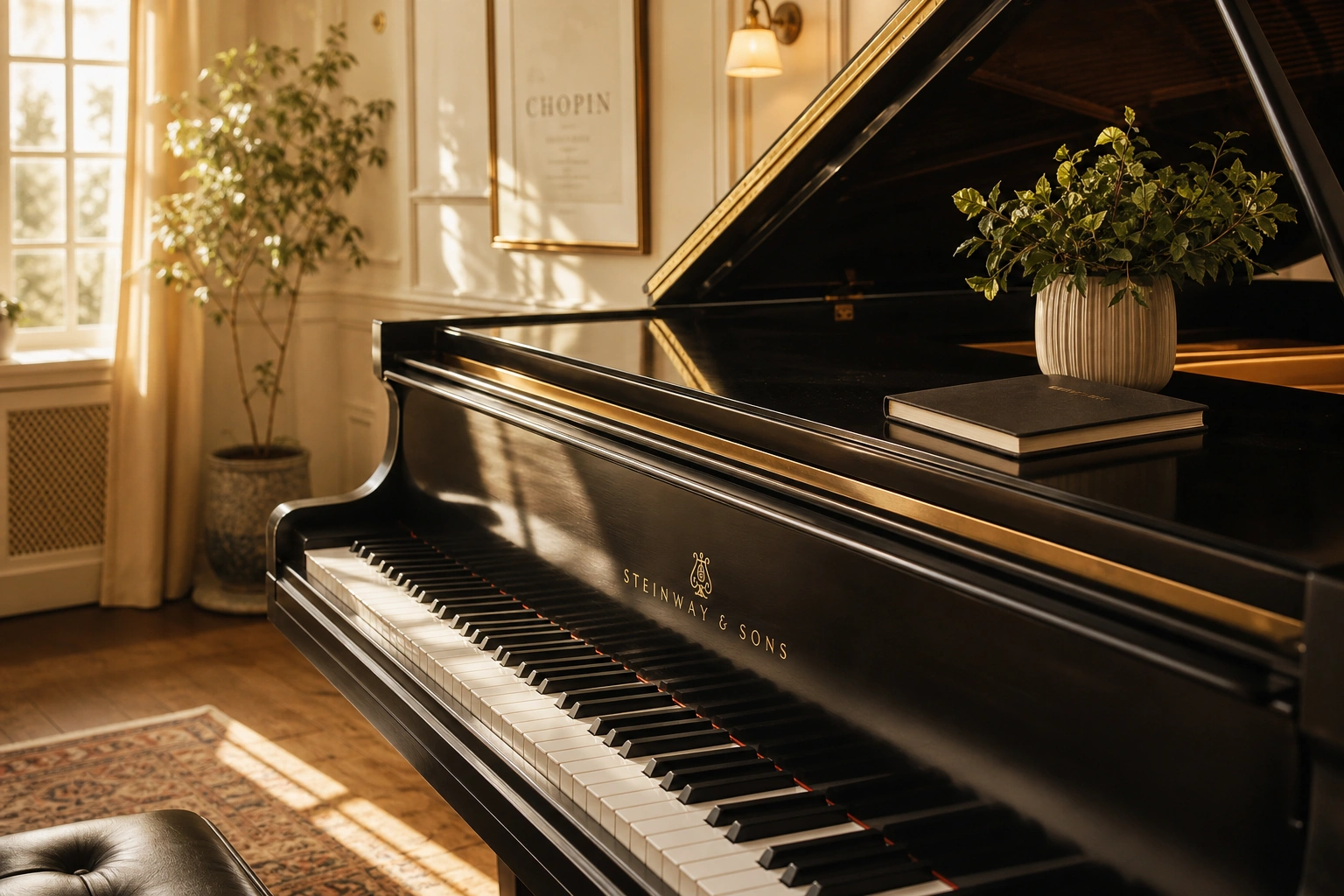
Piano key names use only seven letters: A, B, C, D, E, F, and G. This same seven-letter pattern repeats over and over from the lowest key to the highest, so a standard 88-key piano has no unique names beyond those seven – just multiple repeats of the same sequence at different pitches called octaves.
I still remember a student named Sam, a 34-year-old beginner, staring at the keyboard on his first day like it was a foreign alphabet with 88 different symbols. Once I showed him it was really just seven letters repeated, his shoulders dropped about two inches. If you want that same “oh, that’s it?” moment yourself, a free 30-minute trial lesson is a fast, low-pressure way to get it explained on your own keyboard.
Why are there only seven letter names for piano keys?
Piano keys are named with seven letters because Western music theory is built on a seven-note major scale, and those letters simply repeat higher and lower to cover the full range of the instrument. After G, the pattern starts back over at A, one octave higher, sounding like the same note but pitched differently.
This system dates back centuries and is documented in standard music theory references, including the overview on Wikipedia’s musical note page. It is not arbitrary – it maps directly onto the white keys of the keyboard.
- The white keys, in order, spell out A, B, C, D, E, F, G, then repeat.
- Each repeat of the full seven-letter cycle is called an octave.
- A standard 88-key piano spans just over seven full octaves.
- The lowest key is an A, and the highest key is a C.
Here’s a mistake I see constantly with new students: they try to memorize all 52 white keys as if each one is a totally separate fact. That’s backwards. You only need to memorize seven letters and the repeating pattern – the rest is recognizing where you are in the cycle.
What are the black keys on a piano called?
Black keys on a piano are named using sharps and flats attached to the letter names of the white keys next to them. A sharp (♯) raises a note, and a flat (♭) lowers it, so the black key between C and D is called either C sharp or D flat, depending on the musical context.

There are five black keys in every repeating group, arranged in a pattern of two, then three, with small gaps between the groups of two and three. That visual pattern is actually the fastest way to orient yourself on the keyboard without counting from the very end every time.
- Between C and D: C♯ or D♭
- Between D and E: D♯ or E♭
- Between F and G: F♯ or G♭
- Between G and A: G♯ or A♭
- Between A and B: A♯ or B♭
Notice there is no black key between E and F, or between B and C. Those two gaps are the reason the black-key groups come in twos and threes instead of one continuous row of five – and they’re the visual anchor most of my students use to find any white key almost instantly.
How do you find middle C and use it as a landmark?
Middle C is the C key closest to the center of a standard piano keyboard, and it sits directly to the left of a group of two black keys. Once a student can spot that group of two black keys reliably, they can find middle C from across the room without counting a single white key.
If you’d like someone to point at your actual keyboard and make this click in real time, Your first 30-minute lesson with Austin is free – no card, no pressure.
Middle C is also the reference point for reading sheet music, since it sits right between the treble and bass clefs. I cover this landmark in much more depth, with photos of exactly where to look, in a dedicated guide to finding middle C on piano. It’s worth a slow read if this is new territory.
One eight-year-old student of mine, Lila, used to call the group-of-two black keys “the twins.” Silly as it sounds, giving the pattern a nickname made it stick permanently – she never lost her place on the keyboard again after that lesson.
What’s the fastest way to actually learn all the key names?
The fastest way to learn piano key names is to memorize the seven-letter sequence, the black-key sharp and flat pattern, and one landmark note like middle C, then practice naming random keys out loud for five minutes a day. Most beginners get comfortable within one to two weeks of short daily repetition.
- Say the seven letters A through G out loud while touching each corresponding white key.
- Find the groups of two and three black keys across the whole keyboard.
- Locate middle C using the group-of-two landmark near the center.
- Name five random white keys per day without counting from the end.
- Add sharps and flats once the white keys feel automatic.
Adult learners often try to skip straight to reading music before this step is solid, and it always slows them down later. Kids, on the other hand, usually pick up the pattern faster than adults because they’re less worried about getting it “wrong” and just start pointing and guessing.
“I started as a complete beginner, and Austin made the learning process feel comfortable.” – Noah Peterson
This kind of foundational knowledge matters more than it seems. Deciding whether to focus on chords or note names first gets a lot easier once the keyboard layout itself is no longer confusing. It’s also worth knowing this holds true whether you’re practicing on a full acoustic piano or a keyboard – the letter names and layout are identical either way.

Common questions
Do piano keys have different names in other countries?
Yes. Many countries, including much of Europe and Latin America, use solfège-based names – Do, Re, Mi, Fa, Sol, La, Ti – instead of letters. The pitches are identical; only the naming convention differs. English-speaking countries almost always use the A through G letter system.
How many keys does a full-size piano have?
A standard full-size piano has 88 keys: 52 white keys and 36 black keys, spanning just over seven octaves. Smaller keyboards used by beginners commonly have 61 or 76 keys, which still cover the full letter-name pattern, just across a shorter range.
Why do some black keys have two names?
Black keys have two names because they can be described relative to either neighboring white key – a sharp raises the lower note, and a flat lowers the higher note, landing on the same physical key. Which name is used depends on the key signature and musical context, not the sound itself.
Is there an easy way to remember the black key pattern?
Look for the visual grouping: black keys always cluster in twos, then threes, repeating across the keyboard. Many students use a phrase or nickname for the “group of two” to spot middle C, and for the “group of three” to locate F quickly from anywhere on the keys.
Do I need to memorize key names before I can play songs?
Basic familiarity helps, but you don’t need perfect memorization before playing your first song. Many of my students play a simple two-hand piece within a few weeks while still occasionally double-checking letter names, and the recognition solidifies naturally through repetition. See how many lessons it typically takes to play a song for a realistic timeline.
Are key names the same on a digital keyboard as an acoustic piano?
Yes, the letter names, octave pattern, and black-and-white key layout are identical on digital keyboards and acoustic pianos. The only differences are in touch and sound production, not naming. This applies whether you’re practicing at home or joining lessons over Zoom.
Ready to find out for yourself?
Your first 30-minute lesson with me is completely free – we will evaluate where you are, talk through your goals, and map out your path.
