The short answer
7th chords piano playing starts with a basic triad – root, third, fifth – with a fourth note stacked on top, a 7th above the root. That one added note is what gives 7th chords their richer, more “grown-up” sound compared to plain major and minor chords, and it’s the building block of jazz, blues, gospel, and most pop chord progressions you hear today.
If you’ve been playing simple triads and want to add real color to your playing, this is one of the most useful theory concepts you can learn, and it’s something I walk nearly every student through once they’re comfortable with basic chords. If you’d like someone to check your hand shapes and voicings in real time, Weaver Music’s first lesson is a full 60 minutes for $29, paid only after the lesson, and only if you love it.
What makes a chord a 7th chord?
A 7th chord is any four-note chord formed by stacking a seventh interval on top of a triad. Instead of just root, third, and fifth – like a C major chord (C-E-G) – you add one more note a seventh above the root, giving you four notes played together, like C-E-G-B.
Think of it like building with blocks. You start with the triad, which already sounds complete on its own, then add one more layer. That fourth note doesn’t change the chord’s basic identity – a C7 chord is still clearly built on C – but it adds tension, color, or sophistication depending on which type of seventh you use.
There are five common 7th chord types pianists use regularly:
- Major 7 (maj7)
- Dominant 7 (7)
- Minor 7 (m7)
- Half-diminished 7 (m7♭5)
- Fully diminished 7 (dim7)
Each one is built from a different combination of intervals, and each has its own emotional flavor and typical use. We’ll go through them one at a time. For the triads these are built on, our basic piano chords for beginners post is a good place to start if you haven’t covered that ground yet, and the Music Theory for Musicians and Normal People lesson on seventh chords is a solid outside reference if you want another explanation of the intervals involved.
How do you build a major 7 chord?
A major 7 chord is a major triad plus a major seventh above the root – in C, that’s C-E-G-B. It has a smooth, dreamy, almost floating quality, very different from the brighter, more resolved sound of a plain major triad.
The formula is simple once you see it in half steps: root, major third (4 half steps up), perfect fifth (7 half steps up), major seventh (11 half steps up). For C major 7, that lands on C, E, G, B. For F major 7, it’s F, A, C, E.
Major 7 chords show up constantly in jazz standards, ballads, and a lot of modern singer-songwriter pop – think of that soft, hazy sound under a slow verse. I tell students to listen for it as the “coffee shop chord” because so many lo-fi and acoustic arrangements lean on it.
A quick shortcut I give students: play the major triad, then simply drop your top note down one half step. That half-step drop from the octave to the major 7th is the entire difference.
How do you build a dominant 7 chord?
A dominant 7 chord is a major triad plus a flatted (minor) seventh above the root – in C, that’s C-E-G-B♭. It has a bluesy, unresolved, “wants to go somewhere” sound, which is exactly why it’s the backbone of blues and so much classic rock and gospel playing.
The formula: root, major third, perfect fifth, minor seventh (10 half steps up from the root). So G7 is G, B, D, F. This is the chord you’ll meet constantly if you’ve worked through a basic chord progression in blues or gospel style.
Dominant 7 chords are called “dominant” because of their job in a key – built on the 5th scale degree, they pull strongly back toward the home chord (G7 wants to resolve to C, for example). This pull is one of the most important things to listen for once you start recognizing it by ear.
One mistake I see constantly: students build a dominant 7 and accidentally use the major 7th instead of the flatted one, because their ear is used to the brighter major 7 sound from pop radio. Training your fingers to drop that top note a full step, not a half step, is worth drilling slowly.
How do you build a minor 7 chord?
A minor 7 chord is a minor triad plus a flatted seventh above the root – in A minor, that’s A-C-E-G. It has a mellow, warm, slightly melancholic sound that’s softer than a plain minor triad but less tense than a diminished chord.
The formula: root, minor third (3 half steps up), perfect fifth, minor seventh (10 half steps up). For D minor 7, that’s D, F, A, C. For E minor 7, it’s E, G, B, D.
Minor 7 chords are everywhere in jazz, R&B, neo-soul, and modern pop ballads. If you’ve ever heard a chord progression described as “jazzy” or “smooth,” there’s a strong chance minor 7 chords are doing a lot of that work. They’re also one of the easiest 7th chords for beginners to grab onto because the shape feels naturally comfortable under the hand.
I had a student, a returning adult player in her 40s, who’d only ever played simple triads in church hymnals. The first time she played a ii-V-I with minor 7 and dominant 7 chords, she stopped and said it suddenly sounded like “real jazz.” That’s usually the moment 7th chords click for people – they hear the difference before they fully understand the theory.
If stacking these intervals by ear still feels shaky, that’s completely normal – most students need a few guided sessions before 7th chords feel automatic under their hands. Your first lesson with Austin is a full 60 minutes for just $29 (normally $99). Love it, or it’s on us.
What is a half-diminished 7 chord?
A half-diminished 7 chord is a diminished triad plus a minor (flatted) seventh above the root – in B, that’s B-D-F-A. It sounds tense and unsettled but not fully “collapsed,” which is why it’s often written as m7♭5.
The formula: root, minor third, diminished fifth (6 half steps up, a flatted fifth), minor seventh (10 half steps up). This chord is one half step away from a fully diminished chord, hence “half-diminished.”
You’ll hear half-diminished 7 chords most often as the ii chord in a minor key ii-V-i progression – for example, in A minor, that’s B half-diminished 7 moving to E7 and resolving to A minor. It’s a staple of jazz and film-score writing when composers want a moody, unresolved color before a resolution.
What is a fully diminished 7 chord?
A fully diminished 7 chord is built entirely from stacked minor thirds – in C, that’s C-E♭-G♭-B♭♭ (enharmonically, A). It has the most unstable, dramatic sound of all the 7th chord types, which composers have used for centuries to create suspense.
The formula: root, minor third, diminished fifth, diminished seventh (9 half steps up, enharmonically the same pitch as a major sixth). Because every interval is a minor third, the chord is symmetrical – you can rename any of its four notes as the root and get the same notes.
That symmetry is genuinely useful once you notice it. A single diminished 7 shape, moved up in minor thirds, gives you access to all twelve keys’ worth of diminished chords using only three distinct note groupings. Composers from Bach to film composers have leaned on this chord for suspenseful, “something’s about to happen” moments.
In classical repertoire, diminished 7 chords often appear right before a dramatic resolution – a technique you can hear clearly if you’ve studied pieces like the one covered in our Moonlight Sonata breakdown. The Encyclopedia Britannica’s entry on harmony is also worth a read if you want more background on how composers historically used tension and resolution like this.
Which 7th chords should beginners learn first?
Beginners should start with dominant 7 and minor 7 chords, since they’re the easiest to hear in familiar blues, gospel, and pop songs and appear most often in real music. Major 7 comes next, with half-diminished and fully diminished chords saved for later since they’re rarer and more dissonant.
A practical order that works well for most of my students:
- Dominant 7 (common in blues, gospel, rock)
- Minor 7 (common in jazz, pop, R&B)
- Major 7 (common in ballads, jazz, lo-fi)
- Half-diminished 7 (common in minor-key jazz progressions)
- Fully diminished 7 (common in classical transitions, film scoring)
This order follows how frequently you’ll actually encounter each chord in real sheet music and songs, not just how they’re organized in a textbook. There’s no point memorizing a diminished 7 chord in isolation before you can comfortably play a dominant 7 in multiple keys – the rarer chord won’t stick without that foundation.
How do you practice 7th chords so they stick?
The most effective way to practice 7th chords piano style is to play each type in all 12 keys slowly, hands separately at first, while saying the note names out loud as you play them. Most students who do this 10 minutes a day get comfortable with one chord type per week.
A few specific habits that actually move the needle:
- Play the triad first, then add the 7th – don’t try to grab all four notes blind right away
- Practice resolving dominant 7 chords to their home chord (G7 to C, for example) so your ear learns the pull
- Use a slow metronome setting and only speed up once the shape is accurate every time
- Name each note out loud as you play it – this is the single habit that separates students who really learn chords from those who just memorize finger shapes
One student of mine, a teenager working through a jazz combo book, kept rushing past the half-diminished shape because it felt awkward. We slowed down to half speed for about a week, just that one chord in three keys, and it stopped feeling foreign. Awkward chords almost always resolve with slower, more deliberate reps – not more reps done fast.
If you’re working through 7th chords on your own, our post on memorizing piano notes pairs well with this, since knowing your note names cold makes building any chord faster.
“I started as a complete beginner, and Austin made the learning process feel comfortable.” – Noah Peterson
Common questions
What’s the difference between a 7th chord and a regular triad?
A regular triad has three notes – root, third, and fifth – while a 7th chord adds a fourth note, a seventh above the root. That extra note adds color and tension, making 7th chords sound richer and more complex than plain triads, which is why they’re so common in jazz and blues.
Are 7th chords harder to play than triads?
Seventh chords require stretching to four notes instead of three, so they can feel harder at first, especially for smaller hands. Most students adjust within a few weeks of regular practice, and in many voicings you can drop or reposition a note to make the stretch more comfortable.
Do I need to know 7th chords to play jazz?
Yes, 7th chords are essential for jazz. Nearly every jazz standard chord progression, including the common ii-V-I pattern, is built from minor 7, dominant 7, and major 7 chords, so understanding how to build and hear them is one of the first real steps into jazz piano.
Can I use 7th chords in pop or worship music too?
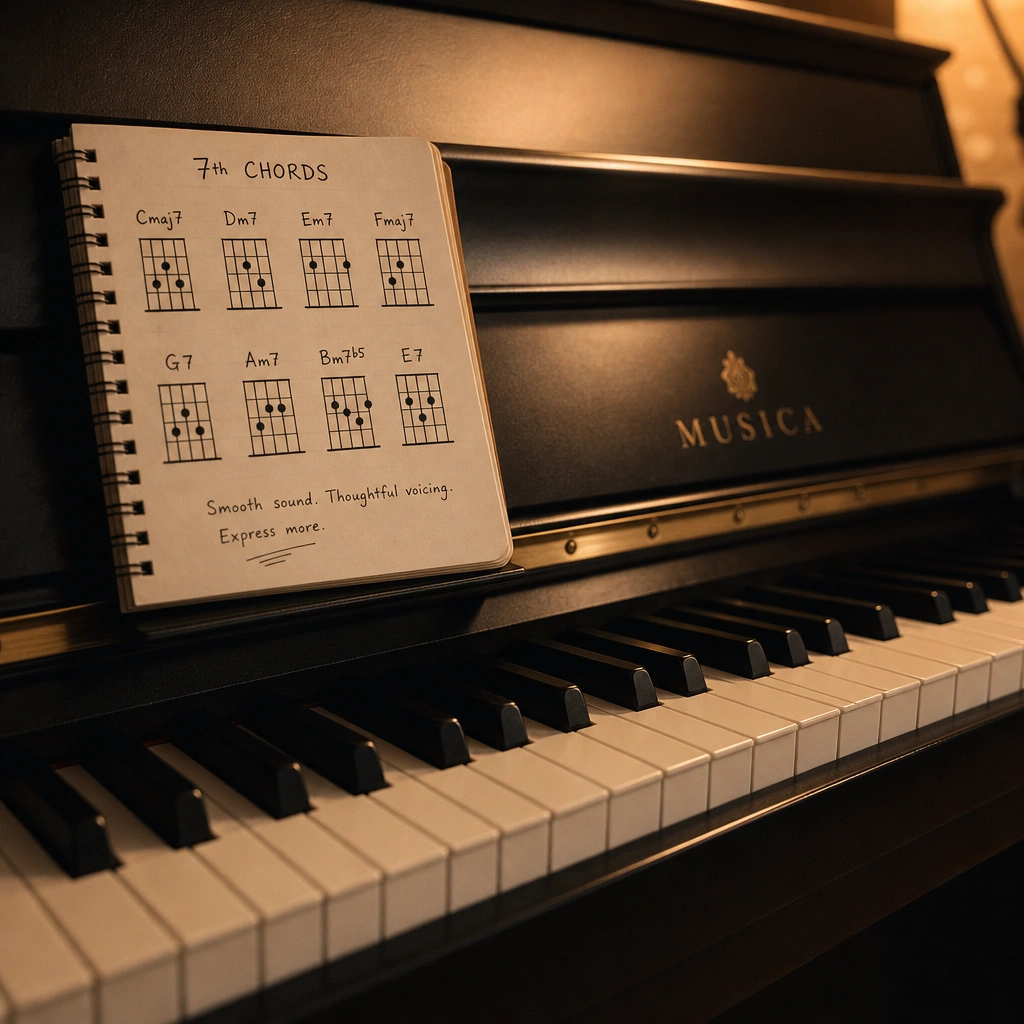
Absolutely. Major 7 and minor 7 chords are extremely common in pop ballads, worship music, and neo-soul, often used to add warmth without the bluesy edge of a dominant 7. Many modern lead sheets will mark these chords directly using symbols like Cmaj7 or Am7.
What’s the fastest way to memorize all the 7th chord shapes?
Rather than memorizing 60 individual chords, learn the interval formula for each of the five types and apply it to one key at a time. Most students who drill one chord type across all 12 keys for about a week retain it far better than those who jump between chord types randomly.
Do 7th chords sound different depending on inversion?
Yes, the notes you put on top or bottom change the color and smoothness of a 7th chord, though the chord’s basic identity stays the same. Inversions are their own topic worth studying separately once you’re solid on building each 7th chord in root position first.
Seventh chords are one of those concepts that sound intimidating until you actually sit down and build a few – at that point most students realize it’s really just one extra note layered onto something they already know. If you’d like a clear walkthrough of your own, live and one-on-one over Zoom, Austin’s first lesson includes a skill check and a practice plan built around the music you actually want to play.
Ready to find out for yourself?
Your first lesson with me is a full 60 minutes for just $29 (normally $99). We will evaluate where you are, talk through your goals, and map out your path. Love it, or it’s on us.
Free guide for parents
The 10-Minute Practice Plan
What to practice, how to help when you don’t read music, and what to do when they don’t want to. A short printable guide from Austin, with a four-week practice chart.