The short answer
Good piano warm up exercises take 5-10 minutes and move from loose to precise: a minute of shoulder and wrist rolls away from the keys, then five-finger patterns in both hands, a scale or two, an arpeggio, and a few chord shapes in the key you’re about to practice. The goal is relaxed, even sound before you tackle anything hard.
I give every student, from a 7-year-old just starting out to an adult returning after 20 years away, some version of this same sequence before I book a full 60-minute first lesson to see where their hands and ears actually are. It’s $29, paid after the lesson, and if it’s not useful to you, you don’t pay for it.
Why should you warm up before playing piano?
Warming up before playing piano matters because cold muscles and an unfocused ear lead to tense playing, missed notes, and slower progress on whatever you practice next. A short warm-up tells your hands what key you’re in, resets your posture, and shifts your brain from “daily life” into “music mode” in under ten minutes.
I see this constantly: a student sits down, skips straight to their hardest piece, and spends the first five minutes fumbling through passages they played cleanly the day before. Their hands are stiff and their ear hasn’t caught up yet. One of my adult students, a software engineer who came to lessons after years at a desk, used to type for eight hours and then go straight into Chopin. His hands were locked up before he even started. Once he added two minutes of wrist circles and a five-finger pattern first, his opening measures stopped sounding rushed and uneven.
A warm-up also catches tension early, which matters more than most beginners realize. If you’ve ever dealt with sore wrists or a locked jaw while playing, it’s worth reading about adapting piano technique for stiff or painful hands, since many of the same loosening principles apply whether or not you have arthritis.
What are good warm-up moves away from the keys?
Good away-from-the-keys warm-up moves loosen the shoulders, wrists, and fingers before you touch a single note. Shoulder rolls, wrist circles, and gentle finger stretches take about a minute and prevent the stiff, clenched hand position that causes tension injuries and uneven tone over time.
- Shoulder rolls: 8-10 slow rolls backward, letting your arms hang heavy.
- Wrist circles: rotate each wrist in both directions, 5-6 times, keeping fingers relaxed.
- Finger stretches: gently spread and release each hand’s fingers, 3-4 times per hand.
- Arm shakes: let your arms go limp and shake out any tightness from the day.
- Deep breaths: 3-4 slow breaths to settle before you sit at the bench.
I ask younger students to do this as a quick “wake up your hands” game before lessons, and it takes the self-consciousness out of what’s really just basic stretching. Adults tend to skip this step the most, assuming it’s only for kids, but it’s often the single thing that fixes chronic wrist soreness.
What are five-finger pattern exercises?
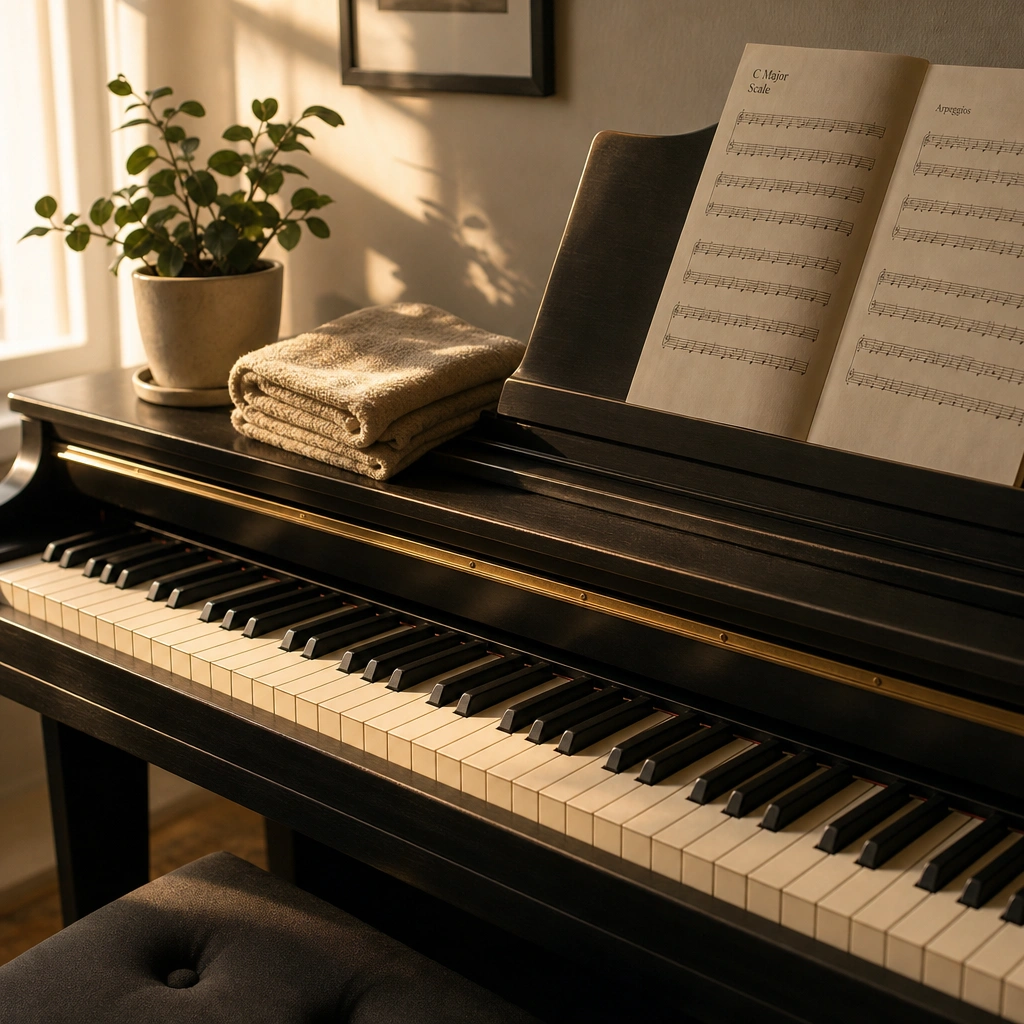
Five-finger pattern exercises are short scale-like runs played with one finger on each of five adjacent notes, usually starting on C, D, or G. They build even finger strength and basic hand position, and they’re the first thing almost every beginner learns before moving into full scales.
A typical pattern: play up five notes (1-2-3-4-5) and back down (5-4-3-2-1), hands separately first, then together. Try these variations once the basic pattern feels comfortable:
- Play it slowly, listening for even volume between fingers.
- Play it staccato (short and detached) to sharpen finger control.
- Play it legato (smooth and connected) to practice finger transfer.
- Shift the starting note up by step and repeat in a new position.
The most common mistake I hear is the fourth finger landing noticeably weaker or louder than the others. It’s almost universal in new students because the ring finger shares tendons with its neighbors. I don’t try to “fix” it in one sitting; I just have students repeat the pattern slowly every day until the evenness shows up on its own, usually within a few weeks.
How do scales and arpeggios fit into a warm-up?
Scales and arpeggios belong in a warm-up as a bridge between simple patterns and real repertoire, because they cover more range and more finger crossings than a five-finger exercise. Playing one or two scales and one arpeggio, hands separately or together depending on level, trains the hand shapes you’ll actually use in pieces.
A practical approach:
- Beginners: one-octave C major scale, hands separately, slow and even.
- Early intermediate: C and G major scales hands together, plus a C major arpeggio (root, third, fifth, octave).
- Intermediate and up: two octaves, two or three keys that match what you’re currently practicing, plus arpeggios in those same keys.
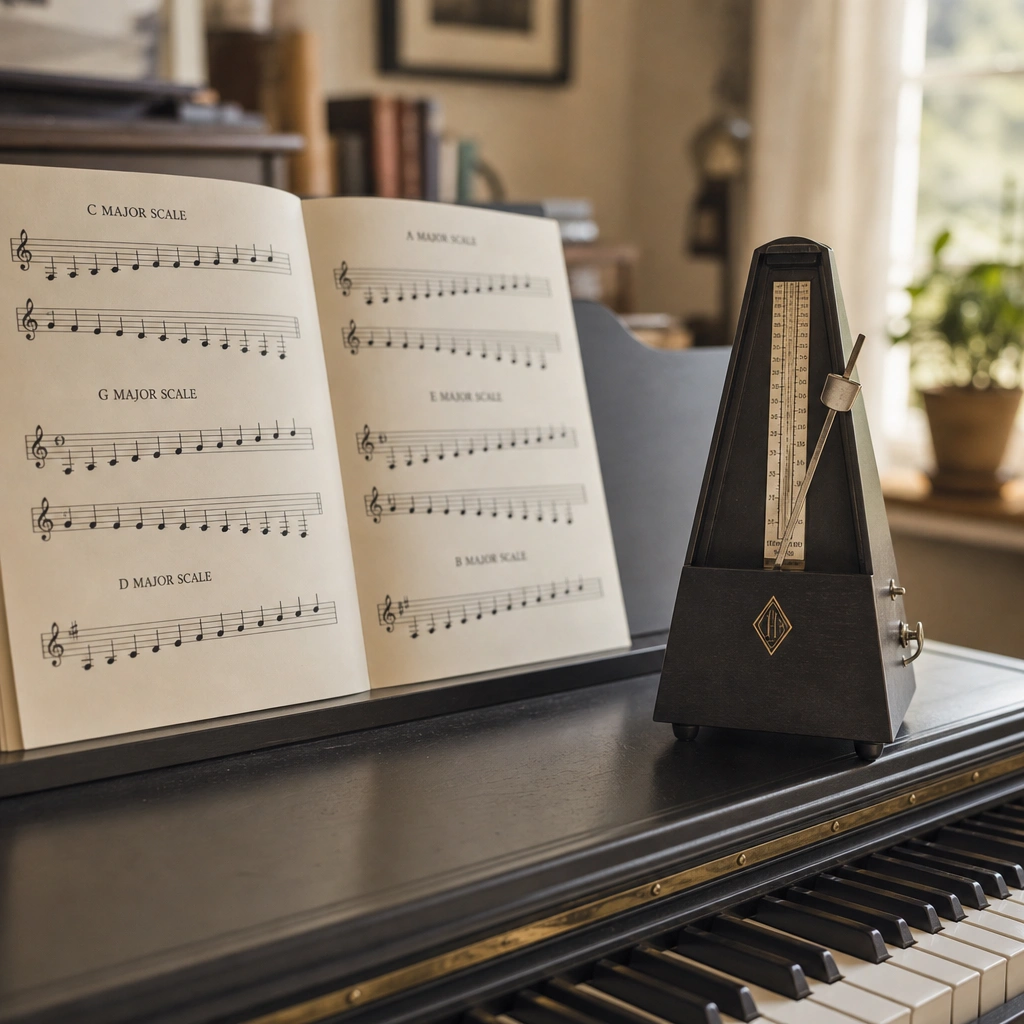
Pick the scale that matches the key signature of whatever piece you’re about to practice. If you’re working on a piece in G major, warming up in C major doesn’t do much for your hands. This is also where a metronome earns its keep: starting around 60-70 beats per minute and only speeding up once the notes are clean prevents the sloppy, rushed scales I hear from students who skip this step.
If scales and arpeggios still feel like a guessing game, a teacher can show you exactly which ones to warm up with for your current repertoire. Your first lesson with Austin is a full 60 minutes for just $29 (normally $99). Love it, or it’s on us.
What chord shape exercises help the most?
Chord shape exercises that help the most are simple triads played in root position and their inversions, moving smoothly from one to the next without looking down. Practicing I-IV-V chords in a key, or just rolling through C, F, and G major triads, trains your hand to recognize shapes instead of hunting for individual notes.
Try this short routine, about two minutes:
- Play a C major triad, then its first and second inversions, ascending.
- Repeat in F major, then G major.
- Play I-IV-V-I as a simple progression, four beats per chord.
- Try the same progression with a slight arpeggiated roll instead of a block chord.
If chord symbols or basic chord shapes are still new territory for you, our guide to basic piano chords for beginners covers that foundation in more depth than I’ll repeat here. Once triads feel natural, warming up on 7th chords is a logical next step, and our piece on 7th chords walks through those shapes.
What should a warm-up look like at each level?
A warm-up should scale with your level: beginners need slow, simple patterns in one key, while advanced players can move through several keys and more complex figures in the same ten minutes. The sequence stays the same; the difficulty and speed change.
- Beginner (first 6 months): loosening moves, one five-finger pattern hands separately, one scale hands separately. About 5 minutes total.
- Early intermediate: loosening moves, five-finger patterns hands together, two scales hands together, one arpeggio, simple triads. About 7 minutes.
- Intermediate to advanced: loosening moves, scales and arpeggios in 2-3 keys matching current repertoire, inversions, and a short technical exercise from a book like Hanon. About 10 minutes.
For structured finger-strengthening drills that slot neatly into this routine, see our guide to Hanon exercises for beginners. If your left hand tends to lag behind, our left-hand piano exercises post is worth adding into the rotation a few times a week.
“Austin explains everything clearly and makes online piano lessons easy to follow.” – Emily Carter
A lot of adult students I work with on Zoom worry that a warm-up is one more thing to remember on top of a busy schedule. In practice, once the sequence is familiar, it takes less time to do than to think about. One parent of a 9-year-old student told me the warm-up became the easiest part of practice because it never changes shape, just difficulty, so her son never dreads starting.

Common questions
Do I need to warm up before every single practice session?
Not strictly, but it helps most on days when your hands feel stiff, you’re starting a demanding piece, or you’ve had a long gap since your last session. A 5-minute version is enough on busy days; skipping it occasionally won’t undo progress, but doing it consistently builds steadier technique over time.
Can warming up actually prevent hand or wrist pain?
Warming up reduces the risk of tension-related soreness by loosening muscles before repetitive motion, but it won’t fix pain caused by poor posture or an awkward bench height. If pain continues after a proper warm-up, it’s worth checking your setup and possibly consulting a teacher or doctor.
Is it okay to warm up using the song I’m currently learning instead of scales?
Using your current song as a warm-up skips the benefit of building general hand flexibility and even tone across all five fingers. Scales and five-finger patterns train broader skills your song doesn’t cover on its own, so it’s better to do both rather than substitute one for the other.
How long until a warm-up routine starts feeling automatic?
Most students I teach stop needing to think through the steps after 2-3 weeks of doing the same basic sequence daily. By that point the hands “know” the pattern and the whole routine takes under ten minutes without feeling like a chore.
Should kids warm up the same way adults do?
Kids benefit from the same structure, loosening, patterns, scales, chords, but shorter and more playful. A 5-year-old might only manage 3 minutes with a game-like framing, while a teenager can usually handle the same 7-10 minute routine an adult uses.
What if I only have 2 minutes before I have to start practicing?
A 2-minute version still helps: 30 seconds of wrist and shoulder loosening, one five-finger pattern hands together, and one scale. It’s not as thorough as a full warm-up, but it beats sitting down cold and jumping straight into a hard piece.
Ready to find out for yourself?
Your first lesson with me is a full 60 minutes for just $29 (normally $99). We will evaluate where you are, talk through your goals, and map out your path. Love it, or it’s on us.
Free guide for parents
The 10-Minute Practice Plan
What to practice, how to help when you don’t read music, and what to do when they don’t want to. A short printable guide from Austin, with a four-week practice chart.