
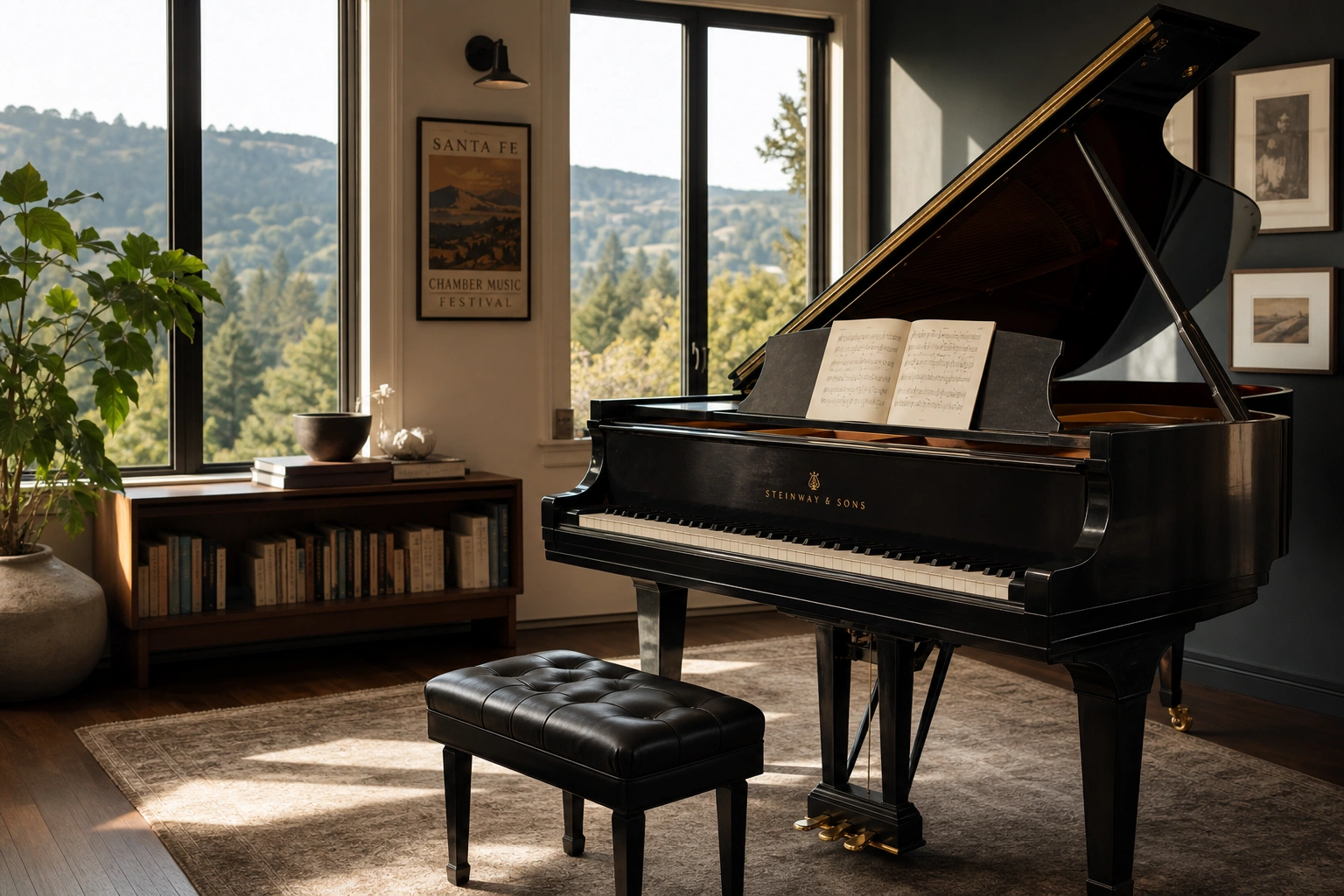
If you’re looking for bay area piano lessons, you’re facing a question that would have seemed impossible just a few years ago: should you learn in person or online? Both formats have real advantages, and both have tradeoffs that matter differently depending on your schedule, location, and learning style.
With 10+ years of experience as a Bay Area pianist, I’ve watched this choice evolve from a pandemic workaround into a permanent part of how people learn music. The truth is, there’s no universally right answer—but there is a right answer for you. If you’d like to experience both teaching styles firsthand, I offer a free 30-minute trial lesson where we can figure out what fits your goals best.
Let’s walk through the real factors that should guide your decision.
The Short Answer
Choose in-person bay area piano lessons if you’re a complete beginner who needs close guidance on hand position and posture, if you’re a young child learning focus and discipline, or if you value the ritual of going somewhere to learn. Choose online bay area piano lessons if you have a reliable schedule conflict with in-person times, if you live far from qualified teachers, if you already have decent technique, or if you learn best in your own familiar space.
Most importantly, the quality of the teacher matters far more than the format. A great teacher will make either setting work beautifully.
Why This Choice Matters Now
Before 2020, piano lessons were almost universally in-person. Teachers occasionally offered Skype makeup lessons, but that was the exception. Then the world changed, and suddenly everyone was teaching on Zoom.
What surprised most of us in the music education world was how well it worked. Not perfectly—there are real limitations—but far better than we expected. Students made genuine progress. Beginners learned proper technique. Advanced students prepared for college auditions.
Now that both options are stable and widely available, choosing between them is less about what’s possible and more about what’s optimal for your specific situation. That’s actually harder, because it requires you to be honest about your priorities and constraints.
The Bay Area adds another layer to this decision. Traffic, commute times, parking, and the sheer geographic spread of the region make logistics matter more here than in many other places. A teacher fifteen miles away might be forty-five minutes in traffic, which changes the calculus considerably.
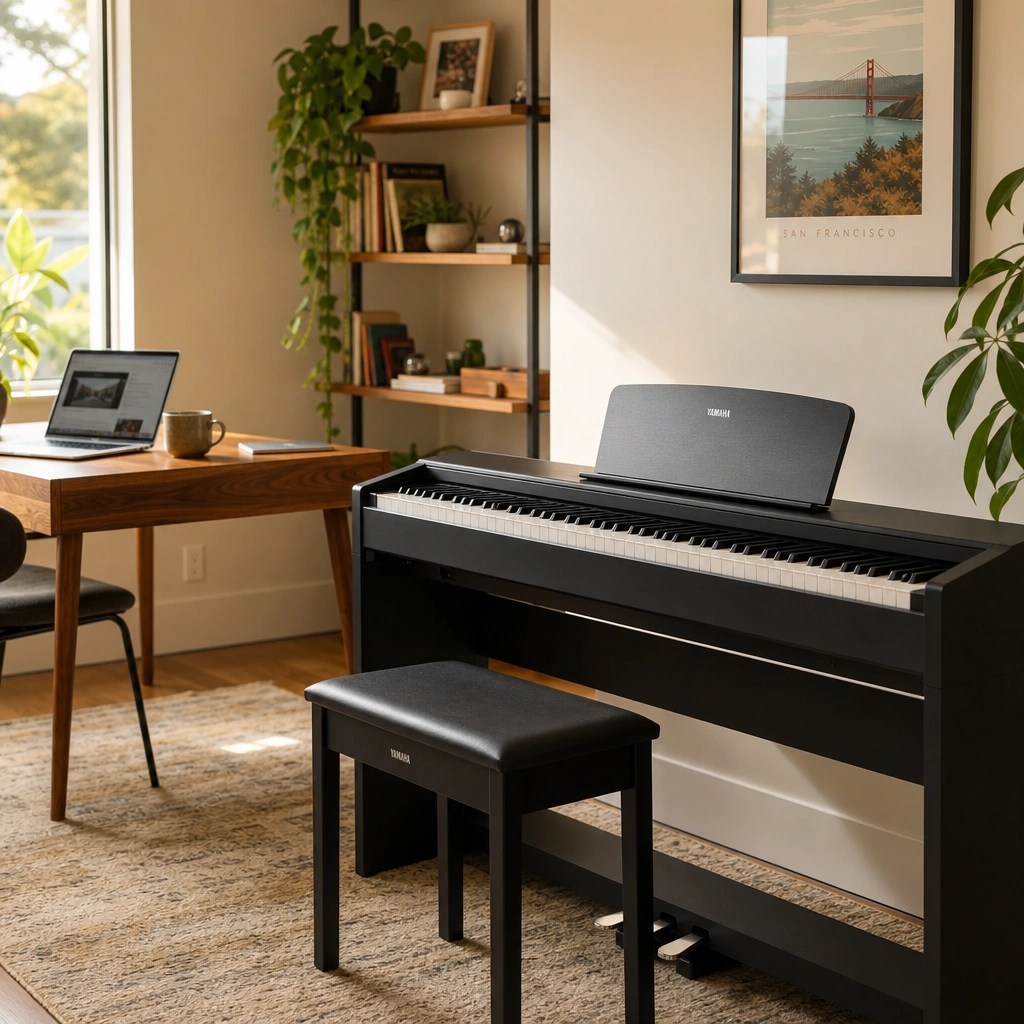
Seven Factors to Weigh
Here are the variables that actually matter when choosing between online and in-person bay area piano lessons. I’ve seen each of these tip the decision for different students.
1. Your Current Skill Level
Complete beginners benefit more from in-person instruction, especially in the first few months. Why? Because learning proper hand shape, wrist position, and posture is much easier when a teacher can gently adjust your hand or demonstrate the angle of your wrist from multiple perspectives.
That said, I’ve successfully taught total beginners online by using multiple camera angles, verbal cues, and careful observation. It works, but it requires more intention from both student and teacher.
If you already play at an intermediate level or higher, the format matters much less. You likely already have solid technique, and what you need most is repertoire guidance, interpretation feedback, and musical insight—all of which translate beautifully through a screen.
2. Your Age and Attention Style
Young children (roughly ages 5-9) often do better with in-person bay area piano lessons. The physical presence of a teacher helps them stay focused, and the ritual of going to a lesson creates a boundary that reinforces focus. At home, surrounded by toys and familiar distractions, staying engaged for thirty minutes can be genuinely harder.
There are exceptions—some kids are more comfortable at home, and some teachers are brilliant at engaging young students through a screen. But as a general pattern, in-person tends to work better for the elementary school crowd.
Teenagers and adults usually adapt to online lessons more easily. They have the self-regulation to stay focused, and many actually prefer the convenience and comfort of learning from home.
3. Your Schedule and Commute Reality
Be ruthlessly honest here. If you live in San Jose and work in San Francisco, and the only teacher you love is in Oakland, are you actually going to make that drive every week?
Bay Area traffic is not theoretical. It’s the difference between a commitment you keep and one that slowly falls apart over six months. I’ve seen students choose a slightly less ideal teacher nearby over a perfect-fit teacher across the bay, and they were right to do so—consistency beats perfection.
Online bay area piano lessons eliminate this variable entirely. Your lesson starts when you sit down at your piano, no buffer time required. For busy professionals, parents juggling multiple kids’ schedules, or anyone with unpredictable work hours, this is transformative.
4. Your Learning Environment at Home
Do you have a quiet, dedicated space where you can take a lesson without interruption? Is your piano or keyboard in good condition, well-lit, and positioned so a camera can capture both your hands and your posture?
If yes, online lessons become much more viable. If your piano is in a high-traffic living room where family members wander through, or if your lighting is poor, or if your internet connection drops frequently, in-person starts to look more appealing.
Technical requirements for online lessons are not demanding, but they are real. You need decent internet, a device with a camera, and a way to position that camera so your teacher can see your hands and upper body. Most people can solve this with a laptop or tablet and a simple stand, but it’s worth thinking through before you commit.
5. Your Instrument Quality
This matters more for online lessons. In person, a teacher can hear and feel the nuances of your instrument. Online, audio quality is compressed, and subtle dynamics get lost.
If you have a real acoustic piano in decent condition, this isn’t an issue. If you’re working with a digital piano, you’ll want at least a mid-range model with weighted keys and decent speakers or headphones. If you’re unsure what you need, this guide on what size keyboard for piano lessons covers the basics.
For in-person bay area piano lessons, many teachers have a high-quality instrument in their studio, which can actually be an advantage if your home piano isn’t great. You get to practice on a better instrument once a week, which helps you develop your ear.
6. What You’re Working Toward
If you’re preparing for a formal piano exam, a conservatory audition, or a high-stakes performance, in-person lessons offer an edge. Your teacher can help you refine stage presence, manage performance anxiety in real time, and give you the experience of playing for someone in the room—something that still feels different from playing for a camera.
If you’re learning for personal enrichment, working through a bucket list of pieces you’ve always wanted to play, or building a skill for songwriting or composition, online lessons work just as well. The goals are more flexible, and the convenience of online often means you’re more consistent, which matters more than the minor advantages of being in the same room.
7. Your Personality and Comfort
Some people simply learn better in person. They feed off the energy of shared physical space, they like the formality and focus that comes with going somewhere, and they find it easier to be vulnerable and make mistakes when they’re not staring at their own face on a screen.
Others are the opposite. They’re more relaxed at home, less self-conscious, and they appreciate the slight distance that a screen provides when they’re working through something difficult. Neither is better—it’s just temperament.
“Austin explains everything clearly and makes online piano lessons easy to follow.” – Emily Carter
Seeing how each format actually feels is the fastest way to know which works for you. Your first 30-minute lesson with Austin is free – no card, no pressure.
When In-Person Bay Area Piano Lessons Make the Most Sense
There are situations where in-person is clearly the better choice, and it’s worth naming them explicitly.
You’re a true beginner with no musical background. The first few months of piano involve building physical habits that will stay with you for years. A teacher who can gently reposition your hand, check your wrist angle from the side, and make sure you’re sitting at the right height has a real advantage. It’s not impossible to learn this online, but it’s harder.
You’re a young child (ages 5-8). The structure and focus that come with going to a teacher’s studio help many young students stay engaged. At home, even with a parent present, the pull of familiar distractions can be strong.
You’re preparing for performance or auditions. Playing for someone in the room is still qualitatively different from playing for a camera. If your goal involves performing in front of people, you’ll want regular practice doing exactly that. For more on this, see this guide to piano recital preparation.
You have a great teacher nearby. If you’ve found someone whose teaching style clicks with you, and they’re a reasonable drive away, the convenience trade-off is often worth it. Teacher quality trumps format almost every time.
You don’t have a good practice environment at home. If your piano is in a chaotic shared space, or if your home internet is unreliable, in-person eliminates those variables.
When Online Lessons Are the Better Fit
Online bay area piano lessons aren’t a compromise—they’re often the optimal choice, depending on your situation.
You have significant commute constraints. If getting to a teacher’s studio takes more than twenty minutes each way, you’re adding nearly an hour to every lesson. Over the course of a year, that’s enormous. Online lessons start on time, every time, with no traffic.
You’re an intermediate or advanced player. Once you have solid technique, most of what you need from a teacher is musical: phrasing, interpretation, repertoire selection, and feedback on your sound. All of this works beautifully online. Some of my most advanced students prefer online lessons because they can record the session and review specific advice later.
You have an unpredictable schedule. Online lessons are easier to reschedule, and some teachers offer more flexible timing for online students because there’s no studio transition time between lessons. If you travel frequently for work or have caregiving responsibilities that make leaving the house complicated, online is often more sustainable.
You’re an adult learner. Many adults feel more comfortable learning at home. There’s less performance pressure, and you can immediately practice what you’ve just learned without having to drive home and try to remember everything. The comfort of your own space can actually accelerate learning.
You want access to a specific teacher. One of the best things about online lessons is that geography stops mattering. If there’s a teacher whose style you love, but they’re two hours away, online makes that possible. I teach students across the Bay Area and beyond, and location is no longer a limiting factor.
Online lessons also pair beautifully with structured supplemental resources. At Weaver Music, students get access to a four-level lesson path that reinforces concepts between lessons, which makes the online format even more effective.
What About Hybrid Options
Some teachers offer a hybrid approach: mostly online with occasional in-person sessions when it makes sense. This can be the best of both worlds.
You get the convenience and consistency of online lessons, but you also get periodic in-person check-ins to address technique, try a different instrument, or prepare for a performance. This works especially well for intermediate students who have solid fundamentals but benefit from occasional hands-on adjustments.
Hybrid formats are more common now than they were a few years ago, and they’re worth asking about if you’re torn between the two. Not every teacher offers this, but it’s becoming more standard in bay area piano lessons as both teachers and students recognize the value of flexibility.
The Bay Area Logistics Reality Check
Let’s talk specifically about what it means to take in-person bay area piano lessons in this region. If you live in a dense neighborhood in San Francisco or Berkeley, getting to a nearby teacher might be a ten-minute walk. That’s easy.
But if you live in Fremont and work in Palo Alto, and the teacher you want is in Oakland, you’re looking at a serious weekly commute. Even fifteen miles can mean forty-five minutes in traffic during peak hours. Over a year, that’s not trivial—it’s dozens of hours and significant stress.
Parking is another factor. Some teachers have dedicated parking; others are in neighborhoods where street parking is competitive. If you’re rushing from work to make a 6 PM lesson and spend fifteen minutes circling for parking, that affects your state of mind when you sit down to play.
I’m not saying these obstacles are insurmountable, but they’re worth being realistic about. I’ve seen students start with enthusiasm, then quietly stop scheduling lessons six months later because the logistics wore them down. If you choose in-person, make sure the location is truly sustainable, not just theoretically possible.
Online bay area piano lessons strip all of this away. Your commute is from your couch to your piano. Your lesson starts on time because there’s no travel buffer. This isn’t a small thing—it’s often the difference between a habit that sticks and one that fades.
According to research on music education retention published by the National Association for Music Education, logistical barriers are one of the top reasons students discontinue lessons, even when they’re still motivated to learn. Removing friction matters.
Making Your Decision
Here’s how I’d suggest thinking through this choice for bay area piano lessons.
First, write down your non-negotiables. What absolutely has to be true for this to work? Maybe it’s “I can’t drive more than twenty minutes each way.” Maybe it’s “I need to practice on my own piano because I can’t afford to buy one yet.” Maybe it’s “I need to be able to reschedule with less than 24 hours’ notice because my work is unpredictable.”
Second, be honest about your learning style. Do you focus better in a formal setting, or do you relax more at home? Do you need physical demonstration to learn movement, or do you pick things up well from verbal instruction and visual example?
Third, consider the practical details. What does your schedule actually look like? Where do you live and work? What’s your commute tolerance? What’s your home environment like?
Fourth, think about cost and value. In-person lessons sometimes cost slightly more because of studio overhead, but not always. At Weaver Music, lessons are $99 per 60-minute session regardless of format. What you’re really trading is time and convenience against certain instructional nuances.
If you’re still unsure, the best move is to try both. Take a few lessons online with one teacher and a few in-person with another (or the same teacher, if they offer both). You’ll know within a month which format feels right. There’s no substitute for direct experience.
Also consider what resources you’ll have access to beyond the lesson itself. Do you learn well from supplemental videos? Do you benefit from written practice guides? Some teaching approaches, like the one I use at Weaver Music, include access to a structured video library that reinforces what we cover in lessons, which makes lessons more effective.
You can also explore whether apps and self-guided tools fit into your plan by reading about whether piano learning apps work, though most students find that apps are best used alongside—not instead of—regular lessons.
Finally, don’t overthink it. This isn’t a permanent, life-altering choice. You can start with online bay area piano lessons and switch to in-person later, or vice versa. You can try hybrid. The important thing is to start, stay consistent, and adjust as you learn what works for you.
“I started as a complete beginner, and Austin made the learning process feel comfortable.” – Noah Peterson
You’ll learn more about your preferences in four weeks of actual lessons than in four hours of research. Trust that you’ll figure it out as you go.
You can read through a dozen articles comparing online and in-person piano lessons, weigh every variable, and map out the perfect decision tree—and all of that has value. But there’s one thing that cuts through all the research faster and more clearly: sitting down with a good teacher and experiencing what a lesson actually feels like.
One thirty-minute session will tell you whether you’re comfortable on camera, whether your home setup works, whether the teacher’s communication style clicks with you, and whether the format feels sustainable. You’ll know in your gut whether this is something you’ll actually do every week, or whether it’s going to quietly fall off your calendar after a month.
That’s exactly why I offer a free trial lesson—no credit card, no obligation, just a real lesson where we figure out where you are and where you want to go. If online feels right, we’ll keep going. My own lessons are online only, live over Zoom. And if the timing isn’t right or we’re not a good fit, that’s fine too.
The format you choose matters less than finding a teacher you trust and a routine you’ll stick with. Everything else is details.
Ready to find out for yourself?
Your first 30-minute lesson with me is completely free – we will evaluate where you are, talk through your goals, and map out your path.

Comments
One response to “Bay Area Piano Lessons: Should You Go Online or In Person?”
[…] background and what types of students they typically work with. At Weaver Music, I teach all ages and levels, from absolute beginners to advanced players, both in-person in the Bay Area and online […]