
If you’ve been looking for a healthy way to manage stress, you might be surprised to learn that piano for stress relief is one of the most effective tools available. I’ve watched hundreds of adult students walk into their lessons carrying the weight of their day—tight shoulders, racing thoughts, endless to-do lists. Thirty minutes later, they leave visibly lighter. Playing piano creates a unique mental state that pushes out anxiety and replaces it with focus, creativity, and calm. In this guide, I’ll show you exactly how piano for stress relief works and how you can start experiencing these benefits yourself.
The short answer
Piano for stress relief works by engaging both hemispheres of your brain simultaneously, demanding complete focus that crowds out anxious thoughts. The act of creating music releases dopamine and reduces cortisol, your body’s primary stress hormone. Unlike passive relaxation methods, playing piano gives you an active, creative outlet that builds competence over time, creating lasting confidence alongside immediate calm.
The physical act of playing—coordinating your hands, reading notation, listening to the sounds you create—occupies your mind so fully that there’s simply no room left for worry. It’s a form of productive meditation that leaves you with something beautiful at the end.
Why piano for stress relief actually works
Piano offers something most stress-management techniques don’t: complete mental absorption without mental strain. When you sit at the piano, you enter what psychologists call a “flow state”—that zone where you’re fully present, time seems to disappear, and worries fade into the background.
I’ve seen this transformation countless times. A software engineer comes in after a brutal day of debugging, sits down, and within five minutes of working through a simple Bach prelude, the tension visibly melts from his face. A nurse practitioner who spends her days managing crisis after crisis finds that twenty minutes at the piano is the only time her mind truly quiets.
The magic happens because piano for stress relief engages you on multiple levels at once:
- Your eyes track notation or watch your hands
- Your ears listen critically to tone, rhythm, and dynamics
- Your hands execute complex coordinated movements
- Your mind plans ahead while staying in the present moment
- Your emotions connect with the music’s expressive qualities
This full-brain engagement doesn’t leave processing power for rumination. Your worries can’t compete for attention when you’re figuring out the fingering for a new passage or perfecting the pedaling in a phrase you love.

Seven ways piano reduces stress
1. Creates mindful focus without meditation pressure
Many people struggle with traditional meditation. Sitting still with your thoughts can feel impossible when you’re stressed. Piano for stress relief offers an alternative—you’re completely present and focused, but on something tangible and rewarding.
You’re not trying to empty your mind; you’re filling it with notes, rhythms, and sounds. This makes the meditative state easier to achieve, especially for people with busy, analytical minds.
2. Provides immediate sensory feedback
Every note you play creates instant auditory feedback. When you improve a passage, you hear it immediately. This real-time response is deeply satisfying and helps break the cycle of rumination that feeds anxiety.
Unlike many sources of stress where progress feels invisible or outcomes are uncertain, piano gives you clear, immediate evidence that your effort matters. That sense of control is profoundly calming.
3. Builds competence and confidence over time
As you develop piano skills, you’re building proof that you can learn difficult things and improve with practice. This growing sense of competence spills over into other areas of life, making stressors feel more manageable.
I’ve had students tell me that the confidence they gained from learning a challenging piece helped them approach difficult conversations at work or tackle projects they’d been avoiding.
4. Offers healthy emotional expression
Music gives you permission to feel and express emotions that might otherwise have no outlet. Playing a melancholy nocturne can help you process sadness. Working through a driving, energetic piece can channel frustration productively.
Using piano for stress relief means you have a safe, constructive way to acknowledge and move through difficult emotions rather than suppressing them.
5. Creates a ritual and routine
The simple act of sitting at the piano at the same time each day creates structure and predictability in a chaotic world. This ritual signals to your nervous system that it’s time to shift gears and decompress.
Many of my students build their piano time into their morning routine before work or their evening wind-down ritual. Either way, it becomes an anchor point in their day—a guaranteed twenty or thirty minutes that belong only to them.
6. Engages the body, not just the mind
Stress lives in your body as much as your mind. The physical act of playing piano—the movement of your fingers, arms, and shoulders, the coordination required, even your breathing—helps release tension stored in your muscles.
It’s gentle, low-impact physical activity that nonetheless gets you out of your head and into your body, creating a more integrated sense of calm.
7. Connects you to something larger
When you play a piece composed centuries ago, you’re connecting with a long tradition of humans using music to express, to cope, and to find beauty. That sense of connection to something beyond your immediate concerns is quietly powerful.
Piano for stress relief isn’t just about distraction—it’s about remembering that beauty exists, that creativity matters, and that you’re part of a larger human story.

What the research says
The benefits of piano for stress relief aren’t just anecdotal—they’re backed by solid research. Studies have shown that playing a musical instrument reduces levels of cortisol, the hormone associated with stress, while simultaneously increasing the production of immunoglobulin A, which strengthens your immune system.
A substantial body of research demonstrates that music-making activates the brain’s reward centers, releasing dopamine and creating feelings of pleasure and satisfaction. This isn’t a temporary distraction; it’s a genuine shift in your neurochemistry.
Other studies have found that learning piano as an adult maintains cognitive function and may even delay cognitive decline. The complex mental tasks involved in reading music and coordinating your hands build neural pathways and keep your brain flexible and resilient.
From a psychological perspective, piano for stress relief works because it satisfies several core human needs simultaneously: the need for competence (getting better at something challenging), autonomy (choosing what to play and how), and creative expression (bringing your own interpretation to the music).
When these needs are met, anxiety naturally decreases. You feel more capable, more in control, and more connected to yourself.
How to start using piano for stress relief
You don’t need years of experience or advanced technique to use piano for stress relief. In fact, some of my most relaxed students are beginners who approach the instrument with curiosity rather than pressure.
Start with simple, satisfying material
Choose pieces that feel manageable but engaging. You want something that requires enough focus to pull you in but doesn’t create new stress through excessive difficulty. Simple folk melodies, hymns, or beginner classical pieces work beautifully.
The goal isn’t to impress anyone—it’s to experience the calming flow state that comes from engaged attention. Even playing scales mindfully, listening to the tone and watching your hand position, can be deeply meditative.
Set up a welcoming practice space
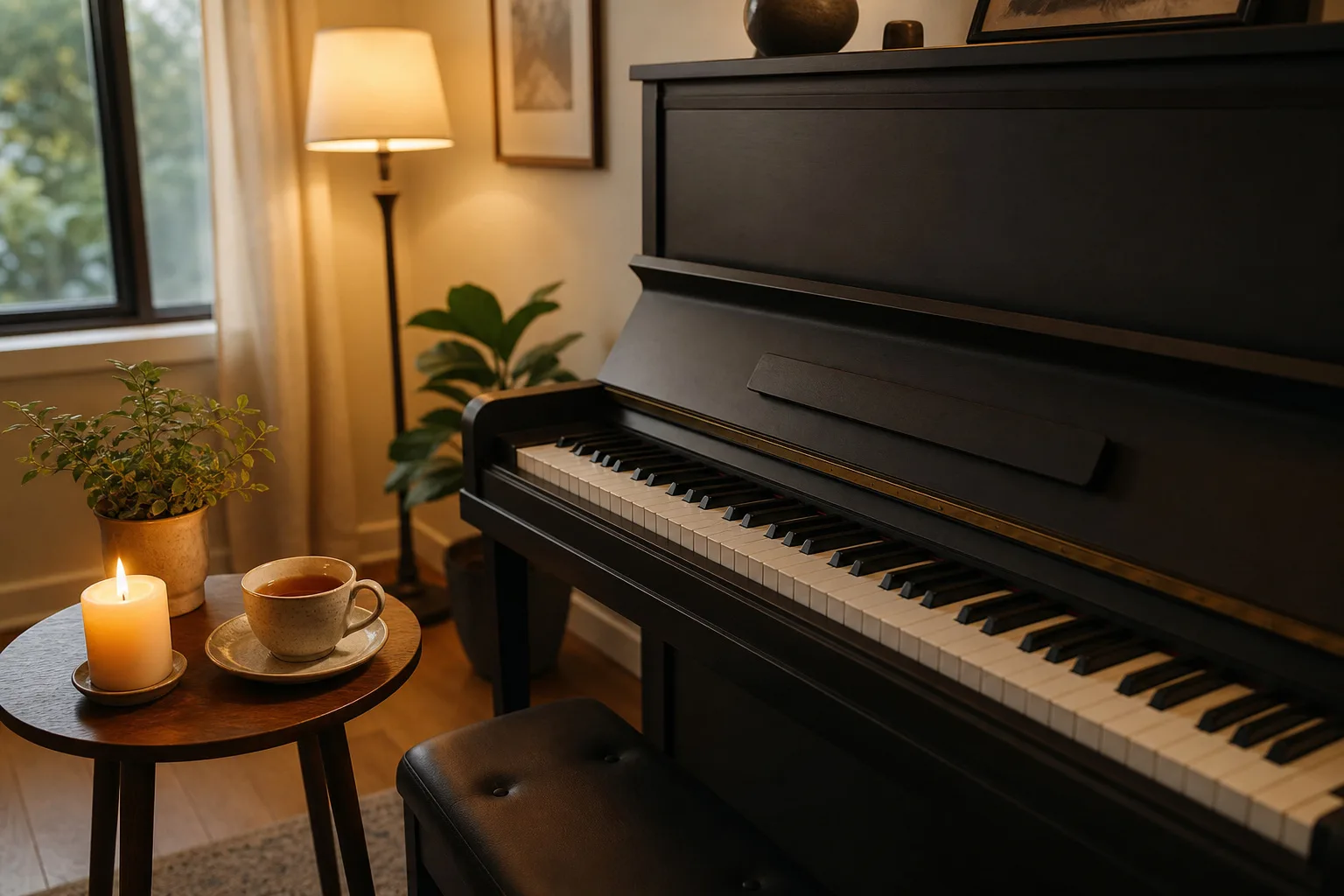
Your environment matters. If possible, create a piano area that feels inviting—good lighting, comfortable seating, maybe a plant or a candle nearby. You want sitting down at the piano to feel like stepping into a peaceful sanctuary, not another obligation.
Keep your music organized and accessible so you’re not creating friction before you even start. The easier it is to begin, the more consistently you’ll practice, and consistency is what builds the stress-relief benefits over time.
Focus on process, not perfection
This is crucial: piano for stress relief requires letting go of perfectionism. You’re not preparing for a performance or proving anything to anyone. You’re simply spending time with music because it feels good.
Allow yourself to play passages slowly, to make mistakes, to repeat sections just because you enjoy them. This permission to be imperfect is itself therapeutic, especially if you’re someone who holds yourself to high standards in other areas of life.
Experiment with different musical moods
Some days you might need the soothing quality of slow, lyrical pieces. Other days, you might need the energizing effect of something rhythmic and bright. Pay attention to what your nervous system needs and honor that.
Building a varied repertoire means you’ll always have the right music for your current emotional state. This flexibility makes piano for stress relief work for the long term.
Consider guided learning
While you can certainly explore on your own, having structure and guidance often makes the stress-relief benefits more accessible. When you’re not worrying about whether you’re practicing correctly or developing bad habits, you can relax more fully into the experience.
At Weaver Music, our lesson plan provides structured learning at four different levels, so you can progress at your own pace without pressure. Many students find that having a clear path forward reduces anxiety and makes practice time more restorative.
Learning this goes faster with a teacher watching your hands. Your first 30-minute lesson with Austin is free — no card, no pressure.
Common obstacles and how to overcome them
“I don’t have time”
This is the most common barrier I hear. Here’s the truth: piano for stress relief doesn’t require hour-long practice sessions. Even fifteen minutes makes a measurable difference in your stress levels.
Think of it this way—you’d take fifteen minutes to scroll social media or watch TV to “unwind.” Piano offers deeper, more restorative relaxation in the same timeframe. It’s not about adding to your to-do list; it’s about replacing a less effective stress-management habit with a better one.
If you’re truly pressed for time, check out the strategies in this guide to piano practice schedules for adults, which shows how to fit meaningful practice into a busy life.
“I’m too stressed to focus”
This feels paradoxical, but it’s real. Sometimes you’re so overwhelmed that even sitting down at the piano feels like too much. Start even smaller—play a single scale, slowly and mindfully. Play one phrase of a piece you know well. Lower the bar until it feels doable.
The act of beginning, even in the smallest way, often shifts your state enough that you can continue. And if you truly can’t focus, that’s information too. Piano for stress relief works best as a regular practice, not an emergency intervention.
“I’m not making progress fast enough”
If you find yourself frustrated with your rate of improvement, you’ve inadvertently turned your stress-relief practice into another performance metric. Take a step back and reconnect with why you started.
Progress matters for building confidence, yes, but the primary goal here is how you feel during and after playing. If you need help recalibrating your expectations, this article on how long it takes to learn piano as an adult offers realistic timelines that can ease the pressure.
“I feel self-conscious, even practicing alone”
Many adults carry shame or embarrassment about being a beginner. Remember that every expert was once where you are. Your piano doesn’t judge you, and the music doesn’t care if you’re perfect.
If self-consciousness is blocking you from experiencing piano for stress relief, it might help to understand that this is incredibly common. Learning something new as an adult takes courage, and that courage itself is worth celebrating.
Real student experiences
Over the years, I’ve worked with dozens of students who came to piano specifically for stress relief. A project manager in her forties told me that piano became her “reset button”—no matter how chaotic her workday, twenty minutes at the piano left her feeling capable and grounded.
A graduate student struggling with dissertation stress found that piano practice was the only time his anxious thoughts actually quieted. He’d tried meditation apps and breathing exercises, but nothing worked like piano for stress relief. The combination of focus and creativity gave him access to calm he couldn’t find any other way.
A recently retired teacher came to lessons because she suddenly had time but felt aimless and anxious about her new identity. Learning piano gave her a sense of purpose and progress during a disorienting life transition. Two years later, she credits piano with helping her build a fulfilling retirement.
These aren’t exceptional cases—they’re typical. Piano for stress relief works because it addresses multiple aspects of stress simultaneously: it occupies your mind, engages your body, satisfies your need for competence, and connects you with beauty and creativity.
Building your stress-relief practice
To get the most benefit from piano for stress relief, approach it as a practice rather than a hobby you’ll get to when you have time. This doesn’t mean rigidity—it means intention.
Create consistency without rigidity
Aim to play at roughly the same time most days, but don’t beat yourself up when life intervenes. The goal is to make piano a reliable part of your routine, a rhythm you can count on, while staying flexible enough that it doesn’t become another source of stress.
Some weeks you’ll play six days; other weeks, three. Both are fine. What matters is that you keep coming back.
Track how you feel, not just what you play
Instead of only noting which pieces you practiced, occasionally jot down how you felt before and after your piano time. You’ll likely notice patterns—maybe you consistently feel calmer, more energized, or more clear-headed after playing.
This awareness reinforces the value of your practice and motivates you to maintain it, especially during busy periods when it’s tempting to skip.
Gradually expand your comfort zone
As you become more comfortable, slowly introduce new challenges—a slightly harder piece, a new technique, a different musical style. Growth itself is rewarding and stress-reducing because it reminds you that you’re capable of more than you think.
But grow at your own pace. Piano for stress relief should feel like a gentle expansion, not a forced march toward arbitrary goals.
Celebrate small wins
Did you finally get that tricky measure smooth? Did you play through a whole piece without stopping? Did you simply show up and practice on a day when you really didn’t want to? These are all victories worth acknowledging.
Adult learners often dismiss their progress because they’re comparing themselves to professionals or to where they wish they were. Instead, compare yourself only to where you were last month. That’s where real progress lives.
When to seek guidance
While you can absolutely use piano for stress relief on your own, working with a teacher amplifies the benefits. A good teacher takes the guesswork out of what to practice, helps you avoid frustration from technical issues, and provides accountability that keeps you consistent.
More importantly, a teacher gives you someone to share your musical journey with—and that connection itself is stress-reducing. You’re not alone in your learning; you have a patient guide who believes in your potential and helps you navigate challenges.
At Weaver Music, I teach live one-on-one lessons over Zoom, working with adults at all levels. Whether you’re a complete beginner or returning to piano after years away, we’ll build a path that serves your goals and fits your life.
Your first lesson is always a free 30-minute trial where we’ll assess where you are, talk about what you’re hoping to gain from piano, and create a practical plan. There’s no pressure, no sales pitch—just an honest conversation about whether piano for stress relief could work for you.
Regular lessons run $99 per 60-minute session, and I work with students worldwide as well as locally. My teaching style is patient and supportive because I know that adult learners thrive with encouragement, not criticism.
If you’re not sure whether lessons are right for you yet, explore what to expect in your first piano lesson to get a sense of how the process works.
For those who prefer self-paced learning, the Weaver Music lesson plan offers structured lessons at four levels. You can work through material on your own schedule and still have a clear, proven path to follow.
Either way—with direct instruction or through courses—having structure and expertise supporting you makes the stress-relief benefits of piano more accessible. You’re free to focus on the music itself rather than worrying about whether you’re doing things correctly.
The research is clear, my experience with hundreds of students confirms it, and maybe your own intuition is telling you the same thing: piano for stress relief is real, accessible, and powerful. It’s not a quick fix or a passing trend—it’s a skill you build that serves you for life.
You don’t need to be musical or talented. You don’t need hours of free time. You just need curiosity, a willingness to be a beginner, and the commitment to show up for yourself regularly.
The piano is waiting. Your calmer, more creative, more resilient self is on the other side of simply beginning.
Ready to find out for yourself?
Your first 30-minute lesson with me is completely free – we will evaluate where you are, talk through your goals, and map out your path.

Comments
One response to “Does Playing Piano Relieve Stress?”
[…] about the learning process, remember that piano should be enjoyable. Many of my students find that piano is actually a wonderful stress reliever, especially when you give yourself permission to experiment and play without […]