
One of the most common questions I hear from adult beginners is whether they can learn piano without reading music. The concern makes complete sense – sheet music looks intimidating, time is precious, and the idea of adding another layer of learning feels overwhelming when you just want to sit down and play.
The honest truth is that yes, you absolutely can learn piano without reading music, and many adults do exactly that. If you’re curious about how that works in practice and whether it’s the right path for you, a free 30-minute trial lesson can give you hands-on clarity about which approach fits your goals.
The short answer
Yes, adults can learn piano without reading music. You can learn songs by ear, follow color-coded systems, watch video tutorials with finger numbers, or use chord-based approaches. Many people play beautifully without ever reading a note.
However, the path you choose depends entirely on what you want to achieve. If your goal is to play a handful of favorite songs for your own enjoyment, you can absolutely do that without notation. If you want to explore a wide repertoire, improvise freely, or develop musical independence, skipping sheet music will eventually create a ceiling.
The most effective approach for most adults combines both worlds – starting with methods that feel accessible while gradually building reading skills in the background.
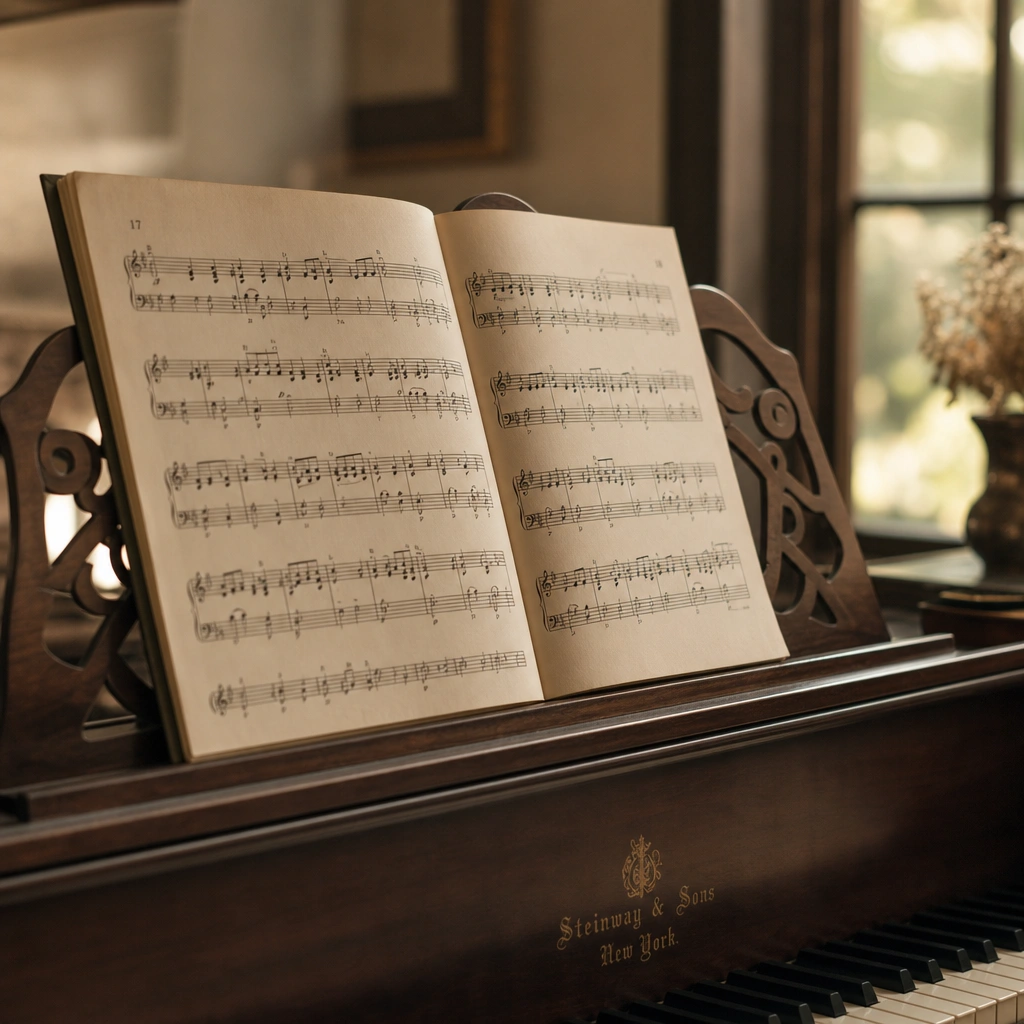
Why adults want to skip sheet music
With over 10 years of experience at the piano, I’ve heard every version of this concern. The reasons adults want to learn piano without reading music usually fall into a few categories.
First, there’s the time factor. Adults are juggling work, family, and a hundred other responsibilities. The idea of learning an entirely new written language on top of learning a physical skill feels like too much.
Second, there’s past experience. Many adults tried piano as kids, struggled with reading music, and quit. The memory of staring at dots on lines and feeling confused is still vivid. They want a different experience this time.
Third, there’s the immediate gratification piece. Sheet music feels abstract. Playing a recognizable melody by following colored stickers or watching someone’s hands feels concrete and rewarding right away.
All of these reasons are completely valid. The question isn’t whether your concern is legitimate – it absolutely is. The question is what trade-offs you’re willing to make and what path will actually get you where you want to go.
Three ways to learn piano without reading music
If you’ve decided you want to learn piano without reading music, there are three main approaches that actually work. Each has strengths and limitations.
Playing by ear
This is the most musical approach. You listen to a song, figure out the melody by trial and error, then add chords or bass notes. Some people have a natural knack for this; others can develop the skill with practice.
Playing by ear builds a deep connection between what you hear and what your hands do. It’s how many jazz, blues, and pop musicians learn. The challenge is that it’s slow at first, and complex pieces can be nearly impossible to decode without a strong foundation in music theory.
When you learn piano without reading music by ear, you’re developing skills that even many classically trained musicians envy. You train your brain to recognize intervals, chord qualities, and rhythmic patterns purely by sound. This intuitive understanding becomes incredibly valuable when you want to play along with recordings or create your own arrangements.
Video tutorials and finger numbers
Platforms like YouTube are full of tutorials that show you exactly which keys to press, often with finger numbers or highlighted keys. You watch, pause, rewind, and copy what you see.
This approach works well for learning specific songs quickly. The downside is that you’re entirely dependent on someone else creating the exact tutorial you need. If a tutorial doesn’t exist for a song you want to learn, you’re stuck.
Many adults find that video tutorials offer a comfortable entry point because they can see exactly where fingers should be placed. The visual learning style feels natural, especially for those who learn better by watching than by reading instructions. However, this method works best when combined with understanding why certain fingerings are used, not just memorizing which fingers go where.
Chord-based playing
This method focuses on learning chord shapes and patterns rather than reading individual notes. You memorize where your hands go for C major, G major, and so on, then follow chord charts above lyrics.
Chord-based playing is powerful for accompaniment and songwriting. It’s the backbone of how most pop, rock, and worship musicians operate. However, it doesn’t help you learn melody-focused pieces like classical music or intricate arrangements.
The beauty of chord-based approaches is that once you understand a few dozen chord shapes and progressions, you can play thousands of songs. You’re learning patterns and relationships rather than memorizing every single note. This efficiency is exactly why so many professionals who learn piano without reading music choose this method.
“I started as a complete beginner, and Austin made the learning process feel comfortable.” – Noah Peterson
What you gain by skipping notation
Let’s be clear about the genuine advantages of choosing to learn piano without reading music. These aren’t imaginary – they’re real benefits that matter to real people.
You get to make music faster. Instead of spending weeks decoding dots and lines, you can sit down and play something recognizable in your first few sessions. That early success builds momentum and keeps motivation high.
You develop a strong ear. When you’re not relying on written music, you’re forced to listen more carefully. You start to recognize patterns, intervals, and chord progressions by sound. This is an invaluable skill that many classically trained musicians wish they had.
You avoid the frustration that stops many beginners. Reading music is genuinely hard at first. For some adults, that initial difficulty is the thing that makes them quit. Bypassing it removes a major obstacle.
You can focus entirely on the physical aspect of playing – hand position, finger strength, coordination, rhythm. That’s already a lot to learn. Removing the reading component simplifies the early learning curve.
There’s also a creative freedom that comes from not being tied to the page. When you learn piano without reading music, you’re often more willing to experiment, add your own variations, and make songs your own. The music becomes more personal because you’re interacting with it directly rather than through the intermediary of notation.
What you lose without reading music
Now for the harder conversation. When you choose to learn piano without reading music, you give up some significant advantages.
You lose independence. Every new song requires finding a tutorial, a teacher to show you, or significant time figuring it out by ear. You can’t walk into a music store, pick up a book of songs you love, and teach yourself.
You lose access to repertoire. The vast majority of piano music – especially classical, jazz standards, and more complex arrangements – exists only in written form. No YouTube tutorial can cover everything you might want to play.
You lose a common language. When you work with other musicians, they’ll often communicate through charts or sheet music. When a guitarist says “let’s take it from measure 32,” you’ll be lost.
You lose efficiency at higher levels. Once you’re past the beginner stage, reading music becomes faster than any other method for learning new pieces. A skilled reader can sight-read a new song while someone watching a tutorial is still pausing and rewinding the first 15 seconds.
You lose the ability to compose or arrange easily. Writing down your own ideas, transposing songs to different keys, or creating variations becomes much harder without notation.
There’s also the issue of musical detail and nuance. Sheet music communicates dynamics, articulation, phrasing, and expression marks that are difficult to pick up from videos or by ear alone. These subtleties are what transform a correct sequence of notes into a truly musical performance.
Figuring out which approach fits your goals is much faster with a teacher who’s guided hundreds of adults through this exact decision. Your first 30-minute lesson with Austin is free – no card, no pressure.
The ceiling problem
Here’s what I’ve observed teaching adults: students who learn piano without reading music often hit a ceiling around the one- to two-year mark.
At first, progress feels great. You learn a few songs, you can play them for friends, you feel like a pianist. But then you want to learn something more challenging, and the tutorial doesn’t exist. Or you want to improvise, but you don’t understand the theory behind what you’re playing.
At that point, many students circle back and decide to learn to read music after all. Which is completely fine – it’s never too late. But it means spending time on a skill you could have been building gradually from day one.
The ceiling isn’t absolute. Some people who learn piano without reading music go on to become excellent players through sheer ear training and repetition. But they’re the exception, and they usually end up learning theory and some form of notation eventually, even if it’s just chord charts.
The question to ask yourself is this: do you want to play piano casually for your own enjoyment with a limited repertoire, or do you want to become genuinely fluent at the instrument? There’s no wrong answer, but the answer determines the path.
I’ve seen talented students plateau precisely because they couldn’t access the next level of material. They had the musical ability and the technical skill, but without reading, they were limited to what they could find in tutorial form or figure out by ear. That limitation becomes increasingly frustrating as your playing ability outpaces your learning methods.
Hybrid approaches that actually work
The good news is that you don’t have to choose between learning piano without reading music and drowning in sheet music on day one. There are hybrid approaches that give you the best of both worlds.
Start with patterns, add notation gradually
You can begin by learning songs through finger numbers, patterns, or by ear. At the same time, you spend just five minutes per practice session learning to recognize a few notes on the staff. Over time, notation becomes familiar without ever feeling overwhelming.
This is the approach I use with many adult students. We get your hands on the keys and making music right away, while building reading skills in the background at a comfortable pace.
Learn chord charts and basic theory
Instead of traditional notation, you can focus on learning to read chord charts and understanding the theory behind them. This gives you the independence to play thousands of songs without needing to read individual notes.
Chord-based literacy is faster to acquire than traditional notation, and it’s incredibly practical for popular music. You can explore more about foundational concepts in basic music theory for piano.
Use simplified notation
Some methods use simplified staff notation – fewer lines, letter names inside note heads, or color coding. These systems act as training wheels, giving you the benefits of written music without the full complexity upfront.
As you get comfortable, the training wheels come off naturally. You stop needing the letter names and start recognizing the notes by position alone.
Focus on repertoire that fits your method
If you choose to learn piano without reading music, pick repertoire where that approach makes sense. Pop songs with repetitive chord progressions, simple melodies you can learn by ear, or pieces where good tutorials exist.
Save the Chopin and Debussy for later – or accept that you might never play them, and that’s okay. There’s a lifetime of music accessible through non-reading methods if you choose repertoire strategically. If you’re looking for accessible starting points, check out the easiest piano songs for beginners.
What I recommend after teaching hundreds of adults
If you’ve read this far, you probably want my honest recommendation. Here it is: I believe the best path for most adults is a hybrid approach that prioritizes making music first and builds reading skills gradually.
When someone comes to me wanting to learn piano without reading music, I don’t force notation down their throat on day one. We start with something that sounds good and feels rewarding. We work on hand position, rhythm, and getting comfortable at the instrument.
But we also introduce note reading in small, manageable doses from the beginning. Maybe that’s just learning to recognize middle C and the notes immediately around it. Maybe it’s understanding how rhythm notation works so you can follow along with a simple melody.
The goal is to build both skills in parallel. You never feel stuck waiting to “finish” reading before you get to play real music. But you’re also never locked out of opportunities because you can’t decode a staff.
Over time – usually six months to a year – reading becomes less intimidating. It’s not the scary foreign language it was at first. It’s a useful tool that expands what you can play.
Some students stay at a basic reading level and primarily learn through other methods. Others discover that reading is actually easier than they thought and lean into it. Both outcomes are fine. The key is keeping the door open rather than closing it on day one.
According to research on adult learning from the Wikipedia overview of adult education, adults learn best when material is immediately applicable and builds on existing knowledge. That’s exactly what a hybrid approach does – you apply musical concepts right away while building literacy incrementally.
I’ve found that adults who learn piano without reading music exclusively often wish later they’d at least learned the basics. But adults who start with a balanced approach rarely regret having reading skills available, even if they don’t use them for every song they learn. It’s about keeping options open and building a complete skill set over time.
Finding the right guidance
Whether you decide to learn piano without reading music, dive straight into notation, or take a hybrid path, having the right guidance makes an enormous difference.
The challenge with self-teaching – especially through free YouTube tutorials or apps – is that you don’t know what you don’t know. You might develop habits that limit you later, or waste time on methods that don’t actually match your goals.
Working with a teacher, even for a short time, gives you clarity. You can explain what you want to achieve, and an experienced instructor can map out the most efficient path to get there. You’ll avoid the common pitfalls and build on a solid foundation from day one.
At Weaver Music, lessons are $99 for a full 60-minute session, and we offer a completely free 30-minute trial lesson so you can experience the teaching style and approach before committing to anything. We work with students live over Zoom, wherever they are.
Every student also gets access to our four-level video course library, which means you have structured material to reference between lessons. This combination of personalized guidance and self-paced resources gives you the flexibility adults need.
The decision of whether to learn piano without reading music doesn’t have to be all-or-nothing, and it doesn’t have to be permanent. You can start one way and adjust as you go. What matters most is that you start – and that you have support that adapts to your needs.
“My confidence at the piano has grown so much since starting lessons.” – Mia Reynolds
You can absolutely teach yourself basics from videos and apps, and there’s value in exploring on your own. But one lesson with an experienced teacher will answer questions you didn’t even know to ask, correct small issues before they become ingrained, and give you a personalized roadmap that’s worth weeks of trial and error.
If you’re serious about making real progress – whether you want to learn piano without reading music or take a more traditional route – the fastest path forward starts with a conversation about your specific goals and the approach that will work for your life.
Many students tell me they wished they’d started with proper guidance sooner. The time you save by avoiding common mistakes and inefficient practice habits more than makes up for the investment in lessons. Plus, having someone who understands the unique challenges adults face makes the entire journey more enjoyable and sustainable.
Ready to find out for yourself?
Your first 30-minute lesson with me is completely free – we will evaluate where you are, talk through your goals, and map out your path.

Comments
2 responses to “Can Adults Learn Piano Without Reading Music?”
[…] reading, especially for students who find sight-reading frustrating early on – our piece on learning piano without reading music covers this approach in more […]
[…] Some students prefer to start by ear and layer in notation later – that’s a legitimate path too, and one I cover in my piece on how to learn piano without reading music. […]