The short answer
To play piano faster, practice slowly and accurately first, break passages into small chunks, use rhythm variations on tricky spots, and raise tempo gradually with a metronome. Speed is a byproduct of clean technique and relaxed hands, not something you force by rushing.
I’ve watched students try to muscle their way to speed for years, and it almost never works long-term. The hands get tight, mistakes get baked in, and the passage that was supposed to get faster actually gets less reliable. The process below is the one I use in lessons every week, with adult students and kids alike, and it works because it respects how the hands and brain actually learn motor sequences. If you want a teacher to check your technique directly, a first lesson (a full 60 minutes for $29, normally $99, paid only after the lesson) is a fast way to find out what’s actually slowing you down.
Why does slow practice make me faster?
Slow practice makes you faster because it lets your fingers learn the correct motion before speed gets added on top. Playing a passage slowly and accurately 20 times builds a clean motor pattern; playing it fast and sloppy 20 times builds a messy one that’s hard to undo later. Speed is just accuracy repeated quickly, which is also the core idea behind a method many teachers call deliberate practice.
Here’s a pattern I see constantly: a student can play a passage at a crawl with zero mistakes, but the moment I ask for full tempo, wrong notes appear. That’s not a speed problem. That’s proof the slow version wasn’t actually locked in yet.
I had an adult student, a software engineer, who insisted he “already knew” a Chopin prelude section slowly and just needed to go faster. We spent two weeks at half tempo instead. The fast version came together in about four days after that.
- Practice slowly enough that you make zero mistakes, not just mostly correct ones.
- If you can’t play it slowly without tension, you can’t play it quickly with ease.
- Slow practice is where your brain actually builds the muscle memory, not just where you warm up.
What is chunking and how do I use it?
Chunking means breaking a piece into small sections, usually two to four measures, and mastering each one separately before stitching them together. It works because your brain and hands can only reliably absorb a small amount of new motion at a time, and trying to fix an entire page at once scatters your attention.
I ask students to find the exact note or chord where things fall apart, not just “the hard part” in general. Usually it’s one specific transition: a hand crossing, a stretch, a finger that’s doing two jobs in a row. Isolate that two-note or four-note moment and loop it slowly, on its own, dozens of times before putting it back into the phrase.
- Pick a chunk small enough to play correctly five times in a row.
- Loop the chunk slowly, then slightly faster, then back to slow again.
- Only connect two chunks once each is reliable on its own.
- Overlap the join: end chunk one and start chunk two together as its own mini-chunk.
How do rhythm variations build speed?
Rhythm variations build speed by forcing your fingers to move quickly in short bursts while your brain still has time to think between notes. Instead of playing a run evenly, you play it in patterns like long-short-long-short, which trains fast finger movement without the sustained pressure of full-tempo playing.
A classic version: take a run of eighth notes and play it as dotted-eighth-sixteenth, then flip it to sixteenth-dotted-eighth. Each note gets a turn being the “fast” one. I use this constantly with scale passages and Hanon-style exercises, and it’s one of the fastest ways I know to fix uneven playing where some fingers lag behind others. If finger strength and evenness are the real issue underneath the unevenness, our guide on finger independence goes deeper into that specific problem.
- Dotted rhythms: long-short, then short-long, alternating through the passage.
- Groupings of three: accent every third note to break up mechanical repetition.
- Stop-and-go: play two notes, pause, play the next two, forcing clean starts.
How do I use a metronome to increase speed?
You increase speed with a metronome by setting it at a tempo you can play perfectly, then raising it in small steps, usually 4-6 beats per minute at a time, only moving up once the current tempo feels completely relaxed. This is often called a metronome ladder, and it’s the most reliable way to turn slow accuracy into real tempo.
If a passage falls apart at a certain speed, drop back 10-12 BPM and spend another day there before climbing again. Rushing the ladder is the single most common mistake I see, usually from students who are excited and skip two or three rungs at once. For the full mechanics of setting one up, including how to handle passages that resist the climb, see our dedicated piece on how to use a metronome.
- Start 20-30% below your target tempo and find your clean, comfortable floor.
- Raise the tempo in small increments, not big jumps.
- If you tense up or miss notes, that tempo was too big a jump; go back.
- Expect the climb to take days, not one practice session.
If you’re not sure whether your hand tension or your fingering is what’s actually capping your speed, a second set of ears makes that obvious in minutes. Your first lesson with Austin is a full 60 minutes for just $29 (normally $99). Love it, or it’s on us.
Why does my playing fall apart when I speed up?
Playing falls apart at speed almost always because of built-up tension in the hand, wrist, or arm, not because the fingers are “too slow.” Tense muscles move less efficiently and tire faster, and tension in one finger often locks up the fingers next to it, causing wrong notes and dropped timing exactly when you push tempo.
Watch your wrist, not just your fingers. I regularly see students whose fingers look fine but whose wrist is rigid and slightly lifted, choking off the whole hand’s mobility. A simple fix: play a phrase, then immediately let your hand go completely limp for a second before the next phrase. That reset teaches your body what relaxed actually feels like, which most people have genuinely forgotten by the time they’re an hour into practice.
- Shake out your hand and wrist between repetitions, every single time.
- Check your shoulders aren’t creeping up toward your ears as tempo rises.
- Play one note, then relax, then the next; isolate where the tightness starts.
- If pain or soreness shows up, stop. Speed work should never hurt.
“My confidence at the piano has grown so much since starting lessons.” – Mia Reynolds
Does fingering actually affect speed?
Fingering affects speed enormously, because an awkward or inconsistent fingering pattern forces your hand into unnecessary stretches, crossings, and repositioning that cost time and cause mistakes. The right fingering, used the same way every single time, lets your hand move in a smooth, predictable path instead of scrambling. The Juilliard School and most conservatory method books treat consistent fingering as a foundation skill for exactly this reason.
I’ve had students “fix” a fast passage simply by changing one finger choice at one note, with zero additional practice. If you’re using a different finger on the same note every time you play a passage, your hand never gets to build one clean motor pattern; it’s relearning the move each pass. Write your fingering into the score in pencil and treat it as fixed once you’ve chosen it, the same way you’d commit to a fingering before memorizing a piece, as covered in our memorizing piano notes guide.
- Choose one fingering per passage and use it every single repetition.
- Favor fingerings that keep your hand in one position longer.
- Avoid crossing the thumb under at awkward moments if an alternative exists.
- If both hands are involved, check that neither hand’s fingering forces the other into a bad position; our playing with both hands article covers coordinating the two.
Why does speed come last in piano practice?
Speed comes last because it’s the result of several other skills, accurate notes, steady rhythm, relaxed hands, and committed fingering, all working together. Chasing tempo before those pieces are in place just means practicing your mistakes faster, which makes them harder to fix later, not easier.
Think of it the way you’d think of a recipe: tempo is the last ingredient added, not the first thing you taste for. I tell students that if they’re thinking about speed, it usually means they haven’t actually answered “is this correct yet?” A piece that’s correct at a slow tempo is 90% of the way to being correct at a fast one. A piece that’s fast but wrong just has more wrong notes per second.
This is also, honestly, where self-teaching from videos tends to go sideways. It’s entirely possible to learn piano on your own, and we go through what that actually looks like in our can you teach yourself piano article, but catching tension and fingering problems in your own playing is genuinely hard to do without outside eyes.
“Austin explains everything clearly and makes online piano lessons easy to follow.” – Emily Carter
In our live, one-on-one lessons over Zoom, this is usually the first thing I check in a skill assessment: where exactly does a fast passage break down, and why. Lessons run $60 for 30 minutes, $80 for 45 minutes, or $99 for a full 60 minutes, and every student, at any level, starts with that $29 first session before committing to anything ongoing.
Common questions
How long does it take to build speed on a piece?
Most intermediate students can take a well-learned slow passage up to performance tempo in 1-3 weeks of daily practice, using a metronome ladder. Simple passages move faster; anything with large stretches or hand crossings can take longer. Rushing the timeline is what causes setbacks, not the passage itself.
Can I play fast if I never use a metronome?
You can develop some speed without a metronome, but it’s much harder to know whether your tempo is actually steady or just feels fast. A metronome gives you an objective target and an incremental path, which is why it’s the tool I use with nearly every student working on speed.
Is it bad to practice a hard passage at full speed to “push through” it?
Yes, this usually backfires. Pushing through a hard passage at full speed bakes in wrong notes and tension, and your hand learns the mistake as thoroughly as it would learn the correct version. Slowing down and rebuilding the passage correctly is almost always faster in the long run than pushing through.
Does playing piano faster ever just come from talent?
Natural coordination can make the process feel a bit easier for some students, but speed itself is built through the same process for everyone: slow accurate practice, chunking, and gradual tempo increases. I’ve seen plenty of naturally coordinated students play fast and sloppy, and plenty of “non-naturals” play fast and clean because they trusted the process.
Why can I play a passage fast alone but not in the full piece?
This usually means the passage isn’t actually secure, your hand is relying on momentum or memory of what comes before it rather than independently knowing the notes. Practice the passage starting cold, with no run-up, until it’s just as clean on its own as it is inside the full piece.
Does a weighted keyboard affect how fast I can play?
A heavier, weighted action can feel slower under the fingers at first because it requires more deliberate movement than a light, unweighted keyboard, but it also builds stronger, more controlled technique over time. Most of the speed limitation still comes from practice habits, not the instrument.
Ready to find out for yourself?
Your first lesson with me is a full 60 minutes for just $29 (normally $99). We will evaluate where you are, talk through your goals, and map out your path. Love it, or it’s on us.
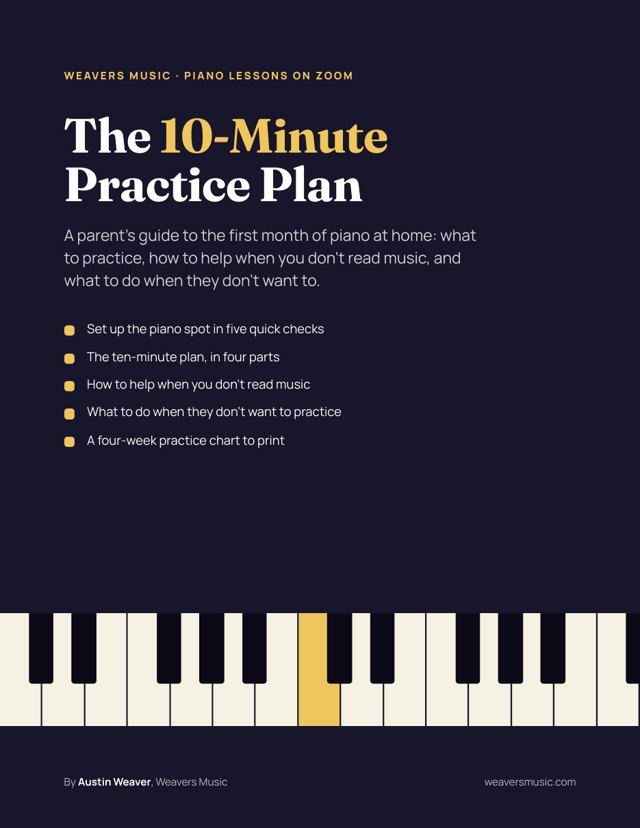
Free guide for parents
The 10-Minute Practice Plan
What to practice, how to help when you don’t read music, and what to do when they don’t want to. A short printable guide from Austin, with a four-week practice chart.