
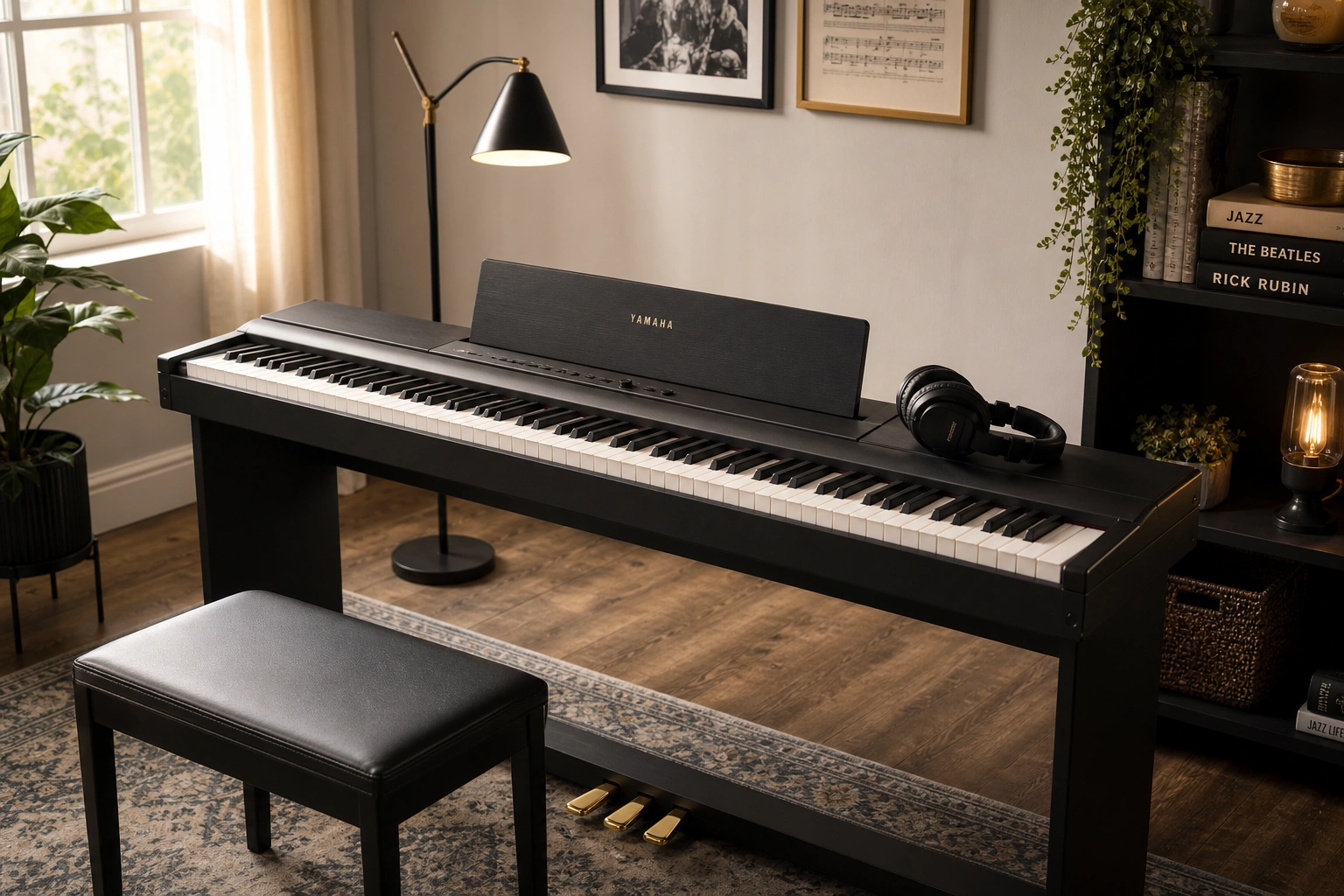
The short answer
A 61-key keyboard with full-size, touch-sensitive keys is fine for your first six months to a year of piano lessons. If you plan to keep going past the beginner books, get an 88-key digital piano with weighted keys. It has the same range as an acoustic piano, so you never outgrow it. Skip 76 keys unless portability matters most.
Keyboard size is one of the first questions new students and parents ask me, and the right answer depends on age, goals, budget and space. If you’d like help matching an instrument to your goals, bring the question to a free 30-minute trial lesson – you get a skill check, your questions answered and a plan with a book list, no card required.
What is the difference between 61, 76 and 88 keys?
The difference between 61, 76 and 88 keys is range. A 61-key keyboard covers five octaves, a 76-key keyboard covers about six and a quarter, and an 88-key keyboard covers just over seven octaves, which is the full range of a standard acoustic piano, from the lowest A to the highest C.
The 88-key layout has been the piano standard since the late 1800s, which is why published piano music assumes you have all of it. As the Wikipedia overview of the piano notes, a modern piano has 52 white keys and 36 black keys. Its lowest note, A0, sounds at 27.5 Hz and its highest, C8, at about 4,186 Hz, according to the standard piano key frequency chart.
| 61 keys | 76 keys | 88 keys | |
|---|---|---|---|
| Range | 5 octaves (C to C) | About 6¼ octaves (usually E to G) | Just over 7 octaves (A0 to C8) |
| White / black keys | 36 / 25 | 45 / 31 | 52 / 36 |
| Keys missing vs. a piano | 27 (15 at the bottom, 12 at the top) | 12 (split between both ends) | None |
| Typical key action | Usually unweighted | Usually unweighted or semi-weighted | Often weighted or hammer action |
| Typical width | Roughly 3 feet | Roughly 4 feet | About 52 inches on slim models |
| Best for | First 6 to 12 months, young kids, travel | Gigging, portability, MIDI controller use | Lessons past the beginner stage |
In practice, a 61-key keyboard stops at the C two octaves below middle C and the C three octaves above it. That’s plenty for early lessons. What you lose is the deep bass and the bright top octave, exactly where advanced music likes to go. So when people ask me what size keyboard for piano lessons they really need, the honest answer is “it depends how far you’re going.”
When does a student outgrow a 61-key keyboard?
A piano student usually outgrows a 61-key keyboard somewhere between six months and two years into lessons. The first things to push past five octaves are later method-book levels, Romantic pieces by composers like Chopin, and pop or film arrangements with low bass octaves. Missing touch sensitivity or a pedal jack can force the upgrade even sooner.
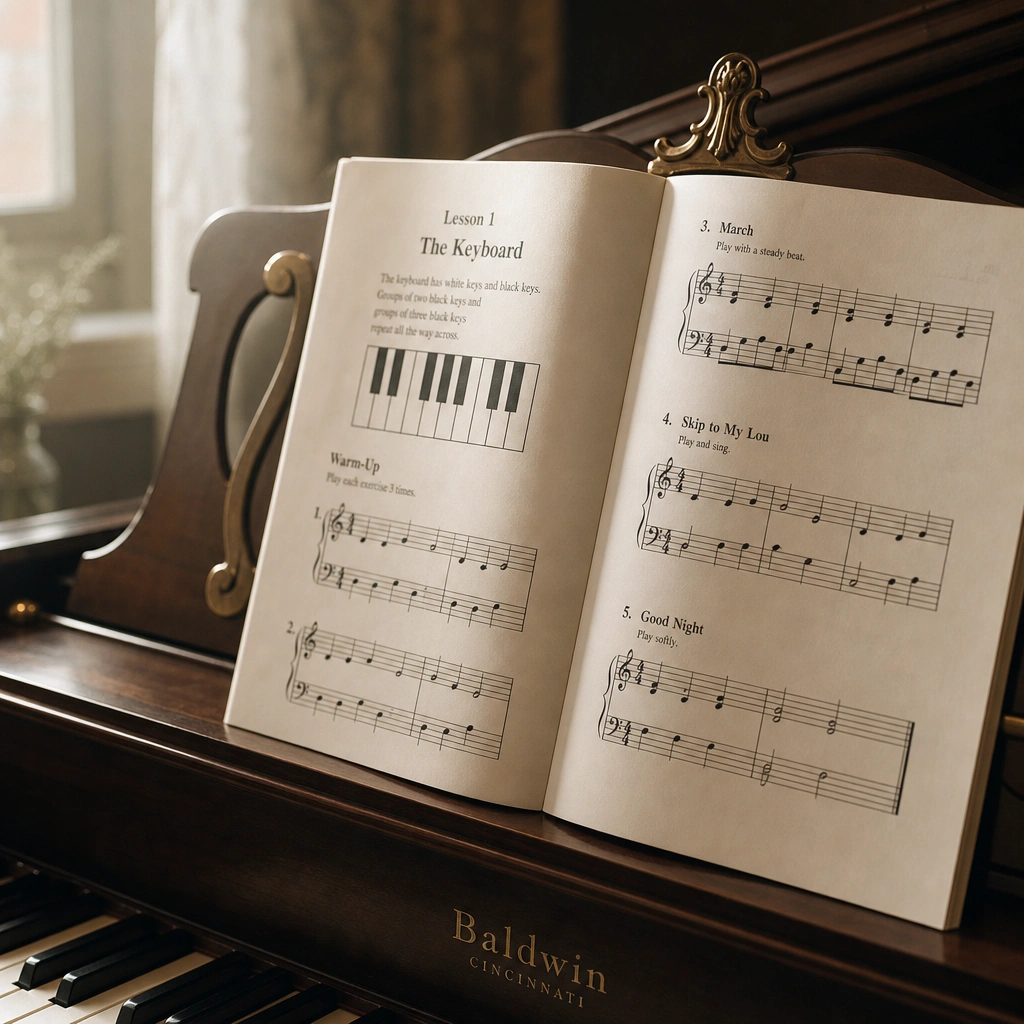
Beginner material fits comfortably. In Levels 1 and 2 of the four-level curriculum I teach, students work in five-finger positions, one-octave scales, basic triads and simple left-hand patterns, and very little of that strays far from middle C.
Things change as the music gets more interesting:
- Method books. In a series like Faber or Alfred, the later books send the left hand lower and the right hand higher, and students on small keyboards tend to hit those edges within the first year or two.
- Romantic repertoire. Chopin and the composers after him wrote for bigger pianos than Bach or Mozart had, so bass notes below a 61-key keyboard’s lowest C show up regularly.
- Pop, film and video game arrangements. Even simplified versions often put low octaves in the left hand or spread chords wide across the keyboard.
- Pedal work. By Level 3 in my curriculum, the sustain pedal is a core skill, and many cheap 61-key keyboards have no proper pedal jack or no touch sensitivity at all.
Easier Baroque and Classical pieces, like the Clementi sonatinas and easy Bach in Level 3, tend to stay mid-keyboard because they were written for smaller instruments.
I’ve had students start on 61 keys, especially young kids whose parents weren’t sure piano would stick, and the keyboard served its purpose for six months to a year. The trouble starts when the music gets fun: we end up skipping a piece or moving it up an octave, and that interrupts the natural order of the lessons.
Signs it’s time to upgrade:
- Assigned pieces run off either end of the keyboard
- You or your child keep asking for songs that don’t fit
- Soft and loud playing sound the same
- Notes cut out when you hold the pedal through big chords
Is a 76-key keyboard a good compromise?
A 76-key keyboard is a reasonable compromise for portability, but rarely the best buy for piano lessons. Its six-plus octaves handle beginner and most early-intermediate music, yet 76-key models are usually unweighted and often cost close to an entry-level 88-key digital piano, so lesson students still end up upgrading.
I rarely recommend 76 keys for lessons. A 76-key keyboard isn’t cheap enough to be a temporary starter, and it isn’t complete enough to last. The 12 missing keys matter less than you’d think; the bigger problem is that most 76-key models lack the weighted action a lesson student needs. My guide to weighted vs unweighted keys explains why touch matters so much.
There are real cases where 76 keys make sense:
- Gigging musicians who carry their keyboard and mostly play contemporary music
- Producers using a keyboard as a MIDI controller for a computer
- A portable second instrument for travel, with a full-size piano at home
If you’re weighing a new 76-key keyboard against a used 88-key digital piano at a similar price, I’d take the used 88 every time.
Not sure whether your current keyboard will hold up for lessons, or what to buy next? Your first 30-minute lesson with Austin is free – no card, no pressure.
What size keyboard should kids, teens and adults start on?
Students ages 7 and up, including teens and adults, should start on an 88-key digital piano with weighted keys if they plan to take lessons for more than a year. Children around ages 3 to 6 can start on a 61-key keyboard with full-size, touch-sensitive keys, with a plan to upgrade once lessons stick.
Here’s how I usually answer the question of what size keyboard for piano lessons, broken down by who’s playing.
Young children (about ages 3 to 6)
Small hands and short attention spans mean the first months of lessons use a small slice of the keyboard. A 61-key keyboard can work for six months to a year, especially if you’re testing interest. Look for full-size, touch-sensitive keys, even if they aren’t weighted.
If your child is clearly hooked, though, I’d go straight to 88 keys. Kids adapt quickly, and buying the full instrument early saves you a second purchase later.
Older kids and teens (7 and up)
By around age seven, most students have the hand size and focus for a full keyboard, and motivated teens can move fast. Teens especially want to play pop songs, film scores and video game music, and those arrangements usually need more than five octaves. Get 88 keys.
Adult beginners and returning players
A 61-key keyboard is fine for an adult to start on, but if you already know you’re committed, 88 weighted keys will save you from buying twice. Adults usually have specific pieces they dream of playing, and those pieces almost always use the full keyboard. If you’re coming back after years away, my post on getting back into piano as an adult covers what to expect.
Intermediate and advanced students
Once you’re working on intermediate or advanced repertoire, 88 keys isn’t optional. Look for graded hammer action, where the low keys feel slightly heavier than the high ones, just like on an acoustic grand.
If you’re still deciding between a keyboard and an acoustic instrument, piano vs keyboard for beginners walks through that choice.
Which keyboard features matter more than key count?
Key action and touch sensitivity matter as much as key count for piano lessons. A good lesson keyboard has full-size weighted or hammer-action keys, touch-sensitive volume, a sustain pedal jack, a headphone jack, at least 64-note polyphony and a stable stand. An 88-key keyboard without those features will still hold a student back.
Here’s the checklist I give students:
- Weighted or hammer-action keys. Resistance under the fingers builds the strength and control that transfer to any acoustic piano. Unweighted keys feel like pushing buttons.
- Touch sensitivity. Playing gently should sound soft and playing firmly should sound loud. Without it, dynamics and phrasing are impossible, and some very cheap keyboards skip it, so check before you buy.
- Full-size keys. Narrow mini keys change your hand position and reach.
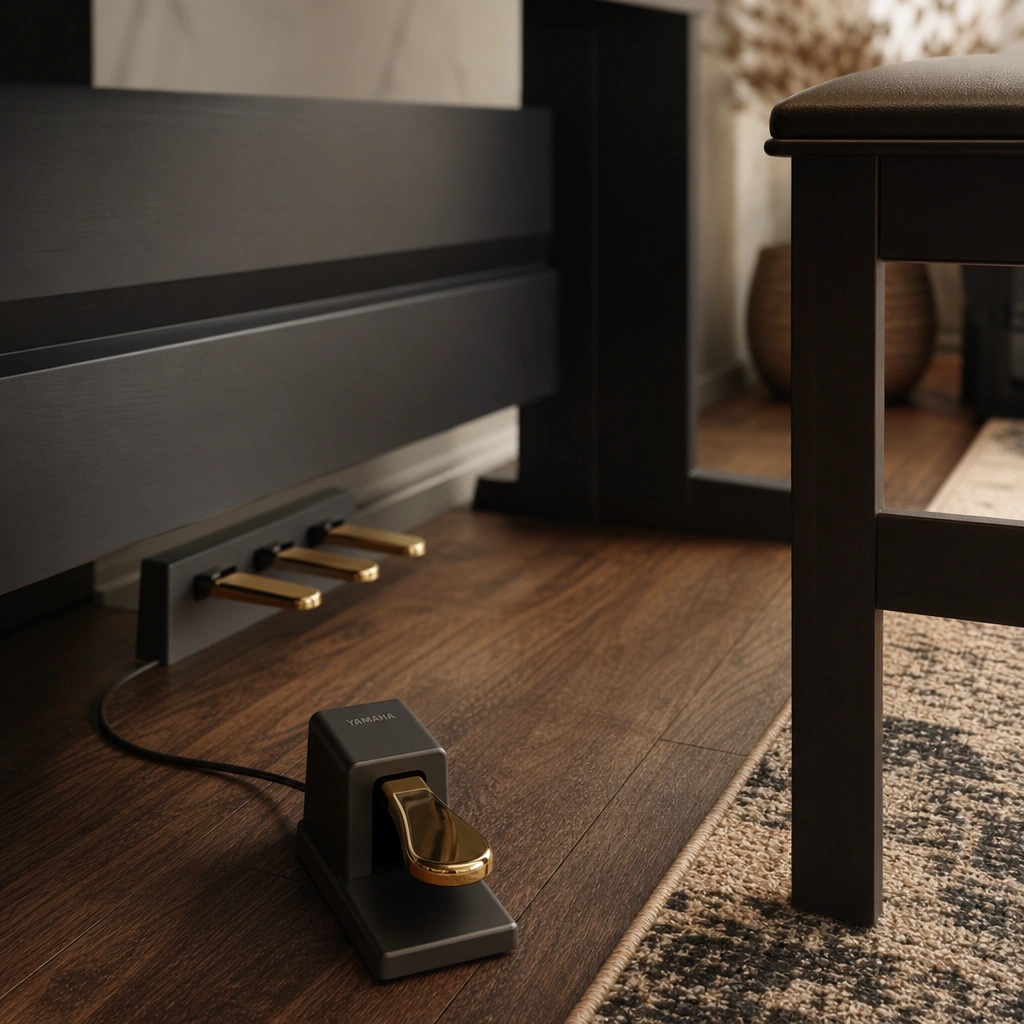
- Sustain pedal input. Budget for a pedal if one isn’t included. A pedal that supports half-pedaling is worth it later.
- Polyphony of 64 notes or more. 128 is better. Low polyphony makes notes cut out when you pedal through chords.
- Headphone jack. Quiet practice keeps the peace at home.
- A sturdy stand and a bench at the right height. A wobbly stand makes good posture and relaxed wrists much harder.
I see this play out all the time: a budget 88-key digital piano with hammer action serves a student far better than a fancy 61-key keyboard loaded with sounds and rhythms. The extra voices are fun for a week. The key action is what you live with every practice session.
For lessons over Zoom, a few extras help. Built-in speakers loud enough for your microphone let me hear your dynamics, and a camera angle that shows both hands on the keys lets me catch posture and fingering. Zoom’s “original sound for musicians” setting also stops the app from filtering sustained piano notes out as background noise.
“Austin explains everything clearly and makes online piano lessons easy to follow.” – Emily Carter
For specific models and what to spend, see my digital piano buying guide for beginners.
How do you choose a keyboard when budget or space is tight?
When budget is tight, a used 88-key digital piano from Yamaha, Casio, Korg or Roland is usually a better buy than a new 61- or 76-key keyboard. When space is tight, a slim 88-key digital piano is only about 52 inches wide. If neither works, start on 61 keys and plan the upgrade from day one.
- Tight budget: Look for older entry-level models like a used Yamaha P-45 or Casio CDP-130. Check local classifieds, Facebook Marketplace and music store bulletin boards.
- Tight space: Measure your wall before ruling out 88 keys. Slim portable models fit small apartments.
- Very young child, unsure about commitment: A 61-key keyboard with touch-sensitive keys works as a trial instrument for six months to a year. Upgrade before your child hits the limits, not after frustration sets in.
- Serious about learning: Just get 88 keys. The difference in cost is smaller than the difference in experience.
Whether you take lessons over Zoom or in person, the keyboard you practice on every day shapes your progress. If you’d like a second opinion before spending money, bring your questions to a free trial lesson and we’ll talk through your budget, space and goals.
Common questions
Is 61 keys enough for piano lessons?
Yes, 61 keys is enough for the first six months to a year of piano lessons, as long as the keys are full size and touch sensitive. Beginner material stays near middle C. Most students outgrow 61 keys once they reach later method books, Romantic pieces or pop arrangements with low bass notes.
Do I need 88 keys to learn piano?
No, you don’t need 88 keys to start learning piano, but you will need them to keep progressing. An 88-key keyboard matches an acoustic piano’s full range from A0 to C8, so every piece of piano music fits. Anyone planning more than a year or two of lessons should buy 88 keys from the start.
Can you learn piano on a 76 key keyboard?
Yes, you can learn piano on a 76-key keyboard. Its roughly six and a quarter octaves cover beginner and most intermediate music, and it lacks only 12 keys at the extremes. The bigger issue is action: most 76-key keyboards are unweighted, which limits touch and technique more than the missing keys do.
What keyboard do I need for online piano lessons?
Online piano lessons need the same keyboard you’d use in person: at least 61 full-size, touch-sensitive keys to start, and 88 weighted keys as you progress. Add a sustain pedal, speakers loud enough for your microphone to pick up, and a phone or laptop camera placed where your teacher can see both hands.
Can I use a MIDI controller for piano lessons?
A MIDI controller works for piano lessons if it has full-size, velocity-sensitive keys and ideally weighted action. A controller makes no sound by itself, so you also need a computer, tablet or sound module plus headphones or speakers. For most beginners, a digital piano with built-in sound is simpler and skips setup before every practice.
Are mini keys okay for a young child?
Mini keys are fine for a toddler exploring sound, but not for piano lessons. Mini keys are narrower than standard piano keys, so hand position, finger spacing and reach all feel different when a child moves to a real piano. Even for ages 3 to 6, choose full-size keys, even on a 61-key keyboard.
Ready to start on the keyboard you have?
Your first 30-minute lesson with me is completely free – we will see where you are, answer your keyboard questions, and map out your path with a book list.