Category: Practice Tips

  • Piano Performance Anxiety: How to Calm Your Nerves Before You Play

    Piano Performance Anxiety: How to Calm Your Nerves Before You Play

    If your hands shake before a recital, your mind goes blank when you sit at the bench, or you’ve ever considered skipping a performance altogether, you’re dealing with piano performance anxiety. This challenge affects nearly every pianist at some point, from beginners playing their first simple piece to advanced musicians tackling complex repertoire.

    The good news? With the right strategies, you can transform that nervous energy into focused, confident playing.

    With 10+ years of experience and hundreds of students, I’ve seen every shade of performance anxiety. I’ve also discovered what actually works to overcome it, and what’s just well-meaning advice that doesn’t hold up in the real world.

    The Short Answer

    Piano performance anxiety stems from our brain’s threat response kicking in when we feel judged or fear making mistakes. To overcome it, combine thorough preparation with physical calming techniques (like breathing exercises), mental reframing strategies, and gradual exposure to performance situations.

    The key is addressing both the physical symptoms and the underlying thoughts that trigger them.

    Most importantly, understand that some nervousness is normal and even helpful. The goal isn’t to eliminate anxiety completely, but to manage it so it doesn’t interfere with your playing.

    Why Piano Performance Anxiety Happens

    Before we tackle solutions, it helps to understand what’s happening in your body and mind when piano performance anxiety strikes. This isn’t weakness or a character flaw—it’s your brain doing exactly what evolution designed it to do.

    The Biology of Performance Nerves

    When you face an audience, your amygdala (the brain’s threat-detection center) can interpret the situation as dangerous. It floods your system with adrenaline and cortisol, triggering the fight-or-flight response.

    Your heart races, your hands might shake or sweat, and blood flow redirects from fine motor control to major muscle groups.

    This response helped our ancestors escape predators, but it’s less helpful when you need delicate finger control for a Chopin nocturne. Understanding this biology is the first step in managing piano performance anxiety, because you realize your body isn’t malfunctioning—it’s just responding to perceived threat.
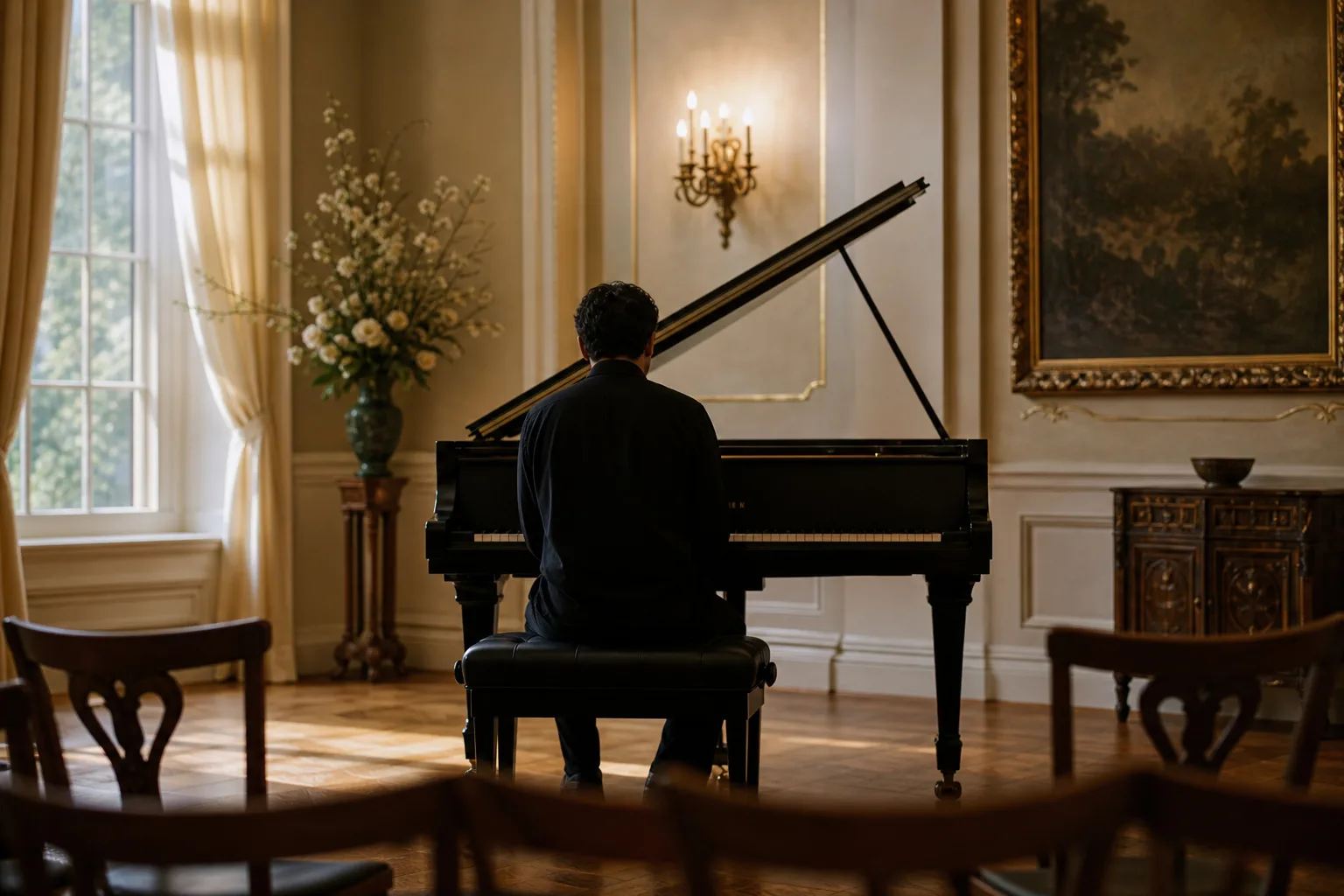
    Pianist seated calmly at a grand piano viewed from behind while using piano performance anxiety relief techniques

    Common Mental Triggers

    Several thought patterns intensify piano performance anxiety:

    • Perfectionism: Believing you must play flawlessly or you’ve failed
    • Catastrophizing: Imagining worst-case scenarios (forgetting the piece, public humiliation)
    • Comparison: Measuring yourself against other performers
    • External validation: Tying your self-worth to audience approval
    • Inexperience: Fear of the unknown when you haven’t performed much

    Many students I work with at Weaver Music discover that their piano performance anxiety actually has little to do with their playing ability. It’s rooted in these thought patterns, which means it can be addressed through specific mental strategies.

    Preparation Strategies That Build Real Confidence

    The foundation for managing piano performance anxiety is laid weeks before the performance. Thorough preparation doesn’t just improve your playing—it gives you genuine confidence that withstands pressure.

    Master Your Piece Beyond Performance Level

    I tell my students to prepare their recital piece to about 120% of what they need. If you can play it perfectly in your studio, you might manage 80% of that quality under performance stress.

    But if you’ve practiced it until you can play it in your sleep, that 80% will still sound great.

    This means continuing work on a piece long after you can “play it through.” Polish every phrase, nail every transition, and practice until your fingers know the music so deeply that even when your conscious mind panics, muscle memory carries you through.

    Simulate Performance Conditions

    Piano performance anxiety spikes when the performance environment feels unfamiliar. Combat this by recreating performance conditions during practice:

    • Play through your piece without stopping, even if you make mistakes
    • Practice on different pianos when possible
    • Record yourself and listen back
    • Perform for family members or friends
    • Practice in “concert dress” if your outfit might affect your playing
    • Stand up, bow, sit down, and begin—practice the whole ritual

    At Weaver Music, I encourage students to schedule mini-performances during their practice routine. Even playing for your cat while imagining an audience helps your brain normalize the performance experience.

    Develop a Pre-Performance Routine

    Athletes use pre-performance routines to trigger focus and calm. Pianists can too. Create a sequence you do before every practice run-through and every actual performance.

    This might include specific stretches, breathing patterns, or mental visualization.

    When piano performance anxiety rises before a recital, this familiar routine signals to your brain: “We’ve done this many times before. We know what to do.” The familiarity itself is calming.

    Understanding the Practice-Performance Connection

    Research from the American Psychological Association shows that performance anxiety decreases significantly when musicians practice under varied conditions rather than only in comfortable settings.

    This means occasionally practicing when you’re tired, in different rooms, or with minor distractions present.

    The more your practice incorporates variety and challenge, the more adaptable you become under pressure. Your brain learns that it can play this piece under different circumstances, which builds genuine resilience against piano performance anxiety.
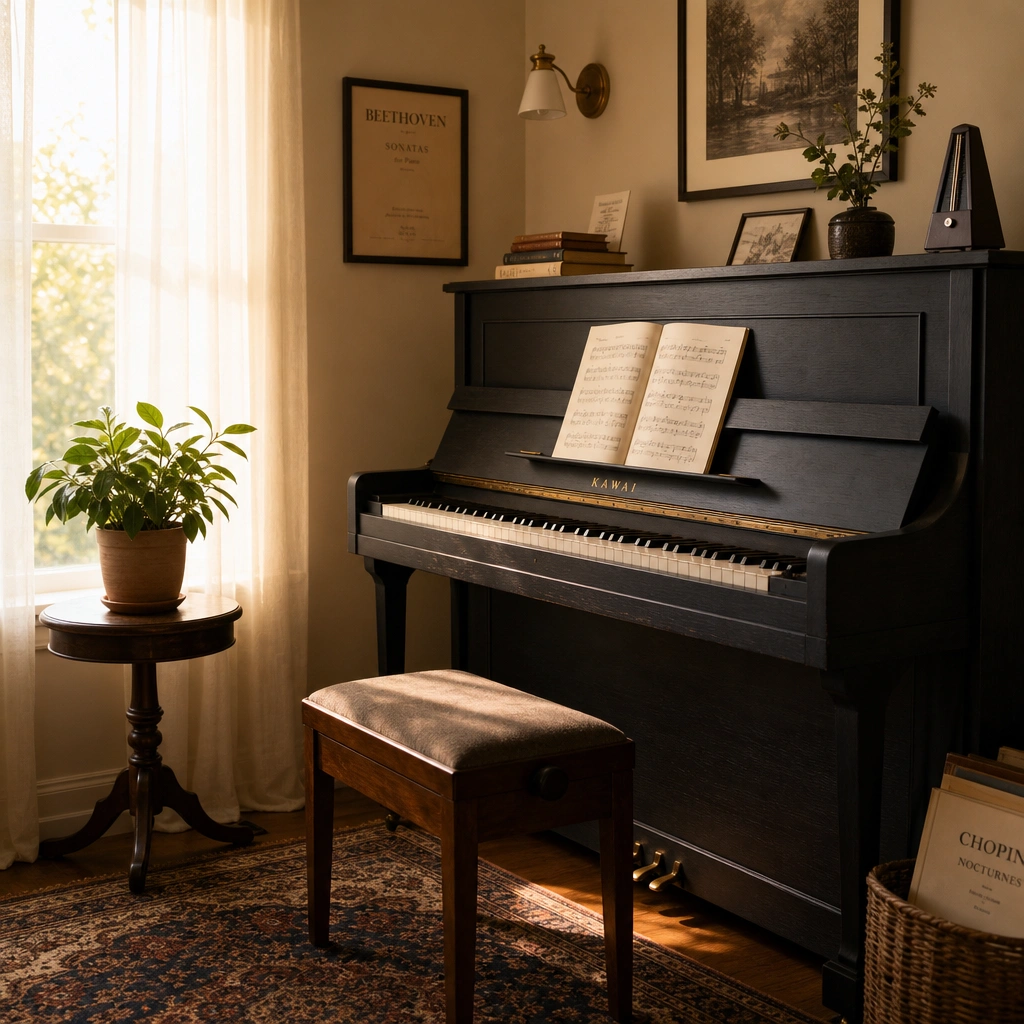
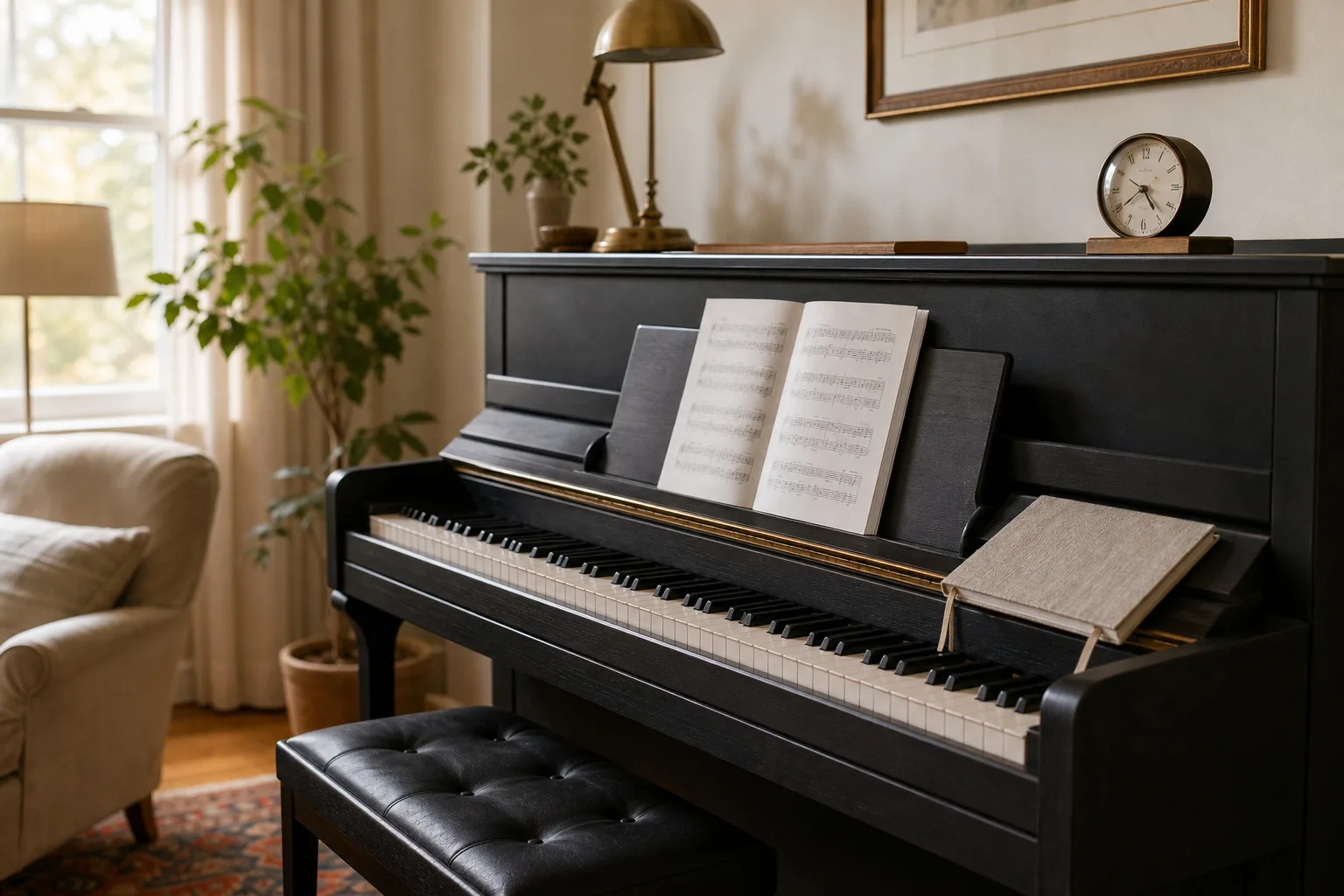
    Cozy piano practice space where students prepare and overcome performance challenges

    Physical Techniques to Calm Your Body

    When piano performance anxiety triggers physical symptoms, you need tools to bring your body back to baseline. These techniques work because they directly influence your nervous system.

    Breathing Exercises That Actually Help

    Controlled breathing is one of the fastest ways to signal safety to your nervous system. When you’re anxious, breathing becomes shallow and rapid. Deliberately slowing it down tells your brain the threat has passed.

    Try box breathing: Inhale for four counts, hold for four, exhale for four, hold for four. Repeat five times.

    I’ve seen students go from shaking hands to steady calm in just two minutes using this technique backstage.

    Another effective approach is the 4-7-8 breath: inhale for four counts, hold for seven, exhale slowly for eight. The extended exhale activates your parasympathetic nervous system, the “rest and digest” mode that counteracts anxiety.

    Progressive Muscle Relaxation

    Piano performance anxiety often manifests as tension—tight shoulders, clenched jaw, rigid fingers. Progressive muscle relaxation teaches you to recognize and release this tension.

    Starting at your toes, deliberately tense each muscle group for five seconds, then release and notice the difference. Work up through your legs, torso, arms, hands, neck, and face.

    This practice helps you identify where you hold tension and consciously let it go.

    Before a performance, a quick version focusing just on your shoulders, arms, and hands can make an immediate difference in your playing comfort.

    Physical Warm-Up Routines

    Never go into a performance cold. A physical warm-up serves multiple purposes: it prepares your muscles, occupies your anxious mind, and establishes your routine. Your warm-up might include:

    • Gentle hand and wrist stretches
    • Shoulder rolls and neck stretches
    • Playing scales or arpeggios (not your performance piece)
    • Simple exercises to get blood flowing to your fingers

    Many pianists find that establishing a consistent warm-up routine helps manage piano performance anxiety by giving them something concrete to focus on rather than spiraling worry.

    The Role of Physical Health

    Your overall physical condition affects how intensely you experience piano performance anxiety. Regular exercise, adequate sleep, and proper nutrition all contribute to a more resilient nervous system.

    According to research published in the National Institutes of Health, regular aerobic exercise can reduce general anxiety levels by up to 20%, which translates to lower baseline anxiety when you approach performances.

    You don’t need to become an athlete, but basic self-care genuinely impacts your ability to manage performance nerves.

    Mental Approaches That Actually Work

    Physical techniques help, but piano performance anxiety lives primarily in your mind. These mental strategies address the root of the problem.

    Reframe Your Relationship with Mistakes

    Much of piano performance anxiety comes from fear of mistakes. But here’s the truth: every performer makes mistakes. Every single one.

    The difference is how they respond.

    Professional pianists develop the skill of recovering smoothly when something goes wrong. They don’t stop, grimace, or apologize—they keep the musical line going and most audience members never notice.

    Practice making intentional mistakes during run-throughs, then continuing without breaking character. This sounds strange, but it’s incredibly liberating. When you know you can recover from errors, they become much less frightening.

    Students in my lesson plan often tell me this single shift—from “mistakes are disasters” to “mistakes are manageable”—transforms their relationship with piano performance anxiety.

    Visualization and Mental Rehearsal

    Your brain doesn’t fully distinguish between vividly imagined experiences and real ones. This means mental rehearsal creates real neural pathways.

    Spend time visualizing your performance from start to finish. Imagine walking to the piano, feeling the bench beneath you, seeing the keys, and hearing yourself play beautifully.

    Include sensory details—the temperature of the room, the sound of your breathing, the satisfaction of a well-executed passage.

    Also visualize handling challenges. Imagine making a small mistake and recovering gracefully. Picture piano performance anxiety symptoms arising—and then using your breathing technique to calm down.

    Mental rehearsal of both success and recovery builds comprehensive confidence.

    Shift Your Focus from Self to Music

    Piano performance anxiety intensifies when you’re focused on yourself: “How do I look? What are they thinking? Am I good enough?” This self-focused attention creates a vicious cycle of anxiety.

    Instead, commit to serving the music. Your job isn’t to prove your worth or be perfect—it’s to share something beautiful.

    When you shift focus from “me” to “the music,” the pressure transforms into purpose.

    Before you perform, remind yourself: “I’m here to share this piece I’ve grown to love. The audience wants to receive it.” This subtle mental shift can dramatically reduce piano performance anxiety.

    Cognitive Restructuring Techniques

    Cognitive-behavioral approaches to piano performance anxiety involve identifying and challenging unhelpful thoughts. When you notice catastrophic thinking (“If I mess up, everyone will think I’m terrible”), deliberately counter it with evidence.

    “I’ve recovered from mistakes before. Most audience members won’t notice small errors. My worth isn’t determined by one performance.”

    This isn’t about positive thinking—it’s about realistic thinking. You’re training your brain to assess situations accurately rather than defaulting to worst-case scenarios.
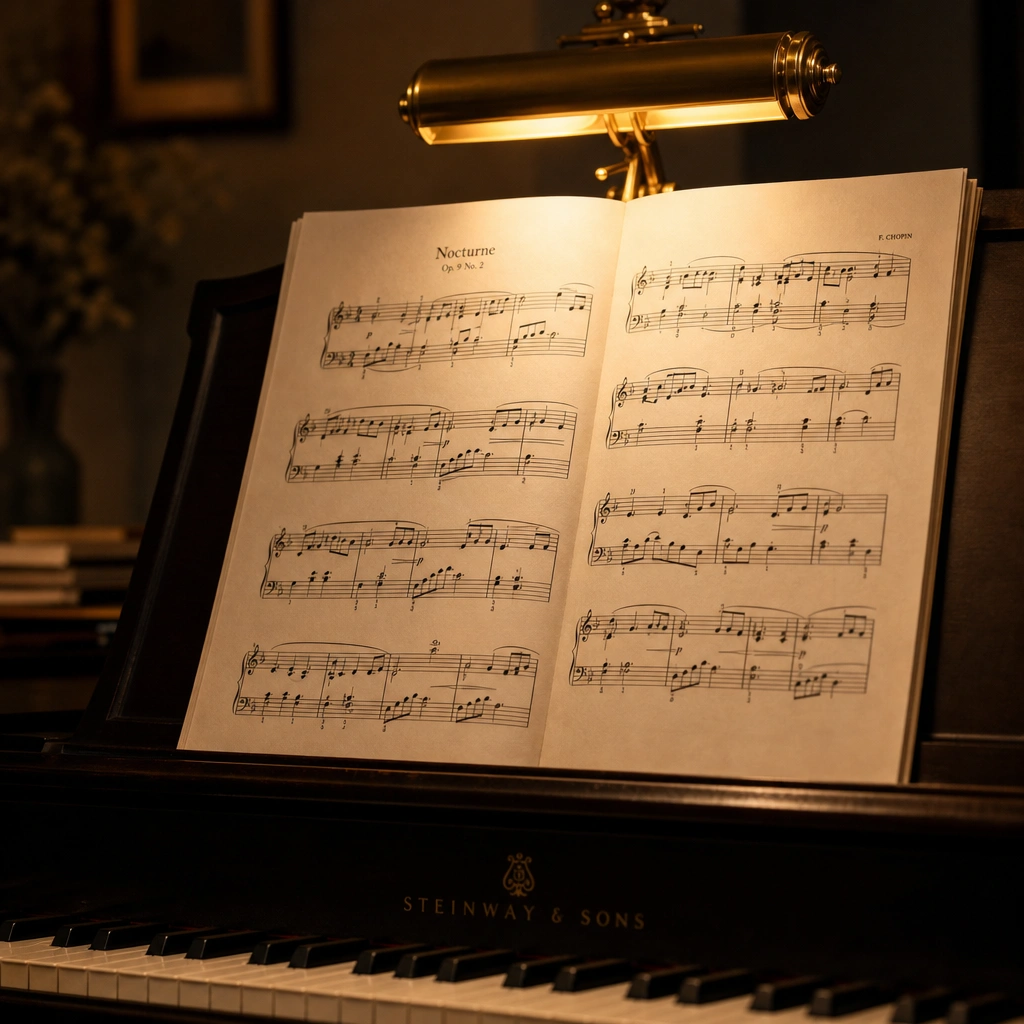
    Sheet music on piano stand in peaceful studio setting for focused practice

    Day-of-Performance Strategies

    The day of your recital requires specific strategies to manage piano performance anxiety as it peaks.

    Morning and Afternoon Preparation

    How you spend performance day matters. Avoid over-practicing—this usually increases anxiety and tires your muscles. Instead:

    • Play through your piece once or twice in the morning, slowly and mindfully
    • Engage in calming activities—walk, read, listen to music you love
    • Eat regular, balanced meals (skip heavy foods that make you sluggish)
    • Stay hydrated but not over-caffeinated
    • Avoid other pianists’ performances on YouTube—comparison fuels anxiety

    One student told me she used to spend recital day frantically practicing, which amplified her piano performance anxiety. When she switched to one calm morning run-through followed by a nature walk, her performance quality improved dramatically.

    Right Before You Perform

    In the final minutes before your performance, piano performance anxiety may peak. Have a plan.

    Find a quiet space if possible. Do your breathing exercises. Run through your pre-performance routine. Some pianists benefit from listening to their piece one final time; others prefer silence.

    Know what works for you.

    Importantly, accept the nervousness rather than fighting it. Tell yourself, “My body is energized and ready. This nervousness is excitement. It will help me play with intensity and focus.”

    Research shows that reframing anxiety as excitement actually improves performance.

    The Walk to the Piano

    Your walk to the piano sets the tone. Move deliberately, not rushed. Breathe. Remind yourself of your intention—to share the music.

    Settle at the bench without hurrying. Adjust if needed. Place your hands.

    Before you begin, take one full breath. This pause—just three or four seconds—allows your nervous system to settle and signals to the audience that you’re in control. Then begin with commitment.

    Many pianists battling piano performance anxiety rush this moment, starting before they’re truly ready. The pause is powerful.

    Managing Unexpected Challenges

    Sometimes performance day brings surprises: a different piano than you expected, an uncomfortably warm room, or an unexpected delay. Piano performance anxiety can spike when things don’t go as planned.

    Build flexibility into your mental approach. Remind yourself that professional musicians perform under varied conditions all the time. Your preparation is solid enough to handle variations.

    Having a flexible mindset—”I can adapt to whatever comes”—reduces the impact of surprises on your nerves.

    After the Performance: Learning and Growing

    How you process a performance affects your future relationship with piano performance anxiety.

    Realistic Self-Assessment

    After performing, your brain may fixate on mistakes while ignoring everything that went well. This negativity bias is normal but unhelpful.

    Deliberately practice balanced assessment. Write down three things that went well and one or two things to improve next time.

    Notice what you did right—maintained tempo through a tricky section, recovered smoothly from a memory slip, connected emotionally with the music.

    In my experience teaching at Weaver Music, students who practice this balanced reflection develop much healthier relationships with performance than those who focus only on what went wrong.

    Gathering Useful Feedback

    If you’re working with a teacher, discuss the performance. At Weaver Music, I help students process performances during their lessons, identifying both strengths and specific areas to address.

    Audience feedback can be tricky—people are usually kind but vague (“Great job!”). The most useful feedback comes from musicians who can offer specific observations while remaining supportive.

    Planning Your Next Performance

    One of the best ways to overcome piano performance anxiety is to perform regularly. Each performance provides data and experience that inform the next one.

    Don’t wait a year between performances. Look for lower-stakes opportunities: play at an open mic, perform for a community group, organize a small house concert, or even go live on social media.

    Frequency builds comfort.

    The students I work with who perform every few months develop resilience around piano performance anxiety that those who perform once yearly never quite achieve. Exposure is genuinely therapeutic.

    Celebrating Progress, Not Just Perfection

    Each performance is a learning opportunity. Maybe this time you managed your breathing better than last time. Perhaps you recovered more smoothly from a mistake. Or you simply felt more present with the music.

    These incremental improvements matter. Celebrating them reinforces positive patterns and gradually reshapes your relationship with piano performance anxiety.

    Long-Term Solutions for Piano Performance Anxiety

    While the strategies above help with specific performances, addressing piano performance anxiety in the long term requires deeper work.

    Build Performance Into Regular Practice

    Make performance mode part of your regular practice routine, not something you only do right before a recital. Once or twice a week, do a complete run-through as if you’re performing.

    Some pianists even dress up for these practice performances.

    This regular exposure normalizes the performance state. Your brain stops treating it as a rare, threatening event and starts seeing it as just another thing you do.

    Address Underlying Perfectionism

    If piano performance anxiety is severe and persistent, it may be rooted in perfectionism or deeper self-worth issues. This is common among serious musicians and nothing to be ashamed of.

    Working with a teacher who understands these dynamics can help. In my first lessons, I often discuss not just technique but the mental game of piano playing, because the two are inseparable.

    For some pianists, working with a therapist alongside a piano teacher provides the most comprehensive support for piano performance anxiety. Cognitive-behavioral therapy has strong research support for performance anxiety specifically.

    Develop Multiple Identities

    When your entire self-worth rests on piano performance, the stakes of any single recital become unbearably high. Piano performance anxiety often decreases when you cultivate a rich life with multiple sources of meaning and accomplishment.

    You are not just a pianist. You’re also a friend, perhaps a parent, a professional in another field, someone with hobbies and interests beyond music.

    This broader identity provides perspective: a less-than-perfect recital doesn’t define you.

    I’ve written before about why students quit piano, and often it’s because the pressure became too intense. Keeping piano in healthy perspective—something you love and work hard at, but not the sole source of your worth—actually improves both your enjoyment and your performance.

    Understand That Growth Takes Time

    Managing piano performance anxiety is a skill like any other—it develops with practice over time. Your first few performances might still involve significant nerves. That’s okay.

    Each one teaches you something.

    Be patient with yourself. Notice the small improvements: “Last time my hands shook through the whole piece; this time they settled after the introduction.” Progress isn’t always linear, but it is real.

    Students who work with me long-term, whether through online courses or regular Zoom lessons, consistently report that piano performance anxiety diminishes as they gain experience and implement these strategies.

    It’s not about becoming fearless—it’s about becoming capable even in the presence of fear.

    Consider the Role of Preparation Consistency

    Inconsistent practice schedules often worsen piano performance anxiety because you’re never quite sure how prepared you really are. When you maintain a steady practice routine, you build reliable competence that withstands pressure.

    Many adult students benefit from structured approaches to practice. I’ve found that students who follow a consistent schedule—even if it’s just 20-30 minutes daily—report less anxiety than those who cram before performances.

    Know When to Seek Additional Support

    For most pianists, the strategies in this article will significantly reduce piano performance anxiety. But if your anxiety is severe—causing panic attacks, making you avoid all performance opportunities, or significantly impacting your quality of life—consider seeking support from a mental health professional who specializes in performance anxiety.

    There’s no shame in this. Professional athletes, actors, and musicians often work with sports psychologists or therapists to optimize their performance mindset.

    You deserve the same level of support.

    Additionally, working with an experienced teacher can make a tremendous difference. At Weaver Music, I’ve helped hundreds of students work through piano performance anxiety, and because every lesson is live over Zoom, location is rarely a barrier.

    The investment in quality instruction—$99 for a 60-minute lesson—often pays dividends in both your playing and your confidence.

    The Power of Community and Shared Experience

    Connecting with other pianists who understand piano performance anxiety can be remarkably healing. You realize you’re not alone in this struggle, and you can learn from how others manage their nerves.

    Consider joining piano groups, online forums, or attending masterclasses where performance anxiety is discussed openly. The more normalized these conversations become, the less shame and isolation you’ll feel around your own experience.

    Celebrate the Courage It Takes

    Finally, recognize that stepping onto a stage or even performing for a small group requires genuine courage. Piano performance anxiety is your brain trying to protect you from perceived threat.

    The fact that you do it anyway—that you share your music despite the fear—is worthy of respect.

    Every performance, regardless of outcome, is an act of vulnerability and bravery. Over time, as you implement these strategies and gain experience, piano performance anxiety typically lessens.

    But even if it doesn’t disappear entirely, you’ll develop the skills to perform well anyway.

    That’s the real goal: not to eliminate fear, but to make music regardless. And that’s absolutely achievable for every pianist willing to do the work.

    Ready to find out for yourself?

    Your first lesson with me is a full 60 minutes for just $29 (normally $99). We will evaluate where you are, talk through your goals, and map out your path.
    Book Your First Lesson

  • How to Use a Metronome for Piano Practice

    How to Use a Metronome for Piano Practice

    If you’ve ever felt like your metronome is mocking you—clicking away smugly while you struggle to stay in time—you’re not alone. Learning how to use a metronome piano practice can feel like rubbing your head and patting your stomach simultaneously while reciting the alphabet backwards.

    It’s one of those skills that separates disciplined pianists from the rest, yet it’s also one of the most universally dreaded tools in music education. In my 10+ years of experience, I’ve watched hundreds of students go from metronome-haters to metronome-believers.

    The difference isn’t talent or discipline. It’s approach. Most people use metronomes wrong from day one, which creates frustration that compounds over time.

    But when you understand how to use a metronome piano techniques correctly, the clicking transforms from enemy to ally. This comprehensive guide will show you exactly how to make that transformation happen in your own practice sessions.

    In this guide, I’ll walk you through seven practical strategies that make metronome practice actually work. These aren’t theoretical music school concepts—they’re methods I use every day with real students at Weaver Music, from total beginners to advanced players preparing for performances.

    The short answer

    To use a metronome effectively at the piano, start at a tempo where you can play the passage perfectly with zero mistakes. Then practice the section multiple times at that tempo until it feels easy.

    Only then should you increase by 5 BPM. Use subdivision clicks (eighth notes or sixteenth notes) instead of just quarter notes, and alternate between practicing with the metronome and without it to develop both external and internal timing.

    The key insight: the metronome isn’t there to push you faster. It’s there to build consistency at tempos you’ve already mastered. Think of it as a mirror for your rhythm, not a drill sergeant.

    Understanding how to use a metronome piano practice tool correctly will transform your playing faster than almost any other single technique adjustment. The metronome reveals timing inconsistencies you might not hear otherwise and helps build the muscle memory needed for professional-level playing.

    When used properly, this simple tool becomes your most reliable partner in developing rock-solid rhythm, even tempo control, and the confidence to tackle increasingly challenging repertoire. The strategies that follow will show you exactly how to harness that power.

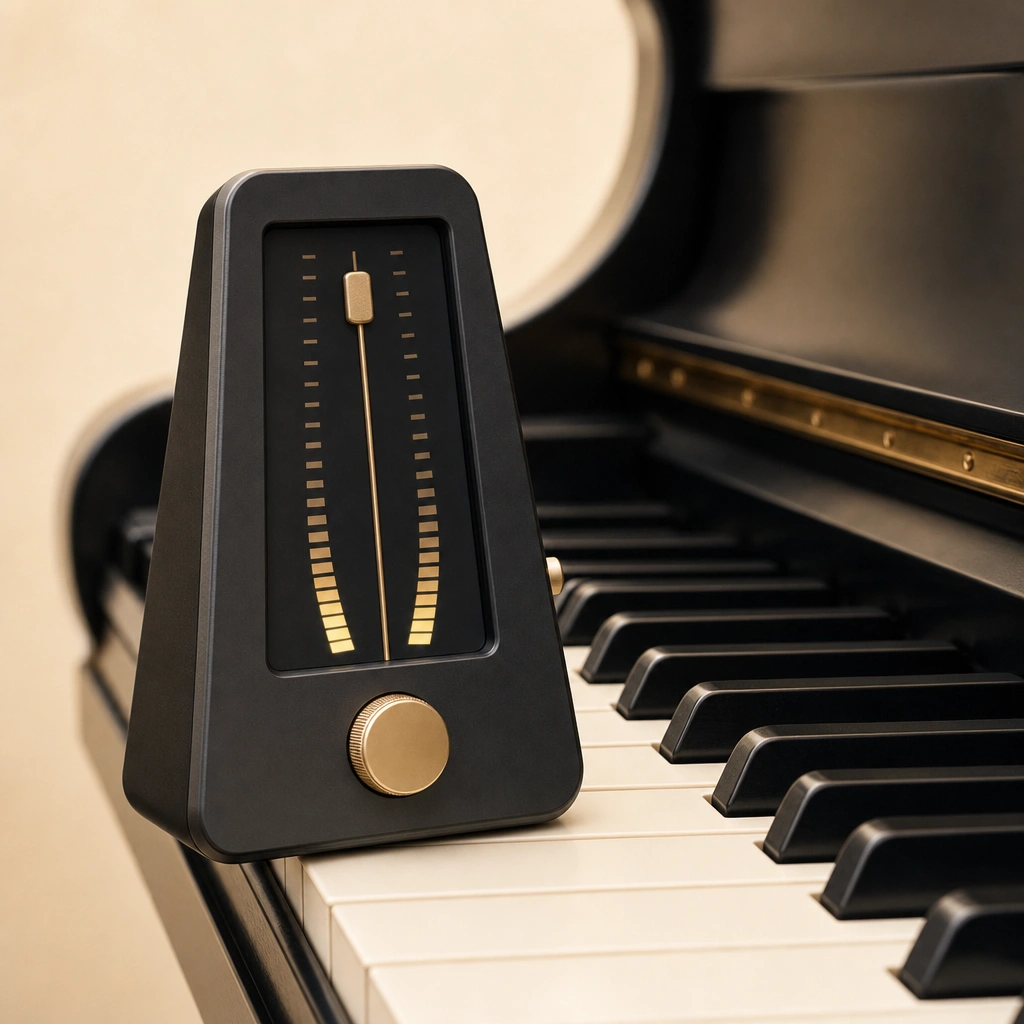
    Digital metronome on piano keys showing how to use a metronome piano techniques

    Why metronomes feel awful at first

    Before we dive into technique, let’s acknowledge why metronomes trigger such visceral reactions. Understanding the psychology helps you work with your brain instead of against it.

    The metronome exposes every imperfection. When you practice without one, your brain smooths over rhythmic inconsistencies. You slow down during hard parts and speed up during easy sections, but it feels smooth to you.

    The metronome reveals this truth brutally. It creates cognitive overload for beginners. You’re already managing notes, fingering, hand position, dynamics, and pedaling.

    Adding a relentless external timekeeper feels like one task too many. Your brain literally doesn’t have enough processing power yet to handle everything at once.

    Here’s what most teachers don’t tell you: this feeling is temporary. As technical skills become automatic, your brain frees up capacity for timing.

    The metronome gets easier not because you “get better at metronomes” but because everything else becomes less demanding. Many students also start at the wrong tempo.

    They set the metronome to the target performance speed, then try to play along. This guarantees failure and frustration. We’ll fix that in the next section.

    The clicking sound itself can be psychologically challenging. Our brains naturally want to interpret and adjust rhythm based on musical context, which is why the strict, unforgiving click of a metronome feels so unnatural at first.

    Another psychological barrier is the fear of judgment. The metronome doesn’t care about your excuses or explanations—it simply reveals whether you’re on the beat or not. This objective feedback can feel harsh, especially for perfectionists who struggle with making mistakes.

    But here’s the reframe that helps my students: the metronome isn’t judging you. It’s just providing data. That data is incredibly valuable because it shows you exactly where to focus your practice energy.

    Start slower than you think

    This is the single most important principle for how to use a metronome piano practice effectively. You must start slower than feels necessary. Much slower.

    Here’s my rule: set the metronome to a tempo where you can play the passage perfectly ten times in a row without a single mistake, hesitation, or stumble.

    For most students learning a new piece, this ends up being 40-60% of the target tempo. Yes, really. I had a student recently working on a Chopin Nocturne.

    She wanted to practice it at 120 BPM because that’s how her favorite recording sounded. At that speed, she made mistakes in nearly every measure. We dropped it to 50 BPM.

    She hated how it felt at first—”It’s too slow, I can’t feel the music!” But here’s what happened: at 50 BPM, she could play it perfectly.

    After three practice sessions at that glacial pace, we bumped it to 55 BPM. Then 60. Then 65. Within two weeks, she was at 90 BPM playing more musically than she ever had at 120 with mistakes.

    Slow practice with a metronome builds three things simultaneously:

    • Muscle memory that’s accurate from the start
    • Mental clarity about every note and rhythm
    • Confidence that you can execute the passage reliably

    Fast practice with mistakes builds muscle memory for the mistakes. You’re literally training your fingers to play wrong notes. Slow, perfect repetition is exponentially more effective than fast, sloppy repetition.

    One more thing: don’t judge the musicality of slow practice. It won’t sound beautiful at 50 BPM. That’s not the point. You’re building a foundation.

    The music comes later, and it comes more reliably because the foundation is solid. This approach to how to use a metronome piano slow practice creates neural pathways that lock in accuracy before speed.

    Think of it like building a house. You wouldn’t rush through the foundation to get to the pretty parts faster. The same principle applies to piano technique.

    Neuroscience research shows that slow, deliberate practice with immediate feedback (which the metronome provides) creates stronger neural connections than fast, error-prone repetition. You’re not just training your fingers—you’re rewiring your brain for precision.

    When students understand this scientific basis, they’re more willing to embrace the slow tempos that feel uncomfortable at first. The patience pays dividends in the form of faster long-term progress and fewer ingrained bad habits to unlearn later.

    Use subdivision, not just quarter notes

    Most beginners set their metronome to click on quarter notes. This is fine for simple pieces, but it’s actually one of the biggest obstacles to understanding how to use a metronome piano technique for anything moderately complex.

    Instead, set your metronome to click on the smallest rhythmic value you’re playing. If your passage has sixteenth notes, set the metronome to click sixteenth notes.

    If you’re playing eighth-note triplets, use triplet clicks. Why does this work so much better? Because it removes ambiguity.

    When the metronome only clicks quarters, you have to subdivide in your head to place the eighths and sixteenths accurately. For beginners, this is asking your brain to do two hard things at once: play the passage and calculate subdivision.

    When the metronome clicks the subdivision, you just match the clicks. One action, not two. Your fingers and the clicks line up directly. This dramatically reduces cognitive load.

    Here’s how I teach this: let’s say you’re playing a C major scale in sixteenth notes. Instead of setting the metronome to quarter note = 60, set it to sixteenth note = 60 (which many metronomes display as quarter = 60 but in sixteenth-note mode).

    Now every note of your scale gets its own click. Practice it until every finger attack aligns perfectly with a click. Then, gradually turn off some of the subdivision.

    Maybe switch to eighth-note clicks. Your internal sense of sixteenth notes will be much stronger because you built it with complete external support first.

    This is especially powerful for dotted rhythms, syncopation, and any passage where students “feel” the rhythm wrong. The subdivision clicks force you to place notes exactly where they belong mathematically, which often differs from where they feel like they should go.

    Professional pianists use this subdivision technique constantly when learning complex contemporary works. It’s not a beginner crutch—it’s a professional tool that happens to be especially helpful for developing players.

    I’ve seen subdivision clicking transform students’ understanding of complex rhythmic patterns in just a single practice session. What felt impossibly complicated suddenly becomes clear when every note division has its own audible reference point.

    This technique is particularly valuable for passages with mixed rhythms—say, triplets in one hand against straight eighths in the other. Setting the metronome to click the lowest common denominator (often sixteenth-note triplets in this case) makes the mathematical relationship crystal clear.

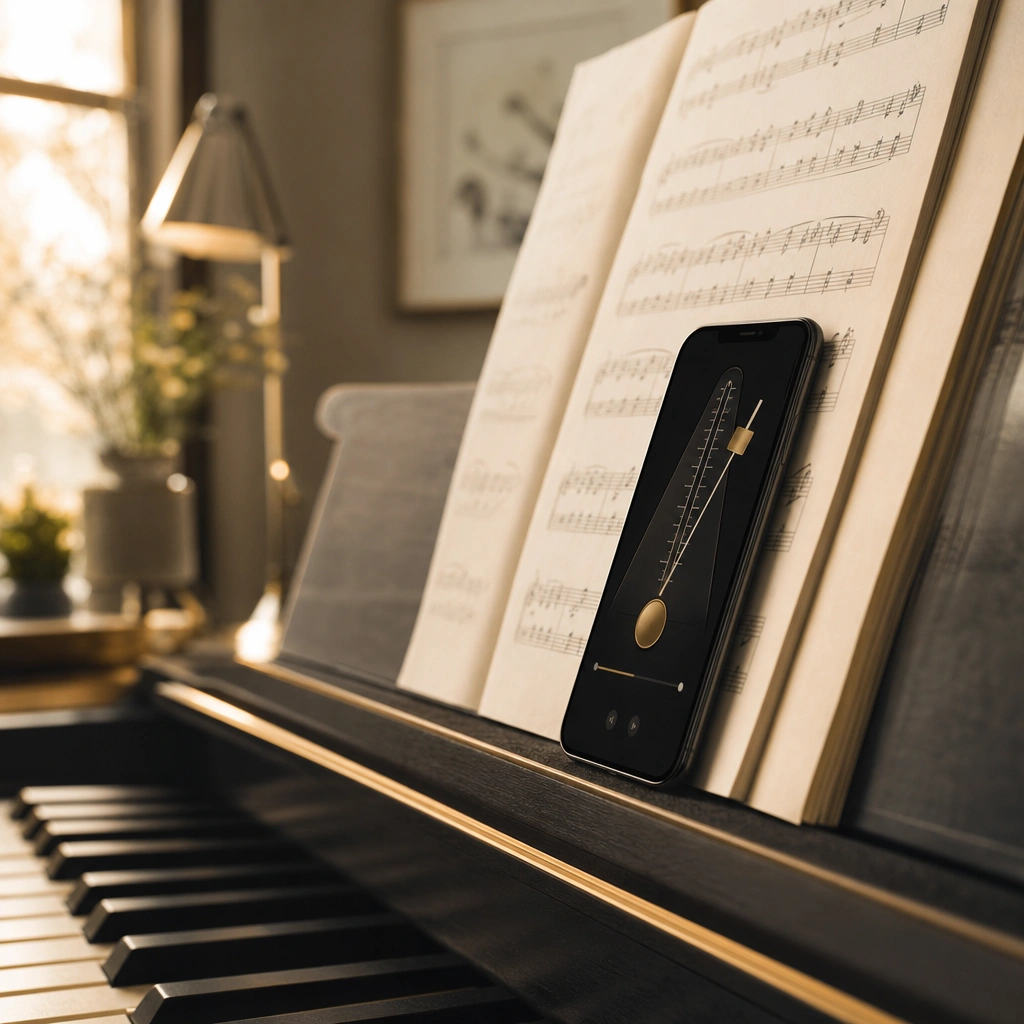
    Metronome app on smartphone with piano sheet music for practice guidance

    Practice with it, then without it, then with it again

    One of the biggest mistakes students make is practicing exclusively with the metronome or exclusively without it. Both approaches have problems. Only practicing with the metronome makes you dependent on external timekeeping.

    You develop the skill of following a click, but not the skill of generating steady time internally. The moment you perform without a metronome, your timing falls apart.

    Only practicing without a metronome means you never get objective feedback. You develop an internal sense of time, but it might be inaccurate. You’ll slow down in difficult passages and rush through easy ones without realizing it.

    The solution is alternation. Here’s the practice cycle I teach at Weaver Music, and it’s transformed how to use a metronome piano students approach this essential tool:

    • Phase 1: Practice the passage with metronome subdivision clicks at a very slow tempo until perfect (5-10 repetitions)
    • Phase 2: Turn off the metronome and play the passage twice, trying to maintain that exact tempo internally
    • Phase 3: Turn the metronome back on at the same tempo and check whether you stayed consistent
    • Phase 4: If you stayed consistent, increase by 5 BPM and repeat. If not, stay at the current tempo for another cycle

    This builds both external and internal timing skills. You learn to follow an external pulse and to generate a steady internal pulse. Most importantly, you learn whether your internal sense matches reality.

    I’ve had countless students swear they maintained tempo during Phase 2, only to discover in Phase 3 that they slowed down by 15-20 BPM without realizing it.

    This awareness is valuable. It tells you where your practice needs to focus. Over time, the gap closes. Your internal tempo becomes more accurate.

    Eventually, you can play entire pieces at steady tempo without external support—but you’ll have developed that skill by regularly checking it against objective measurement.

    This alternating approach is one of the most effective ways to internalize rhythm while maintaining accountability. It trains independence while preventing the drift that happens when you never check your assumptions against reality.

    The alternation method also prevents metronome dependency, which is a real concern for students who use the tool too consistently. You want the metronome to be a training partner, not a permanent crutch.

    By regularly practicing without it and then verifying your accuracy, you build genuine internal timing that will serve you in performance situations where no external click track is available.

    Let the metronome follow you first

    Here’s a technique I don’t see enough teachers using: before you try to follow the metronome, let it follow you. This works especially well for expressive pieces where strict tempo feels wrong, or for students who tense up the moment the clicking starts.

    It reverses the power dynamic and removes the performance anxiety. Here’s how: play through the passage at whatever tempo feels natural and comfortable.

    Don’t try to be steady; just play musically. Record yourself or have someone tap along to find your natural tempo. Then set the metronome to that exact speed.

    Suddenly, the metronome isn’t an adversary. It’s simply reflecting what you’re already doing. This creates a feeling of alignment instead of conflict.

    Practice at this “natural tempo” with the metronome until it feels easy and collaborative. Then—and only then—start making small adjustments.

    Maybe your natural tempo was 76 BPM but the target is 80. Instead of jumping straight to 80 and struggling, you’ve built comfort at 76 first. Moving to 77, then 78, then 79, then 80 happens organically.

    This approach is particularly effective for adults who come to piano later in life. Many of my adult students at Weaver Music have spent decades in careers where they were competent and in control.

    The metronome makes them feel incompetent, which triggers avoidance. Starting with “the metronome matching you” instead of “you matching the metronome” preserves that sense of agency.

    It’s also psychologically easier. You’re not learning a new skill (following external time); you’re just adding external validation to something you already do (playing at your natural pace).

    Once that foundation exists, expanding the skill becomes less threatening. This reverse-engineering approach to how to use a metronome piano practice sessions creates confidence instead of anxiety.

    I’ve used this technique with students who had developed almost phobic reactions to metronomes after years of frustrating experiences. By letting them “teach” the metronome their tempo first, we removed the emotional charge and created a neutral starting point.

    Within a few weeks, these same students were comfortably using metronomes in the traditional way because the initial psychological barrier had been dismantled.

    How to use a metronome piano scales and technical work

    Scales, arpeggios, and technical exercises are where metronome work pays the biggest dividends. This is also where understanding how to use a metronome piano students can achieve the fastest progress.

    For scales, start with one octave at a time. Set the metronome to click on every note (subdivision clicks, as discussed earlier). Play the scale up and down, ensuring every finger strikes exactly with a click. This builds evenness.

    Once one octave is even, extend to two octaves. You’ll notice certain transitions—often the thumb-under at the octave break—tend to rush or drag.

    The metronome exposes this immediately. Isolate those transitions and drill them separately at the same tempo. Here’s a specific how to use a metronome piano scales technique I use constantly: the accent drill.

    Play your scale with the metronome, but accent every fourth note. Then every third note. Then every fifth note. This forces you to maintain steady time while adding rhythmic complexity, which builds polyrhythmic awareness and strengthens your sense of pulse.

    For arpeggios, the same principles apply, but the technical challenge is often greater because of the wider hand position changes. Start absurdly slow—maybe one note per second.

    Make every position shift deliberate and exactly timed. Speed comes from accuracy, not from trying to go fast. Technical exercises like Hanon or Czerny are metronome goldmines.

    These are specifically designed to be practiced slowly for accuracy, then gradually increased in speed. Track your progress by writing down the date and tempo in your practice journal.

    Seeing “Hanon #1: 60 BPM” grow to “Hanon #1: 100 BPM” over weeks provides tangible evidence of improvement. One mistake to avoid: don’t practice scales and technical work exclusively at one tempo.

    Vary it. Some days, practice scales at a very slow tempo with perfect articulation and dynamics. Other days, push the tempo to your current maximum. This builds both control and speed, and prevents boredom.

    When working on how to use a metronome piano scales practice, consistency matters more than intensity. Five minutes of focused, metronome-guided scale work every day produces better results than thirty minutes once a week.

    The daily repetition builds automaticity in your fingers and deepens your internalized sense of steady pulse. Over time, you’ll notice that even your sight-reading improves because your rhythmic foundation is so much stronger.

    Another powerful technique for scale practice: play your scales in different rhythmic patterns while maintaining steady clicks. Try long-short patterns (dotted eighth-sixteenth), then short-long (sixteenth-dotted eighth), then triplet groupings.

    This transforms boring scale practice into genuinely engaging rhythmic training while the metronome keeps you honest about maintaining the underlying pulse. The combination builds both technical facility and rhythmic sophistication simultaneously.

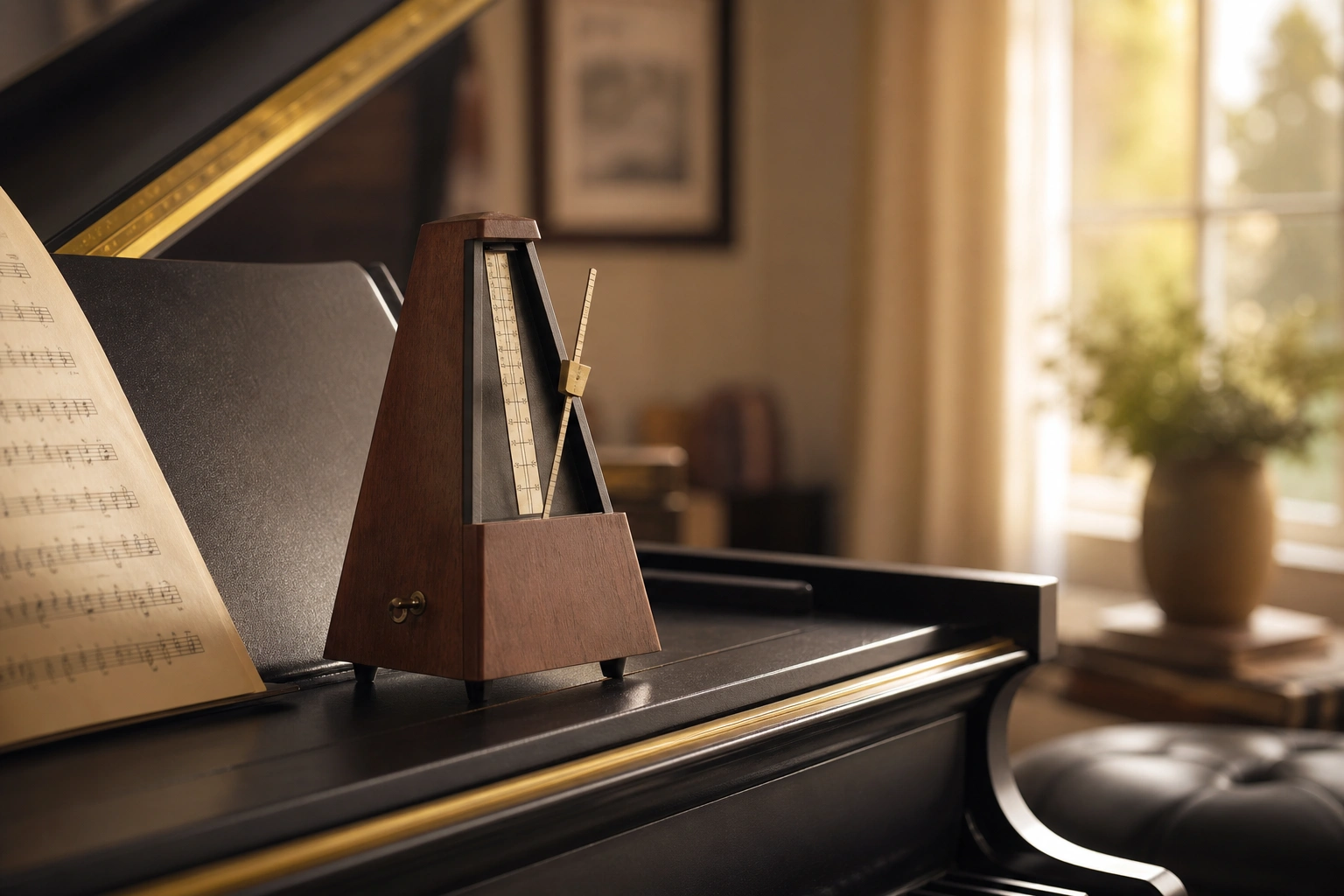
    Classic mechanical metronome standing on top of a piano during practice session

    The 5-BPM rule for building speed

    I’ve mentioned this a few times already, but it deserves its own section because it’s that important. When you’re ready to increase tempo, increase by exactly 5 BPM. Not 10. Not “a little faster.” Exactly 5.

    Why 5? It’s small enough that your fingers and brain can adapt without struggle, but large enough that you’re making real progress. Jumps of 10 or more BPM often reintroduce mistakes, which means you’re back to practicing errors.

    Here’s the protocol: once you can play a passage perfectly five times in a row at a given tempo, you’re ready to move up 5 BPM. Not three times. Not “pretty well most of the time.” Five perfect repetitions.

    This patience is hard for students who are goal-oriented. You want to play Für Elise at 120 BPM, and you’re stuck at 75 BPM. The temptation is to jump ahead. Resist it.

    Every time you jump ahead and practice with mistakes, you’re taking two steps back. I promise you: slow, incremental progress is faster in the long run.

    A student who increases 5 BPM every few days will reach the target tempo weeks before a student who keeps attempting the target tempo and making mistakes.

    Track your progress. Write down the date and tempo every time you increase. This creates motivation and accountability. When you see “October 15: 75 BPM, October 18: 80 BPM, October 21: 85 BPM,” you have proof that the system works, which makes it easier to trust the process during the slow middle stages.

    Also, understand that progress isn’t always linear. Some weeks you’ll increase 10-15 BPM total. Other weeks you’ll stay at the same tempo, consolidating. Both are valuable.

    The metronome shows you exactly where you are, without judgment or wishful thinking. This gradual building approach is central to how to use a metronome piano technique development at every level.

    Professional concert pianists use the exact same 5-BPM increment method when learning new repertoire. It’s not a beginner technique—it’s simply the most efficient way the human brain and fingers learn complex motor patterns at increasing speeds.

    Some students find it helpful to use even smaller increments—2 or 3 BPM—especially when working on particularly challenging passages or when approaching the upper limits of their current technical ability. There’s no prize for rushing the process.

    The goal is sustainable progress that sticks, not temporary speed gains that collapse under performance pressure. I’ve watched students reach impressive tempos through patient 5-BPM increments and maintain those speeds reliably for months or years.

    Meanwhile, students who try to force faster progress often find themselves stuck at the same tempo for weeks because they keep introducing errors that have to be corrected before real advancement can happen.

    Choose the right metronome for you

    Not all metronomes are created equal, and finding one that doesn’t irritate you makes a huge difference in whether you’ll actually use it. Traditional mechanical metronomes have a visual component (the swinging pendulum) that some students find helpful.

    Watching the motion creates a secondary sensory input beyond just sound. However, they’re not portable, they can’t do subdivision clicks easily, and the ticking sound drives some people crazy.

    Digital metronomes offer more features: subdivision settings, different sound options, visual flashing lights, and precise BPM control. They’re also usually cheaper and more portable. The downside is they can feel less “organic” and the beeping sounds are sometimes harsh.

    Smartphone apps are what most of my students use now. Apps like Soundbrenner, Pro Metronome, or even the built-in metronome in GarageBand offer incredible flexibility.

    You can choose different sounds (wood block, hi-hat, beep), set complex subdivision patterns, create tempo changes within a single session, and even use vibration mode if sound is distracting.

    Here’s my advice: try several. The “best” metronome is the one you’ll actually use. If the sound of one app annoys you, try another.

    If you love the aesthetic of a wooden mechanical metronome and it makes you more likely to practice with it, get that instead of the “technically superior” digital option.

    One feature I strongly recommend: visual feedback in addition to audio. Many apps flash the screen in time with the beat. This visual pulse helps some students sync up more easily than audio alone, especially students who are more visually oriented or who struggle with auditory processing.

    Whatever you choose, keep it easily accessible. If your metronome is buried in a drawer or requires five minutes of app navigation to start, you won’t use it.

    Put it on your music stand, on your piano, or keep the app on your phone’s home screen. Making it easy to start your metronome practice removes one more barrier to consistent training.

    Some advanced metronome apps even offer features like gradual tempo acceleration (automatically increasing BPM over time), programmable tempo maps for pieces with multiple tempo changes, and practice mode features that can help you track your progress over weeks and months.

    These features can be valuable for advanced students, but beginners should stick with basic functionality—just a steady click at adjustable tempos with subdivision options. Don’t let feature overload prevent you from using the tool at all.

    Common metronome mistakes to avoid

    Even when students commit to using a metronome, certain mistakes undermine the effectiveness. Let’s address the most common ones I see in my teaching practice.

    Mistake 1: Starting too fast. I’ve mentioned this already, but it bears repeating because it’s the most common error. Your ego wants to practice at performance tempo. Your fingers need to practice at learning tempo. Trust the process.

    Mistake 2: Only using it on pieces you’re learning. The metronome is equally valuable—maybe more valuable—for pieces you’ve already “finished.” It reveals tempo fluctuations you’ve stopped noticing.

    Record yourself playing an old piece without metronome, then check it against a metronome. You’ll be surprised how much you’re rushing or dragging in familiar passages.

    Mistake 3: Treating it as a performance tool rather than a practice tool. Some students think they’ve “failed” if they can’t perform with a metronome clicking. That’s not the goal.

    The metronome is training wheels. It helps you build steady internal time. Once built, you remove it for performance.

    Mistake 4: Using it for every piece, every time. Some music is meant to be rhythmically flexible. Romantic-era pieces, for instance, often use rubato (expressive tempo changes) as a core musical element.

    Using a metronome on Chopin’s Nocturne in E-flat major, for example, can strip away the interpretive freedom that makes the piece beautiful. We’ll discuss this more in the next section.

    Mistake 5: Not adjusting for different practice goals. If you’re working on dynamics and phrasing, maybe you don’t need the metronome that day. If you’re working on evenness and rhythm, you definitely do. Match the tool to the goal.

    Mistake 6: Giving up after one bad session. Your first few attempts with a metronome will probably feel awful. That’s normal. It takes several sessions before your brain adapts. Don’t judge the tool based on day one. Give it a full week of honest effort.

    If you’re struggling with consistency in your practice overall, not just with metronome work, you might find my article on creating a piano practice schedule for adults helpful for building sustainable habits.

    Another common mistake is fighting the click instead of listening to it. When you notice you’re off the beat, many students try to force their fingers back in sync mid-phrase, which creates tension and usually makes things worse.

    Instead, if you fall out of sync, finish the phrase, stop, reset, and start again from a convenient musical entry point. Don’t try to “catch up” to the metronome—that’s not how motor learning works.

    Mistake 7: Ignoring your body’s tension signals. If you notice your shoulders rising, your jaw clenching, or your breathing becoming shallow while practicing with a metronome, that’s a sign you need to slow down or take a break.

    Physical tension actively interferes with motor learning and can lead to injury over time. The metronome should support relaxed, efficient technique, not create stress that compromises it.

    When NOT to use a metronome

    I’ve spent this entire article teaching you how to use a metronome piano practice effectively. Now I’m going to tell you when to ignore everything I just said and not use one at all.

    Metronomes are tools, not rules. There are legitimate times when practicing without one is better for your musical development.

    When learning a brand-new piece in the first reading: When you’re sight-reading through something for the first time, your goal is to get a general sense of the music—the melody, harmony, structure, and character.

    Adding a metronome at this stage adds unhelpful pressure. Just play through it at whatever tempo works, stopping when you need to, getting familiar with the landscape.

    When working on musical expression: If your focus today is on phrasing, dynamics, pedaling, or emotional interpretation, the metronome can actually get in the way.

    These elements often require subtle tempo fluctuations—a slight ritardando at the end of a phrase, a slight acceleration into a climax. Strict tempo prevents you from exploring these expressive tools.

    When practicing deliberately flexible music: As mentioned earlier, some pieces are meant to be played with rubato. Debussy’s “Clair de Lune,” many Chopin pieces, improvisatory-style works—these require rhythmic freedom.

    You might use a metronome to learn the notes and basic rhythms accurately, then set it aside for interpretive work.

    When you’re mentally exhausted: Metronome practice requires focused concentration. If you’re practicing at the end of a long day and your brain is fried, sometimes it’s better to just play for enjoyment without the cognitive load of strict timekeeping.

    Playing piano for stress relief is valuable too, as I discuss in this article, and the metronome isn’t always compatible with that goal.

    When it’s creating more frustration than value: If you’ve spent 20 minutes trying to sync with the metronome and you’re on the verge of throwing it across the room, stop. Take a break. Practice something else.

    Come back to it tomorrow. Frustration creates tension, and tension in your hands and shoulders creates bad technique.

    The goal is to develop strong internal timing that doesn’t depend on external tools. The metronome helps you build that skill, but it’s not meant to be a permanent crutch.

    Think of it like training wheels on a bicycle—essential for learning balance, but eventually you need to ride without them.

    In my teaching at Weaver Music, I use metronomes strategically, not universally. In a typical lesson, we might use it for 10-15 minutes on specific technical passages or scales, then set it aside for the rest of the hour while we work on musicality, interpretation, and the joy of making music.

    If you’re curious about what a lesson with me actually looks like, you can read more about what to expect in a first piano lesson.

    Balance is everything. Use the metronome enough to build accurate timing. Don’t use it so much that it kills your musical spirit. You’ll know you’ve found the right balance when your playing is both rhythmically solid and emotionally alive.

    One final thought: if you’re working with a teacher—in person or over Zoom, they can help you determine when metronome work is appropriate for your current pieces and goals.

    At Weaver Music, personalized guidance on practice strategies is a core part of every lesson, and you can also access structured practice guidance through our four-level lesson path that breaks down exactly how to practice effectively at each stage of development.

    The metronome is powerful when used wisely. It’s just one tool among many in your practice toolkit. Master it, use it strategically, and you’ll see dramatic improvements in rhythmic accuracy, technical evenness, and confidence.

    But never forget that the ultimate goal isn’t perfect time—it’s beautiful music. The metronome serves that goal; it doesn’t replace it.

    When you truly understand how to use a metronome piano practice sessions become more productive, less frustrating, and ultimately more musical. The click that once felt like criticism becomes a supportive partner in your journey toward mastery.

    Consistent metronome practice over weeks and months trains your internal sense of timing, making you a steadier musician even when you’re not using the tool.

    That’s the real power of this simple clicking device—it’s building skills that last far beyond the practice session itself.

    The transformation that happens when you master how to use a metronome piano techniques extends beyond just the pieces you’re currently learning. You’ll find that your sight-reading becomes more accurate because you’re better at anticipating and maintaining steady rhythmic patterns.

    Your ensemble playing improves because you can lock into a shared pulse more reliably. Even your improvisational skills benefit because you have a stronger internal framework for organizing musical ideas in time.

    These compound benefits make the initial discomfort of learning to work with a metronome worthwhile many times over. The students who push through the awkward early stages and develop genuine facility with this tool consistently outpace their peers in overall musicianship development.

    So yes, the metronome might feel like your enemy at first. But with the seven strategies outlined in this guide, you can transform it into one of your most valuable practice partners.

    Start slower than feels comfortable, use subdivision clicks for clarity, alternate between guided and independent practice, let the tool match your natural tempo before pushing you faster, apply it systematically to scales and technical work, increase tempo in small increments, and choose a metronome you’ll actually enjoy using.

    Follow these principles consistently, and within weeks you’ll notice the difference—not just in the pieces you’re practicing with the metronome, but in every aspect of your playing that depends on solid rhythmic foundation and steady tempo control.

    Ready to find out for yourself?

    Your first lesson with me is a full 60 minutes for just $29 (normally $99). We will evaluate where you are, talk through your goals, and map out your path.
    Book Your First Lesson

  • How Often Should a Beginner Practice Piano, and for How Long?

    How Often Should a Beginner Practice Piano, and for How Long?

    When students ask me how often should a beginner practice piano, I can see the worry in their eyes. They’re afraid I’ll say two hours a day, or that anything less means failure. Here’s the truth I’ve learned after teaching hundreds of students: consistency beats heroic effort every single time.

    The beginner who practices 15 minutes daily will outpace the one who crams an hour on Sundays, and I’ve watched this play out year after year. The question of how often should a beginner practice piano deserves an honest answer, not an idealized one.

    I’m going to share what actually works in the real world, for real people with jobs and families and busy lives. Understanding how often should a beginner practice piano is the foundation of sustainable progress and long-term success at the instrument.

    The Short Answer: How Often Should a Beginner Practice Piano

    For most beginners, the ideal practice schedule is 5-6 days per week, 20-30 minutes per session. That’s it. Not two hours. Not until your fingers bleed. Just 20-30 minutes, almost every day.

    This schedule works because your brain needs regular reinforcement to build new neural pathways. When you’re learning piano, you’re literally rewiring your brain to coordinate complex movements, read a new language (music notation), and process auditory feedback simultaneously.

    If you can only manage 15 minutes a day, that’s absolutely fine for the first month or two. If you’re a younger student (under 10), 15-20 minutes is actually more appropriate than longer sessions.

    The key principle: how often should a beginner practice piano is more important than how long. Daily short sessions trump weekly marathons every time. When considering how often should a beginner practice piano, think about frequency first and duration second.

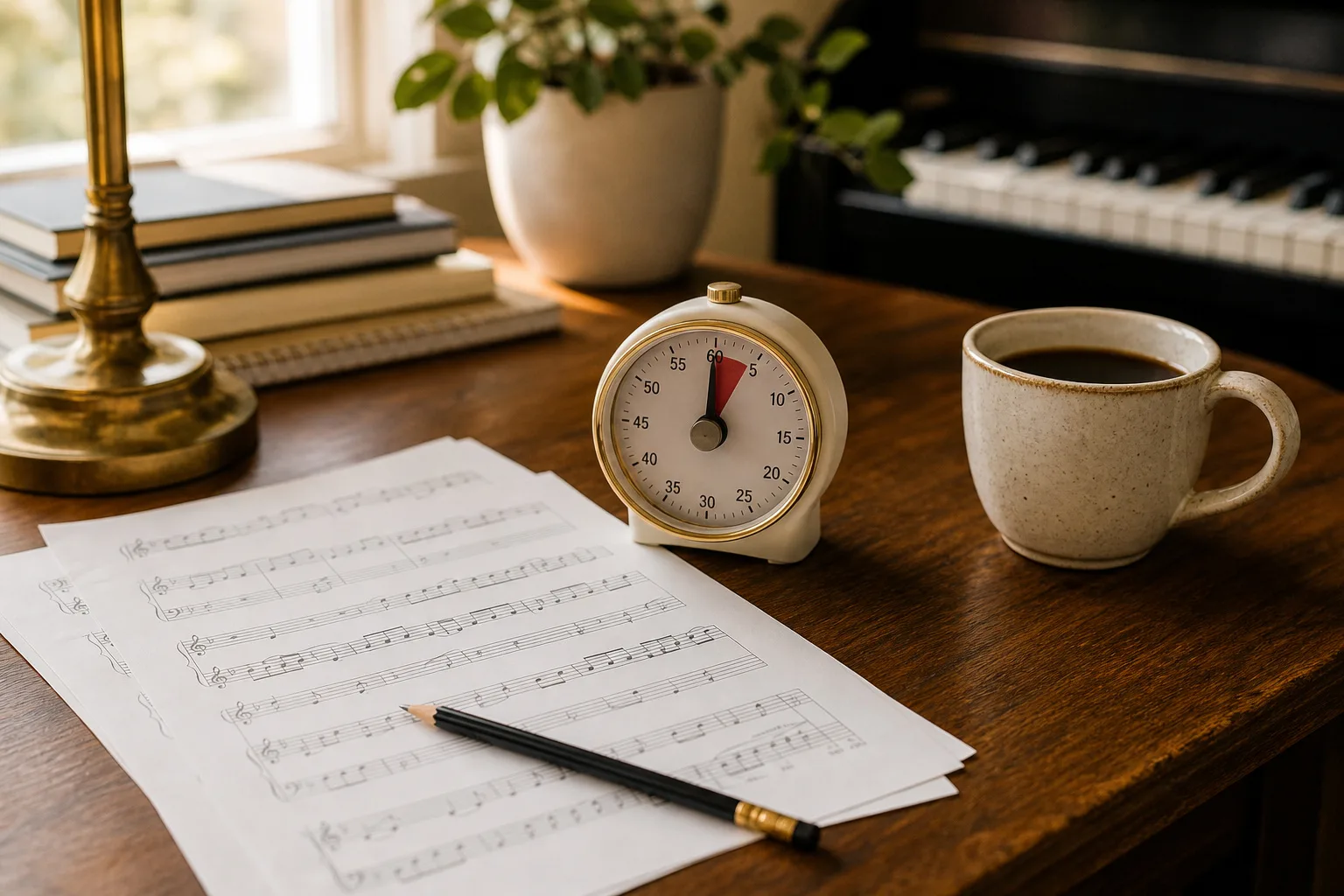
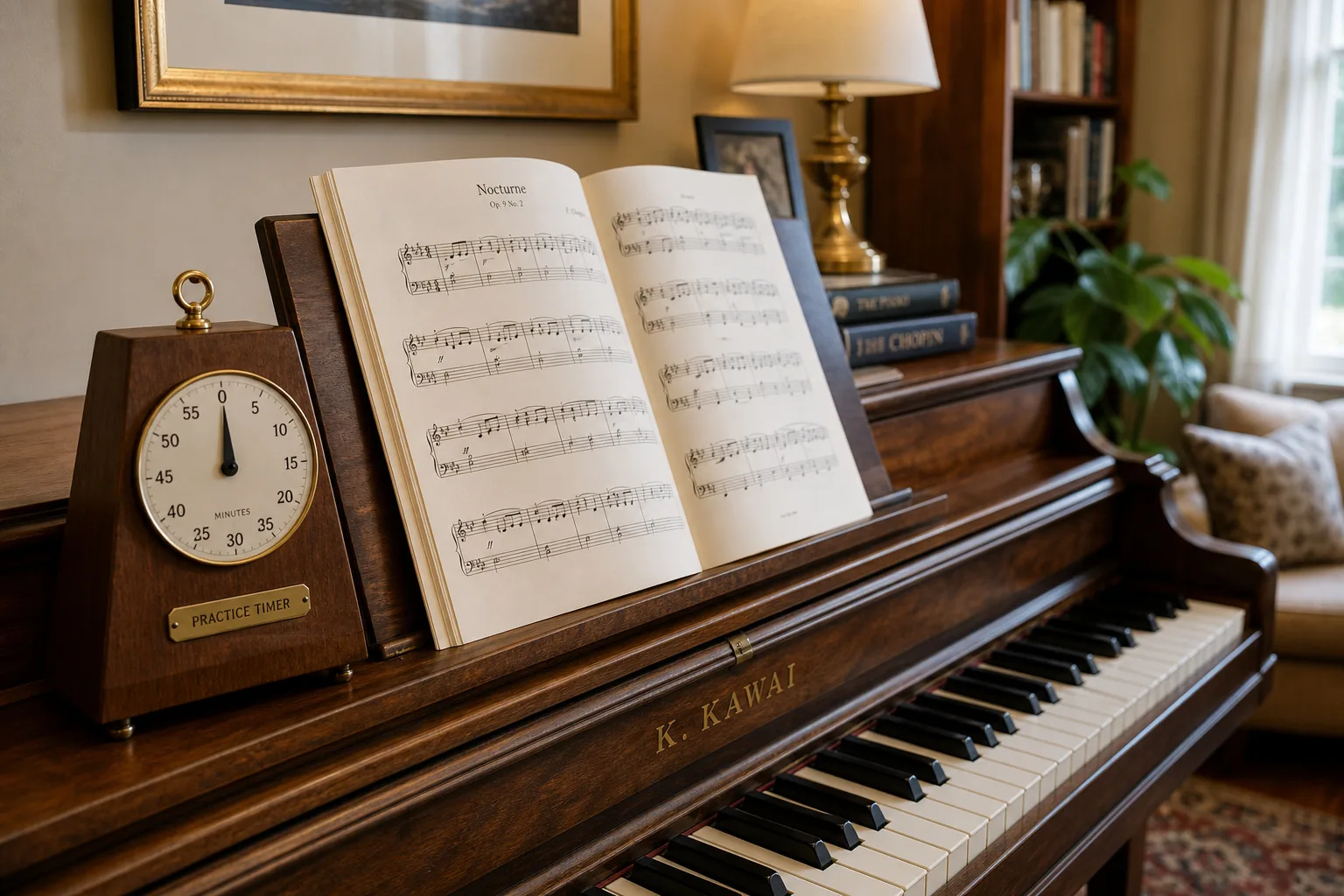
    Practice timer and sheet music helping plan how often should a beginner practice piano each week

    Why Frequency Matters More Than Duration

    I’ve had students apologize to me: “I could only practice 10 minutes each day this week.” Meanwhile, they’ve made more progress than the student who practiced one 90-minute session. Why?

    Understanding the science behind practice frequency helps answer how often should a beginner practice piano in a way that actually produces results.

    How Your Brain Learns Motor Skills

    Piano playing is a motor skill, similar to learning to write or ride a bicycle. Motor learning research shows that distributed practice (spread over time) is vastly more effective than massed practice (crammed together).

    Each time you sit at the piano, your brain strengthens the neural connections related to finger movement, reading notes, and hand coordination. These connections need time to consolidate—that happens during sleep and rest periods between practice sessions.

    When you practice daily, you give your brain multiple opportunities to consolidate learning. You’re essentially pressing “save” on your progress every single day. This biological reality fundamentally shapes how often should a beginner practice piano for optimal learning.

    The Muscle Memory Myth

    People often talk about “muscle memory,” but that’s not quite accurate. Your muscles don’t have memory—your brain does. What we call muscle memory is actually procedural memory, stored in the cerebellum and motor cortex.

    Building procedural memory requires repetition over time. Five 20-minute sessions spread across a week will build stronger procedural memory than one 100-minute session. Understanding this changes how we think about how often should a beginner practice piano.

    Preventing Burnout and Injury

    Shorter, frequent sessions also protect beginners from two common problems: mental burnout and physical strain. Your hands, wrists, and forearms need time to adapt to new movements.

    Overdoing it in one session can lead to tension or even repetitive strain injuries. I’ve seen too many enthusiastic beginners flame out after two months because they pushed too hard, too fast. Sustainable progress is always better than spectacular burnout.

    Realistic Practice Schedules: How Often Should a Beginner Practice Piano

    Let me break down what how often should a beginner practice piano looks like for different situations. These are the schedules I actually recommend to my students, not some idealized fantasy.

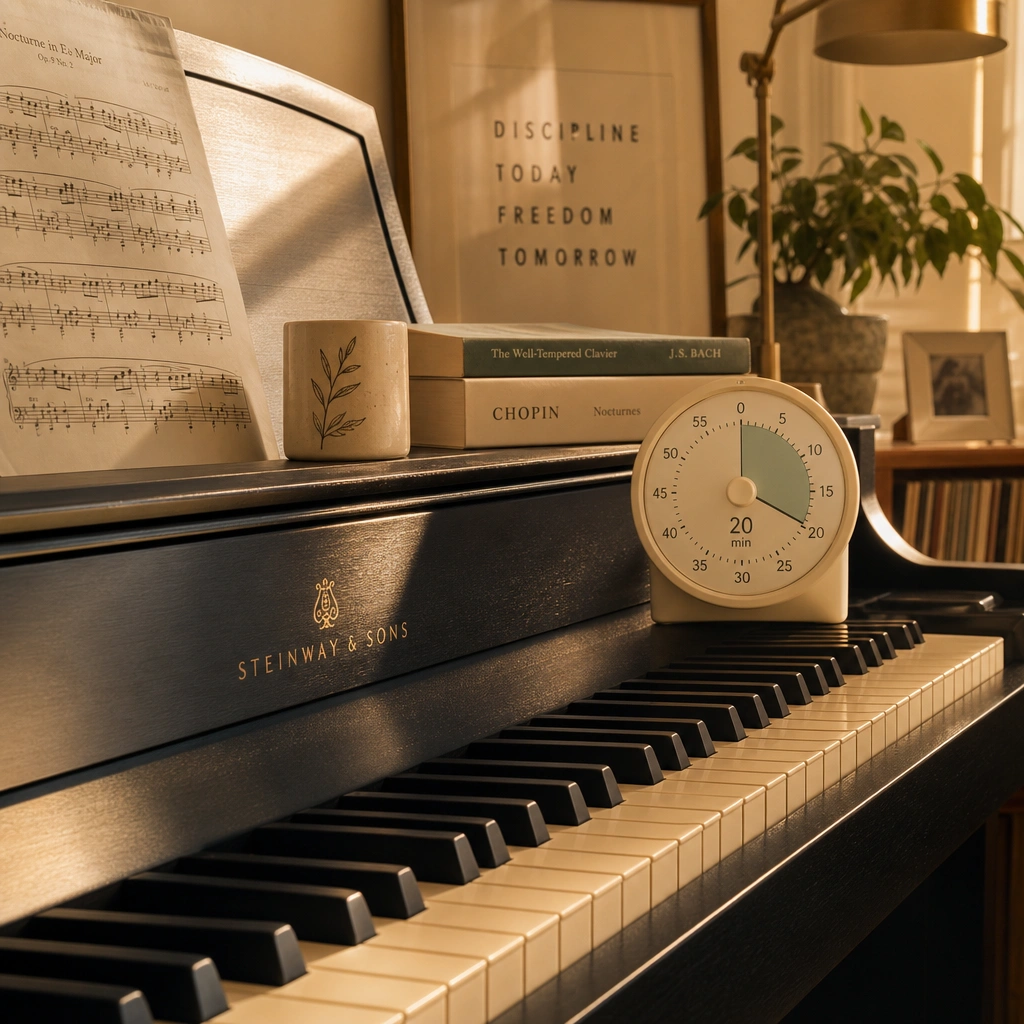
    Piano with timer showing recommended beginner practice session length

    The Absolute Minimum (Maintenance Mode)

    • Frequency: 4 days per week
    • Duration: 15 minutes
    • Total weekly time: 60 minutes
    • Expected progress: Slow but steady; you’ll improve but not quickly

    This is your fallback during crazy-busy life seasons. It’s enough to maintain skills and inch forward. I often recommend this for adult beginners who are testing the waters or going through a particularly demanding work period.

    The Sweet Spot (Recommended)

    • Frequency: 5-6 days per week
    • Duration: 20-30 minutes
    • Total weekly time: 100-180 minutes
    • Expected progress: Steady, satisfying improvement; noticeable month-to-month gains

    This is what I recommend to almost every beginner. It’s sustainable, effective, and fits into most lives. At this pace, you’ll typically work through a beginner method book in 6-9 months and be playing recognizable simple songs within 8-12 weeks.

    This schedule aligns with what I teach in my four-level lesson path, where each level is designed around this practice frequency. When people ask how often should a beginner practice piano, this is the gold standard answer.

    The Accelerated Track (for Highly Motivated Students)

    • Frequency: 6-7 days per week
    • Duration: 30-45 minutes
    • Total weekly time: 180-315 minutes
    • Expected progress: Rapid improvement; you’ll advance quickly through material

    Some beginners have the time, motivation, and frankly the obsession to practice more. If that’s you, wonderful—but I’d still cap sessions at 45 minutes for the first six months. Your hands need time to adapt, regardless of your enthusiasm.

    For Young Children (Ages 5-9)

    • Frequency: 5-6 days per week
    • Duration: 10-20 minutes
    • Total weekly time: 50-120 minutes

    Young children have shorter attention spans but can still make excellent progress. For parents wondering how often should a beginner practice piano when that beginner is seven years old, this is your answer. Better to keep it short and successful than long and frustrating.

    For more guidance on young students, check out my article on the best age to start piano lessons.

    What to Do in Those Practice Sessions

    Knowing how often should a beginner practice piano is only half the equation. The other half is knowing what to do during that time. A focused 20-minute session beats an aimless 45-minute session every time.

    A Simple Practice Structure

    Here’s the basic structure I teach all my beginners:

    • Warm-up (3-5 minutes): Scales, simple five-finger patterns, or easy pieces you already know well
    • Technique work (5-7 minutes): Specific technical exercises from your lesson—hand position, finger independence, chord changes
    • New material (10-15 minutes): The piece or pieces you’re currently learning, working slowly through trouble spots
    • Review (2-3 minutes): Play through something you learned a few weeks ago to maintain it

    This structure ensures balanced development. You’re warming up your hands, building foundational technique, pushing into new territory, and maintaining past gains. This framework answers not just how often should a beginner practice piano, but how to make that practice maximally effective.

    The Power of Focused Repetition

    In a 20-minute practice session, it’s tempting to just play through pieces from beginning to end repeatedly. That’s not efficient. Instead, identify the 2-4 measures giving you trouble and repeat just those measures 5-10 times.

    If you’re working on a piece and stumbling at measure 12, don’t restart from measure 1 every time. Practice measures 11-13 in isolation until they’re smooth, then integrate them back into the full piece.

    What Your Teacher Assigns Matters

    When I work with students over Zoom, I tailor assignments to their practice schedule. If someone can only practice 15 minutes a day, I’m not going to assign three new pieces. One piece practiced well beats three pieces practiced poorly.

    During your first lesson, we talk about your realistic practice availability, and I structure your learning path accordingly. We’ll discuss how often should a beginner practice piano in your specific situation.

    Quality Over Quantity, Always

    I need to emphasize this: how often should a beginner practice piano matters, but how you practice matters even more. I’ve taught students who practiced 45 minutes daily but developed bad habits that took months to undo.

    I’ve also taught students who practiced 20 focused minutes and progressed beautifully. The quality of your practice time determines whether you’re building skills or just reinforcing mistakes.

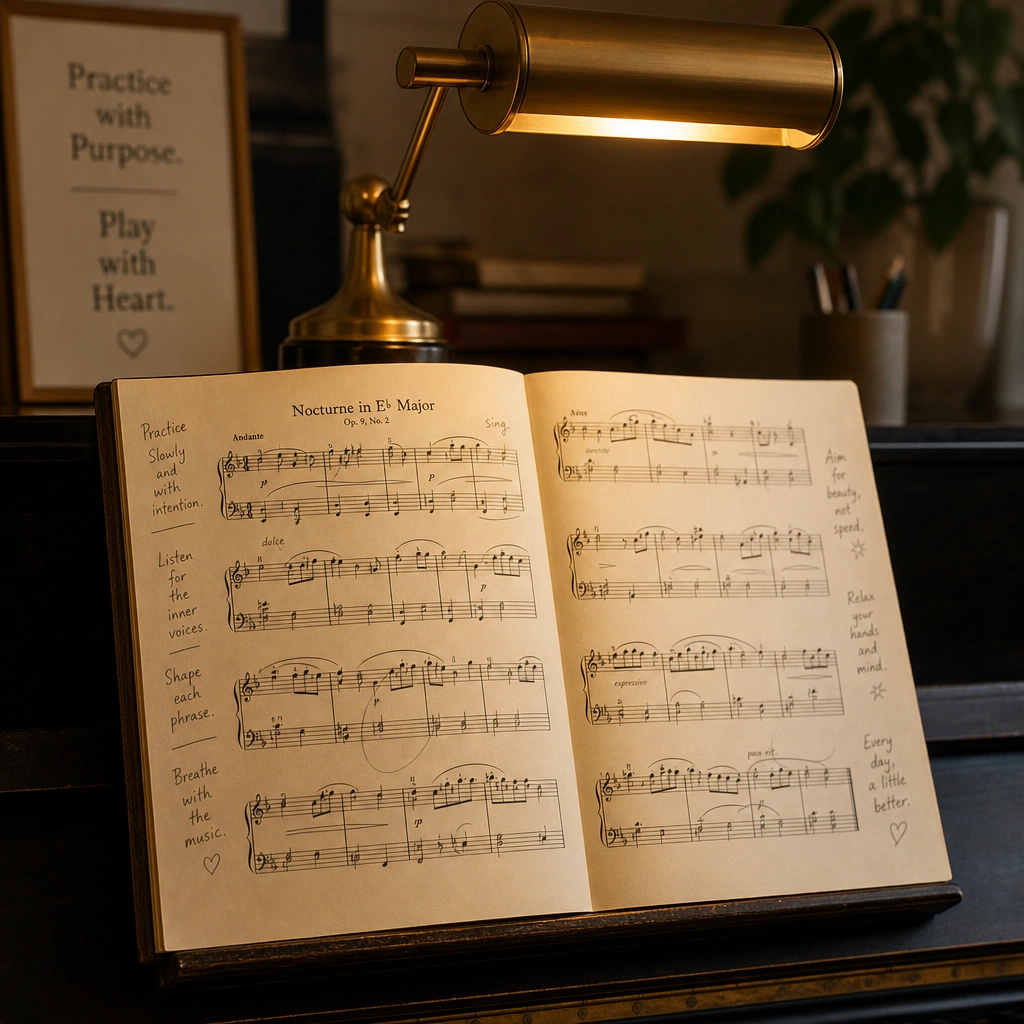
    Piano sheet music with practice notes emphasizing quality focused practice

    Signs of Quality Practice

    • You’re working slowly enough to play correctly
    • You’re noticing and correcting mistakes, not just repeating them
    • You’re focusing on your hand position and posture
    • You’re practicing with intention, not just running through motions
    • You’re following your teacher’s specific instructions

    Signs of Low-Quality Practice

    • You’re playing too fast and making the same mistakes repeatedly
    • You’re multitasking (TV on, half-focused)
    • You’re tensing up—shoulders hunched, wrists locked
    • You’re frustrated but not changing your approach
    • You can’t remember what your teacher asked you to work on

    One quality 20-minute session is worth three unfocused 20-minute sessions. That’s why the answer to how often should a beginner practice piano must always include the caveat: with focus and intention.

    The Role of Mindfulness

    Piano practice can be meditative when done right. You’re fully present, listening carefully, feeling the keys, noticing every detail. Many of my adult students discover that piano practice becomes their daily mindfulness anchor.

    If you’re interested in this aspect, I’ve written about using piano for stress relief. When you understand how often should a beginner practice piano and combine it with mindful practice, the results can be transformative both musically and personally.

    Common Mistakes Beginners Make

    With 10+ years of experience, I’ve seen the same practice mistakes repeatedly. Let me help you avoid them so you can truly benefit from knowing how often should a beginner practice piano.

    Mistake 1: The Weekend Warrior Approach

    Some beginners practice zero minutes Monday through Friday, then try to “make up for it” with a two-hour Saturday session. This doesn’t work. By Saturday, you’ve lost most of what you practiced the previous weekend. You’re essentially starting over each week.

    When students ask me how often should a beginner practice piano, I’m explicit: distributed practice is non-negotiable for effective learning. If you can truly only practice on weekends, piano might not be the right hobby right now—and that’s okay.

    Mistake 2: Practicing Without a Plan

    Sitting down and noodling around isn’t practice. Real practice is directed work toward specific goals. Before each session, you should know: “Today I’m working on measures 9-12 of this piece and getting the left-hand rhythm steady.”

    I send my students home from each lesson (whether that’s a $99 sixty-minute session in my studio or online) with written practice instructions. If you’re teaching yourself, write your own. Knowing how often should a beginner practice piano is meaningless without knowing what to practice.

    Mistake 3: Never Taking a Day Off

    Some overachievers practice all seven days, every single week, and wonder why they’re burned out after three months. Rest matters. Your brain consolidates learning during rest. Taking one day off per week isn’t slacking—it’s strategic.

    I recommend six days maximum for beginners, with that seventh day completely piano-free. This prevents mental and physical burnout and keeps the joy alive.

    Mistake 4: Comparing Yourself to Others

    Your practice schedule should fit your life. If your friend practices 45 minutes daily and you practice 20, that doesn’t make you less dedicated. Comparison is the thief of joy—and it’s a major reason why students quit piano.

    The question of how often should a beginner practice piano has a different answer for different people. The right answer is whatever you can sustain long-term while continuing to enjoy the process.

    Adjusting Your Schedule as You Progress

    The practice schedule that works for your first three months won’t be the same one you need after a year. As you advance, your needs change. Understanding how often should a beginner practice piano means also understanding how those needs evolve.

    Months 1-3: Building the Habit

    In the early months, how often should a beginner practice piano is primarily about habit formation. You’re training yourself to sit at the piano regularly. Even 15 minutes daily is a win if you do it consistently.

    Focus on making practice a non-negotiable part of your routine, like brushing your teeth. I encourage new students to practice at the same time each day—mornings before work, lunch breaks, or evenings after dinner. Routine reduces friction.

    Months 4-6: Increasing Duration

    Once daily practice feels automatic, you can gradually extend session length. If you started at 15 minutes, try 20. If you started at 20, try 25-30. Your hands are adapting, your focus is improving, and you probably have more material to work on.

    This is also when some students start exploring different styles or working on pieces that genuinely excite them. That intrinsic motivation makes longer practice sessions feel less like work.

    Months 7-12: Deepening Practice

    By now, you’re no longer a true beginner. You might naturally want to practice longer because you’re engaged with more complex pieces. Thirty to forty minutes might start feeling normal. That’s great—just keep one day off per week.

    For adult learners wondering about this progression, I cover realistic timelines in my article on how long it takes to learn piano as an adult.

    When You Hit a Plateau

    Everyone hits plateaus. You’ll practice the same amount with seemingly no progress for a few weeks. This is normal. Your brain is consolidating complex learning under the surface.

    Don’t increase practice time dramatically in frustration—that rarely helps. Instead, evaluate practice quality. Are you working slowly and deliberately? Are you isolating problem areas? Sometimes a conversation with your teacher is the best remedy. This is exactly the kind of thing we troubleshoot together in lessons.

    When Life Gets in the Way

    Real talk: some weeks, life explodes. Work deadlines, family emergencies, illness, travel. You’re not going to practice five days that week. What do you do? How often should a beginner practice piano when normal routines fall apart?

    The Two-Day Rule

    I teach all my students the two-day rule: never let more than two days pass without touching the piano. If you miss Monday and Tuesday, you absolutely practice on Wednesday, even if it’s just 10 minutes.

    Why? Because three days becomes four, four becomes a week, and a week becomes “I guess I don’t play piano anymore.” The two-day rule keeps you connected to the instrument even during chaos.

    The 5-Minute Emergency Session

    On truly insane days, practice for just five minutes. Play one scale and one piece you already know. That’s it. It keeps the habit alive and your hands somewhat warm. It counts.

    When thinking about how often should a beginner practice piano, remember that consistency across months and years matters more than perfection in any given week.

    Bouncing Back After a Break

    If you miss a full week (it happens), don’t try to cram extra practice the following week to “catch up.” Just resume your normal schedule. You might be a bit rusty for a few days, but you’ll bounce back quickly if the break was short-term.

    If the break extends beyond three weeks, you’ve lost some progress. Be patient with yourself. Review easier material for a few sessions before tackling where you left off.

    Scheduling Practice Like an Appointment

    The students who succeed are those who treat practice like any other important appointment. It goes on the calendar. If someone asks, “Can you meet Tuesday at 6:30?” and that’s your practice time, the answer is, “No, I have a commitment then.”

    This isn’t selfishness—it’s self-respect. Your musical development matters. Protect that time. This mindset is essential for anyone serious about answering how often should a beginner practice piano with consistent action.

    Making It Stick: Long-Term Success

    So, how often should a beginner practice piano for long-term success? The answer is consistent, sustainable practice that fits your life—not someone else’s ideal.

    Here’s what I’ve observed in hundreds of students: the ones still playing five years later aren’t necessarily the ones who practiced the most in month one. They’re the ones who found a sustainable rhythm and stuck with it.

    They’re the ones who gave themselves grace during hard weeks and showed up again when life calmed down. Piano is a lifetime pursuit. There’s no finish line where you “complete” piano and move on. It’s a practice in the truest sense—something you return to, again and again, that grows with you.

    The Joy Factor

    Finally, I’ll share something I tell every new student: if you’re not enjoying the process at least 80% of the time, something’s wrong. Maybe you’re practicing too much and burning out. Maybe you’re practicing too little and feeling frustrated by lack of progress. Maybe your practice approach needs adjustment.

    Piano should be challenging, yes. It should require focus and effort, absolutely. But it should also bring you joy, satisfaction, and moments of genuine beauty. If it doesn’t, let’s figure out why.

    Working with a Teacher

    One of the best ways to answer how often should a beginner practice piano for your specific situation is to work with a teacher who knows you. I adjust practice recommendations constantly based on what I see in lessons—how someone’s hands are developing, how they’re managing the workload, whether they’re frustrated or flourishing.

    Whether you work with me (live lessons over Zoom) or another teacher, that personalized feedback is invaluable. We can spot issues you can’t see yourself and adjust your practice plan in real-time.

    If you’ve never experienced professional piano instruction, I encourage you to learn what to expect in your first piano lesson and consider trying it. The difference between self-teaching and working with an experienced guide is profound.

    Recommended Resources

    For more structured guidance, consider exploring comprehensive approaches to learning. Research from music education consistently shows that beginners benefit from systematic instruction combined with regular practice habits.

    The National Association for Music Education has published studies indicating that students who maintain consistent practice schedules, even brief ones, show significantly better retention and progress than those with irregular patterns. You can explore more about the science of music learning through academic resources on motor learning and skill acquisition.

    These research-based insights confirm what experienced teachers observe: how often should a beginner practice piano is answered not by arbitrary rules, but by understanding how the brain actually learns complex motor skills.

    Your Personal Practice Philosophy

    Ultimately, you need to develop your own practice philosophy—one that honors your goals, your schedule, and your well-being. For some people, piano is a serious pursuit and they’ll happily dedicate 45 minutes daily. For others, it’s a joyful hobby worth 20 minutes most days. Both are valid.

    The question of how often should a beginner practice piano isn’t about judgment or comparison. It’s about finding what works for you and committing to it fully, whatever that looks like.

    Moving Forward

    If you take nothing else from this article, remember these three things:

    • Frequency matters most: 20 minutes six times a week beats 90 minutes twice a week
    • Consistency beats intensity: Sustainable practice wins long-term
    • Quality over quantity: Focused, intentional practice is what actually builds skill

    Start where you are. If you can commit to 15 minutes five days a week, start there. As it becomes habit, you can extend and expand. The important thing is to start—and to keep showing up.

    My 10+ years of experience at the piano have shown me that success isn’t about talent or massive time investment. It’s about showing up consistently, practicing intelligently, and staying patient with yourself. Every single student I’ve seen succeed has followed this path.

    Now you know the answer to how often should a beginner practice piano: 5-6 days per week, 20-30 minutes per session, with focused intention and sustainable commitment. This isn’t just theory—it’s proven practice wisdom from years of watching students transform from absolute beginners into confident players.

    The question isn’t really how often should a beginner practice piano in some abstract sense. The question is: how often will you practice? Because your answer to that question, followed by consistent action, will determine your entire piano journey.

    You can do this. The path is clear, the schedule is reasonable, and the rewards are immeasurable. Start today, practice tomorrow, and keep going. That’s how pianists are made—one consistent practice session at a time.

    Ready to find out for yourself?

    Your first lesson with me is a full 60 minutes for just $29 (normally $99). We will evaluate where you are, talk through your goals, and map out your path.
    Book Your First Lesson

  • Piano Practice Schedule for Adults With a Full-Time Job

    Piano Practice Schedule for Adults With a Full-Time Job

    The short answer

    A realistic piano practice schedule for adults with a full-time job is four focused 20- to 25-minute sessions a week plus one floating catch-up session, roughly 90 to 120 minutes total. Practice at the same time of day when you can, give each session one clear goal, and keep a 10-minute fallback for busy days.

    If you’d like help fitting that into your work week, that’s what a 60-minute first lesson for $29 is for: a skill check, your questions answered, and a plan with a book list. You pay only after the lesson.

    What does a weekly piano practice schedule look like for a working adult?

    A weekly piano practice schedule for a working adult should rest on four protected core sessions of 20 to 25 minutes, each with its own focus, plus one flexible 15- to 30-minute session that floats to wherever the week has room. Five-minute touchpoints on off days are optional but keep your hands familiar with the keys.

    Here’s the piano practice schedule for adults I give most of my students. Swap the days to fit your calendar.

    Day Session Length Focus
    Monday Core 1 20–25 min Technique: scales, arpeggios, hand-independence drills
    Tuesday Off or touchpoint 0–10 min Play a piece you already know
    Wednesday Core 2 20–25 min New material: learn the next few measures
    Thursday Flex 15–30 min Make up a missed session, or go longer if you have energy
    Friday Core 3 20–25 min Problem-solving: loop the hardest passages slowly
    Saturday Off or touchpoint 0–10 min Improvise or sight-read something easy
    Sunday Core 4 20–25 min Performance: play pieces all the way through

    The flex session is your insurance policy: when a work crisis eats Wednesday, Thursday’s flex slot covers it. Across the week, aim for roughly 70 percent of your time on pieces at your level, 20 percent on easier pieces you’ve already learned, and 10 percent on something that stretches you.

    Why four short sessions instead of one long one? Skills settle in between sessions, not only during them. Researchers at the National Institutes of Health reported in 2019 that people learning a new sequence of keystrokes made most of their gains during short rest breaks. Spacing practice out, known as the spacing effect, gives your brain more of those windows than one Saturday marathon.

    Brand new to piano? I cover the first few months in how often a beginner should practice piano.

    Weekly planner showing structured piano practice schedule for adults

    How should you use 25, 15 or 10 minutes at the piano?

    A 25-minute piano session should spend about 10 minutes slowly looping the hardest passages in your current piece, with short blocks of warm-up, technique and review around that core. On tighter days, cut the warm-up and review first at 15 minutes, and at 10 minutes pick one specific goal and work on nothing else.

    For a full session after work, this is the split I recommend:

    Minutes What to do
    1–3 Warm-up: a scale, arpeggio or finger exercise
    4–8 Technical work tied to your current piece
    9–18 Loop the hardest 2–4 measures of your repertoire slowly
    19–22 Play through easier or review material
    23–25 Sight-reading or exploring, if time allows

    The step-by-step version of a single session lives in my guide on how to practice piano effectively. Here’s what to cut when your workday shrinks the window.

    When you only have 15 minutes

    1. Problem measures in your current piece, the ones you can’t play smoothly yet
    2. New material you’re actively learning
    3. Technical exercises that support those pieces
    4. Everything else: warm-ups, sight-reading and easy review go first

    When you only have 10 minutes

    Use a one-goal session. Decide the goal before you sit down, and stop when the timer does:

    • “Get measures 9–12 smooth at half tempo.”
    • “Memorize the right-hand melody of the B section.”
    • “Drill the chord change in measure 16.”

    Whatever the length, play new passages at 50 to 70 percent of full tempo, and speed up only after five clean repetitions in a row. Rushing to feel productive when time is short is exactly backward.

    Practice timer and sheet music on a piano marking a focused piano practice schedule for adults

    What is the best time of day to practice piano with a full-time job?

    The best time of day to practice piano with a full-time job is whenever you are reliably alert and uninterrupted, which for many working adults means early morning before work. Practicing at the same point in your day matters more than the exact hour, because a fixed slot turns practice into a habit instead of a daily decision.

    The windows that tend to work:

    • Early morning, before work. Nothing has derailed your day yet.
    • Lunch break, if you work from home.
    • Before dinner, as a buffer between work and home.
    • After the kids’ bedtime, if you still have focus left.
    • Weekend mornings, when your mind is fresh for new material.

    Not sure which is yours? Track your energy for one week. Fifteen minutes when you’re alert beats 45 minutes when you’re drained after a long day.

    Early mornings in a shared home usually mean a digital piano and headphones. My guide to practicing piano in an apartment covers how to do that without waking anyone.

    What do practice schedules look like for office workers, parents and shift workers?

    Practice schedules for working adults differ by job, but each successful one protects a few predictable windows: an office worker practicing before work plus weekends, a parent using 5:30 AM before the kids wake, or a shift worker planning four 20-minute sessions every Sunday. All three land between 60 and 100 minutes a week.

    These are adapted from real schedules of adult students I’ve worked with.

    Who When they practice Weekly total What makes it work
    Office worker, 9 to 6 with a 45-minute commute Tue and Thu 6:45–7:05 AM; Sat 9:00–9:30 AM; Sun 7:30–7:55 PM; flex on a Wed or Fri lunch when working from home 75–100 min Everything set up the night before: book open to the right page, coffee on a timer
    Parent of two kids under seven Mon, Wed, Fri 5:30–5:50 AM; 15–20 min during Saturday nap time; optional 5–10 min after bedtime 60–90 min Headphones, so early practice doesn’t wake the house
    Nurse on rotating shifts Four 20-minute sessions planned each Sunday around the week’s shifts: afternoons after day shifts, or before leaving on night-shift weeks 80 min A weekly target instead of fixed time slots

    The office worker removed every decision from her early mornings and kept that schedule for two years. The parent accepts that some weeks land at the low end of his range. The nurse’s schedule changes every week, but her total doesn’t. You don’t need a routine schedule, just a routine commitment.

    If you work full time and can’t see where piano fits in your week, we can map out a realistic schedule together in one conversation. Your first lesson with Austin is a full 60 minutes for just $29 (normally $99). Love it, or it’s on us.

    Book your first lesson →

    How do you practice piano with a busy schedule?

    Practicing piano with a busy schedule works best when you shrink sessions instead of skipping them, keeping a 10-minute minimum on hectic days and adding five-minute touchpoints or commute-time mental practice around them. Ten focused minutes on a bad day keeps the habit alive, while skipping entirely makes the next session harder to start.

    These are the patterns I see fail most often with working adults:

    • The daily two-hour plan. It lasts about three days before work intervenes.
    • The weekend warrior. One Saturday cram gives your hands one round of reinforcement a week instead of four.
    • All or nothing. If you can’t do a “full” session, you skip it, and guilt does the rest.

    Early in my teaching, I assigned adults practice plans that looked great on paper and fell apart in real life. The students who stuck with piano were doing something much simpler that matched the energy they actually had after work.

    Tools for busy days

    • Touchpoints (5–10 minutes): run through a piece you know, improvise, or play one hard measure.
    • Mental practice: visualize fingerings, hum the melody, or listen to a recording of your piece on the commute.
    • Double-duty technique: if your piece has Alberti bass or octave jumps, make that pattern your warm-up.

    Mental practice is a real supplement, not a replacement. In a well-known 1995 study led by neurologist Alvaro Pascual-Leone, people who only imagined practicing a five-finger piano exercise showed brain changes similar to those who physically played it, though actually playing still improved performance more.

    What should you do when work derails your practice for a week or more?

    When work derails your piano practice for a week or more, return with shorter, easier sessions rather than long make-up sessions: 10 to 15 minutes of music you already know, rebuilding to full length over three or four practices. Muscle memory is more resilient than it feels, and most skills come back within a week or two.

    The comeback plan

    • Start with 10–15 minutes of easy pieces you already know
    • Rebuild to your full session length over 3–4 practices
    • Lower your expectations for hard passages for a few days
    • Rebuild the habit before you worry about progress

    Maintenance mode for busy seasons

    For heavier stretches, like a job change, a move or a yearly crunch at work, switch to maintenance mode:

    • At least two 15-minute sessions per week
    • Only pieces you already know
    • No new material, and no guilt about it
    • The goal is staying connected to the piano, not making progress

    One student kept twice-a-week maintenance sessions through the birth of her first child. She learned nothing new for six months, then was back to full learning capacity within a month of refocusing.

    If your busy season is predictable, say November through January, plan maintenance mode for it in advance and go deeper during quieter months.

    How do you make a practice schedule actually stick?

    A piano practice schedule for adults sticks when sitting down at the piano is the easiest option at your chosen time, so keep the instrument where you walk past it, leave the music open, and set up the night before. A 30-second practice log and a monthly five-minute review show you which slots work and which to move.

    Remove the friction

    • Keep your piano or keyboard in a room you pass through, not a spare room
    • Leave your music open to the right page, with a pencil nearby and headphones plugged in
    • Put each core session in your calendar like a meeting

    Track lightly

    After each session, log the date and length, what you worked on, and one sentence on how it went. Once a month, check which slot keeps getting skipped. If Sunday evening never happens, move it instead of blaming yourself.

    Every 4 to 6 weeks, record your pieces on your phone. Listening back months later reveals progress your day-to-day ear misses, which is exactly what you need during a plateau.

    Leather practice journal, pencil and coffee beside a piano for tracking a piano practice schedule for adults

    Leave room for play, and get some accountability

    Let some sessions be pure play, with no metronome and no agenda. They remind you why you started. A weekly lesson also helps: it gives your schedule a deadline and gives you someone to adjust the plan when your work life changes.

    “My confidence at the piano has grown so much since starting lessons.” – Mia Reynolds

    Lessons with me are live and one-on-one over Zoom. Start with a 60-minute first lesson for $29, or start on your own today: put four 20-minute windows in this week’s calendar and show up for them.

    Common questions

    How many minutes a day should an adult practice piano?

    Most adults should practice piano 15 to 30 minutes a day, four or five days a week. Twenty focused minutes is a strong default for a beginner with a full-time job. If you have more time on a given day, two shorter sessions usually work better than one long session when you’re already tired.

    Is 20 minutes of piano practice a day enough?

    Yes, 20 minutes of focused piano practice a day is enough for steady progress, especially for beginners and early intermediate players. The key word is focused: 20 minutes with one clear goal beats an hour of playing songs from the top. Practicing four or five days a week matters more than the exact minutes.

    Can I do all my piano practice on the weekend?

    Weekend-only piano practice works poorly compared with spreading the same minutes across the week. One long Saturday session gives your hands a single round of reinforcement and six days to forget. If weekends are truly your only option, split practice into Saturday and Sunday sessions and add short weekday touchpoints when you can.

    Does mental practice away from the piano count?

    Mental practice counts as a supplement to piano practice, not a substitute for it. Visualizing fingerings, humming melodies and listening to recordings of your pieces during a commute help you arrive at the keyboard with a clearer plan. Keep at least three or four real sessions at the piano each week alongside it.

    Should I take planned weeks off from piano practice?

    A planned lighter week every 6 to 8 weeks helps most working adults avoid burnout. Cut back to two or three short sessions, skip new material, and simply maintain what you’ve built. Planned rest removes the guilt of pulling back, and your brain keeps consolidating what you learned in the weeks before.

    How long does it take a working adult to learn piano?

    A working adult practicing 15 to 30 minutes, four or five days a week, typically plays recognizable songs within 3 to 6 months and reaches intermediate pieces within 1 to 2 years with a teacher or structured curriculum. Consistency affects that timeline more than talent. I go deeper in how long it takes to learn piano as an adult.

    Want a practice schedule that fits your work week?

    Your first lesson with me is a full 60 minutes for just $29 (normally $99). We will look at where you are, talk through your schedule and goals, and map out a plan you can actually keep.

    Book Your First Lesson