
If you’re thinking about getting back into piano as an adult after years away from the instrument, you’re not alone. I’ve worked with dozens of returning pianists, and almost every single one shares the same mix of excitement and anxiety about starting again.
The truth is, getting back into piano as an adult is different from learning as a child. Your brain works differently now. Your time is more limited. But you also have patience, self-awareness, and genuine motivation that most children lack—and those advantages make all the difference.
This guide will walk you through exactly how to return to piano in a way that’s realistic, enjoyable, and sustainable. These aren’t theoretical tips; they’re the same strategies I use with my returning students, many of whom haven’t touched a piano in ten, twenty, or even thirty years.
The short answer
Getting back into piano as an adult requires three things: honest assessment of where you are now (not where you were), patient rebuilding of fundamentals through simple exercises, and a sustainable practice schedule of 15-30 minutes most days. Start easier than you think you should, focus on technique over repertoire for the first month, and consider lessons to avoid relearning bad habits.
Why adults return to piano after years away
Before we dive into the how, it’s worth acknowledging the why. Understanding your motivation helps you stay committed when progress feels slow.
Most of my returning students fall into one of these categories:
- Life finally has space for music again after years of career-building or raising children
- A desire for creative expression that work and daily responsibilities don’t provide
- Recognition that piano offers genuine stress relief and mental health benefits
- Regret over quitting as a child and wanting to reclaim something lost
- Watching their own children learn and feeling inspired to join them
- Simply missing the feeling of playing music
Whatever your reason, hold onto it. Getting back into piano as an adult will have frustrating moments, and your “why” will carry you through them.
Set realistic expectations for getting back into piano as an adult
Here’s what I tell every returning student on day one: you will not pick up where you left off. And that’s completely okay.
Your muscle memory has faded. Your sight-reading speed has dropped. Pieces that felt comfortable ten years ago will feel challenging now. This isn’t failure—it’s biology. Motor skills atrophy without use, especially the fine motor control that piano requires.
The good news? Skills come back faster the second time around. Your brain already has neural pathways for reading music, understanding rhythm, and coordinating your hands. You’re not starting from zero; you’re dusting off and rebuilding.
Timeline expectations
Most returning players see noticeable progress within 4-6 weeks of consistent practice. Within 3-4 months, you’ll likely surpass what you remember being able to do comfortably. By six months, many of my students are playing pieces they never would have attempted during their first go-round.
The key word is consistent. Practicing 20 minutes five days a week will get you much further than practicing two hours on Saturday. Adult brains consolidate motor learning during sleep, so regular practice across multiple days beats cramming every time.
Understanding the neuroscience
Your adult brain has advantages your childhood brain didn’t. You understand abstract concepts better. You can identify patterns more quickly. You have metacognitive awareness—meaning you can think about your own thinking and adjust your approach when something isn’t working.
These cognitive strengths compensate for the slower motor learning that comes with age. Where a child might mindlessly repeat passages, you can strategically problem-solve technical challenges. This makes getting back into piano as an adult not just possible, but potentially more efficient than your original learning experience.
Assess where you actually are today
One of the biggest mistakes I see when adults start getting back into piano as an adult is overestimating their current level. I understand the impulse—you remember playing intermediate repertoire, so you pull out a Chopin waltz. Three days later you’re frustrated and discouraged.
Do yourself a favor: start with an honest assessment. Sit down at the piano and try these diagnostics:
- Can you comfortably play a two-octave C major scale hands together at a moderate tempo?
- Can you sight-read a simple hymn or folk song without stopping?
- Can you play a basic I-IV-V-I chord progression in a major key?
- Do your fingers naturally curve, or have they forgotten proper hand position?
If you struggled with any of these, that’s your starting point. Not where you were at your peak, but where you are today. Getting back into piano as an adult means meeting yourself where you are with compassion, not judgment.
Test your reading skills
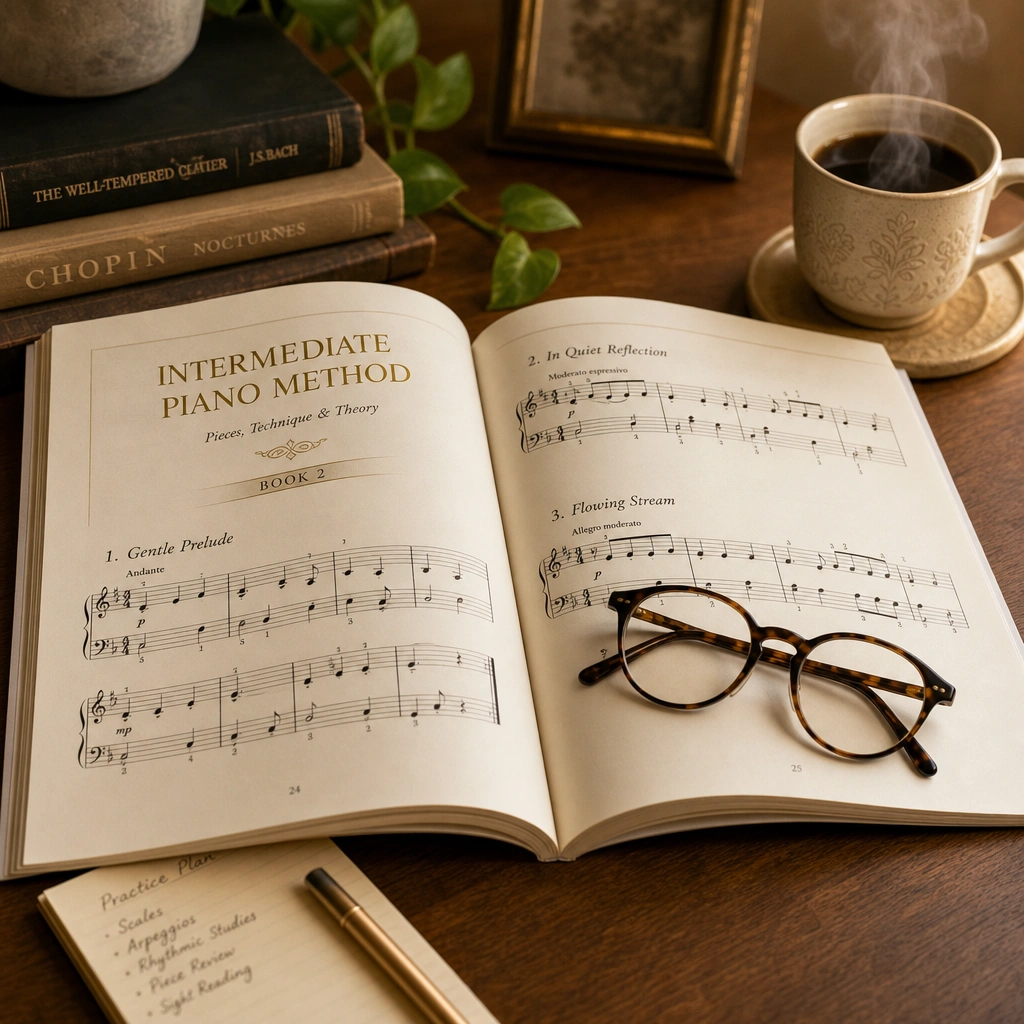
Pull out an easy method book—something rated early intermediate or even late beginner. Can you play through a page at tempo on first read? If not, your sight-reading needs work before you tackle more complex repertoire.
This isn’t discouraging news. It’s clarifying. Once you know what needs attention, you can address it systematically instead of spinning your wheels on pieces that are currently out of reach.
Physical assessment matters too
Pay attention to any physical discomfort. Adult bodies often carry tension differently than they did years ago. Do your shoulders creep up toward your ears? Does your lower back ache after ten minutes? Are your wrists properly aligned or collapsing?
These physical habits need addressing early. Bad posture and tension not only limit your technical progress but can lead to repetitive strain injuries. Getting back into piano as an adult successfully means building healthy physical habits from day one.
Rebuild your fundamentals patiently when getting back into piano as an adult
I know fundamentals sound boring when what you really want is to play beautiful music. But here’s what I’ve observed: students who spend their first month rebuilding technique progress three times faster than those who jump straight into repertoire.
Getting back into piano as an adult with a foundation-first approach means you’re building on solid ground, not on the shaky habits of a decade ago.
Scales and arpeggios
Yes, really. Start with C major, hands separately, one octave, at a comfortable tempo. Focus on even tone, curved fingers, and smooth thumb crossings. When that feels solid, add the second octave. Then hands together. Then increase tempo gradually.
Once C major is comfortable, add G major. Then F major. Work through the circle of fifths methodically. This isn’t glamorous work, but it’s rebuilding the neural pathways and muscle memory that support everything else.
Aim for 5-10 minutes of scales and arpeggios at the start of each practice session. Use a metronome (here’s how if you need a refresher) and increase tempo by only 2-4 bpm per week.
Hand independence exercises
Your hands have forgotten how to do different things simultaneously. Rebuild this with simple exercises: right hand plays quarter notes while left hand plays half notes. Then swap. Then try different rhythms, different intervals, different patterns.
If you’re looking for structured exercises, left hand exercises can help strengthen your weaker hand independently before coordinating both hands together.
Hanon and finger exercises
Hanon exercises get mixed reviews in the piano world, but for returning players, they’re genuinely useful. They’re repetitive patterns that rebuild finger independence and strength without requiring you to focus on reading complex music.
Start with exercises 1-5. Play them slowly, focusing on evenness of tone and lifting each finger deliberately. This is physical therapy for your hands, not performance preparation.
Don’t neglect music theory review
While you’re rebuilding physical skills, refresh your theory knowledge. Can you identify intervals by sight? Do you remember key signatures? Can you recognize common chord progressions?
Theory knowledge accelerates everything else. When you understand what you’re playing structurally, you learn faster and remember better. Spend 5-10 minutes a few times per week reviewing theory concepts. There are excellent free resources online, or consider a review book designed for returning students.
Learning this goes faster with a teacher watching your hands. Your first 30-minute lesson with Austin is free — no card, no pressure.
Create a sustainable practice routine
Adult life is busy. You’re not going to practice two hours a day, and you don’t need to. What you need is consistency over intensity.
When someone asks me about getting back into piano as an adult, my standard recommendation is 15-30 minutes, five to six days per week. That’s enough for steady progress without burning out. (Here’s more on practice frequency if you’re curious about the research behind this.)
Structure your practice session
A typical 30-minute session might look like this:
- 5 minutes: Scales and arpeggios
- 5 minutes: Technical exercises (Hanon or similar)
- 15 minutes: Repertoire work on 1-2 pieces
- 5 minutes: Sight-reading something new
If you only have 15 minutes, cut each segment in half. The proportions matter more than the duration. You’re balancing technique, repertoire, and reading skills so all three develop together.
Find your practice time
Morning practice before work tends to stick better than “whenever I have time” practice. Life will always fill available time with something urgent. Treat practice like a recurring appointment.
If noise is an issue, consider practicing on a digital piano with headphones. If you’re shopping for an instrument, understanding weighted versus unweighted keys will help you make the right choice for serious practice.
Practice techniques that maximize your limited time
As an adult getting back into piano as an adult, you need efficient practice strategies. Don’t just play through pieces start to finish repeatedly. That’s not practice—that’s performance.
Real practice isolates problem spots. Identify the two or three measures that trip you up, then work those in isolation. Slow them down to half tempo. Practice hands separately. Vary the rhythm. Work backward from the last measure of the difficult passage.
These focused techniques accomplish in 20 minutes what mindless repetition can’t achieve in an hour.
Track your practice
Keep a simple log—date, duration, what you worked on, and one thing that went well. This creates accountability and helps you see patterns. Maybe you’re consistently avoiding technique work. Maybe you practice less on Wednesdays. These insights let you adjust your approach strategically.
Choose the right pieces for your level
This is where ego and practicality collide. You want to play Clair de Lune. I’m going to suggest you start with Burgmüller.
Getting back into piano as an adult means choosing repertoire that’s achievable within a reasonable timeframe—say, 2-4 weeks for a piece. If you’re still struggling after a month, the piece is too hard for your current level, no matter what you could play in high school.
Where to find appropriate repertoire
Look for anthologies labeled “easy classics” or “intermediate favorites.” Collections from publishers like Alfred, Faber, or Hal Leonard often include graded compilations that work well for returning players.
Start one level below where you think you should. If you breeze through a piece in a week, great—bump up the difficulty next time. But most returning students find they need to spend time at easier levels rebuilding fluency before tackling the repertoire they remember.
Learning how to play by ear can also supplement your repertoire work and make practice feel more creative and less like a chore.
Popular pieces for returning adults
These pieces hit the sweet spot of musically satisfying without being technically overwhelming for someone getting back into piano as an adult:
- Burgmüller’s “Arabesque” or “Ballade”
- Bach’s “Minuet in G Major”
- Beethoven’s “Für Elise” (the A section, at least)
- Chopin’s Prelude in E Minor (Op. 28, No. 4)
- Yiruma’s “River Flows in You”
- Comptine d’un autre été (from Amélie)
Notice these pieces have recognizable melodies and emotional depth despite being technically accessible. That combination keeps you motivated through the rebuilding phase.
Balance challenge and enjoyment
You need a mix in your repertoire rotation. One piece that stretches you technically, one that you can play comfortably and enjoy, and one that you’re sight-reading for fun. This variety prevents burnout and ensures you’re always making progress somewhere.
The stretching piece builds your skills. The comfortable piece maintains your confidence. The sight-reading piece develops your fluency. All three are essential to successfully getting back into piano as an adult.
Consider working with a teacher
You can absolutely teach yourself, especially if you had solid training originally. But here’s what a teacher offers that self-study doesn’t: someone to catch bad habits before they solidify, someone to troubleshoot when progress stalls, and someone to hold you accountable to your goals.
I’m biased, obviously—I make my living teaching piano. But I’ve also seen the difference between self-taught returning players and those who work with a teacher, even just for a few months. The teacher-guided students progress faster and with less frustration.
What to look for in a teacher
You need someone who works with adults and understands the unique challenges of getting back into piano as an adult. You don’t need someone who specializes in preparing children for competitions.
Ask about their experience with returning students. Ask about their teaching philosophy and how they structure lessons. And don’t be afraid to try a trial lesson before committing. (At Weaver Music, I offer a free 30-minute trial lesson specifically so we can both assess whether we’re a good fit—book yours here if you’re curious.)
In-person versus online lessons
Both can work beautifully. I teach students live over Zoom, wherever they are. Online lessons require decent internet and a camera angle that lets your teacher see your hands and posture, but they eliminate commute time and open up teacher options beyond your immediate geography.
If you’ve never taken an online lesson, here’s what to expect in a first lesson so you can prepare your space appropriately.
Alternatives to private lessons
If budget or schedule makes private lessons difficult, lessons can bridge the gap. At Weaver Music, I’ve created a four-level lesson path that covers everything from absolute basics to intermediate repertoire. (Explore the courses here.) It’s not the same as personalized feedback, but it provides structure and guidance when self-teaching.
YouTube can also be valuable, but be selective. Look for channels run by actual teachers with credentials, not just enthusiastic amateurs. Quality matters when you’re rebuilding technique.
The value of short-term instruction
Even if you don’t want ongoing weekly lessons, consider working with a teacher for just a few months while getting back into piano as an adult. Those initial sessions can set you on the right path, correct problematic habits, and give you a roadmap for independent practice.
Many teachers offer package deals or monthly commitments rather than year-long contracts. This flexibility works well for adults who want expert guidance without long-term obligation.
Celebrate your progress along the way
Adult learners are terrible at celebrating wins. You’ll master a scale pattern, then immediately focus on what you still can’t do. I see this constantly.
Getting back into piano as an adult requires cultivating self-compassion and actually noticing progress. Keep a practice journal. Record yourself playing the same piece once a week—you’ll be amazed at the improvement that’s invisible day-to-day but obvious over a month.
Dealing with frustration
There will be days when your hands won’t cooperate, when your brain can’t decode the notes, when you feel like you’re moving backward. This is normal. Motor learning isn’t linear. You plateau, then jump forward, then plateau again.
On frustrating days, return to something you’ve already mastered. Play that C major scale beautifully. Revisit a piece from two months ago that felt hard then but feels easy now. Remind yourself that progress is happening even when it’s not obvious.
If you’re also dealing with nerves about performing or playing for others (even just family), strategies for managing performance anxiety can help. Many returning players feel vulnerable sharing their renewed hobby, and that’s worth addressing.
Avoiding burnout
One reason people abandon piano the first time is burnout—pressure, joyless practice, focus on perfection over expression. Don’t repeat that pattern.
Make sure some of your practice time is purely for enjoyment. Play carols in December even if they’re technically beneath you. Mess around with improvisation. Learn the theme song from a TV show you love. Piano should fit into your life as a source of joy, not another obligation on an endless to-do list.
Understanding why students quit piano can help you structure your return in a way that avoids common pitfalls and keeps you engaged for the long term.
Joining a community
Isolation makes it easy to quit. Connection makes it easier to persist. Look for adult piano groups in your area, online forums for returning players, or regular jam sessions where people share what they’re working on.
Many of my students connect with each other through group classes or informal recitals. There’s something powerful about realizing you’re not the only person struggling to relearn something you used to know.
According to research from the American Psychological Association, adult music learners who engage with communities of fellow learners show significantly higher persistence rates and report greater satisfaction with their progress.
The long view
Getting back into piano as an adult isn’t a sprint to recover lost skills. It’s a lifelong practice that will grow and change with you. Some seasons you’ll practice daily and make rapid progress. Other seasons you’ll maintain with 15 minutes three times a week. Both are valid.
The goal isn’t to become a concert pianist. The goal is to integrate music back into your life in a sustainable, meaningful way. That might mean playing for ten minutes before bed to decompress. It might mean working toward a single dream piece over a year. It might mean playing hymns at church or accompanying your kid’s school musical.
There’s no single correct version of what getting back into piano as an adult should look like. The only version that matters is the one that fits your life and brings you joy.
When to push and when to ease up
Learning to read your own energy and motivation is crucial. Some days you need to push through resistance because you know you’ll feel better after practicing. Other days, forcing it will only build resentment.
A good rule of thumb: if you haven’t wanted to practice for three or four days in a row, something needs to adjust. Maybe the pieces are too hard. Maybe your practice schedule is unrealistic. Maybe you need to reconnect with why you’re doing this in the first place.
Piano should be challenging, but it shouldn’t feel like punishment. Check in with yourself regularly and make adjustments as needed.
Milestone celebrations
Set concrete milestones and celebrate when you reach them. Finished your first complete piece? Treat yourself to dinner out. Mastered all major scales? Buy that music anthology you’ve been eyeing. Practiced consistently for three months? Share a video with friends.
These celebrations aren’t silly—they’re psychological reinforcement that makes long-term habit formation more likely. Getting back into piano as an adult is a significant accomplishment. Honor it.
You already have what it takes
If you’re still reading, you’re serious about getting back into piano as an adult. That commitment alone puts you ahead of most people who only think about returning but never actually sit down at the keys.
The path forward is simple, even if it’s not always easy: assess honestly, start appropriately, practice consistently, choose repertoire wisely, and be patient with yourself. You’re not trying to become who you were ten years ago. You’re becoming a new kind of pianist—one with adult discipline, genuine motivation, and the life experience to truly feel the music you play.
The piano is waiting. It doesn’t care how long you’ve been gone. It’s ready whenever you are.
Ready to find out for yourself?
Your first 30-minute lesson with me is completely free – we will evaluate where you are, talk through your goals, and map out your path.