
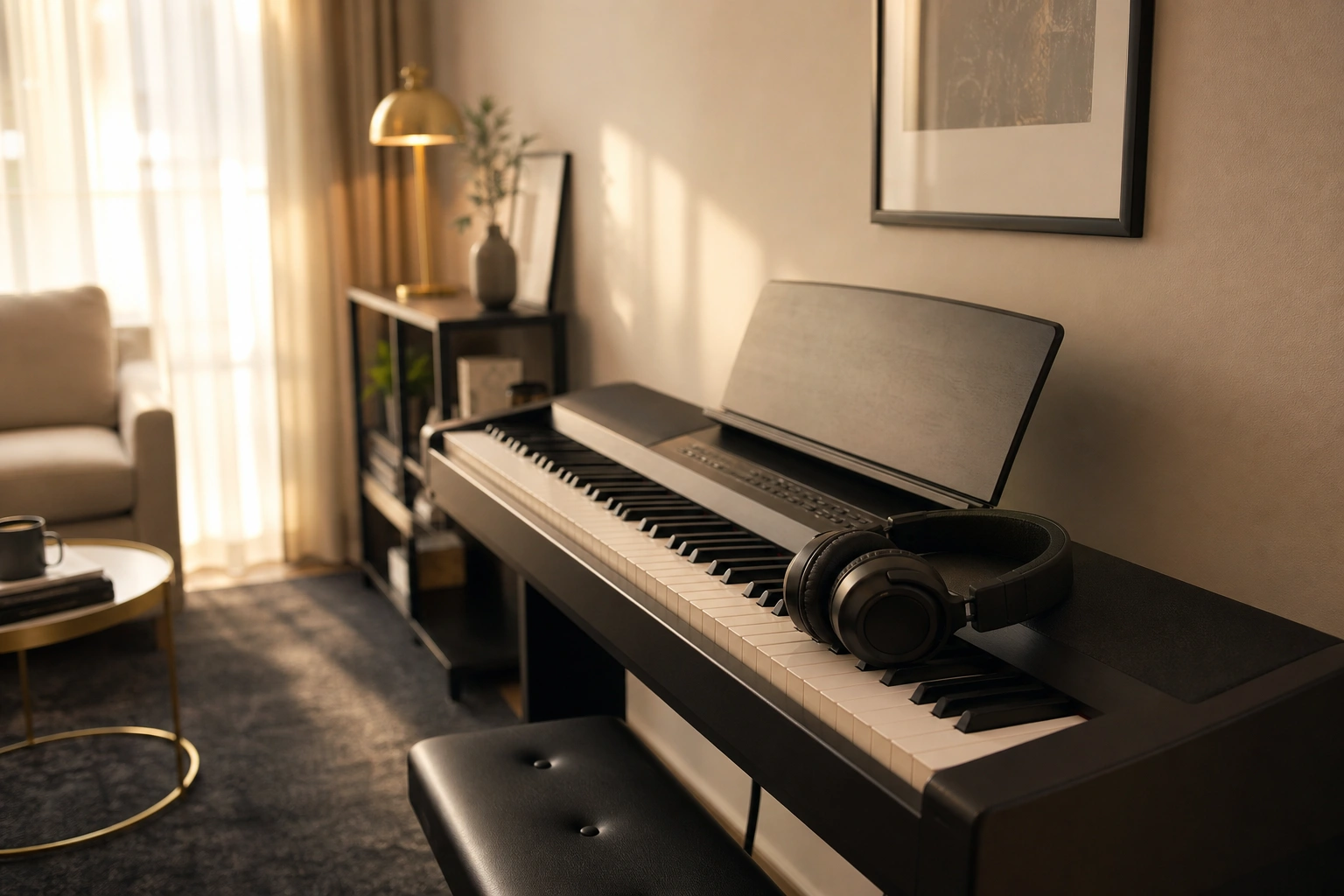
If you’re trying to practice piano in apartment settings, you’re facing a challenge that millions of urban pianists know all too well. The sound of even gentle practice can travel through walls and ceilings, creating anxiety about disturbing neighbors or family members. But you don’t have to sacrifice your musical dreams just because you live in shared housing.
I’ve worked with countless students navigating exactly this situation, and I can tell you there are real, practical solutions that work. The good news is that learning to practice piano in apartment environments doesn’t require expensive renovations or giving up on your musical goals. You can develop real skill and musicality even in the most sound-sensitive living situations.
With the right combination of equipment choices, timing strategies, and creative techniques, you can maintain a consistent, productive practice routine without constant worry. If you’re just starting out and want guidance tailored to your living situation, I offer a free 30-minute trial lesson where we can discuss what will work best for your space.
The short answer
To practice piano in apartment settings effectively, your best option is a digital piano with headphones, allowing completely silent practice at any hour. If you have an acoustic piano, a practice mute pedal can reduce volume by 80-90%.
Combine equipment solutions with strategic practice timing, basic soundproofing like rugs and wall padding, and open communication with neighbors to create a sustainable routine. When you practice piano in apartment spaces thoughtfully, you respect everyone’s peace while achieving your musical goals.
Why apartment piano practice feels impossible
The anxiety around apartment piano practice is real and legitimate. Piano is one of the louder instruments, and modern apartment construction often features minimal sound insulation. Even modest practice volumes can carry through shared walls, floors, and ceilings.
Many of my students describe the psychological burden of constantly worrying whether they’re bothering someone. This worry creates tension that actually interferes with learning—you can’t relax into technique work or expression when you’re worried about every note.
The challenge intensifies if you keep irregular hours, share walls with young families or shift workers, or live in buildings with strict quiet hours. Some students have told me they’ve avoided learning piano entirely because they assumed apartment living made it impossible.
But here’s what I’ve observed over hundreds of students: the ones who succeed aren’t necessarily those with the most space or the most tolerant neighbors. They’re the ones who approach the challenge strategically and use the right tools for their specific situation.
When you practice piano in apartment conditions with the right approach, the environment becomes manageable rather than prohibitive. The key is understanding that apartment piano practice isn’t about eliminating sound completely—it’s about managing it intelligently.
Sound management becomes easier when you understand how sound travels through buildings. Low frequencies travel through structures more readily than high frequencies, which is why bass notes often bother downstairs neighbors more than treble passages.
Sound also travels through air gaps like doors and windows, through shared ventilation systems, and through vibrations in floors and walls. Each transmission path requires different mitigation strategies, which we’ll explore throughout this guide.
Invest in a quality digital piano with headphones
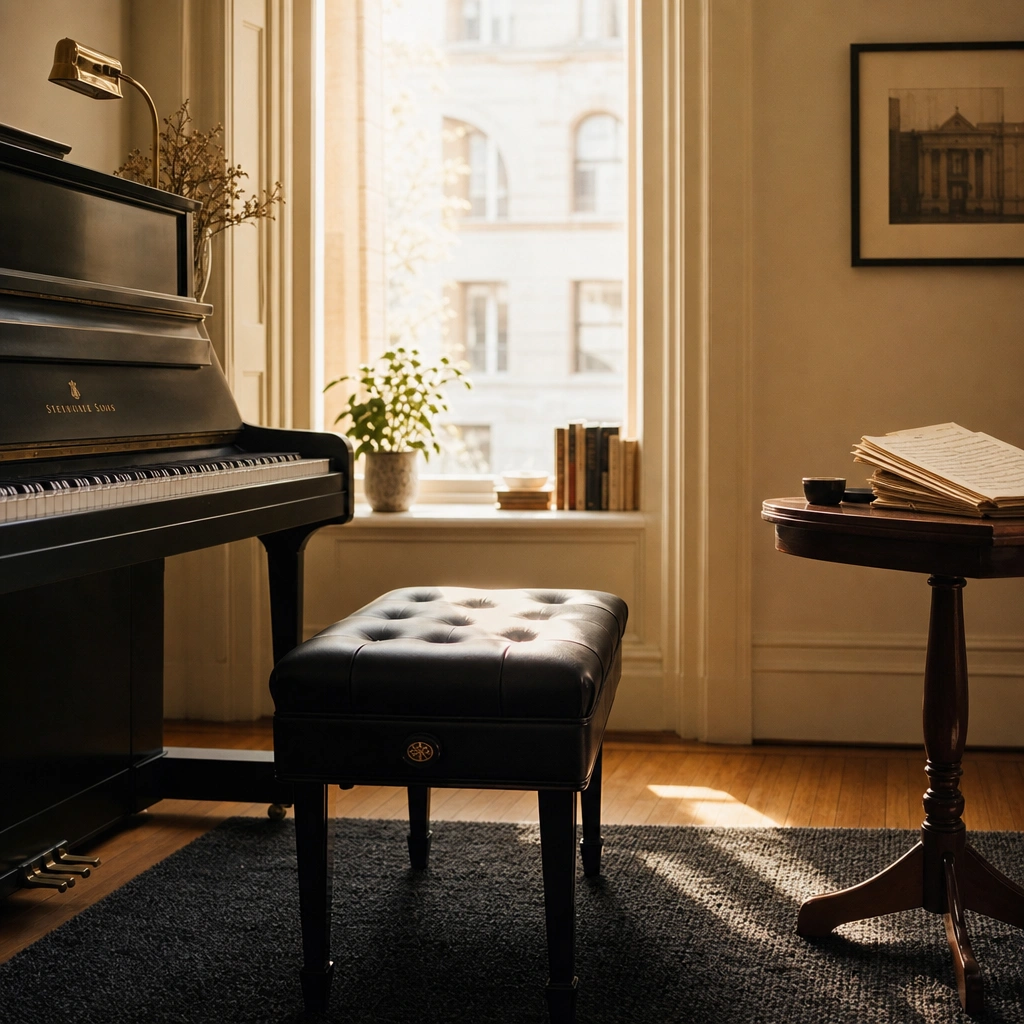
The single most effective solution to practice piano in apartment spaces is a digital piano with weighted keys and a good pair of headphones. This setup allows you to practice at any hour with zero sound leakage—something no acoustic solution can truly match.
Modern digital pianos have come remarkably far in replicating the feel and response of acoustic instruments. Look for models with fully weighted, hammer-action keys. The weight and resistance matter enormously for developing proper technique that will transfer to acoustic pianos.
When choosing a digital piano for apartment practice, prioritize:
- Fully weighted, hammer-action keys (not semi-weighted)
- At least 88 full-size keys
- A good headphone output with minimal latency
- A quiet key mechanism (some cheaper models are mechanically noisy even without speakers)
- Quality piano samples that inspire you to practice
You don’t need to spend thousands. Many excellent digital pianos in the $500-$1200 range offer everything you need to practice piano in apartment settings effectively. I’ve seen students make tremendous progress on modest digital instruments when they practice consistently.
Brands like Yamaha, Kawai, Roland, and Casio all offer reliable entry-level and mid-range models. The Yamaha P-125 and P-515, Kawai ES110 and ES520, and Roland FP-30X and FP-60X are all popular among my students who practice piano in apartment environments.
The headphone choice matters too. Closed-back headphones prevent sound from leaking out and bothering anyone nearby. They also create better isolation, helping you focus on what you’re playing.
You don’t need studio-grade monitoring headphones—comfortable, closed-back models from reputable audio brands work beautifully. Many students find that over-ear designs provide better comfort for longer practice sessions than on-ear models.
Popular headphone choices for piano practice include the Audio-Technica ATH-M40x and M50x, Sony MDR-7506, and AKG K371. These range from $80-$200 and provide excellent sound quality with the comfort needed for hour-long practice sessions.
One often-overlooked benefit of digital piano practice: the ability to record yourself easily, adjust volumes for left and right hand separately, and even layer in a metronome without external equipment. These features accelerate learning in ways that have nothing to do with apartment living.
Some modern digital pianos also include educational features like built-in lessons, the ability to slow down recordings without changing pitch, and USB connectivity for learning software. These extras aren’t essential, but they can enhance your practice when you practice piano in apartment spaces where external resources might be limited.
Recording your practice sessions and listening back through headphones provides invaluable feedback. You’ll hear mistakes and musical opportunities you miss while playing. This self-assessment accelerates improvement significantly.
The Bluetooth connectivity available on many modern digital pianos also lets you play along with backing tracks, streaming lessons, or recordings wirelessly. This integration creates a rich practice environment even in the smallest apartment spaces.
Digital piano placement tips for apartments
Even silent digital pianos benefit from thoughtful placement. Position your instrument where you have good lighting and a comfortable practice environment. Natural light helps maintain energy during practice sessions, while good artificial lighting reduces eye strain when reading music.
Consider room acoustics even when using headphones. Practicing in a pleasant-sounding space improves your experience when you occasionally practice without headphones during permitted hours.
If you live with roommates, positioning your digital piano away from bedroom walls shows consideration, even though the sound through headphones won’t disturb them. The mechanical clicking of keys can still be audible in very quiet environments.
Use practice mutes for acoustic pianos
If you already own or have access to an acoustic piano and want to practice piano in apartment conditions, a practice mute system is your best option. These systems dramatically reduce volume while preserving the acoustic piano touch you need for technique development.
There are two main types of practice mutes:
Rail-mounted practice pedals: These aftermarket systems install a felt rail between the hammers and strings, similar to what many upright pianos have built in as a middle pedal. When engaged, the felt muffles the sound by 80-90%.
Quality systems like those from Kawai or Yamaha cost $200-$600 depending on your piano model and whether you hire installation help. The reduction is substantial—a piano that would normally carry through walls becomes just audible in the same room.
You won’t achieve truly silent practice, but you can practice during reasonable hours without creating a disturbance. Many of my students who practice piano in apartment buildings find that practice mutes provide the perfect balance between acoustic feel and volume control.
Built-in silent systems: Many modern acoustic pianos come with or can be retrofitted with true silent systems. When activated, these stop the hammers from striking the strings entirely and instead use optical sensors to trigger digital samples through headphones.
You get the exact touch and action of your acoustic piano with zero acoustic sound. These systems are expensive—often $2000-$4000 for retrofit installation—but they’re transformative if you’re committed to acoustic piano and need to practice piano in apartment environments without compromise.
I have students who swear by them. The Yamaha TransAcoustic and Silent Piano systems are particularly well-regarded, as are PianoDisc’s SilentDrive systems for retrofitting existing instruments.
One important note: practice mutes and silent systems don’t eliminate the mechanical sound of the keys themselves. A practice mute will still produce some sound from the key action, loud enough that practicing at 2 AM in a quiet apartment probably isn’t advisable.
But for evening and daytime practice, they make acoustic piano genuinely viable in shared living spaces. The mechanical noise is typically comparable to typing on a keyboard—noticeable if you’re listening for it, but not disturbing through walls.
Installation of practice mute systems typically requires a piano technician, though some systems are designed for DIY installation if you’re mechanically inclined. Factor in installation costs when budgeting—professional installation typically adds $100-$300 to the system cost.
Finding the right practice setup for your apartment is much easier when a teacher understands your constraints. Your first 30-minute lesson with Austin is free – no card, no pressure.
Strategic timing matters more than you think
Even with equipment solutions in place, being strategic about when you practice piano in apartment settings shows respect for neighbors and reduces anxiety. I always encourage students to think about their practice schedule as part of their overall approach.
Most apartment buildings and rental agreements specify quiet hours, typically from 10 PM to 8 AM on weekdays. Obviously, if you’re using headphones with a digital piano, these restrictions don’t apply to you. But if you’re using any acoustic sound—even a muted acoustic piano—staying well within permitted hours is essential.
Beyond official quiet hours, consider the rhythms of your neighbors’ lives. Early morning practice before 9 AM on weekends might be technically allowed but still frustrating to people trying to sleep in.
Evening practice between 6-8 PM, when many people are home and cooking dinner, is often more acceptable than late-night sessions. The background noise of daily life provides some natural sound masking during these hours.
If you’re working or have an unpredictable schedule, this is where digital piano with headphones becomes invaluable. The freedom to practice piano in apartment settings at 6 AM or 11 PM without any concern is worth the investment for many urban pianists.
I’ve also found that consistency helps. If neighbors know you practice Monday, Wednesday, and Friday from 7-8 PM, the predictability makes it easier for them to plan around. Random, scattered practice sessions at different hours can be more disruptive than regular, predictable ones.
Consider creating a practice schedule that accounts for your neighbors’ patterns. If you know the family next door puts their children to bed at 8 PM, ending your acoustic practice by 7:30 PM shows consideration.
These small adjustments make it much easier to practice piano in apartment environments harmoniously. Building goodwill through respectful timing creates space for occasional flexibility when you really need extra practice time.
Maximizing limited practice windows
When you can only practice piano in apartment settings during specific time windows, efficiency becomes crucial. Structure your practice sessions to maximize learning in limited time.
Start with technical warm-ups to prepare your fingers and mind. Spend the middle portion on challenging repertoire that requires full concentration. End with material you know well to finish on a positive, confident note.
This structure ensures you address difficult material when your focus is sharpest, while still covering the full range of practice activities your development requires. Even 30-minute sessions can be highly productive with this approach.
Soundproofing solutions that actually work
True soundproofing is expensive and usually impractical for renters, but there are modest interventions that help when you practice piano in apartment spaces. These won’t create a silent practice room, but they reduce sound transmission enough to make a real difference.
Strategic furniture placement: Positioning your piano against an exterior wall rather than a shared wall reduces neighbor disturbance significantly. If you must place it against a shared wall, adding a bookshelf filled with books between the piano and the wall creates a sound buffer.
Mass absorbs and blocks sound—a packed bookshelf provides meaningful mass. Heavy furniture like dressers or storage units can serve the same purpose. The goal is to create layers of dense material between your piano and your neighbors’ living spaces.
Rugs and underlayment: If you’re on an upper floor, the sound traveling downward is often your biggest concern. A thick rug or carpet under and around your piano, ideally with dense rubber underlayment, reduces vibration transmission through the floor.
This is especially important for bass notes, which travel through building structures more readily than higher frequencies. Some students invest in specialized acoustic isolation pads designed for studio equipment, which work well under digital pianos and keyboard stands.
Products like the Auralex SubDude or similar isolation platforms cost $40-$80 and significantly reduce vibration transmission when you practice piano in apartment buildings with sensitive downstairs neighbors.
According to research on soundproofing methods, adding mass and decoupling vibration are the two most effective strategies for reducing sound transmission in existing structures.
Acoustic panels and curtains: While these don’t prevent sound from leaving your apartment, they reduce echo and reverberation within your space. This makes your practice sound less harsh and percussive, which can make it more tolerable if some sound does carry.
Inexpensive foam panels or heavy curtains on walls and windows help absorb reflections. Even hanging a thick blanket or tapestry on the wall behind your piano can soften the sound noticeably when you practice piano in apartment settings with hard, reflective surfaces.
Acoustic treatment also improves your practice experience. Reducing excessive reverberation helps you hear your playing more clearly, making it easier to identify mistakes and refine your technique.
Door seals and weatherstripping: Sound escapes easily through gaps around doors. Adding weatherstripping or a door sweep to your practice room door won’t create a soundproof seal, but it noticeably reduces sound leakage to other parts of your apartment, which matters if you have roommates or family.
These interventions cost between $50-$300 total for most apartment setups. They’re not transformative by themselves, but combined with equipment choices and good timing, they create enough sound reduction that you can practice piano in apartment environments without constant worry.
The cumulative effect of multiple small interventions can be surprisingly effective—rugs, strategic placement, door seals, and some acoustic treatment together might reduce perceived volume by 30-40%, which often makes the difference between disruptive and tolerable.
Understanding sound transmission in apartments
Sound travels through apartment buildings via two main paths: airborne transmission (through air spaces) and structure-borne transmission (through physical building materials). Piano sound uses both paths, which is why it’s challenging to contain.
Airborne transmission carries through doorways, windows, ventilation ducts, and any gaps in walls. Structure-borne transmission vibrates through floors, walls, and the building frame itself, especially with bass frequencies.
Effective solutions address both paths. Rugs and isolation pads reduce structure-borne transmission. Door seals and acoustic treatment reduce airborne transmission. Understanding these principles helps you prioritize interventions when you practice piano in apartment buildings.
Mental practice and silent techniques
One of the most underutilized strategies to practice piano in apartment situations is incorporating silent practice techniques. These aren’t substitutes for regular practice, but they’re powerful supplements that can happen anytime without disturbing anyone.
Score study away from the piano: Spend time studying your sheet music in detail without playing. Analyze the harmonic structure, mark fingerings, identify patterns and repetitions. This mental work accelerates learning and can be done silently on your couch, at a coffee shop, or during a commute.
I often find that students who study their music away from the instrument learn pieces faster because they understand the structure before their fingers learn the patterns. This is especially valuable when you practice piano in apartment spaces with limited available keyboard time.
Try marking your scores with analytical notes: circle repeated motifs, label chord progressions, highlight dynamic changes. This deep engagement with the music creates mental pathways that translate directly to better performance when you return to the keys.
Visualization and mental rehearsal: Top-level musicians regularly practice mentally, visualizing and hearing passages in their mind. Research shows this activates similar neural pathways to physical practice.
When you can’t make sound, mentally rehearsing challenging sections—imagining the feel of the keys, the sound, the fingerings—provides real learning benefit. Some students set aside five minutes before bed to mentally rehearse their current pieces, reinforcing memory and musical understanding.
Start by visualizing your hands on the keyboard. Imagine playing through a passage slowly, seeing each finger movement, hearing each note. This technique becomes more powerful with practice and can significantly supplement physical practice time.
Tabletop finger exercises: You can practice finger independence, strength, and coordination on any flat surface without sound. Hanon exercises, scales, and technical patterns done on a table don’t provide the resistance of piano keys, but they reinforce muscle memory and finger patterns.
I often recommend this for students who travel or have very limited practice windows. You can do finger exercises while watching television, during breaks at work, or anywhere you have a flat surface and a few spare minutes.
Focus on maintaining proper hand position and finger curves even on a flat surface. The mental focus and muscle coordination translate meaningfully to the piano when you can practice piano in apartment settings with actual sound.
Rhythm and theory work: Practice counting rhythms, clapping patterns, or working through music theory exercises. These foundational skills directly support your piano playing but require no instrument.
Fifteen minutes of rhythm practice with a metronome and a pencil can happen in any apartment at any hour. Ear training apps on your phone with headphones provide silent practice that builds critical listening skills.
Apps like EarMaster, Perfect Ear, and Tenuto offer comprehensive ear training that directly improves your musical understanding and piano playing. These silent practice tools let you learn even when you absolutely cannot make piano sounds.
Silent practice techniques won’t replace time at the keyboard, but they meaningfully extend your practice capacity when you’re trying to practice piano in apartment spaces with limited available hours for making sound.
Some of my most dedicated students spend nearly as much time on silent practice as they do at the instrument, and their progress shows it. The combination of physical and mental practice creates deeper, more durable learning than either approach alone.
Communicate with neighbors and housemates
I’ve seen situations transform when students simply talked to their neighbors about their practice plans. Open communication reduces anxiety on both sides and often reveals more flexibility than you’d expect when you practice piano in apartment settings.
Consider introducing yourself to immediate neighbors and explaining that you’re learning piano. Ask if there are times that would be particularly inconvenient for them, and share when you typically plan to practice piano in apartment hours.
Most people are remarkably accommodating when approached respectfully and given some control over the situation. The key is making the conversation collaborative rather than confrontational.
You might say something like: “I’m learning piano and want to be respectful of your schedule. I’m planning to practice weekday evenings around 7 PM for about 45 minutes. Would that work for you, or are there times that would be better or worse?”
This approach invites collaboration rather than creating conflict. It positions you as considerate and reasonable, which encourages neighbors to respond in kind.
Some students have even invited neighbors to hear them play after months of practice—turning potential annoyance into genuine interest and support. I’ve heard stories of neighbors who started asking about progress and became informal cheerleaders, genuinely invested in seeing the student succeed.
If you share your apartment with roommates or family, the same principle applies. Establish clear expectations about practice times, and honor them consistently. If you commit to not practicing after 9 PM, stick to it.
Reliability builds trust and goodwill that makes everyone more comfortable when you practice piano in apartment settings. Broken promises create resentment; consistent consideration builds lasting goodwill.
Consider offering something in return for flexibility—maybe you adjust your practice schedule around your roommate’s important work calls, and they’re understanding about weekend morning practice. Reciprocity strengthens household harmony.
In rare cases where a neighbor is genuinely unreasonable—complaining about modest, reasonable-hour practice even after respectful communication—document your efforts and, if necessary, involve your landlord or building management.
Most lease agreements and local ordinances protect reasonable daytime activities, including musical practice during non-quiet hours. But in my experience, these situations are uncommon.
Most conflicts around apartment piano practice come from uncertainty and surprise, not from the practice itself. When people know what to expect and feel their concerns are heard, they’re usually quite reasonable.
Building goodwill with neighbors over time
Small gestures build significant goodwill. If you practice piano in apartment settings long-term, consider occasional friendly gestures toward neighbors who accommodate your practice schedule.
A simple thank-you note, holiday cookies, or helping carry groceries builds positive relationships that make everyone more tolerant of minor inconveniences. When neighbors see you as a friendly, considerate person, they’re far more understanding of practice sounds.
Some of my students have created informal “practice agreements” with neighbors, where they trade flexibility. “I’ll keep my piano practice to early evenings if you can keep your guitar practice to afternoons.” These mutual accommodations work beautifully.
Working with a teacher who understands your constraints
When you’re figuring out how to practice piano in apartment settings, working with an experienced teacher who understands your constraints makes the journey much smoother. A good teacher can structure lessons and practice assignments around your actual available practice conditions rather than assuming unlimited access to a grand piano in a soundproof room.
For instance, if you’re limited to headphone practice on a digital piano, I adjust technical work to emphasize what transfers well from digital to acoustic instruments. If you can only practice for 30 minutes a day during specific hours, we focus on high-efficiency practice strategies that maximize those limited windows.
“My confidence at the piano has grown so much since starting lessons.” – Mia Reynolds
I’ve also helped students troubleshoot their practice setups—recommending specific digital piano models for tight budgets, suggesting furniture arrangements to reduce sound transmission, or structuring practice schedules around work and household rhythms. These practical elements often get overlooked, but they’re fundamental to consistent progress.
Students who practice piano in apartment buildings face unique challenges that traditional piano pedagogy doesn’t always address. A teacher who understands these constraints can help you work around them effectively rather than treating them as insurmountable obstacles.
If you’re considering lessons but worried about equipment or space constraints, these are exactly the kinds of real-world challenges we address together. My students practice in all kinds of situations—tiny studios, shared apartments, houses with young children. The constraints are workable when you have a plan.
You can work with me over Zoom from anywhere. Lessons are $99 for 60 minutes, and you get access to my four-level video course library to supplement our work together.
But we always start with a free 30-minute trial where we can talk through your specific situation, including your practice space and schedule. This trial gives us a chance to discuss how you’ll practice piano in apartment conditions specific to your building, your neighbors, and your daily routine.
Many students find that even just one lesson provides clarity about practice strategies that would have taken months to figure out alone. We look at your space, your instrument, your schedule, and your goals, and build a realistic practice plan that actually fits your life.
That’s particularly valuable when you’re trying to practice piano in apartment conditions where you can’t just play freely whenever inspiration strikes. We create structure that works within your reality, not despite it.
Whether you choose to work with me or another teacher, look for someone who asks about your practice environment and helps you optimize it. Teaching that ignores your real-world constraints isn’t truly practical teaching.
The best instruction meets you where you are and helps you succeed with the resources and space you actually have available. Learning to practice piano in apartment environments requires adapting traditional teaching to modern urban realities.
A teacher who understands apartment constraints can also help you set realistic expectations. Progress might look slightly different when you practice piano in apartment settings compared to students with unlimited access to acoustic grands, but the progress is absolutely real and meaningful.
I’ve seen students in tiny apartments with modest digital pianos develop beautiful technique, deep musicality, and genuine performance ability. The environment doesn’t determine your potential—your approach and consistency do.
Ready to find out for yourself?
Your first 30-minute lesson with me is completely free – we will evaluate where you are, talk through your goals, and map out your path.

Comments
2 responses to “How to Practice Piano in an Apartment Without Bothering Neighbors”
[…] written more about practicing piano in an apartment if this is your […]
[…] you’re practicing in a shared space, our guide on practicing piano in an apartment has useful tips for keeping this last stretch enjoyable without disturbing […]