
The short answer
Piano lessons for teenagers work best when the teacher builds real skill around music the teen actually chose, not around a fixed method book series alone. Teens between 13 and 17 stay motivated by autonomy, visible progress, and repertoire that matches their taste – pop, film scores, video game music, whatever they’re into. A free 30-minute trial lesson is a low-pressure way to find out what actually clicks for a specific teen.
I’ve taught this age group more than any other, and the pattern is consistent: the teens who stick with it are the ones whose lessons feel like theirs. That means the teacher listens to what they want to play and finds a way to teach real technique through it, instead of making them wait a year to “earn” the songs they care about.
Why do teenagers quit piano more than younger kids?
Teenagers quit piano more often than younger kids because their schedules get crowded fast (school, sports, jobs, social life), and because many feel stuck playing music a parent or teacher chose rather than music they actually like. Boredom and lack of visible say in the process, not lack of ability, is the number one reason I see teens walk away.
A few specific patterns show up over and over in my studio:
- Repertoire mismatch: A 15-year-old assigned Clementi sonatinas with zero say in the matter loses interest within a month, even if they were excited to start.
- Perceived babying: Teens resent lesson materials clearly designed for 8-year-olds – bright cartoon books, stickers, oversimplified explanations.
- No visible payoff: If a teen can’t play anything recognizable after 8-10 weeks, they conclude piano “isn’t for them.”
- Time pressure: Junior year of high school is brutal. If practice isn’t built into an already tight schedule, it’s the first thing cut.
One student, a 14-year-old named Jordan, told his previous teacher he wanted to learn a specific anime opening theme. He was told to wait until he’d “finished the book” – a book with 40 more pages in it. He quit within the month. When he started with me, we transcribed that exact song by ear in his second lesson alongside his technique work, and he’s been playing for two years since.
What songs should a teenager learn on piano?
A teenager should learn songs they already like listening to, arranged at their actual skill level, rather than songs picked purely from a standard curriculum. Pop ballads, movie themes, video game soundtracks, and current chart hits all teach real technique – chords, pedaling, dynamics – while keeping a teen invested week to week.
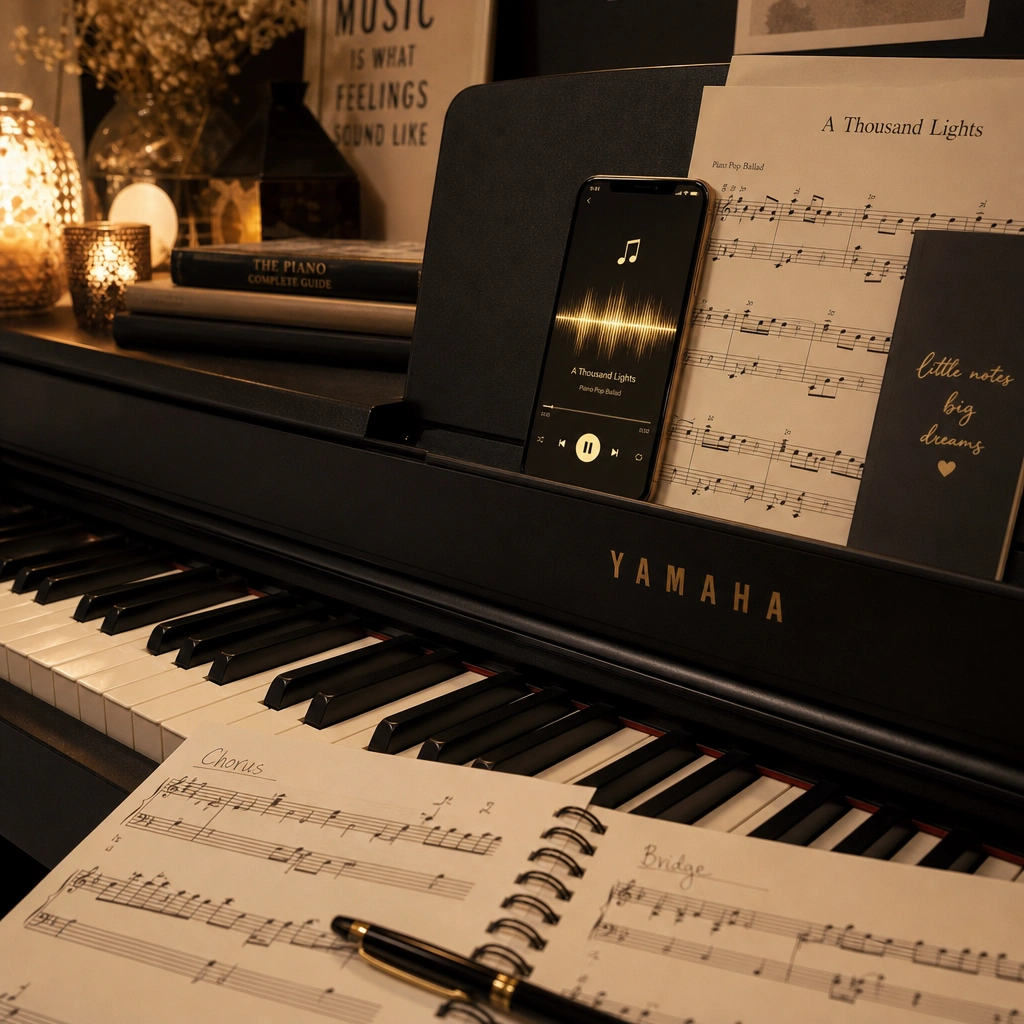
In practice, this looks like blending two tracks side by side:
- Foundational skill work: technique, reading, and theory that build a real, transferable skill set – scales, chord inversions, sight-reading fluency.
- Song-driven repertoire: whatever the teen actually wants to play, arranged at a level they can handle now and rewritten harder as they improve.
This second track is something I build into lessons at Weaver Music – I arrange the song a student wants at their level, working it out by ear when there’s no sheet music available (common with anime themes, newer pop releases, and video game scores), then make it harder as their skill grows. If your teen has a running list of songs they want to play, my guide to lessons built around a specific song goes deeper on how that process works.
A realistic timeline: a teen with zero background typically plays a simplified version of a song they chose within 3-4 weeks of starting, and a fuller arrangement close to the original within 3-4 months of consistent practice.
How long should piano lessons be for a teenager?
Most teenagers do well with 45-minute lessons once they’re past the first few months, since that length allows time for both technique/theory and song work without rushing either. Younger teens or complete beginners often start fine with 30 minutes; older teens tackling harder repertoire sometimes benefit from a full 60 minutes.
At Weaver Music, lessons (technique, reading, theory, repertoire) run $60 for 30 minutes, $80 for 45 minutes, or $99 for 60 minutes.
If your teenager is on the fence about starting or restarting piano, the easiest way to find out what would actually work for them is to just try one lesson. Your first 30-minute lesson with Austin is free – no card, no pressure.
Should a teenager take online or in-person piano lessons?
Teenagers can make strong progress with either online or in-person piano lessons, and the right choice usually comes down to schedule and personality rather than one format being objectively better. A busy 16-year-old juggling AP classes and sports often does better with Zoom lessons that don’t require travel time.
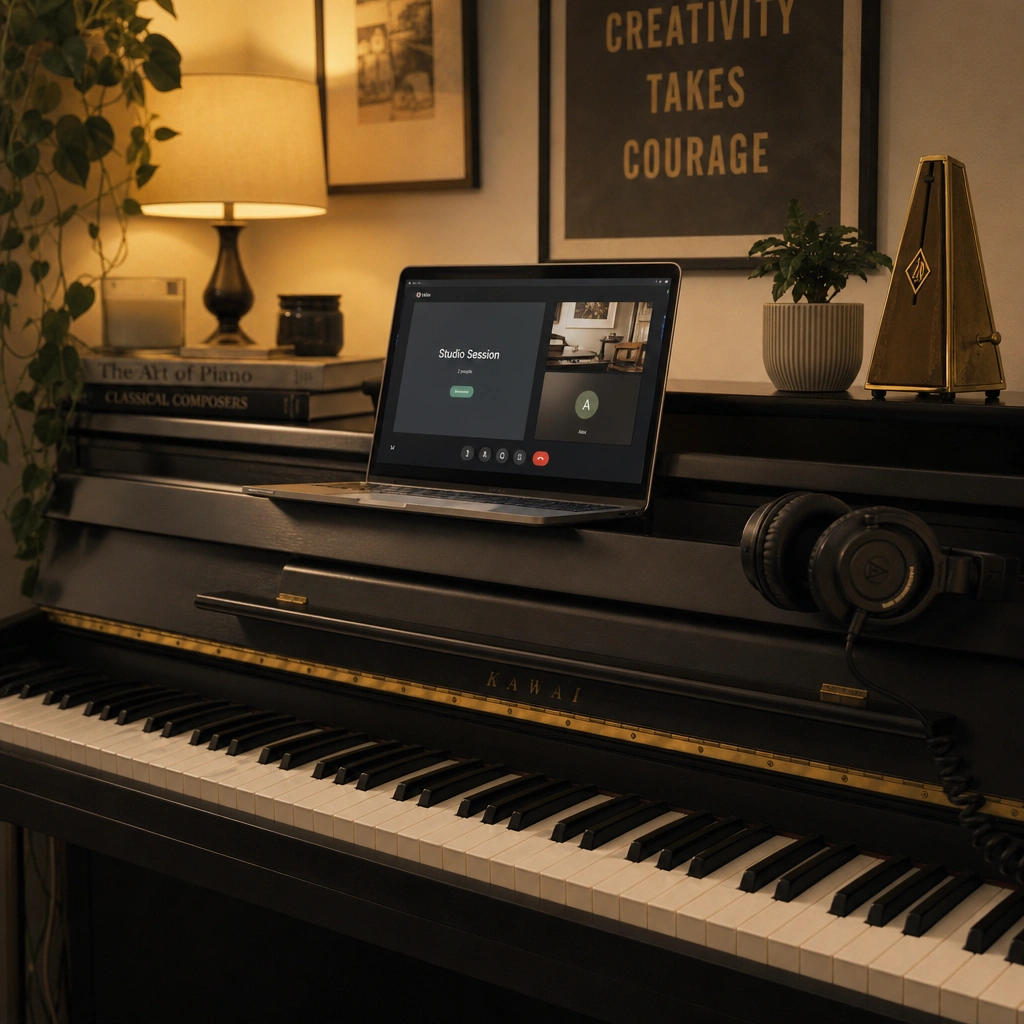
Live one-on-one lessons over Zoom work well for most teens because the interaction is still real-time and personal – it’s not a pre-recorded course. With younger teens, I keep the screen to the lesson itself: notifications off and other tabs closed. I’ve written more on the tradeoffs in my piano lessons on Zoom guide if you’re weighing the two.
A few signs a given format is or isn’t working:
- If a teen is distracted by notifications or other tabs during Zoom lessons, in-person may help more than a stricter no-phone rule would.
- If travel time to a lesson is the thing most likely to get it cancelled, online removes that friction entirely.
- If a teen learns better watching close-up hand technique on camera than across a room, video actually has an advantage here.
How do you motivate a teenager who wants to quit piano?
Motivating a teenager who wants to quit piano usually means changing what they’re playing before changing anything else, since the underlying skill and interest are often still there – the material just stopped feeling worth the effort. Ask what song they’d play if they could play anything, then build the next month around that.
Other things that consistently help:
- Give them a say in pacing: Some teens want to move fast through easier material; others want to slow down and nail one hard piece. Both are fine.
- Set a visible short-term goal: a school talent show, a family gathering, a song for a specific event 6-8 weeks out.
- Normalize the plateau: most teens hit a flat stretch around month 4-6 where progress feels invisible even though it isn’t. Naming this ahead of time prevents it from feeling like proof they should quit.
- Track it concretely: a simple log of songs learned or minutes practiced gives teens (who respond well to visible metrics) proof they’re improving.
I had a 16-year-old student, Maya, who was ready to quit around her sixth month – she felt like she’d “stalled.” We looked back at her first recording next to her most recent one. She hadn’t stalled at all; she’d just stopped noticing her own progress because it had become normal to her. That comparison alone kept her going for another two years.
“My confidence at the piano has grown so much since starting lessons.” – Mia Reynolds
According to the American Psychological Association’s research on adolescent development, intrinsic motivation in teens rises sharply when they feel a sense of autonomy and competence rather than external control – which lines up exactly with what I see at the piano. (Wikipedia: Self-determination theory)
Common questions
Is it too late to start piano lessons at 15 or 16?
No – 15 and 16 year olds regularly make fast progress because they can already read, focus for longer stretches, and understand abstract concepts like theory faster than younger kids. Teens who start at this age often catch up to years-long younger students within 12-18 months of consistent lessons.
How much should a teenager practice piano per week?
Most teens who stick with piano practice 15-25 minutes, 4-5 days a week, rather than one long session. Short, frequent practice builds muscle memory more reliably than a single 2-hour weekend session, and it fits more realistically around a busy teenage schedule.
Can a teenager learn piano without reading sheet music?
Yes, to a point – many teens start by learning songs by ear or from chord charts, especially pop and video game music. Long-term, reading notation opens up far more repertoire and makes learning new pieces faster, so I always work it in gradually rather than skipping it entirely.
Should a teenager take piano lessons if they also play another instrument?
Yes – piano is one of the most useful secondary instruments because it makes music theory and chord structure visible in a way that’s harder to see on guitar, violin, or wind instruments. Many of my teen students who play band or orchestra instruments say piano lessons directly improved their understanding of their primary instrument.
What if my teenager only wants to play one specific song?
That’s a completely normal starting point and often the best hook to build real skill around. A good teacher arranges that one song at the student’s level, teaches technique through it, then expands into related repertoire once the teen is hooked – rather than refusing to touch it until “fundamentals” are done.
Do teenagers need their own piano at home, or is a keyboard enough?
A weighted 61- or 88-key keyboard is enough for most teens in their first year or two of lessons, especially if space or budget is limited. What matters more than the instrument itself is consistent short practice sessions – the upgrade to a full piano can come later once the teen is clearly committed.
Ready to find out for yourself?
Your first 30-minute lesson with me is completely free – we will evaluate where you are, talk through your goals, and map out your path.
