
The short answer
Hanon exercises are worth a limited amount of time for adult beginners, but they are not essential and should never be your main practice. They build finger evenness and basic hand strength through repetitive patterns, but they do not teach rhythm, reading, or musicality – skills a free 30-minute trial lesson can help you prioritize instead.
I bring this up because at least once a month a new adult student shows up with a dog-eared copy of “The Virtuoso Pianist” by Charles-Louis Hanon, convinced they need to grind through it before they’re “allowed” to play real songs. That’s backwards, and it’s worth unpacking why.
What are Hanon exercises, exactly?
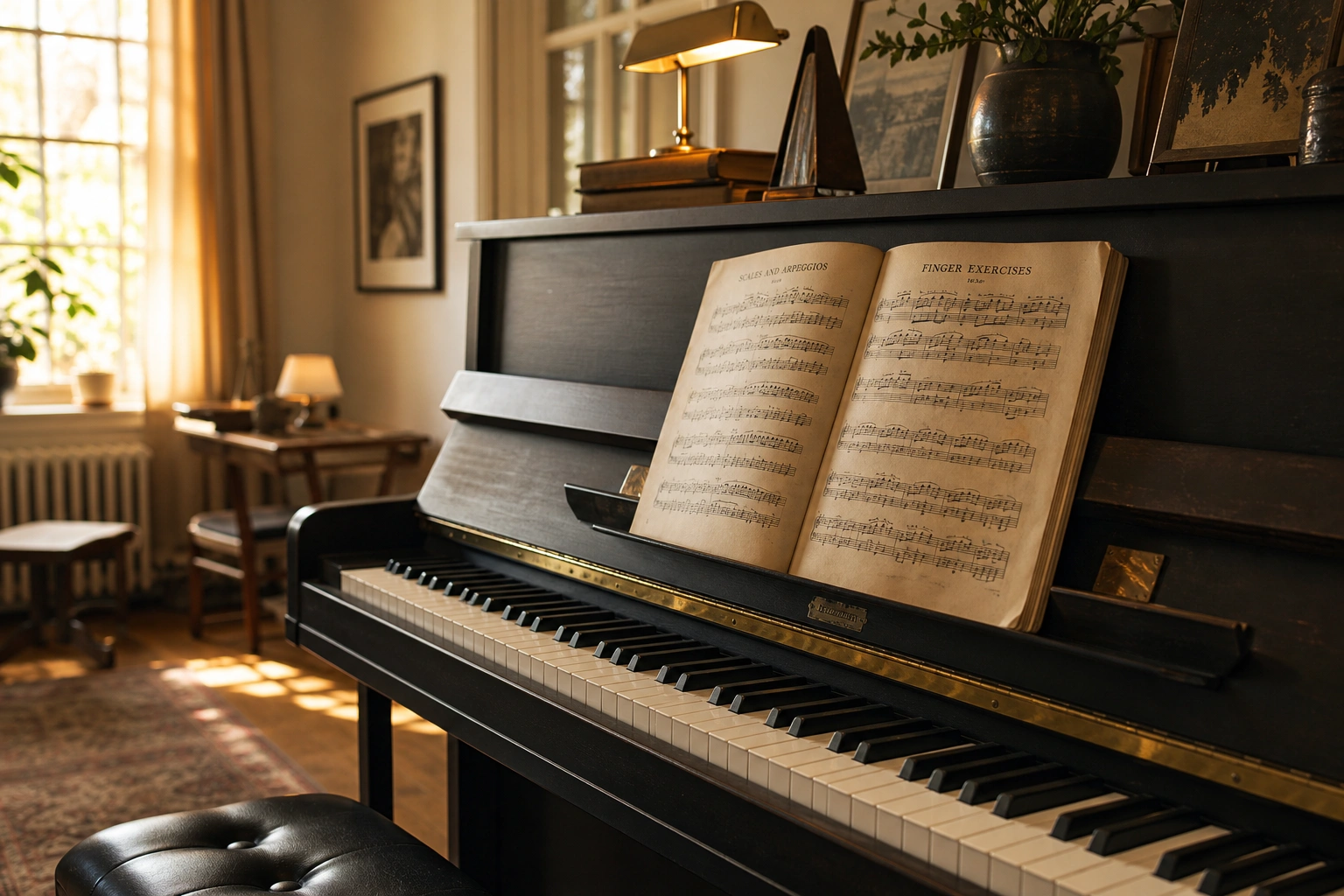
Hanon exercises are a set of 60 finger patterns published by French pianist Charles-Louis Hanon in 1873, designed to build finger independence, evenness, and speed through repetitive five-finger drills. They are not songs – there is no melody to enjoy, just patterns you repeat up and down the keyboard.
The book is split into three parts: Part 1 (exercises 1-20) targets finger independence and is what most beginners encounter first. Part 2 adds scales, arpeggios, and octaves. Part 3 is advanced technical prep for repertoire like Chopin or Liszt. You can read more about the collection’s history on Wikipedia.
- Written in 1873, still in print today, in the public domain
- 60 total exercises across three parts
- No chords, no syncopation, no dynamics to speak of
- Designed originally for conservatory students, not hobbyists
What do Hanon exercises actually build?
Hanon exercises genuinely build finger evenness, basic hand strength, and the muscle memory for moving fingers independently of each other. Played slowly and attentively, they can smooth out a wobbly 4th or 5th finger within a few weeks of short daily reps.
I’ve had adult students use just the first 2-3 exercises as a 5-minute warm-up before real repertoire, and it genuinely helps their fingers “wake up” faster than jumping straight into a piece cold. One student, a 58-year-old retired engineer, used exercise No. 1 for three weeks and noticed his right-hand pinky stopped collapsing inward when he played scales.
That said, the gains are narrow. Hanon does nothing for reading fluency, rhythm, phrasing, dynamics, or ear training – the things that actually make you sound musical.
Why do some teachers dislike Hanon?
Some teachers dislike Hanon because the exercises are mechanical, repetitive, and musically empty, and students who overuse them can develop tense, percussive technique instead of relaxed, musical playing. Repetition without listening can actually reinforce bad habits rather than fix them.
The bigger risk I see in my own studio isn’t the exercises themselves – it’s how adult beginners use them. Common mistakes:
- Playing fast before playing evenly, which bakes in tension
- Using Hanon as a substitute for real repertoire instead of a 5-minute warm-up
- Ignoring wrist and shoulder tension because “it’s just drilling”
- Ignoring finger numbers and hand position printed in the score
I had one adult student who drilled Hanon for 20 minutes a day for two months and made almost zero progress on actual songs, because she never touched a piece of real music in that time. Once we cut Hanon to 5 minutes and spent the rest on a song she wanted to learn, her motivation and her hand coordination both improved within three weeks.
Should a total beginner start with Hanon?
A total beginner should not start with Hanon. In the first few months, the priority is learning to read notes, find notes on the keyboard, and count rhythm accurately – skills Hanon doesn’t address at all, since it has no note-reading challenge and almost no rhythmic variety.
If you’re brand new, your early practice time is better spent on a structured method book with simple melodies, basic hand-position pieces, and rhythm work. Understanding how to count rhythm on piano will do more for your playing in month one than any amount of finger drilling.
If you’re not sure whether Hanon belongs in your practice routine at all, a quick conversation can save you months of guessing. Your first 30-minute lesson with Austin is free – no card, no pressure.
How should an adult beginner use Hanon if they try it?
An adult beginner who wants to try Hanon should treat it as a short, slow warm-up – not the main event. Five to seven minutes at the start of a practice session, played slowly with relaxed wrists, is enough to get the benefit without wasting time that could go toward real music.
- Start with exercises 1-5 only; skip the rest until you’re past beginner level
- Play each one slowly enough that every note is even in volume and timing
- Stop the moment you feel tension in your wrist, forearm, or shoulder
- Cap it at 5-7 minutes, then move on to repertoire or reading practice
- Use a metronome and increase speed gradually, never jumping ahead
As of 2026, most method-based curricula (including the one I use with students) build finger independence directly into early repertoire, so Hanon is optional rather than required. It’s a supplement, not a foundation.
What should adult beginners do instead of, or alongside, Hanon?
Adult beginners get more value from scales, simple etudes, and real repertoire chosen at the right difficulty level than from Hanon alone, because these build the same finger coordination while also teaching reading, rhythm, and musical phrasing at the same time.
- Major and minor scales, hands separately then together
- Short etudes by Czerny or Burgmüller, which are more musical than Hanon
- A piece you actually enjoy, even if it’s simplified
- Rhythm and sight-reading drills a few minutes a day
Research on motor skill acquisition, including studies summarized by the National Institutes of Health, generally supports varied, purposeful practice over pure repetition for long-term retention – which lines up with what I see in lessons every week. Students who split practice time between technique and real music simply progress faster than students who drill exercises in isolation.
“Austin explains everything clearly and makes online piano lessons easy to follow.” – Emily Carter

In my studio, technique work like this is built into the regular Weaver Music curriculum – lessons run $60 for 30 minutes, $80 for 45, or $99 for a full hour, all live over Zoom. If you’d rather work toward a specific song while building technique, we can build that into the same curriculum.
Common questions
Is Hanon outdated for modern piano students?
Hanon isn’t outdated so much as narrow. Written in 1873 for conservatory technique, it still builds finger evenness effectively, but modern method books now weave similar coordination work directly into songs, so Hanon has become optional supplementary material rather than a required text.
Can Hanon exercises cause injury?
Hanon exercises can contribute to tension or strain if played too fast, too long, or with a stiff wrist, especially by beginners unfamiliar with relaxed hand position. Five to seven minutes a day at a slow, controlled tempo is low-risk; 20-30 minutes of fast repetition is where I see problems start.
How many Hanon exercises should a beginner learn?
A beginner rarely needs more than the first 5-10 exercises from Part 1, which focus on basic finger independence. The later exercises and Parts 2-3 are intended for intermediate and advanced players working on scales, arpeggios, and virtuosic repertoire.
Is Hanon better than scales for building technique?
Hanon is not better than scales – the two serve different purposes. Scales teach key signatures, finger crossings, and real musical patterns used in actual pieces, while Hanon isolates raw finger movement. Most teachers, myself included, consider scales the higher-priority skill for beginners.
Do piano teachers still assign Hanon today?
Some piano teachers still assign Hanon, usually in small doses as a warm-up rather than a core assignment. Others skip it entirely in favor of technique built into repertoire. It’s a matter of teaching philosophy, not a settled fact – both approaches produce capable players.
Will Hanon help me play songs faster?
Hanon can modestly improve finger speed and evenness over several weeks, but it won’t teach you to read, phrase, or feel a song. A student who spends equal time on Hanon and real repertoire will generally play songs sooner than one who drills Hanon exclusively.
If you’re an adult beginner trying to figure out where Hanon – or any technique exercise – actually fits in your practice, that’s exactly the kind of question I help sort out in a first lesson. We’ll look at where your hands are at right now and build a plan around it, live over Zoom.
Ready to find out for yourself?
Your first 30-minute lesson with me is completely free – we will evaluate where you are, talk through your goals, and map out your path.
